NTES(09999)

Search documents
网易-S(09999.HK):游戏出海持续推进 AI多维度赋能业务
Ge Long Hui· 2025-11-27 20:04
Core Insights - The company reported a revenue of 28.36 billion yuan in Q3 2025, reflecting a year-over-year increase of 8.2% and a quarter-over-quarter increase of 1.7% [1] - The adjusted net profit for Q3 reached 9.5 billion yuan, showing a year-over-year growth of 26.7% with a net profit margin of 33.5% [1] Group 1: Gaming and Related Services - The gaming and related services revenue for Q3 was 23.3 billion yuan, up 11.8% year-over-year, driven by growth in key titles such as "Dream of the Red Chamber" PC and "Nirvana in Fire" [1] - The peak online user count for "Dream of the Red Chamber" PC reached a record high of 3.58 million [1] - The company is expanding its global footprint with new game launches, including "Destiny: Stars" in August and upcoming titles like "Nirvana in Fire" and "Diablo IV" in December [1] Group 2: Youdao Business - Youdao's revenue for Q3 was 1.63 billion yuan, reflecting a year-over-year increase of 3.6% [1] - The company is advancing its "AI + Education" strategy, enhancing both hardware and software offerings [1] - A new AI-powered product, the Youdao AI Answering Pen SpaceX, is set to launch in August 2025, with a daily average of over 10 answers per user [1] Group 3: Cloud Music - Cloud Music reported a revenue of 1.96 billion yuan in Q3, down 1.8% year-over-year [2] - The company is enhancing user experience through AI-driven features, including the "AI Tuning Master" which allows for personalized audio adjustments [2] - The introduction of AI functionalities aims to enrich the platform's content ecosystem and improve user engagement [2] Group 4: Financial Projections - Revenue projections for the company are estimated at 113.91 billion yuan for 2025, 124.63 billion yuan for 2026, and 134.92 billion yuan for 2027 [2] - The expected net profit (Non-GAAP) for the same years is 39.67 billion yuan, 42.26 billion yuan, and 46.08 billion yuan respectively [2]
支援香港大埔救灾,阿里、滴滴、腾讯、字节、小米、京东等大厂捐款捐物



YOUNG财经 漾财经· 2025-11-27 14:26
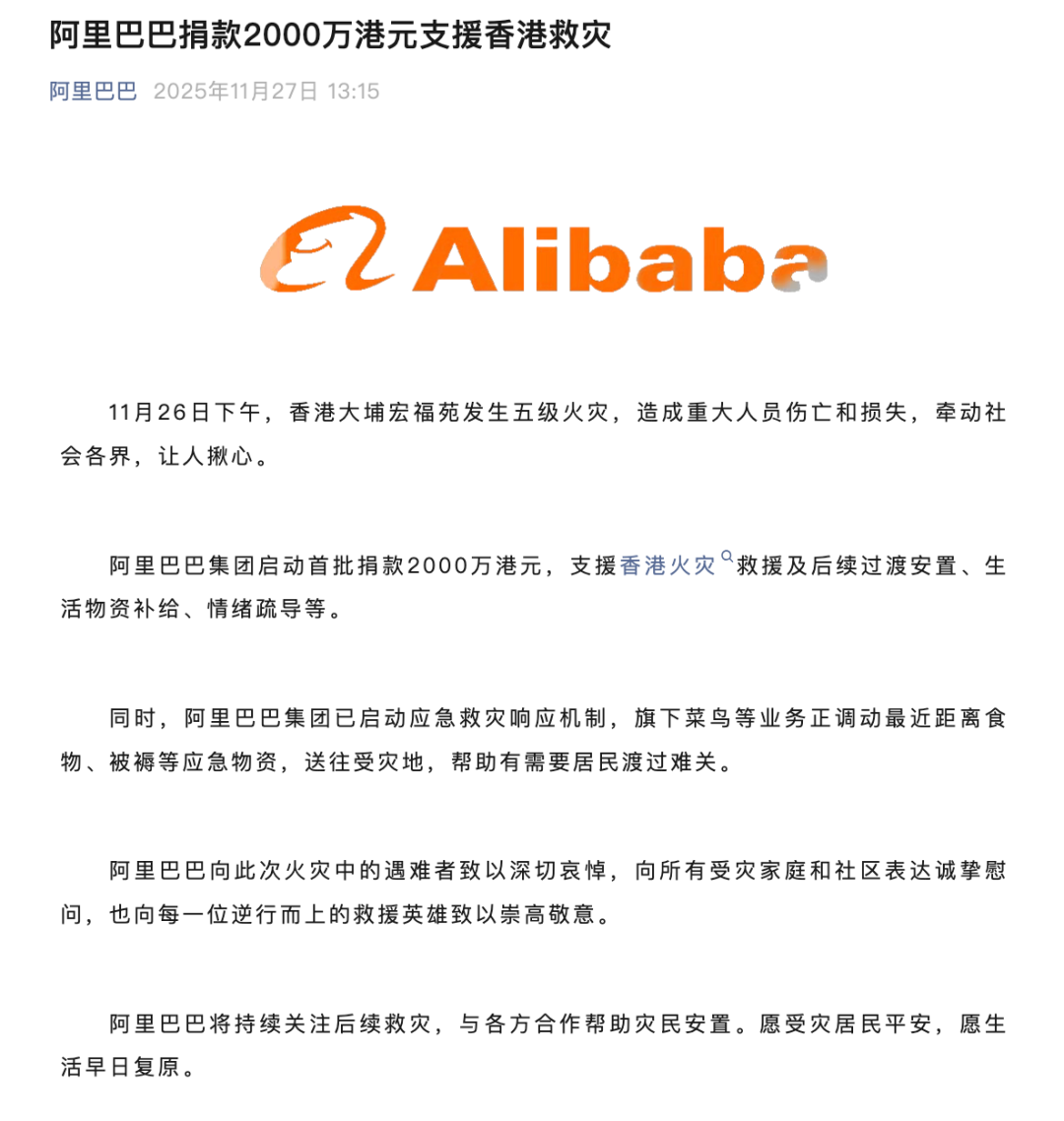
Group 1 - Major tech companies including Alibaba, JD.com, Didi, Tencent, ByteDance, and Xiaomi have made significant donations to support disaster relief efforts in Hong Kong following a severe fire incident in Tai Po [2][3][4][5]. - The Ma Yun Public Welfare Foundation donated 30 million HKD to assist affected families and individuals, while Alibaba Group initiated a donation of 20 million HKD for rescue and recovery efforts [2]. - Didi contributed 10 million HKD for emergency rescue and humanitarian aid, and is actively coordinating with local authorities to ensure public safety during the crisis [2][5]. Group 2 - Tencent Charity Foundation announced an initial donation of 10 million HKD for urgent relief, transitional housing, and emotional support for affected residents [2][5]. - Lenovo Hong Kong also donated 10 million HKD to support emergency rescue, medical assistance, and subsequent recovery efforts for the affected community [4]. - Xiaomi Foundation pledged 10 million HKD for immediate disaster relief, alongside contributions from BYD and NetEase, each donating 10 million HKD, and Anta Group and 361° Group contributing a total of 30 million HKD and 15 million HKD respectively [5]. Group 3 - JD.com quickly mobilized resources, delivering essential supplies such as bottled water and instant noodles to the disaster site, with logistics support from its extensive supply chain network [5]. - Alibaba's logistics arm, Cainiao, is actively dispatching emergency supplies like food and bedding to the affected areas [6].


网易-S(09999):网易(9999)25Q3点评:长青游戏持续修复,《燕云十六声》全球表现亮眼
Orient Securities· 2025-11-27 13:53
Investment Rating - The report maintains a "Buy" rating for the company with a target price of 248.49 HKD / 226.29 CNY [3][5]. Core Insights - The company's Blizzard games are gradually resuming operations, and the evergreen game "Yan Yun Shi Liu Sheng" is performing excellently both domestically and internationally. The anticipated launch of "Forgotten Sea" in 2026 is expected to drive growth [3]. - The adjusted profit forecasts for the company from 2025 to 2027 are 362 billion, 398 billion, and 450 billion CNY respectively, reflecting slight adjustments based on game performance and Q3 financial results [3]. Financial Performance Summary - **Revenue Forecasts**: The company expects revenues of 103,468 million CNY in 2023, growing to 138,188 million CNY by 2027, with a CAGR of approximately 12.37% from 2025 to 2027 [4]. - **Net Profit**: The net profit attributable to the parent company is projected to increase from 29,417 million CNY in 2023 to 44,999 million CNY in 2027, with a notable growth rate of 21.98% in 2025 [4]. - **Earnings Per Share (EPS)**: EPS is expected to rise from 9.29 CNY in 2023 to 14.20 CNY in 2027 [4]. - **Profit Margins**: The gross margin is projected to improve from 60.95% in 2023 to 66.19% in 2027, while the net margin is expected to stabilize around 32% [4]. Market Performance - The company's stock price as of November 20, 2025, was 212.6 HKD, with a 52-week high of 248 HKD and a low of 125.99 HKD [5]. - The company's market capitalization is approximately 673,508 million HKD [5]. Game Performance Insights - The total revenue from games and related value-added services in Q3 2025 was 233 billion CNY, reflecting a year-on-year growth of 12% [10]. - The game "Dream Journey" continues to see high activity levels, and "Yan Yun Shi Liu Sheng" is expected to perform well in overseas markets in Q4 [10].
网易-S(09999):25Q3点评:长青游戏持续修复,《燕云十六声》全球表现亮眼
Orient Securities· 2025-11-27 13:04
Investment Rating - The report maintains a "Buy" rating for the company [5] Core Insights - The company is experiencing a recovery in Blizzard games, with the evergreen game "Yanyun Sixteen Sounds" performing well both domestically and internationally. The anticipated launch of "Forgotten Sea" in 2026 is expected to drive growth. The adjusted net profit forecasts for 2025-2027 are 362 billion, 398 billion, and 450 billion CNY respectively, reflecting slight adjustments based on game performance and Q3 financial results. The target price is set at 248.49 HKD / 226.29 CNY [3][5] Financial Performance Summary - **Revenue Forecasts**: The company’s revenue is projected to grow from 103,468 million CNY in 2023 to 138,188 million CNY in 2027, with year-on-year growth rates of 7.23%, 1.77%, 7.77%, 8.37%, and 12.37% respectively [4] - **Operating Profit**: Operating profit is expected to increase from 27,709 million CNY in 2023 to 45,775 million CNY in 2027, with significant growth in 2025 at 22.22% [4] - **Net Profit**: The net profit attributable to the parent company is forecasted to rise from 29,417 million CNY in 2023 to 44,999 million CNY in 2027, with a notable growth of 21.98% in 2025 [4] - **Earnings Per Share (EPS)**: EPS is projected to grow from 9.29 CNY in 2023 to 14.20 CNY in 2027 [4] - **Profitability Ratios**: The gross margin is expected to improve from 60.95% in 2023 to 66.19% in 2027, while the net margin is projected to increase from 28.43% to 32.56% over the same period [4] Market Performance - The company's stock price as of November 20, 2025, was 212.6 HKD, with a 52-week high of 248 HKD and a low of 125.99 HKD [5]
支援香港大埔救灾,阿里、京东、滴滴、腾讯、联想等大厂捐款捐物
2 1 Shi Ji Jing Ji Bao Dao· 2025-11-27 12:14
Core Points - Major internet companies including Alibaba, JD.com, Didi, Tencent, ByteDance, and Lenovo have made significant donations to support fire relief efforts in Hong Kong following a severe fire incident in Tai Po [1][2][3] Group 1: Donations and Contributions - Alibaba Group has initiated a donation of 20 million HKD for fire relief, including 30 million HKD from the Jack Ma Foundation for affected families [1] - Didi has pledged 10 million HKD for emergency rescue and humanitarian aid, with plans for ongoing support [1] - Tencent Charity Foundation has committed 10 million HKD for urgent relief efforts, including transitional housing and emotional support for affected residents [1] - ByteDance and Lenovo each donated 10 million HKD to assist with emergency rescue and community recovery efforts [1] - Xiaomi Foundation has also contributed 10 million HKD for the fire relief [2] - BYD and NetEase each donated 10 million HKD, while Anta Group and 361° Group collectively contributed 30 million HKD and 15 million HKD respectively [2] Group 2: Logistics and Support - JD.com has mobilized its logistics network to deliver essential supplies such as water and food to the disaster area, with the first batch dispatched on the night of the fire [2] - JD Logistics has activated emergency plans to ensure timely delivery of bedding, hygiene products, and other necessities from its warehouses [2] - Didi's public welfare rescue team is collaborating with local rescue teams to participate in post-disaster support efforts [2] - Alibaba's logistics arm, Cainiao, is coordinating the delivery of food and emergency supplies to the affected areas [3]

支援香港大埔救灾,阿里、京东、滴滴、腾讯、联想等大厂捐款捐物
21世纪经济报道· 2025-11-27 12:07
Group 1 - Major internet companies including Alibaba, JD.com, Didi, Tencent, ByteDance, and Lenovo have made significant donations to support fire relief efforts in Hong Kong following a major fire incident in Tai Po [1][2] - Alibaba Group has initiated a donation of 20 million HKD for disaster relief, while the Ant Group contributed 10 million HKD [1] - Didi and Tencent each donated 10 million HKD for emergency rescue and humanitarian assistance [1] - ByteDance and Lenovo also contributed 10 million HKD each to support urgent relief and community recovery efforts [1] - Xiaomi Foundation announced a donation of 10 million HKD for immediate fire relief [1] Group 2 - Other companies such as BYD and NetEase donated 10 million HKD each, while Anta Group and 361° Group collectively donated 30 million HKD and 15 million HKD respectively [2] - JD.com played a crucial role in logistics, delivering essential supplies like bottled water and instant noodles to the disaster site, with a rapid response team established for ongoing support [2] - Didi's public welfare rescue team is collaborating with local rescue teams to assist in post-disaster recovery efforts [2] - Alibaba's logistics arm, Cainiao, is mobilizing emergency supplies to the affected area [2]

女频化、抽卡师、全面出海:AI漫剧的十大趋势
3 6 Ke· 2025-11-27 11:33
Core Insights - The AI animation industry is experiencing a significant transformation, with major platforms investing heavily in AI animation projects and talent acquisition [1][2][4] - AI animation teams, such as Lingju Animation, are achieving unprecedented production efficiency, completing 100 minutes of content in just 22 days at a fraction of traditional costs [1][10] - The market is witnessing a shift towards both male and female-oriented content, with female-targeted narratives beginning to gain traction [5][6][8] - The industry is exploring international markets, particularly in Western fantasy genres, as a potential avenue for growth [14][15] Investment and Support Initiatives - Major companies like Kuaishou, NetEase, Bilibili, and Douyin have launched various support programs for AI animation, including competitions to discover new talent [2][4] - Kuaishou's upgraded investment plan for AI animation includes guaranteed cash support and significant resource allocation [2] Content Trends - Male-oriented themes dominate the AI animation landscape, but there is a growing interest in female-oriented content, as evidenced by the success of titles like "Interstellar Beast World" [5][6][8] - The majority of AI animations are based on existing IPs, which facilitates high production volumes [11][13] Production and Technology - The emergence of new roles, such as "card drawing engineers," is enhancing production efficiency, with skilled engineers significantly reducing costs [10] - The industry is still grappling with the question of monetization, with only 20% of users willing to pay for AI animations [9] Market Expansion and Challenges - The AI animation sector is preparing for international expansion, with Western fantasy genres being particularly appealing to overseas audiences [14][15] - Concerns exist regarding the adaptability of AI animations in diverse markets, especially in regions with different cultural contexts [15] Talent and Location Strategy - Cities like Beijing, Hangzhou, and Chengdu are identified as key locations for AI animation talent, with significant demand for skilled professionals [16][18] - Companies are considering cost-effective locations for team expansion to optimize production expenses [18] IP Development and Brand Collaboration - The potential for monetizing AI animation IPs is vast, with opportunities for cross-industry collaborations and merchandise development [19][21] - Successful collaborations, such as the partnership between a fruit wine brand and the AI animation "You Mountain Spirit," demonstrate the commercial viability of AI animation IPs [21] Competitive Landscape - The market for AI video generation tools is highly competitive, with a significant share held by companies like Ju Rilu [22][24] - The industry is evolving rapidly, with the need for continuous innovation in tools and production methods to maintain market position [22] Future Outlook - The AI animation industry is at a critical juncture, facing challenges related to monetization, international expansion, and IP development [26] - The focus will shift from production speed to understanding user needs and managing IPs effectively [26]
腾讯、阿里、蚂蚁、字节跳动、小米、滴滴……宣布捐款捐物!
Zheng Quan Shi Bao Wang· 2025-11-27 10:13
Core Viewpoint - Multiple companies, including Tencent, Alibaba, Ant Group, ByteDance, Xiaomi, and Didi, have announced donations and support in response to a significant fire incident in Hong Kong, demonstrating corporate social responsibility and community support during emergencies [1][2][3][4]. Group 1: Donations and Support - Ant Group and AlipayHK donated 10 million HKD for emergency relief, transitional housing, and supply of living materials for affected residents [2]. - Alibaba Group initiated a donation plan of 20 million HKD for fire rescue efforts, transitional housing, and emotional support for victims [2]. - Didi donated 10 million HKD for emergency rescue and humanitarian aid, and is coordinating with local authorities for safe transportation and information dissemination [2]. - ByteDance announced a donation of 10 million HKD for emergency relief and community recovery efforts [3]. - NetEase also pledged 10 million HKD to support local emergency relief and community recovery [3]. - The Jack Ma Foundation committed to donating 30 million HKD for economic assistance to affected families and support for emergency personnel [3]. - Xiaomi's Hong Kong Foundation pledged 10 million HKD for medical aid and transitional support for affected residents [3]. - Tencent Charity Foundation announced a donation of 10 million HKD for emergency relief and support for affected residents [3]. Group 2: Additional Contributions - Anta Group announced a total donation of 30 million HKD, including 10 million HKD in cash and 20 million HKD in winter gear for emergency housing and basic living support [4]. - 361° Group pledged 15 million HKD in cash and equipment to support local rescue and housing efforts [4].
腾讯、阿里、蚂蚁、字节跳动、小米、滴滴……宣布捐款捐物!

券商中国· 2025-11-27 09:35
Core Viewpoint - The article highlights the collective response of various companies and organizations to the fire disaster in Hong Kong's Tai Po district, emphasizing their financial contributions and support for emergency relief efforts [1][2][3][4]. Group 1: Company Contributions - Ant Group and AlipayHK donated 10 million HKD for emergency relief, transitional housing, and supply of living materials for affected residents [2]. - Alibaba Group announced an initial donation of 20 million HKD to support disaster relief and subsequent transitional housing, along with mobilizing resources for food and bedding [2]. - Didi donated 10 million HKD for emergency rescue and humanitarian aid, while also facilitating safe transportation for citizens [2]. - ByteDance pledged 10 million HKD for emergency relief and community recovery efforts [3]. - NetEase also committed 10 million HKD to support local emergency rescue and community recovery [3]. - Xiaomi Foundation announced a donation of 10 million HKD for medical aid and transitional living support for affected residents [3]. - Tencent Charity Foundation initiated a donation of 10 million HKD for urgent relief and emotional support for residents [3]. - Anta Group pledged a total of 30 million HKD, including 10 million HKD in cash and 20 million HKD in winter gear for emergency support [4]. - 361° announced a donation of 15 million HKD in cash and equipment to assist local rescue and relief efforts [4]. Group 2: Support Mechanisms - AlipayHK established a dedicated assistance channel on its homepage to facilitate public donations for the relief efforts [2]. - Didi's platform is actively guiding vehicles to avoid disaster areas and disseminating official rescue and assistance information [2]. - Various foundations, including the Ma Yun Public Welfare Foundation, are providing financial aid to affected families and emergency personnel [3].

首批捐款超1亿港元,阿里、腾讯、小米、网易等驰援香港大埔火灾救援
Guo Ji Jin Rong Bao· 2025-11-27 08:32
Core Points - A significant fire occurred in Hong Kong's Tai Po district, prompting widespread concern and support from various organizations and individuals [1] Group 1: Donations and Support Initiatives - Alibaba, led by Jack Ma, donated a total of 60 million HKD, including 30 million HKD from the Jack Ma Foundation for economic aid to affected families and support for firefighters [2] - Tencent Charity Foundation announced a donation of 10 million HKD for emergency relief and support for affected residents [5] - Xiaomi's founder Lei Jun announced a donation of 10 million HKD through the Xiaomi Foundation for fire relief efforts [7] - ByteDance pledged 10 million HKD for emergency rescue and community recovery efforts [9] - NetEase also committed 10 million HKD for emergency relief and community support [11] - Midea Group and Trip.com each announced donations of 10 million HKD for urgent rescue and post-disaster recovery efforts [12][13] Group 2: Emergency Response and Logistics - Alibaba initiated an emergency response mechanism to mobilize essential supplies like food and bedding to the affected area [2] - JD.com was the first to deliver rescue supplies to the scene, coordinating with local councils to provide essential items like water and food [14]