
NTES(09999)

Search documents
腾讯、网易相继布局,FunPlus死磕这一赛道,潜力如何?
3 6 Ke· 2025-11-27 08:15
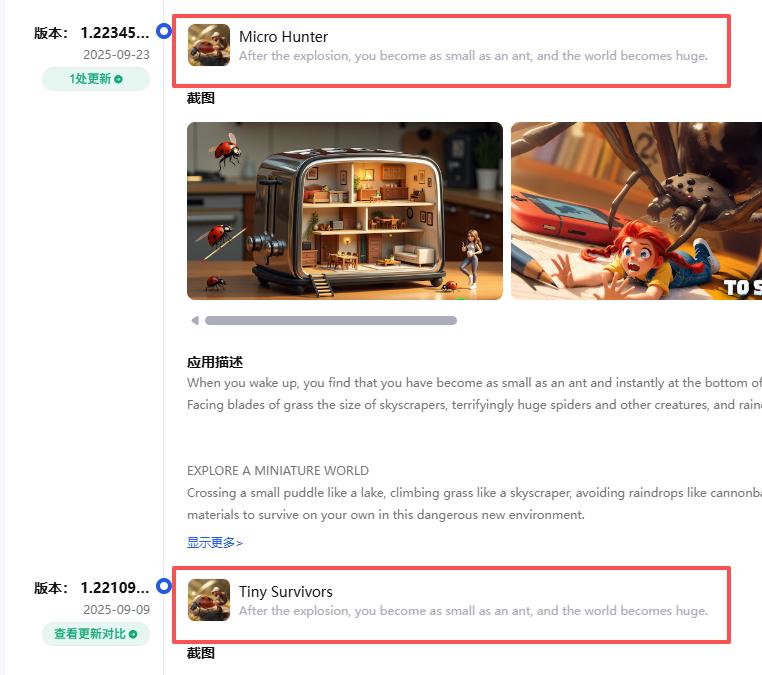
Core Insights - FunPlus has launched its micro-world SLG game "Micro Hunter" in late September, but its market performance has been underwhelming, peaking at 55th in the strategy category in the US [1][2] - The game has undergone extensive testing over three years, indicating FunPlus's commitment to the micro-world theme, which is now attracting attention from major competitors like NetEase and Tencent [1][20] Market Situation - "Micro Hunter" was previously known as "Tiny Survivors" and began small-scale testing in February across several countries, officially rebranding on September 23 [2] - The game has seen a gradual increase in estimated downloads, reaching approximately 717,000 globally by November 23, with a significant portion from Google Play [4][6] Download Performance - Brazil leads in downloads with 113,000, followed by the US with 76,000, while Southeast Asia shows notable interest with three entries in the top ten download regions [6] - The game has generated an estimated revenue of around $550,000, with a peak daily revenue of approximately $13,000 on November 2 [7][9] Advertising Trends - The iOS version of "Micro Hunter" began advertising in October, but the volume of ad materials has since declined, with a peak of nearly 200 ads on October 13 [10] - The target audience for the ads is predominantly male (78%), with the primary age group being 25-34 years old, accounting for 39% of the audience [11][12] Creative Material - The advertising materials focus on the "micro" theme, showcasing the challenges faced by small characters in a larger world, with a mix of animation and voiceover [13][14] - Three main types of creative content have been identified: micro-world exploration, crisis management in gameplay, and character design showcasing [14][16][18] Conclusion - Despite not achieving standout success, "Micro Hunter" reflects FunPlus's long-term investment in the micro-world genre, which has garnered interest from other major players in the industry [20][21] - The micro-world theme is seen as having market potential due to its unique appeal and the growing trend of casual SLG games, although it may not suit all developers [21]


从段永平的万字访谈中,帮你梳理好了他的股票投资体系
雪球· 2025-11-27 08:06
Group 1 - The core idea of the article revolves around investment strategies and methodologies shared by prominent investors like Duan Yongping, emphasizing the importance of understanding company culture, business models, and differentiation in stock selection [5][7][39]. - The article highlights the significance of company culture, stating that a strong culture can guide a company back on track, and changes in culture should prompt investors to reassess their investments [10][18][20][24]. - It discusses the importance of a solid business model, using examples like Buffett's investment in Coca-Cola and Duan's success with NetEase, showcasing the need for deep understanding of the business [25][28][29][31]. Group 2 - Differentiation is emphasized as a critical factor in avoiding price wars and maintaining customer loyalty, with Duan mentioning that products lacking differentiation face significant challenges [32][34][37]. - The article advises investors to limit the number of stocks they invest in, suggesting that understanding a few companies deeply is more beneficial than spreading investments too thin [39][41][44]. - It introduces the concept of "full position" investing, where investors should fully commit to stocks they understand, rather than holding cash that may lose value over time due to inflation [46][48][51]. Group 3 - The article warns against short-term trading, explaining that quantitative trading strategies can make it increasingly difficult for retail investors to profit from market fluctuations [54][56][62]. - It contrasts long-term investing with quantitative trading, suggesting that successful investing is akin to nurturing a growing tree, while quantitative strategies focus on short-term price discrepancies [66][70]. - The article clarifies a common misconception about value investing, stating that while long-term holding is essential, investors should also be prepared to sell if better opportunities arise [72][76].


俄回应“和平计划”:绝无可能作出任何让步;香港大埔火灾已致44人遇难,警方拘捕3人



Sou Hu Cai Jing· 2025-11-27 04:26
Market Overview - US stock market continued its strong performance with major indices rising for four consecutive trading days, driven by a rebound in technology stocks and increased probability of a Federal Reserve rate cut in December [2][4] - The Dow Jones Industrial Average rose by 314.67 points (0.67%) to close at 47,427.12, the Nasdaq Composite increased by 0.82% to 23,214.69, and the S&P 500 climbed 0.69% to 6,812.61 [2] Stock Performance - Notable technology stocks showed mixed results: Tesla and Microsoft rose by 1.7%, Nvidia by 1.3%, while Amazon and Meta declined by 0.2% and 0.45% respectively [3] - Dell surged by 5.8% due to strong demand for AI data center servers, exceeding quarterly earnings expectations [3] - Oracle's stock increased by 4.0%, with Deutsche Bank projecting minimal impact on earnings despite the exclusion of OpenAI-related revenue [3] Economic Indicators - Initial jobless claims fell by 6,000 to 216,000, the lowest level since April, while continuing claims showed an upward trend, indicating a challenging labor market [4] - Durable goods orders rose by 0.5% in September, matching expectations but slowing from August's growth, with weak demand in the civilian aircraft sector offsetting gains in other categories [4] - Retail sales increased by 0.2% in September, a slowdown from the revised 0.6% growth in August [4] Federal Reserve Insights - The Federal Reserve's Beige Book indicated ongoing economic struggles, with low hiring intentions and persistent inflation concerns [4][5] - The CME FedWatch Tool shows an 84.9% probability of a 25 basis point rate cut in December, nearly doubling from the previous week [6] - Recent dovish comments from Fed officials have contributed to market optimism regarding potential rate cuts [6] Sector Highlights - Airline stocks experienced significant gains, with the S&P 1500 Airline Index rising by 3.4%, reflecting positive consumer health indicators ahead of the holiday shopping season [7] - Workday's stock fell over 8% after reporting third-quarter subscription revenue that met expectations [8] Commodity Performance - International oil prices saw slight increases, with WTI crude oil rising by 1.21% to $58.65 per barrel and Brent crude oil up by 1.04% to $63.13 per barrel [9] - Gold prices fluctuated upwards, with COMEX gold futures for November delivery increasing by 0.61% to $4,165.20 per ounce [10]

智通ADR统计 | 11月27日
智通财经网· 2025-11-26 22:25
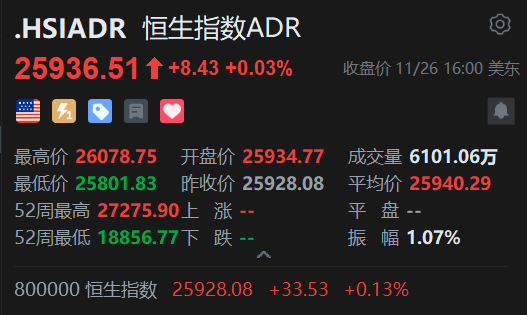
Market Overview - The Hang Seng Index (HSI) closed at 25,936.51, up by 8.43 points or 0.03% on November 26 [1] - The index reached a high of 26,078.75 and a low of 25,801.83 during the trading session, with a trading volume of 61.01 million shares [1] Stock Performance - Major blue-chip stocks showed mixed performance, with HSBC Holdings closing at HKD 109.799, up by 2.04% compared to the Hong Kong close [2] - Tencent Holdings closed at HKD 614.101, down by 0.87% compared to the Hong Kong close [2] Individual Stock Movements - Tencent Holdings (00700) reported a price of HKD 619.500, down by HKD 5.500 or 0.88%, with an ADR price of USD 614.101, reflecting a decrease of 0.87% [3] - Alibaba Group (09988) saw a decline of HKD 3.000 or 1.90%, with a latest price of HKD 154.800 and an ADR price of USD 153.233, down by 1.01% [3] - HSBC Holdings (00005) increased by HKD 0.800 or 0.75%, with a latest price of HKD 107.600 and an ADR price of USD 109.799, up by 2.04% [3] - AIA Group (01299) rose by HKD 1.450 or 1.83%, with a latest price of HKD 80.700 and an ADR price of USD 81.128, up by 0.53% [3] - Meituan (03690) increased significantly by HKD 5.550 or 5.65%, while other stocks like Baidu (09888) and Kuaishou (01024) experienced declines of 2.05% and 2.83% respectively [3]




网易-S(09999):游戏出海持续推进,AI多维度赋能业务
Huaan Securities· 2025-11-26 09:08
Investment Rating - The investment rating for the company is "Buy" (maintained) [1] Core Insights - The company achieved revenue of 28.36 billion yuan in Q3 2025, representing a year-over-year increase of 8.2% and a quarter-over-quarter increase of 1.7% [4] - The gross profit for Q3 was 18.18 billion yuan, with a gross margin of 64.1%, an increase of 1.2 percentage points year-over-year [4] - Adjusted net profit reached 9.50 billion yuan, reflecting a year-over-year growth of 26.7% and a net margin of 33.5%, up 4.9 percentage points year-over-year [4] Revenue Breakdown - The gaming and related services revenue for Q3 was 23.3 billion yuan, up 11.8% year-over-year, driven by growth in key titles such as "Fantasy Westward Journey" and "Nirvana in Fire" [5] - The company continues to expand its global gaming footprint, with successful launches of new titles in overseas markets [5] AI and Education Initiatives - The Youdao segment reported revenue of 1.63 billion yuan in Q3, a year-over-year increase of 3.6%, focusing on the "AI + Education" strategy [6] - New AI-enabled hardware and software products have been introduced, enhancing the educational offerings [6] Cloud Music Developments - Cloud Music generated revenue of 1.96 billion yuan in Q3, a slight decline of 1.8% year-over-year, with AI features enhancing user experience [7] - The introduction of the "AI Tuner" feature aims to enrich the platform's content ecosystem [7] Financial Projections - Projected revenues for 2025, 2026, and 2027 are 113.91 billion yuan, 124.63 billion yuan, and 134.92 billion yuan, respectively [8] - Non-GAAP net profits for the same years are expected to be 39.67 billion yuan, 42.26 billion yuan, and 46.08 billion yuan [8] Key Financial Metrics - The company is expected to maintain a gross margin of around 64% over the next few years, with a projected return on equity (ROE) of 24% in 2025 [11] - Earnings per share (EPS) are forecasted to grow from 10.37 yuan in 2024 to 14.29 yuan in 2027 [11]
网易-S(9999.HK):经典游戏表现亮眼 后续储备丰富有望贡献增量
Ge Long Hui· 2025-11-26 04:02
Core Insights - The company reported a revenue of 28.4 billion yuan for Q3 2025, representing an 8.2% year-on-year increase [1] - The net profit attributable to shareholders reached 8.6 billion yuan, a significant growth of 31.8% year-on-year [1] - The gaming segment showed strong performance, with revenue from games and related services amounting to 23.3 billion yuan, up 11.8% year-on-year [1][2] Financial Performance - Q3 2025 revenue: 28.4 billion yuan, up 8.2% YoY [1] - Gross profit: 18.2 billion yuan, up 10.3% YoY [1] - Net profit attributable to shareholders: 8.6 billion yuan, up 31.8% YoY [1] - Non-GAAP net profit: 9.5 billion yuan, up 26.7% YoY [1] - Operating cash flow: 12.9 billion yuan, up 21.7% YoY [1] - Cash reserves at the end of Q3: 153.2 billion yuan [1] Gaming Segment Performance - Classic games performed well, with "Dream of the Red Chamber" achieving a peak of 3.58 million concurrent players [2] - New game launches enriched the product matrix, including "Fate: Stars" topping iOS download charts in multiple regions [2] - Upcoming titles like "Reverse Water Cold" and "Forgotten Sea" are expected to contribute to future revenue [2] Cost and Expenses - Operating costs for Q3 2025 were 10.2 billion yuan, an increase from 9.8 billion yuan in Q2 2025 [3] - Operating expenses also rose to 10.2 billion yuan, driven by increased marketing costs for games [3] Future Outlook - The company maintains a strong investment rating, projecting net profits of 35.1 billion yuan, 38.5 billion yuan, and 42.5 billion yuan for 2025-2027 [3]
网易-S(09999.HK):看好游戏出海、新游上线及AI赋能深化驱动成长
Ge Long Hui· 2025-11-26 04:02
Core Viewpoint - The company shows strong growth momentum driven by deferred revenue and overseas expansion, maintaining a "buy" rating Group 1: Financial Performance - In Q3 2025, the company achieved revenue of 28.4 billion yuan, a year-on-year increase of 8.2% and a quarter-on-quarter increase of 1.7% [1] - The net profit attributable to the parent company was 8.6 billion yuan, reflecting a year-on-year growth of 31.8% and a quarter-on-quarter increase of 0.2% [1] - The gross margin for Q3 was 64.1%, up 1.2 percentage points year-on-year, while the net profit margin reached 31.0%, an increase of 5.4 percentage points year-on-year [1] - As of the end of Q3 2025, the company's contract liabilities amounted to 19.5 billion yuan, a year-on-year increase of 25% and a quarter-on-quarter increase of 15% [1] Group 2: Game and Product Performance - Revenue from games and related value-added services reached 23.3 billion yuan in Q3 2025, with a year-on-year increase of 11.8% and a quarter-on-quarter increase of 2.3% [2] - The growth in revenue was driven by titles such as "Dream of the Red Chamber" and "Egg Party," as well as new games like "Yanyun Sixteen Sounds" [2] - The gross margin for the gaming segment was 69.3%, reflecting a year-on-year increase of 0.5 percentage points [2] - The peak concurrent online users for "Dream of the Red Chamber" reached 3.58 million, setting a new record [2] Group 3: AI and Innovation - Cloud music's revenue in Q3 was 1.96 billion yuan, a year-on-year decrease of 1.8%, but the gross margin improved by 2.6 percentage points to 35.4% [3] - The introduction of "AI Tuning Master" aims to enhance user experience with personalized music [3] - Youdao's revenue in Q3 was 1.63 billion yuan, showing a year-on-year increase of 3.6% and a quarter-on-quarter increase of 14.9%, primarily driven by online marketing services [3] - AI-driven subscription service revenue reached approximately 100 million yuan, marking a year-on-year growth of over 40% [3]
当音乐遇到算法,抖音和腾讯谁占上风?
创业邦· 2025-11-26 03:34
Core Viewpoint - The online music industry is transitioning from a copyright-driven model to an algorithm-driven era, reshaping platform dynamics and user engagement [6][18]. Group 1: Historical Development - The initial phase of China's digital music industry was characterized by disorder, dominated by piracy and unauthorized content, with platforms like QQ Music and KuGou Music relying on user-uploaded content [8][9]. - The introduction of regulatory measures in 2015 led to significant content removal, marking the beginning of a copyright governance era, with over 2.2 million songs taken down by major platforms [11][9]. - The competitive landscape shifted as Tencent Music consolidated its platforms and established a dual-monopoly with NetEase Cloud Music, focusing on stable copyright partnerships and user retention [17][15]. Group 2: Platform Competition - Tencent Music and NetEase Cloud Music adopted different strategies: Tencent focused on traffic synergy and product differentiation, while NetEase emphasized community engagement and user-generated content [14][15]. - By 2020, Tencent Music reported a 56% increase in music subscription revenue, reaching 5.56 billion yuan, while NetEase Cloud Music faced a net loss of nearly 3 billion yuan despite generating 4.9 billion yuan in revenue [15][17]. Group 3: Emergence of New Competitors - The entry of Douyin with its "Soda Music" app disrupted the market by leveraging algorithm-driven content distribution, contrasting with traditional music apps that relied on user-initiated searches [19][20]. - By September 2025, Douyin's music products showed significant user growth, with "Tomato Listening" and "Soda Music" achieving 92.4% and 90.7% year-on-year growth, respectively, while Tencent's platforms experienced declines [20][22]. Group 4: Future Outlook - The digital music market is at a crossroads, facing the choice between strengthening content barriers through libraries and subscriptions or adopting algorithm-driven models for user engagement [24]. - The competition dynamics have shifted, with algorithmic recommendations becoming a key factor in user acquisition and retention, challenging the traditional value chain of music distribution [24][22].


网易《射雕》停运:一场“150年长线运营”的豪赌 在第545天仓促落幕
Xin Lang Zheng Quan· 2025-11-26 02:45
Core Insights - The MMORPG "The Legend of the Condor Heroes" developed by NetEase officially ceased operations on November 24, 2025, after only 545 days since its launch, highlighting the conflict between long-term aspirations and short-term realities in the gaming industry [1][2]. Investment and Financial Overview - The project was initiated with significant expectations, involving an investment of approximately 1 billion yuan and a development team of 600 people over six years, with the game receiving official licensing from the Jin Yong's "Condor Trilogy" [2]. - During its initial launch phase, the game achieved a monthly active user (MAU) count of over 8 million and a payment rate of 18.7% [2]. Operational Challenges - The game faced rapid user attrition, losing over 80% of its mobile users within a month due to issues such as immature art style, inadequate mobile optimization, and a fragmented combat system [2]. - Despite attempts to revitalize the game through a "rework plan" and a 2.0 version, which included a shift to a more realistic style and simplified combat, it only reached a peak ranking of 63 on the sales charts [2]. Strategic Conflicts - The reliance on the Jin Yong IP became a creative constraint, as the licensing entity imposed strict controls on narrative updates, hindering the game's ability to adapt to player feedback [3]. - The economic system design failed to align with player expectations, leading to rapid devaluation of high-tier equipment and diminishing long-term payment willingness among players [3]. - Internal resource allocation issues arose as NetEase closed multiple studios and shifted focus to other projects, resulting in diminished support for "The Legend of the Condor Heroes" [3]. Industry Trends - The gaming environment has shifted dramatically, with average mobile gaming time dropping to 42 hours per year and new MMO titles experiencing a DAU retention rate below 5% by day 90 [3]. - The failure of "The Legend of the Condor Heroes" reflects a broader industry trend of moving from "traffic competition" to "content cultivation," emphasizing the need for sustainable operational models [6]. Player Reactions - The shutdown announcement led to player backlash, with users expressing dissatisfaction over the lack of compensation for in-game purchases and perceived discrepancies between the game's planned updates and its abrupt termination [4]. - Legal actions were initiated by players, citing unfair practices regarding refund policies and the handling of unspent in-game currency [4]. Future Directions - The industry may shift towards "micro-licensing" collaborations and AI-driven content regeneration mechanisms to overcome traditional content production bottlenecks [6]. - NetEase's experience with "The Legend of the Condor Heroes" serves as a reminder that long-term operations require more than just ambitious timelines; they necessitate ongoing value creation for users [6].
海外市场手游收入TOP100:国内厂商超30家,点点互动第一
3 6 Ke· 2025-11-25 23:32
Core Insights - The global mobile game publishers have shown significant revenue performance in overseas markets as of November 15, 2023, with leading companies like Scopely and Microsoft dominating the rankings through popular titles [1][3] - A trend is observed where top publishers focus on specific game genres, leading to the creation of multiple hit titles within those segments, influencing other companies to adjust their strategies for growth [1][3] - Chinese publishers are making notable breakthroughs in overseas markets, leveraging their genre advantages, with companies like 点点互动 and 库洛 achieving impressive revenue growth [1][7] Publisher Rankings - Scopely leads with overseas revenue of $205 million, followed by Microsoft with $182 million and 点点互动 with $159 million [3] - Dream Games and Playrix also feature prominently, with revenues of $156 million and $148 million respectively [3] - FUNFLY and Take-Two follow closely, with revenues of $146 million and $142 million [3] Revenue Growth Trends - 点点互动's overseas revenue reached approximately $1.597 billion, marking a 72% year-on-year increase, with significant contributions from titles like "Whiteout Survival" and "Kingshot" [7] - FUNFLY's revenue of $1.465 billion represents a 36% increase, driven entirely by the success of "Last War: Survival" [9] - 柠檬微趣 experienced a remarkable 158% growth, with overseas revenue of $777 million, primarily from "Gossip Harbor" [10] Market Focus and Strategy - Companies are increasingly concentrating their efforts on specific game genres, with 点点互动 and 柠檬微趣 focusing on SLG and Merge-2 games respectively, leading to substantial revenue increases [1][10] - Tencent's overseas revenue slightly declined by 5% to $761 million, with "PUBG MOBILE" remaining a key revenue driver [11] - 米哈游's overseas revenue fell by 16% to $627 million, with no new titles launched this year [12] Notable New Entrants and Innovations - Florere Game saw a staggering 3102% increase in revenue, reaching $472 million, primarily from "Last Z: Survival Shooter" [13] - 叠纸's overseas revenue doubled to $191 million, driven by the success of "恋与深空" [25] - Companies like FunPlus and 三七互娱 are exploring new game styles and genres to adapt to market changes and consumer preferences [15][17]
