
CITIC Securities Co., Ltd.(600030)

Search documents
黄金跌价,金条跌价,26年1月21日,各大金店黄金、金条最新价格
Sou Hu Cai Jing· 2026-01-25 16:51
Group 1: Gold Market Dynamics - International gold prices are experiencing fluctuations, leading to adjustments in domestic high-end jewelry brand prices, with Chow Tai Fook quoting 1455 CNY/gram, Lao Feng Xiang at 1456 CNY/gram, and others around 1453 CNY/gram for gold [1] - Platinum prices remain high at around 940 CNY/gram, while discounts on gold jewelry are increasing, reflecting a cautious consumer sentiment and a relatively quiet market [1] Group 2: RMB Gold Prices - The Shanghai Gold Exchange reports the RMB-denominated gold spot price at 1047.60 CNY/gram, a slight increase of 2.33 CNY or 0.223% from the previous day, with a trading range between 1042.74 CNY and 1048.50 CNY [6] - Retail prices for gold jewelry or bars are higher than the exchange prices due to additional costs such as design and processing, influenced by international market fluctuations, exchange rates, and domestic supply and demand [6] Group 3: Financial Institutions Gold Bar Prices - Various financial institutions have set their gold bar prices, with China Construction Bank at 1050.74 CNY/gram, Industrial and Commercial Bank at 1050.58 CNY/gram, and others ranging from 1049.2 CNY to 1096.5 CNY per gram [7][8][9][10][11][12][13] Group 4: Wholesale and Retail Price Differences - The wholesale price for gold in Shui Bei is approximately 1203 CNY/gram, with significant price differences compared to retail prices, which can be attributed to store rent, operational costs, and brand premiums [14] - The pricing structure for jewelry includes "gold value + processing fee + brand premium," indicating a need for consumers to be aware of the price alignment with base gold prices when investing [14] Group 5: Domestic Gold Price Trends and Market Analysis - Current gold prices are reported at 1047.00 CNY/gram, with a slight increase of 0.11%, while platinum prices are at 606.79 CNY/gram, reflecting a 0.72% increase [15] - Despite rising gold prices, consumer purchasing enthusiasm is declining, with a reported 7.95% year-on-year decrease in gold consumption and a 32.50% drop in gold jewelry consumption in the first three quarters of 2025 [15] Group 6: Retail Strategies and Market Outlook - Brands are adopting strategies like trade-in programs to lower consumer purchase barriers, while research indicates that retailers need to enhance profit margins per gram of gold jewelry and optimize product offerings [16] - The technical structure of gold prices remains in an upward channel, but with weakening momentum, influenced by a strong dollar and rising real interest rates, which increase the opportunity cost of holding gold [17]






AI语音公司思必驰重启IPO,东吴证券接棒中信证券成辅导机构
Sou Hu Cai Jing· 2026-01-25 14:39
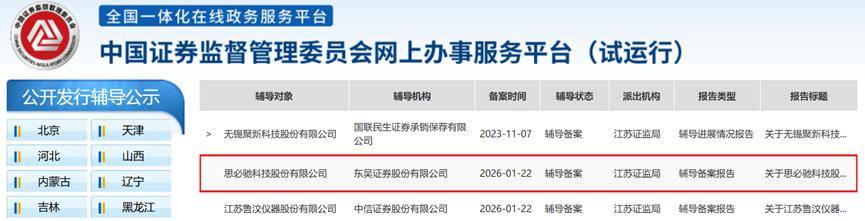
Core Viewpoint - The Jiangsu Securities Regulatory Bureau has accepted the application for the initial public offering (IPO) and listing guidance of SIBICHI Technology Co., Ltd., with the filing date set for January 22, 2026, and Dongwu Securities as the guidance institution [1][2]. Group 1: Company Background - SIBICHI Technology, established in 2007, specializes in human-machine dialogue solutions and has developed key technologies for intelligent voice and natural language interaction [4]. - The company has reported revenues of 236.72 million yuan, 307.43 million yuan, and 423.21 million yuan for the years 2020, 2021, and 2022, respectively [4]. - The net profits for the same years were -179.57 million yuan, -297.59 million yuan, and -263.74 million yuan, indicating ongoing financial challenges [4]. Group 2: Financial Performance - Total assets as of December 31, 2022, were 559.61 million yuan, with equity attributable to shareholders of the parent company at 146.66 million yuan [5]. - The asset-liability ratio for the parent company increased from 19.87% in 2020 to 40.39% in 2022, reflecting a growing financial burden [5]. - The company’s research and development expenses accounted for 74.04% of its revenue in 2022, highlighting a significant investment in innovation despite financial losses [5][6]. Group 3: IPO History and Challenges - SIBICHI previously applied for an IPO on the Sci-Tech Innovation Board in July 2022, which was accepted by the Shanghai Stock Exchange [3]. - The application was terminated on May 9, 2023, due to insufficient disclosure regarding the forecasted compound annual growth rate of revenue and negative net asset risks [3]. - The company had planned to raise 1.033 billion yuan for projects including the construction of an AI dialogue platform and IoT smart terminal projects [6].
【十大券商一周策略】春季行情仍在途,注意总体赚钱效应已逼近高位
券商中国· 2026-01-25 14:11
Group 1 - The core viewpoint of the article emphasizes the ongoing recovery of market confidence, with potential for sector and stock recovery, particularly in consumer and real estate chains before the Two Sessions [2] - The article highlights the significant outflow of funds from broad-based ETFs, with a notable impact on sectors and stocks that are underweight by institutions [2] - It suggests that sectors with strong fundamentals and logical narratives, particularly those not heavily weighted in broad-based indices, are likely to see recovery [2] Group 2 - The spring market is characterized by a transition towards a more stable phase, with the potential for a perfect spring market driven by increased profitability [3] - The article notes that the overall profitability effect is nearing a high point, indicating that the market may face limitations in time and space for further growth [3] - It anticipates a correction phase following the spring market, where the focus will shift to clearer industrial trends and performance digestion [3] Group 3 - The article discusses the supportive role of abundant liquidity in driving the current spring market, stemming from various factors including insurance capital and foreign fund inflows [4] - It emphasizes the importance of focusing on fundamental performance as companies begin to disclose annual reports, with particular attention to sectors like AI hardware, batteries, and pharmaceuticals [5] Group 4 - The article identifies the current market phase as a structural bull market, transitioning from the second consolidation phase to the third upward phase [6] - It suggests that the market may face a correction after reaching a temporary high between 4200 and 4300 points, with a focus on the support levels and core sectors [6] Group 5 - The article advocates for a dual focus on technology and resource sectors, highlighting the importance of macroeconomic conditions and liquidity in shaping investment strategies [7] - It identifies key sectors such as semiconductors, AI, and new energy as central to current market trends, with a positive outlook for resource industries [7] Group 6 - The article suggests that the market's optimism is necessary, particularly in light of the recent volatility and the need to consider the relationship between market optimism and regulatory cooling [8] - It emphasizes the importance of focusing on physical assets and Chinese assets in investment strategies, with a recommendation for sectors like equipment exports and consumer recovery [9] Group 7 - The article indicates that the current market is entering a phase of high volatility and differentiation, with expectations for policy-driven demand expansion [10] - It highlights the potential for the non-ferrous metals sector to benefit from both industrial trends and financial attributes, particularly in light of geopolitical factors [11] Group 8 - The article notes that the A-share market is returning to a slow bull trend, with an increasing importance of sector rotation and fundamental performance [12] - It emphasizes the need to focus on structural investment opportunities, particularly in technology innovation and manufacturing sectors [12] Group 9 - The article suggests that the current market may be entering the latter half of the spring market, with a focus on sectors with strong performance and clear industrial trends [13] - It highlights the potential for price increases in sectors like basic chemicals and new energy materials, as well as opportunities in export-driven sectors [13] Group 10 - The article maintains that the slow bull trend is likely to continue, with a focus on technology, resource sectors, and industries with high growth potential [14] - It suggests that the current market conditions provide ample opportunities for investment, particularly in sectors with strong earnings forecasts [14]



非银金融行业周报:偏股基金新发同比明显增长,公募强化基准约束-20260125
KAIYUAN SECURITIES· 2026-01-25 12:45
Investment Rating - The industry investment rating is "Overweight" (maintained) [1] Core Insights - The report indicates a significant improvement in market trading volume and new fund issuance at the beginning of 2026, which is favorable for the fundamentals of financial IT and brokerage sectors. Brokerage firms are expected to continue rapid growth in their brokerage business, while investment banking, asset management, and overseas expansion are likely to enhance the return on equity (ROE) of leading brokerage firms. The insurance sector has also seen a strong start in both individual and bank-insurance channels, with a continued trend of deposit migration, suggesting a positive outlook for the insurance sector in the spring market [4][6]. Summary by Sections Brokerage Sector - Daily average trading volume for stock funds reached 3.44 trillion, down 16% week-on-week; however, the average trading volume since the beginning of 2026 is 3.64 trillion, a 105% increase compared to Q1 2025 [4] - New stock and mixed fund issuance in January 2026 totaled 44.3 billion, a 56% year-on-year increase [4] - The "Public Fund Performance Benchmark Guidelines" was officially released on January 23, 2026, establishing stricter standards for benchmark selection and changes, enhancing performance evaluation and compensation management systems [4] Insurance Sector - The fourth quarter of 2025 saw a stable research value for ordinary life insurance products at 1.89%, slightly down from 1.90% in the previous quarter, indicating a trend towards stability [6] - The individual insurance channel is under pressure due to various factors, but the strong start in 2026 is expected to improve new policy growth, aided by favorable market conditions [6] - The stabilization of long-term interest rates and a favorable equity market are expected to enhance net assets and profitability for insurance companies, with a potential valuation recovery towards 1x PEV for leading firms [6] Recommended Stocks - Recommended stocks include Guangfa Securities, Guotai Junan, Huatai Securities, and China International Capital Corporation H, as well as China Life, China Pacific Insurance, and Ping An Insurance [7]





无锡先导智能装备股份有限公司向港交所提交上市申请书,联席保荐人为中信证券和摩根大通
Xin Lang Cai Jing· 2026-01-25 11:01
Group 1 - The company, Xian Dao Intelligent Equipment Co., Ltd., has submitted a listing application to the Hong Kong Stock Exchange [1] - The joint sponsors for the listing are CITIC Securities and JPMorgan [1]


金融行业周报(2026、01、25):业绩比较基准新规正式落地,坚定保险中长期向好逻辑-20260125
Western Securities· 2026-01-25 10:30
Investment Rating - The report maintains a positive long-term outlook for the insurance sector, indicating a strong continuity in market performance despite recent fluctuations [2][12][16]. Core Insights - The financial sector experienced a mixed performance this week, with the non-bank financial index down by 1.45%, underperforming the CSI 300 index by 0.83 percentage points. The insurance sector saw a decline of 4.02%, while the brokerage sector decreased by 0.61% [1][10]. - The insurance sector's performance is driven by two main factors: policy support leading to economic recovery and liquidity easing combined with a strong stock market. The report suggests a shift from liquidity-driven growth to a focus on macro policy support and economic recovery expectations [2][13][16]. - The brokerage sector is expected to benefit from new regulations that enhance investment management quality, with a recommendation to focus on larger, undervalued firms and those involved in mergers and acquisitions [3][18]. - The banking sector is facing a slight decline, but there are signs of recovery in profitability for leading banks, with recommendations to focus on banks with high dividend yields and those expected to benefit from market conditions [19][21]. Summary by Sections Insurance Sector - The insurance sector's recent decline is attributed to short-term market sentiment and liquidity changes, but the long-term outlook remains positive due to strong support from both the liability and asset sides [2][12][16]. - Key recommendations include focusing on companies like China Pacific Insurance, China Ping An, China Life (H), and China Taiping, with a specific recommendation for New China Life [4][16]. Brokerage Sector - The brokerage sector's performance is slightly better than the overall market, with a focus on the new guidelines from the regulatory body that aim to improve fund management quality [3][17]. - Recommended firms include Guotai Junan, Huatai Securities, and others, particularly those with strong merger and acquisition prospects [4][18]. Banking Sector - The banking sector has shown a decline but is expected to stabilize, with recommendations to focus on banks with high earnings elasticity and strong dividend yields [19][21]. - Specific banks to watch include Hangzhou Bank, Ningbo Bank, and others, with a focus on those that have previously been undervalued [4][21].


2025Q4公募基金持仓分析:保险持仓环比显著上行
GF SECURITIES· 2026-01-25 10:28
Investment Rating - The industry investment rating is "Buy" [3] Core Insights - The report highlights a significant increase in insurance holdings, with public fund holdings in the non-bank financial sector rising from 1.49% in Q3 2025 to 2.48% in Q4 2025, driven by market style rebalancing and marginal support from the sector's fundamentals [24][34] - The report notes that despite the ongoing pursuit of high-elasticity technology sectors, the non-bank financial sector is at a historical low valuation, with strong performance in the insurance sector and increased trading volumes in brokerage firms, indicating fundamental resilience [24][34] - The report suggests that the public fund holdings in the securities sector increased slightly from 0.63% in Q3 2025 to 0.71% in Q4 2025, reflecting improved performance trends and the appeal of low valuations [33] Summary by Sections New Public Fund Issuance - In Q4 2025, the number of newly issued funds remained stable at approximately 477, with a year-on-year increase of 81% compared to 264 in Q4 2024, while the issuance volume decreased by 15.19% year-on-year [12][19] - The share of newly issued equity funds decreased from 41% in the previous quarter to 32%, while mixed fund shares increased from 15% to 19% [12] Non-Bank Financial Fund Holdings - Public fund holdings in the non-bank financial sector increased, with the total market capitalization share rising to 2.48% in Q4 2025 [24] - The report attributes this increase to a shift in funds from crowded technology sectors to undervalued defensive sectors, alongside a recovery in northbound capital allocations [24] Major Non-Bank Companies' Holdings - The report indicates that major non-bank companies saw slight increases in public fund holdings, with China Ping An leading at 1.11% and China Pacific Insurance at 0.35% [41] - The report recommends focusing on key companies such as CITIC Securities, Huatai Securities, and China Ping An for potential investment opportunities [24][41]
中信证券:本周宽基ETF的赎回规模继续放大 目前仍然未见放缓迹象
Zhi Tong Cai Jing· 2026-01-25 10:13
Core Viewpoint - The redemption scale of broad-based ETFs continues to expand without signs of slowing down, impacting various industries and individual stocks differently, with a notable effect on sectors and stocks that institutions are underweighting [1][2][3] Group 1: ETF Redemption Dynamics - The redemption of broad-based ETFs has led to a significant change in the ETF market structure, with cumulative net redemptions of 8,458 billion yuan since October 2024, while industry/theme ETFs have seen net subscriptions of 5,864 billion yuan [3] - As of January 23, 2026, the total scale of broad-based ETFs is approximately 20,574 billion yuan, with industry/theme ETFs at 15,115 billion yuan, representing 42% of the total [3] - The redemption behavior of broad-based ETFs is perceived more as a profit-taking strategy rather than a means to cool down the market, indicating strong market sentiment and active trading [4] Group 2: Sector Performance and Opportunities - During the recent redemption period, 86 stocks in the CSI 300 index outperformed the index by over 2%, primarily in the electronics, electric new energy, and chemical sectors, while 121 companies underperformed, mainly in non-bank financials and pharmaceuticals [5] - The consumer chain is expected to see increased allocation from now until the Two Sessions, with travel consumption leading the recovery, and the market is pricing in positive changes in consumer sentiment [7][8] - The real estate chain may also experience significant recovery, with signs of market stabilization in new home transactions and rental yields in major cities [9] Group 3: Investment Strategies - A strategy focusing on "resources + traditional manufacturing pricing power" is recommended, emphasizing sectors like chemicals, non-ferrous metals, new energy, and power equipment, which are expected to provide stable returns amid market fluctuations [10] - Investors are encouraged to increase allocations to non-bank financials and select domestic demand sectors, such as duty-free, aviation, and quality real estate developers, to capture potential policy changes and enhance returns [10]
中信证券:市场信心持续恢复 “资源+传统制造定价权重估”继续加深
Jin Rong Jie· 2026-01-25 08:56
Core Viewpoint - CITIC Securities reports that market confidence is continuously recovering, and sectors that are relatively low and logically sound, but not in broad-weighted industries, are expected to see recovery [1] Group 1: Market Recovery - The consumer chain is identified as a key area for allocation, particularly from now until after the Two Sessions, focusing on expected trading [1] - The real estate chain may also experience significant recovery during this period, with the construction materials sector already showing signs of improvement [1] Group 2: Investment Strategy - A foundational portfolio is constructed around chemicals, non-ferrous metals, new energy, and power equipment, based on the principle of "resources + traditional manufacturing pricing power" [1] - This portfolio serves as an anxiety-reducing allocation choice amid the contradiction between the desire for growth and regulatory counter-cyclical adjustments [1] - There is a recommendation to increase allocation in non-bank sectors (securities, insurance) at low points, while enhancing returns through certain domestic demand varieties or high-prosperity sectors [1]
中信证券:市场信心持续恢复,“资源+传统制造定价权重估”继续加深
Xin Lang Cai Jing· 2026-01-25 08:30
Core Viewpoint - The report from CITIC Securities indicates that market confidence is gradually recovering, and sectors that are relatively undervalued and can present a logical narrative are likely to see a rebound, particularly in the consumer and real estate chains before and after the Two Sessions [1] Group 1: Market Recovery - The consumer chain is identified as a key area for allocation, with the timing being favorable from now until the Two Sessions [1] - The real estate chain is expected to show significant recovery during this period, particularly in relation to new construction activities [1] Group 2: Investment Strategy - The report emphasizes a basic strategy of "resources + traditional manufacturing pricing power," focusing on sectors such as chemicals, non-ferrous metals, new energy, and power equipment as a resilient investment choice amid market anxieties [1] - There is a recommendation to increase allocation in non-bank sectors (securities, insurance) during market dips, while also enhancing returns through certain domestic demand or high-growth sectors [1]