
CM BANK(600036)

Search documents
上半年狂买 险资重仓板块曝光
Jing Ji Guan Cha Wang· 2025-09-06 10:02
Core Insights - Insurance funds have significantly increased their presence in the A-share market, with nearly 800 companies listed among the top ten shareholders as of June 2025, and over 280 stocks being increased in the second quarter alone [2][3] - The total investment scale of insurance funds reached 36 trillion yuan by the end of the second quarter of 2025, with stock investments amounting to 3.07 trillion yuan, a net increase of approximately 640 billion yuan compared to the previous quarter [2][3] Group 1: Investment Trends - The seven major A+H listed insurance companies have a combined investment scale of 21.85 trillion yuan, accounting for 60.30% of the total industry [2] - The stock investment scale of these companies reached 2.05 trillion yuan, with a net increase of 431.3 billion yuan, representing 67.39% of the industry's net increase [3] - Insurance funds are increasingly allocating to equity assets due to declining risk-free returns, with different companies showing varied strategies in their asset allocation [4][5] Group 2: Company-Specific Actions - China Ping An saw the largest increase in stock investment, with a net increase of 211.9 billion yuan, raising its proportion by 2.9 percentage points [4] - China Life's stock investment increased by 119.1 billion yuan, with a 1.1 percentage point rise in proportion [4] - Sunshine Insurance has the highest stock investment proportion among the seven companies at 14.1%, with a 23.9% increase [4] Group 3: Sector Preferences - As of mid-2025, insurance funds have allocated nearly 1 trillion yuan to high-dividend other comprehensive income (OCI) stocks, with a significant increase in the proportion of OCI stocks in their portfolios [6] - The top five sectors for insurance fund holdings include banking, transportation, communication, real estate, and utilities, with the media, communication, and utilities sectors seeing the largest increases in holdings [6] Group 4: Market Dynamics - Insurance funds have engaged in 30 "block trades" since the beginning of 2025, with the banking sector being the most active [8] - The shift in accounting standards is expected to influence the stability of insurance companies' net profits, prompting a greater focus on OCI asset allocation [9] - Recent policy changes have encouraged insurance companies to invest more in the A-share market, with a target of 30% of new premiums allocated annually [10]




14家银行上半年信用卡余额“缩水”2000亿元,年轻人不爱用信用卡了
Sou Hu Cai Jing· 2025-09-06 09:20
Group 1 - The core viewpoint of the articles highlights a significant decline in credit card usage among the younger generation, with a notable decrease in credit card loan balances and transaction volumes across major banks in China [1][2][4] - As of mid-2025, the total credit card loan balance of six major state-owned banks and eight joint-stock banks reached 7.52 trillion yuan, a decrease of 197.57 billion yuan or 2.56% compared to the beginning of the year [1] - Major banks reported declines in credit card transaction volumes, with China Merchants Bank leading at 2.02 trillion yuan but experiencing an 8.54% year-on-year drop [1] Group 2 - The changing mindset of cardholders is evident, with many individuals opting to cancel excess credit cards, preferring to maintain only a few essential ones [2][4] - The People's Bank of China reported that by the end of 2024, the total number of credit cards and credit card-like products issued in the country was 727 million, reflecting a year-on-year decline of 5.14% [4] - The decline in credit card issuance is attributed to new regulations that have shifted the credit card business from rapid expansion to a more refined and high-quality development phase [4]





险资入市全拆解:连续五个季度大幅增配股票,二季度整体增配红利,整体仍增配科技
Xin Lang Cai Jing· 2025-09-06 07:29
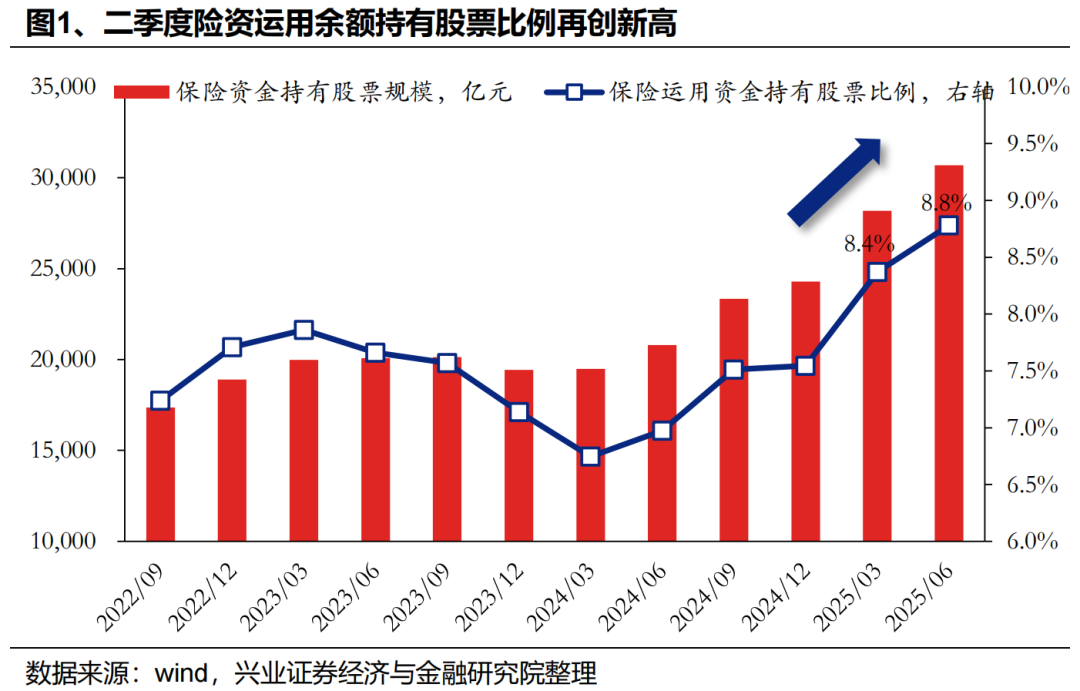
Group 1 - The performance evaluation methods for state-owned insurance companies have been continuously optimized since the beginning of the year, leading to an improved policy environment for insurance fund equity investments, which has accelerated the entry of insurance capital into the market [1] - In the second quarter, insurance companies further increased their stock allocations by approximately 200 billion yuan, with the proportion of stocks held rising by 0.4 percentage points to 8.8% compared to Q1 [1] - It is estimated that insurance capital will continue to increase allocations to A+H stocks by 300 to 400 billion yuan in the second half of the year, based on a 30% investment of new premium income [5] Group 2 - Insurance capital's participation in equity assets is gradually shifting from external management to direct investment, with a notable increase in stock holdings since Q4 2024, while fund holdings have decreased [8] - In the second quarter, insurance capital increased allocations to dividend-paying stocks while reducing holdings in energy sectors, with a focus on technology and high-end manufacturing [11] - The average dividend yield of the top 20 stocks increased to 3.80%, indicating a preference for high-dividend assets [13] Group 3 - Insurance capital has accelerated its stake acquisitions in listed companies, particularly in Hong Kong stocks, with 28 stake acquisitions recorded by August 31, surpassing the total for the previous year [16] - The preference for Hong Kong assets has made insurance capital a core driver of the rise in Hong Kong dividend assets [19] Group 4 - In the first half of 2025, insurance capital's holdings in ETFs saw a slowdown, with a total of 214.9 billion yuan held, reflecting a shift towards direct investments [23] - Despite the slowdown in total ETF allocations, there has been a significant internal structural adjustment, with increased allocations to TMT, manufacturing, and financial real estate sector ETFs [29] Group 5 - The five listed insurance companies in A-shares increased their stock holdings by 411.9 billion yuan in the first half of the year, representing a 28.7% increase [33] - The proportion of FVOCI stocks held by listed insurance companies has significantly increased, with a 62.2% rise in holdings [36]



刷屏!工行、农行、招行、腾讯、蚂蚁等,最新发声
中国基金报· 2025-09-06 06:35
Core Viewpoint - The recent reform of public fund sales fee rates by the China Securities Regulatory Commission aims to lower costs for investors and reshape the public fund sales ecosystem, emphasizing investor interests and promoting industry transformation [1][3][4]. Summary by Sections Fee Rate Adjustments - The maximum subscription fee rates for equity funds, mixed funds, and bond funds have been reduced to 0.8%, 0.5%, and 0.3% respectively, encouraging sales institutions to further discount fees while covering costs [3][4]. - The reform is seen as a key measure to enhance investor satisfaction and shift the industry focus from "seller sales" to "buyer services" [3][4]. Institutional Responses - Major financial institutions like Industrial and Commercial Bank of China and China Merchants Bank are committed to implementing the reforms, focusing on long-term investor interests and improving service quality [3][4]. - Teng'an Fund has already implemented significant fee discounts and aims to provide comprehensive advisory services, having generated over 100 billion yuan in returns for users since its inception [5][6]. Encouragement of Equity Fund Development - The reform encourages the development of equity funds by maintaining a cap on client maintenance fees at 30% of management fees, promoting better service capabilities among sales institutions [7][8]. - The reduction in fees is expected to enhance the growth of equity funds and improve long-term profitability for investors [7][8]. Long-term Industry Impact - The reform is anticipated to shift the public fund industry from a scale-driven profit model to a performance-driven value model, fostering a healthier industry development [8][9]. - It will also lower passive investment costs for investors, enhance investor protection, and improve overall investment experiences [9].

零售银行鏖战AUM
21世纪经济报道· 2025-09-05 15:40
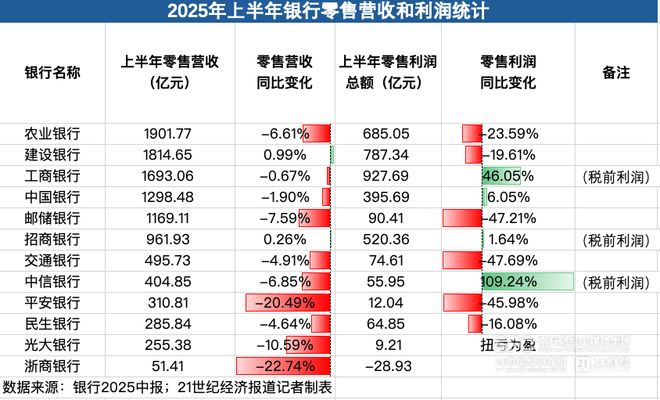
Core Viewpoint - The retail banking sector is under pressure, with declining revenue and profit, while retail credit risks are on the rise. Banks are exploring new retail transformation paths, focusing on expanding retail AUM (Assets Under Management) to enhance non-interest income and reshape their business models towards wealth management [1][3][12]. Retail Banking Performance - In the first half of 2025, three banks (Postal Savings Bank, China Merchants Bank, Agricultural Bank) reported retail revenue contributions exceeding 50%, while most banks with a focus on corporate banking had contributions below 40% [3]. - Among the 12 sample banks, 10 reported a decline in retail revenue, and 7 saw a decrease in total profit. However, three banks (Industrial and Commercial Bank, China CITIC Bank, and China Everbright Bank) showed positive changes in retail profit [3][5]. - The retail revenue and profit statistics for major banks indicate a mixed performance, with some banks like ICBC showing a profit increase of 46.05% [5]. Retail AUM Insights - Retail AUM has become a key indicator for banks, with the top three banks (ICBC, CCB, ABC) exceeding 20 trillion yuan in AUM. ICBC leads with 24 trillion yuan [7]. - All 13 banks reported positive growth in retail AUM compared to the beginning of the year, with notable increases from banks like SPD Bank [7][8]. - Retail AUM is defined as a measure of a bank's comprehensive retail financial capabilities, including personal deposits, wealth management, and insurance [7][8]. Wealth Management Transition - The shift towards retail AUM signifies a transition from traditional deposit-based models to wealth management-focused strategies, enhancing non-interest income [8][12]. - Banks are emphasizing the importance of retail AUM in their earnings reports, with many highlighting their strategies to grow this metric [9][12]. - The growth of retail AUM is expected to support the increase in intermediary business income, as banks focus on expanding their customer base [12][14]. Strategic Focus of Banks - Different banks are adopting varied strategies for wealth management. For instance, China Merchants Bank emphasizes retaining customers over merely selling products, while Ping An Bank aims to enhance its insurance business as a growth engine [14][15]. - ICBC highlights its extensive customer base and wealth management coverage, while China Bank focuses on its infrastructure advantages [15][16]. - The overall trend indicates a move away from high-risk retail asset strategies towards building a sustainable wealth management framework [16].


零售银行鏖战AUM
2 1 Shi Ji Jing Ji Bao Dao· 2025-09-05 12:50
Core Viewpoint - The retail banking sector is under pressure, with declining revenue and profit, while retail credit risks are on the rise, prompting banks to explore new transformation paths focused on retail AUM (Assets Under Management) as a key performance indicator [1][2][5]. Group 1: Retail Banking Performance - In the first half of 2025, three banks (Postal Savings Bank, China Merchants Bank, Agricultural Bank) reported retail revenue contributions exceeding 50%, while most banks with a focus on corporate banking had contributions below 40% [2]. - Among 12 sample banks, 10 reported a decline in retail revenue, and 7 saw a decrease in total profit, indicating that the retail business has not yet hit bottom [2]. - Notably, Industrial and Commercial Bank of China (ICBC) and China CITIC Bank reported significant increases in retail profit, with growth rates of 46.05% and 109.24% respectively [4]. Group 2: Retail AUM Trends - Retail AUM has become a focal point for banks, with the top three banks (ICBC, China Construction Bank, Agricultural Bank) exceeding 20 trillion yuan in retail AUM, and ICBC leading with 24 trillion yuan [5]. - All 13 banks analyzed reported positive growth in retail AUM compared to the beginning of the year, with notable increases from Shanghai Pudong Development Bank and Ping An Bank [5][6]. - Retail AUM is defined as a comprehensive measure of a bank's retail financial capabilities, including personal deposits, wealth management products, and insurance [5]. Group 3: Wealth Management Strategies - Banks are shifting focus from traditional deposit-based models to wealth management, emphasizing the importance of retail AUM for increasing non-interest income [6][11]. - The growth of retail AUM is expected to support the growth of intermediary business income, as highlighted by China Merchants Bank's strategy to enhance customer retention [9][12]. - Different banks are adopting varied approaches to wealth management, with ICBC focusing on customer coverage and China Bank emphasizing its infrastructure advantages [13][14].
再聊“磁升芯”背后的多重考量
凤凰网财经· 2025-09-05 12:28
Core Viewpoint - The announcement of the upgrade of UnionPay-Visa dual-branded magnetic stripe cards to chip cards marks a significant step in the internationalization of the Renminbi, providing enhanced security and user experience compared to single-branded chip cards [1][6]. Group 1: Security and Acceptance - The chip card offers a substantial upgrade in security compared to traditional magnetic stripe cards, utilizing dynamic authentication to prevent data copying and fraud [2][3]. - Chip cards have a broader acceptance range, especially in cross-border scenarios, where they have become essential as many markets no longer accept magnetic stripe transactions [4][5]. Group 2: Strategic Considerations - The transition from magnetic stripe to chip cards reflects a strategic shift in the market, driven by the need for enhanced security and the internationalization of the Renminbi [6][7]. - The collaboration between UnionPay and Visa in launching the chip card is seen as a mutually beneficial outcome, aligning their strategic interests in expanding market presence [8]. Group 3: Evolution of Payment Tools - The upgrade to chip cards signifies an evolution in credit card functionality, transforming them from mere payment tools to international bridges for commerce and communication [9]. - Banks are enhancing their product offerings to cater to cross-border needs, providing additional benefits and rewards for overseas transactions [9][10]. Group 4: Market Performance - The performance of credit cards, particularly from China Merchants Bank, indicates a strong market position, with significant overseas transaction volumes and a leading industry presence [10].

金融行业双周报:上半年上市险企归母净利润“四升一降”,银行业绩边际改善-20250905
Dongguan Securities· 2025-09-05 11:52
Investment Ratings - Securities: Market Perform (Maintain) [1] - Insurance: Overweight (Maintain) [2] Core Insights - The securities industry showed robust performance in the first half of the year, with 42 listed brokerages achieving total revenue of CNY 251.87 billion, a year-on-year increase of 11.37%, and net profit of CNY 104.02 billion, up 65.09% [3][47] - The banking sector demonstrated marginal improvement, with 42 listed banks reporting revenue of CNY 2.92 trillion, a year-on-year growth of 1.04%, and net profit of CNY 1.10 trillion, an increase of 0.80% [6][45] - The insurance sector's five listed companies achieved revenue of CNY 1.33 trillion, a 4.7% increase, and net profit of CNY 178.19 billion, up 3.7% [49] Summary by Sections Market Review - As of September 4, 2025, the banking, securities, and insurance indices experienced declines of -1.93%, -3.56%, and -3.89% respectively, while the CSI 300 index rose by 1.80% [6][14] Valuation Situation - The banking sector's price-to-book (PB) ratio stood at 0.76, with state-owned banks at 0.81, joint-stock banks at 0.64, city commercial banks at 0.72, and rural commercial banks at 0.63 [23] - The securities sector's PB ratio was 1.56, indicating potential for valuation recovery [25] Recent Market Indicators - The average daily trading volume in A-shares was CNY 2.64 trillion, a decrease of 10.79% week-on-week, reflecting a cooling investor sentiment [33] - The one-year medium-term lending facility (MLF) rate was 2.0%, with the one-year and five-year Loan Prime Rates (LPR) at 3.0% and 3.5% respectively [32] Industry News - The insurance sector is encouraged to return to its core protection role, with policies supporting increased equity investment, which is expected to enhance long-term growth [49] - The banking sector is seeing a shift in capital towards high-dividend, low-valuation stocks, driven by a low-interest-rate environment and asset scarcity [45]



招商银行(600036):2025年中报点评:利润转正,不良新生成率降至近年新低
Changjiang Securities· 2025-09-05 10:43
Investment Rating - The investment rating for the company is "Buy" and is maintained [9]. Core Views - The company's profit growth has turned positive, with a notable improvement in asset quality, as indicated by a decrease in the new non-performing loan generation rate to a near historical low [6][11]. - The wealth management income has turned positive this year after several years of adjustments, contributing to the overall revenue recovery [11]. - The company has announced its first interim dividend this year, with a payout ratio of 35%, consistent with the previous year [11]. Summary by Sections Financial Performance - In the first half of the year, the company's revenue growth was -1.7%, while the net profit attributable to shareholders grew by 0.3%. The net interest income increased by 1.6%, but non-interest income decreased by 6.7% [2][6]. - The asset quality shows positive signals, with a non-performing loan ratio of 0.93% at the end of the first half, down 2 basis points from the beginning of the year, and a provision coverage ratio of 411% [2][6]. Loan and Deposit Growth - Total assets increased by 4.2% from the beginning of the year, with loans growing by 3.3%. Retail loans saw a slight increase of 0.9%, while corporate loans rose by 7.9% [11]. - Deposits grew by 3.6%, with demand deposits accounting for 51.0% of total deposits at the end of the first half [11]. Interest Margin and Cost - The net interest margin was 1.88%, a decrease of 10 basis points compared to the previous year. The loan yield dropped to 3.45%, reflecting a shift in loan structure towards lower-yielding corporate and consumer loans [11]. - The deposit cost rate decreased to 1.26%, indicating a strong customer retention and pricing capability [11]. Asset Quality Improvement - The new non-performing loan generation rate for the first half was 0.98%, down 2 basis points from the first quarter, reflecting improvements in both corporate and retail segments [11]. - The retail non-performing loan generation rate decreased to 1.70%, and the credit card non-performing loan generation rate fell to 4.22% [11]. Investment Recommendations - The company is expected to benefit from a restructuring of institutional allocation ratios, with a current A/H share price-to-book ratio of 0.98x/1.00x and a dividend yield of 4.7%/4.6% [11].
招商银行东莞分行首笔“园区贷”落地
2 1 Shi Ji Jing Ji Bao Dao· 2025-09-05 09:10
Core Viewpoint - The successful issuance of the first "Park Loan" by China Merchants Bank Dongguan Branch marks a significant step in addressing the financing difficulties faced by small and micro enterprises in Dongguan, injecting new vitality into their development [2][3]. Group 1: Product Overview - The "Park Loan" is an innovative financial product aimed at supporting Dongguan's "8+8+4" industrial system, focusing on key sectors such as technological innovation, green low-carbon initiatives, and foreign trade [2]. - The loan amount issued was 3 million yuan, providing convenient financing services to enterprises in the pilot park [2]. Group 2: Implementation Mechanism - The product establishes a collaborative mechanism among the government, banks, and park management, integrating government "credit easy loan" platforms with park operational data to create tailored, no-collateral, low-cost, and efficient credit services [2][3]. - Eligible enterprises can also benefit from multiple policy incentives, including interest subsidies and risk compensation from Guangdong Province for manufacturing and high-tech enterprises [2]. Group 3: Service Strategy - China Merchants Bank Dongguan Branch has formed a specialized service team to conduct on-site visits and joint research, utilizing big data models to create a precise profile of pilot parks like Tianan Digital City [3]. - The bank offers customized financing solutions that align closely with the actual needs of Dongguan's technology and manufacturing enterprises, enhancing the relevance of their credit marketing projects [3]. Group 4: Future Plans - The bank plans to leverage the "Park Loan" as an opportunity to explore new models and pathways for financial support to the real economy, aiming to provide robust financial backing for the construction of a modern industrial system in Dongguan [3].
