SAIC MOTOR(600104)

Search documents
上汽集团2025年销量450.7万辆 同比增长12.3%
Yang Zi Wan Bao Wang· 2026-01-07 13:50
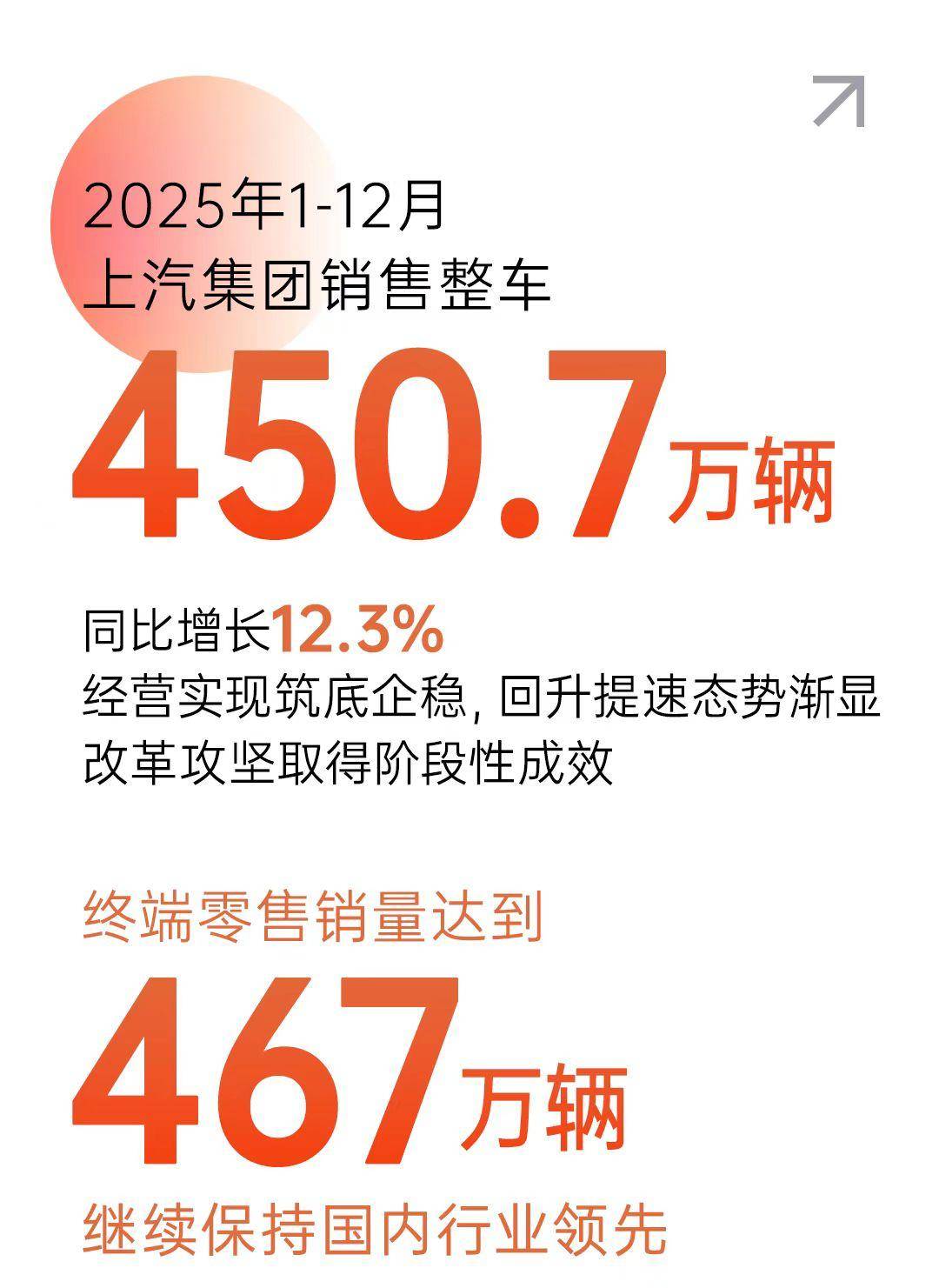
Core Insights - SAIC Motor Corporation's 2025 operational results show a total vehicle sales of 4.507 million units, a year-on-year increase of 12.3%, with retail sales reaching 4.67 million units, maintaining industry leadership in China [1][5] - The company's sales of self-owned brands exceeded 2.928 million units, marking a significant year-on-year growth of 21.6%, while new energy vehicle sales reached 1.643 million units, a record high with a growth rate of 33.1% [1][5] Group 1: Innovation and Technology - Innovation is identified as the core engine for industrial transformation and a fundamental strength for companies to navigate through cycles [6] - The shift in the Chinese automotive market from price competition to value competition emphasizes the importance of mastering core technologies for development [6] - SAIC's growth is attributed to its commitment to technological innovation and continuous investment, exemplified by the successful launch of the MG4 semi-solid state battery and the DMH 6.0 hybrid system [10] Group 2: Ecosystem Collaboration - Ecosystem collaboration is deemed essential for modern industrial development and a key pathway to activate innovation [11] - SAIC's strategy of "equal rights-driven advancement, co-creating a better travel experience" fosters a diverse collaborative industrial ecosystem, enhancing high-quality development [11] - Collaborations with companies like Huawei and OPPO have led to innovative products that enhance user experience and facilitate rapid application of cutting-edge technologies [13] Group 3: Global Expansion - Globalization is crucial for expanding development space and signifies the Chinese automotive industry's entry into the global market [18] - SAIC's overseas sales reached 1.071 million units in 2025, reflecting a year-on-year growth of 3.1%, with cumulative sales surpassing 6 million units [20] - The company's Glocal strategy aims to deepen international market penetration, transitioning from product export to value chain upgrades, showcasing the global competitiveness of Chinese automotive brands [20]


2026年,这些“创二代”,谁能突围,谁是扶不起的阿斗?
3 6 Ke· 2026-01-07 13:07
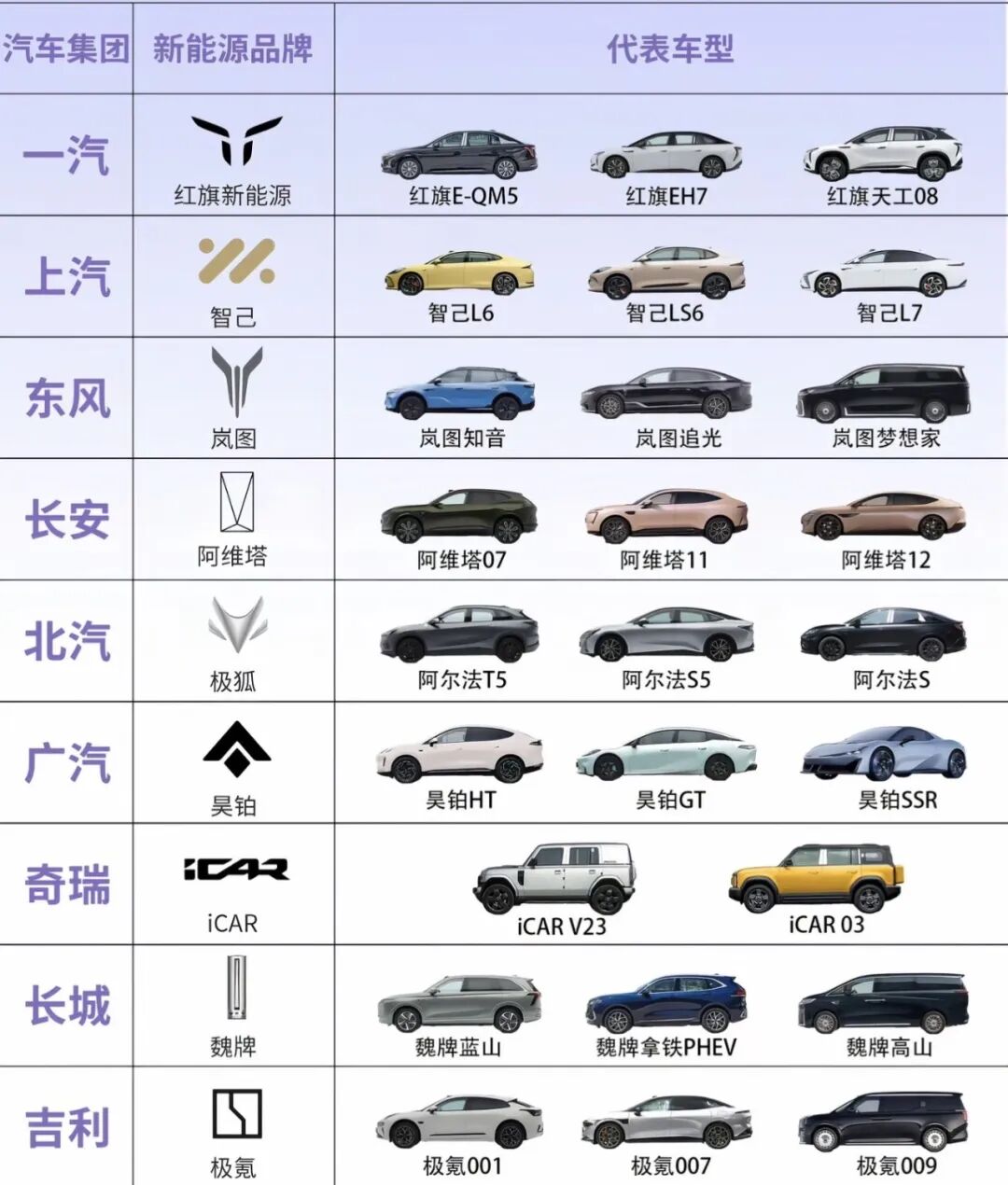
Core Insights - The new energy vehicle (NEV) industry in 2025 has seen a clear division between leading brands and those lagging behind, with companies like Leap Motor, Hongmeng Zhixing, and Xiaopeng firmly establishing themselves in the top tier, while traditional automaker-backed brands struggle to gain traction [1][6][11] Group 1: Market Performance - In 2025, the top three new car brands were Leap Motor (596,555 units, +103%), Hongmeng Zhixing (589,107 units, +32%), and Xiaopeng (429,445 units, +126%) [6][7] - The second tier includes Xiaomi Auto (over 411,625 units), Li Auto (406,343 units), and Deep Blue (333,117 units), while brands like Lantu, Avita, and Zhiji lagged with sales of 150,169, 128,772, and 81,017 units respectively [6][7][8] - The overall NEV market is expected to enter a phase of slower growth and intensified competition in 2026, with significant price cuts from major players like BMW and Tesla reigniting a price war [2][5] Group 2: Brand Dynamics - The "second-generation" brands, despite their backing from established automakers, have not been able to match the performance of pure new car brands, with significant sales gaps [6][11] - However, brands like Deep Blue and Lantu have shown impressive growth rates, with Lantu achieving a 87% increase in sales [8][21] - Traditional automakers are heavily investing in these "second-generation" brands, providing them with essential resources and support to compete in the high-end NEV market [11][13][15] Group 3: Future Outlook - Predictions for 2026 indicate a potential market growth of only about 2%, significantly lower than the previous year's growth [16] - Lantu is expected to expand its product lineup significantly and is on track for an IPO, which could enhance its market position [21][23] - Deep Blue is also positioned for growth, having achieved a high completion rate of its annual sales target [21][23] - Brands like Avita and Zeekr may stabilize but face challenges in maintaining competitive pricing and market share [26][29]





上汽集团-业务协同助推复苏步伐;超配
2026-01-07 03:05
Summary of SAIC Motor Corp. Ltd. Conference Call Company Overview - **Company**: SAIC Motor Corp. Ltd. (上汽集团) - **Industry**: Automotive Industry in China Key Points and Arguments 1. **Integrated Business Model**: The integrated business model of SAIC is expected to play a significant role in 2026, allowing the company to capture more value across the automotive supply chain as sales recover. This model includes upstream (auto parts) and downstream (sales and automotive finance) operations, enhancing profitability during the transition period [3][12][4]. 2. **Sales Recovery**: SAIC's self-owned brands saw a significant sales rebound in 2025, driven by domestic product upgrades, new brand launches, and stable overseas sales contributions. The outlook for SAIC Volkswagen and SAIC General Motors remains robust, benefiting from an upcoming product cycle and improved prospects for the new energy transition [3][9]. 3. **Financial Performance**: The company has adjusted its earnings forecasts to reflect a slower recovery start but maintains a target price of RMB 22.90, indicating a potential upside of 50%. The expected price-to-earnings ratio for 2026 is 10.4 times, suggesting that the market's expectations are relatively low [4][10]. 4. **Profitability Sources**: Key sources of profitability include: - Stable contributions from Huayu and automotive finance, which is expected to recover in 2026. - Improvements in self-owned brand operations, with losses decreasing. - Stabilization of joint ventures after a loss in 2024, leading to a more favorable profit outlook. - Release of integration-related costs and normalization of asset impairments [3][12][16]. 5. **Joint Ventures Outlook**: The outlook for joint ventures is stabilizing, with SAIC Volkswagen experiencing a slight decline in sales in 2025 but maintaining a healthy overall performance. SAIC General Motors is recovering post-restructuring, with sales stabilizing at healthy levels [11][9]. 6. **Market Position and Strategy**: SAIC's market share in passenger vehicles provides opportunities for surrounding businesses, such as financial investments. The company is also adapting its product strategy in international markets, shifting from pure electric vehicles (BEV) to plug-in hybrids (PHEV) and hybrids (HEV) to meet regional demand [10][9]. 7. **Investment Opportunities**: SAIC's investment capabilities, particularly in automotive-related enterprises, are expected to remain a significant profit pillar. The company has made strategic investments, such as in Horizon Robotics, which are anticipated to yield returns [13][12]. 8. **Risks and Challenges**: Potential risks include intensified competition in the domestic market, cost pressures from the new energy vehicle transition, and unexpected losses from non-core businesses. The company is also cautious about the impact of EU tariffs on its international strategy [16][23]. Additional Important Information - **Market Capitalization**: Approximately RMB 173.89 billion - **Average Daily Trading Volume**: RMB 1.007 billion - **Earnings Per Share (EPS) Forecast**: Expected to rise from RMB 0.15 in FY24 to RMB 1.94 in FY27 [4][7]. This summary encapsulates the essential insights from the conference call regarding SAIC Motor Corp. Ltd., highlighting its recovery strategy, financial outlook, and market positioning within the automotive industry.
MG7 2026款以“全系标配”诠释轿跑平权
Zhong Guo Qi Che Bao Wang· 2026-01-07 02:46
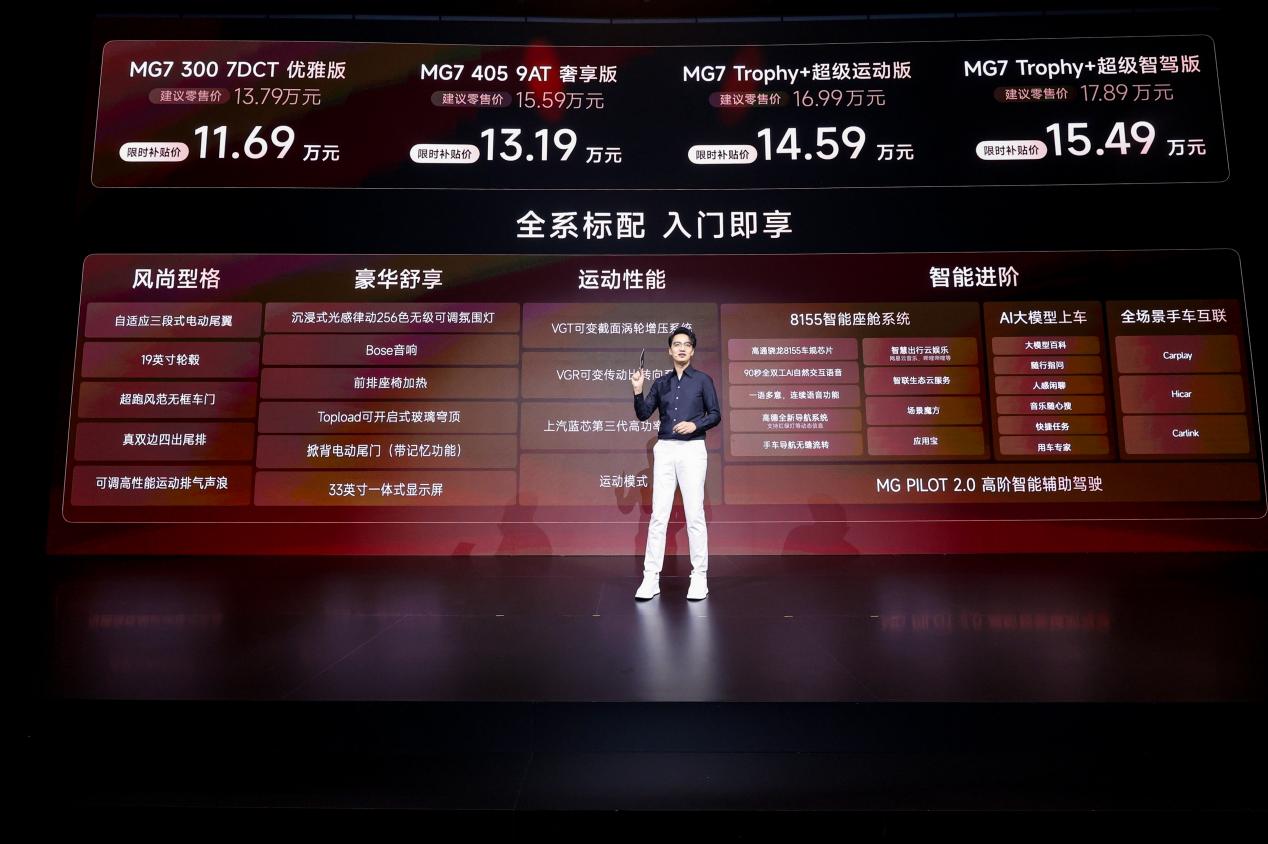
Core Viewpoint - The launch of the MG7 2026 model represents MG's commitment to "technological equality," offering luxury features and high-end technology at an accessible price point of 116,900 to 154,900 yuan, thereby redefining the value benchmark for sedans in the 150,000 yuan segment [1][12][14] Group 1: Product Features - The MG7 2026 model breaks the traditional entry-level low configuration model by offering luxury features across all variants, including frameless doors, fastback design, and a range of high-end configurations such as BOSE sound system and panoramic sunroof [3][6] - The new model includes a unique Iceland Blue color inspired by glacial purity, enhancing its visual appeal [5] - All variants are equipped with the 8155 chip and AI model, enabling advanced intelligent driving assistance and various interactive features, enhancing the user experience [5][12] Group 2: Performance and Technology - The MG7 2026 model features a high-performance 2.0T engine paired with a 9AT transmission, achieving a maximum power of 194.6 kW and a peak torque of 405 N·m, with a 0-100 km/h acceleration time of just 6.5 seconds [6][11] - The model's handling performance is comparable to luxury brands, with features like E-LSD electronic limited-slip differential and mCDC intelligent adjustable suspension, allowing for superior driving dynamics [6][11] - In performance tests against the BMW 425i, the MG7 demonstrated competitive results, including a 6.52-second time in the slalom test and superior performance in various handling scenarios [11] Group 3: Market Impact and Brand Strategy - The launch of the MG7 2026 model signifies a shift towards making advanced technology and luxury features accessible to a broader market, addressing the needs of over 70% of the fuel vehicle market [12][14] - MG's strategy reinforces its global presence and aims to reshape industry value standards, promoting technological benefits for the masses [12][14] - The initiative reflects MG's long-term commitment to users and enhances the global influence of Chinese automotive brands in the parallel development of fuel and new energy vehicles [14]
在电车时代造燃油轿跑,MG于“红海”中造“蓝海”
Xin Hua Cai Jing· 2026-01-07 01:54
Core Viewpoint - MG brand has launched the MG7, a fuel-powered coupe, with a starting price of 116,900 yuan, emphasizing the importance of fuel vehicles alongside electric models in their future strategy [1][3]. Group 1: Product Features and Innovations - MG7 features "full standard configuration," including frameless doors, a fastback design, dual exhausts, and a three-stage electric tail wing, which are typically optional in luxury models [1]. - The MG7 is equipped with advanced intelligent driving assistance systems, including highway NOA and smart parking, addressing the perception that fuel vehicles lack intelligence [2]. - The new MG7 includes a Qualcomm 8155 chip and offers full-scene vehicle connectivity, Android ecosystem applications, and AI capabilities, ensuring continuous smart upgrades for all models [2][5]. Group 2: Market Strategy and Positioning - MG brand maintains a dual strategy of fuel and electric vehicles, responding to market demands where fuel vehicles still hold over 70% of global sales, especially in regions with unique climate and road conditions [3][4]. - The established supply chain and manufacturing capabilities in fuel vehicles provide cost advantages and support for the development of new energy models [3]. - The technological foundation built in the fuel vehicle sector is crucial for developing high-quality new energy products, as seen in the reliability and efficiency of MG's hybrid models [4]. Group 3: Sales Performance and Growth - Since the launch of the MG4, the brand has seen significant growth, with the MG4 selling over 10,000 units for four consecutive months and expanding its sales network to 530 locations by the end of 2025 [6]. - MG has achieved over 300,000 sales in Europe in 2025, maintaining its position as the top-selling Chinese brand in the region for 11 consecutive years [6]. - The MG7 has also performed well in markets like Australia, showcasing the brand's commitment to both fuel and electric vehicle segments during the transition in the automotive industry [6][7]. Group 4: Brand Philosophy and Future Outlook - MG's brand philosophy emphasizes a "young" spirit, focusing on innovation and a vibrant lifestyle, which is reflected in their product offerings [7]. - The upcoming global launch of the MG4 is expected to further showcase MG's technological capabilities and commitment to innovation [7].
汽车视点 | 在电车时代造燃油轿跑,MG于“红海”中造“蓝海”
Xin Hua Cai Jing· 2026-01-07 01:51
Core Viewpoint - The MG brand has launched the MG7, a fuel-powered coupe, with a starting price of 116,900 yuan, emphasizing the concept of "technical equality" in the automotive market, particularly in the coupe segment [1] Group 1: Product Features and Innovations - The MG7 features "full standard configuration," including frameless doors, a sleek design, and high-performance exhaust systems, which are typically optional in luxury models [1] - The MG7 is equipped with advanced intelligent driving assistance systems, including highway navigation assistance and smart parking, challenging the perception that fuel vehicles lack intelligence [2] - The new MG7 addresses previous user feedback by incorporating a Qualcomm 8155 chip and offering full-scene vehicle connectivity, enhancing the overall user experience [2] Group 2: Market Strategy and Positioning - MG's strategy includes maintaining a presence in the fuel vehicle market while also expanding its electric vehicle lineup, with plans to launch 13 new energy models by 2025 [3][4] - The brand recognizes that fuel vehicles still hold over 70% of global sales and are essential in regions with unique climate and road conditions, ensuring a diverse market approach [3] - The established supply chain and manufacturing capabilities in fuel vehicles provide cost advantages and support the development of new energy models [3][4] Group 3: Brand Identity and Growth - MG has experienced rapid growth since 2025, particularly after the launch of the MG4, which has sold over 10,000 units monthly since its release [6] - The brand's sales network has expanded significantly, with over 530 locations by the end of 2025, achieving over 95% coverage in county-level areas in China [6] - MG's commitment to a "young" spirit is reflected in its innovative approach and desire to lead trends, with plans to introduce the MG4 to global markets soon [7]
上汽集团年售车450余万辆自主占65% 海外销量107万辆推动“价值链出海”
Chang Jiang Shang Bao· 2026-01-06 23:40
Group 1 - The core objective of SAIC Group for 2025 was to achieve vehicle sales exceeding 4.5 million units, which has been successfully met with a total of 4.5075 million units sold, representing a year-on-year growth of 12.32% [1][2][3] - The sales of SAIC's self-owned brands reached 2.928 million units in 2025, marking a 21.6% increase and accounting for 65% of the total sales, an increase of 5 percentage points from 2024 [1][4] - The sales of new energy vehicles (NEVs) surged to 1.6428 million units, reflecting a significant growth of 33.12%, with the brand Zhiji contributing 81,000 units sold, a 23.68% increase [1][7] Group 2 - In the overseas market, SAIC Group achieved sales of 1.071 million units, a 3.1% increase, maintaining a leading position in the industry [1][8] - The company launched its overseas strategy 3.0, termed "Glocal," focusing on a combination of global and local strategies to enhance its localized ecosystem and global automotive brand presence [1][8] - SAIC's various subsidiaries reported significant sales growth, with SAIC General's sales reaching 535,000 units (up 22.99%), SAIC Passenger Cars at 886,700 units (up 25.42%), and SAIC-GM Wuling at 1.6151 million units (up 20.52%) [3][4]
上汽集团子公司参与设立的股权投资基金完成备案
Xin Lang Cai Jing· 2026-01-06 19:29
Core Viewpoint - Shanghai Automotive Group Co., Ltd. (stock code: 600104) announced the progress of its wholly-owned subsidiary's participation in establishing an equity investment fund, aiming to strengthen its position in the smart electric vehicle industry ecosystem [1] Group 1: Fund Details - The fund, named Ningbo Yongyuan Junsheng Equity Investment Partnership (Limited Partnership), was registered with the Asset Management Association of China on January 5, 2026, and has completed the first phase of capital contribution [1] - The total fundraising scale of the fund is 1.09 billion yuan, with Shanghai Automotive Group Jin控 contributing 270 million yuan, accounting for 24.77% of the total committed capital [1] - The fund is managed by Shanghai Hengxu Chuangling Private Fund Management Co., Ltd., and the custodian is China Merchants Bank Co., Ltd. [1] Group 2: Investment Purpose - The investment aims to enhance the industrial chain layout around the smart electric vehicle industry through professional investment institutions, assisting the company in forming new productive forces [1] - As of now, the total amount committed by the subsidiary of Shanghai Automotive Group to the fund managed by Hengxu Capital has reached 1.67 billion yuan [1]

上海汽车集团股份有限公司关于子公司参与设立股权投资基金的后续进展暨完成基金备案的公告
Shang Hai Zheng Quan Bao· 2026-01-06 17:49
Group 1 - The company’s wholly-owned subsidiary, Shanghai Automotive Group Financial Holdings Co., Ltd. (上汽金控), has signed a partnership agreement to establish the Ningbo Yongyuan Junsheng Equity Investment Partnership (Limited Partnership) with several partners, raising a total of 1.09 billion yuan, with 上汽金控 contributing 270 million yuan, accounting for 24.77% of the total investment [2] - The fund has completed its registration with the Asset Management Association of China and obtained the Private Investment Fund Registration Certificate, with the registration date being January 5, 2026 [3] - The establishment of the investment fund aims to enhance the company’s capabilities in the smart electric vehicle industry ecosystem, leveraging professional investment experience to strengthen, supplement, and expand the supply chain [3]
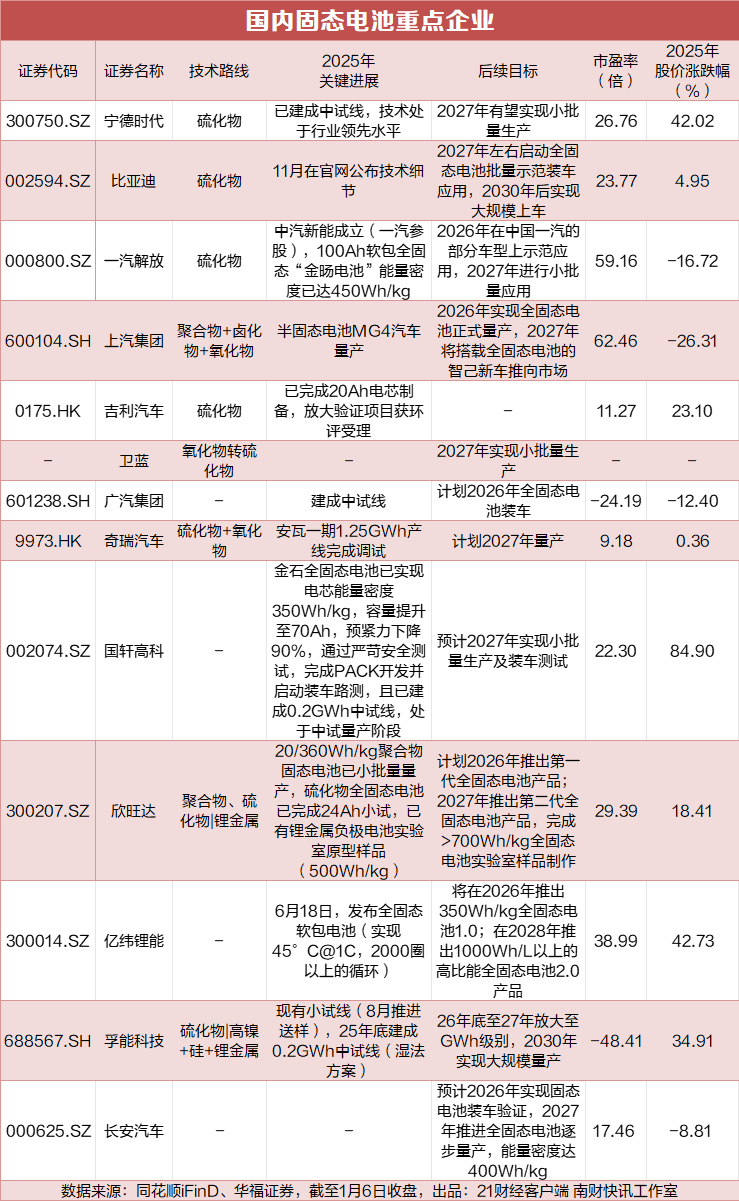
5分钟充满电!全球首款可量产全固态电池来了
2 1 Shi Ji Jing Ji Bao Dao· 2026-01-06 14:25
Group 1 - The solid-state battery sector continues to rise, with companies like HaiXi Communications and DaoShi Technology seeing gains of over 10% [1] - Donut Lab announced the launch of the world's first mass-producible all-solid-state battery at the CES in Las Vegas, boasting an energy density of 400Wh/kg, enabling longer range and lighter structure [1][2] - The all-solid-state battery can be fully charged in just 5 minutes and supports safe, reliable full discharge without significant capacity degradation over its lifespan, which can reach up to 100,000 cycles [1] Group 2 - The battery is designed without flammable liquid electrolytes, eliminating the risk of thermal runaway and dendrite formation, and has been rigorously tested under extreme conditions [2] - Donut Lab claims that the materials used for the solid-state battery are abundant, low-cost, and geopolitically secure, avoiding reliance on rare or sensitive elements [2] - Verge Motorcycles will be the first to use Donut Lab's solid-state battery, allowing for a 10-minute charge that provides up to 60 kilometers of range per minute of charging, with a long-range version capable of 600 kilometers on a single charge [3] Group 3 - Traditional lithium-ion batteries are nearing their theoretical energy density limit of 300Wh/kg, making it difficult to meet the demands for higher energy density and safety in electric vehicles and other applications [3] - Solid-state batteries are recognized as a disruptive technology that can achieve higher energy density and safety, prompting global companies and research teams to innovate to avoid falling behind [3] - The year 2026 is identified as a critical period for equipment localization in the solid-state battery industry [3]