
Hengrui Pharma(600276)

Search documents
年末市场波动加剧,自带杠铃策略的上证180ETF指数基金(530280)备受关注
Xin Lang Cai Jing· 2025-12-02 02:31
Group 1 - The Shanghai 180 Index (000010) shows mixed performance among its constituent stocks, with Transsion Holdings (688036) leading the gain at 4.86% and GAC Group (601238) up by 3.78% [1] - The market is experiencing increased volatility as the year-end approaches, and CICC suggests maintaining a "barbell" strategy (dividend + technology internet) for portfolio allocation [1] - The management fee for the Shanghai 180 ETF Index Fund (530280) is 0.15%, and the custody fee is 0.05% [1] Group 2 - As of November 28, 2025, the top ten weighted stocks in the Shanghai 180 Index include Kweichow Moutai (600519) and Zijin Mining (601899), collectively accounting for 26.13% of the index [2] - The Shanghai 180 ETF Index Fund has several off-market connection options, including Ping An's various linked funds [2]





恒瑞医药(01276.HK)获GIC Private Limited增持42.24万股
Ge Long Hui· 2025-12-01 23:43
| 股份代號: | 01276 | | --- | --- | | 上市法國名稱: | 江蘇恒瑞醫藥股份有限公司 - H股 | | 日期 (日 / 月 / 年): | 02/11/2025 - 02/12/2025 | | 表格序號 | 大股東/董事/最高行政人員名稱作出披露的 買入 / 費出或涉及的 每股的平均價 | | | | 持有權益的股份數目 佔已發行的 有關事件的日期 | | | --- | --- | --- | --- | --- | --- | --- | | | | 原因 | 股份數目 | | ( 請參閱上述 * 註 | 有投票權股 (日 / 月 / 年) | | | | | | | | 份百分比 | | | | | | | | ( % ) | | CS20251201E00011 | 422,400(L) GIC Private Limited | 1101(L) | | HKD 74.9550 | 59.462.200(L) | 23.03(L)27/11/2025 | 格隆汇12月2日丨根据联交所最新权益披露资料显示,2025年11月27日,恒瑞医药(01276.HK)获GIC Pri ...


GIC Private Limited增持恒瑞医药42.24万股 每股作价约74.96港元
Zhi Tong Cai Jing· 2025-12-01 12:39
香港联交所最新资料显示,11月27日,GIC Private Limited增持恒瑞医药(600276)(01276)42.24万股, 每股作价74.955港元,总金额约为3166.1万港元。增持后最新持股数目为5946.22万股,最新持股比例为 23.03%。 ...
GIC Private Limited增持恒瑞医药(01276)42.24万股 每股作价约74.96港元

智通财经网· 2025-12-01 12:33
智通财经APP获悉,香港联交所最新资料显示,11月27日,GIC Private Limited增持恒瑞医药 (01276)42.24万股,每股作价74.955港元,总金额约为3166.1万港元。增持后最新持股数目为5946.22万 股,最新持股比例为23.03%。 ...
中国生物医药二级市场分析:从千金药业看千金不换的妇科药如何开辟增长新路径
Tou Bao Yan Jiu Yuan· 2025-12-01 11:56
Investment Rating - The report does not explicitly provide an investment rating for the gynecological drug industry in China. Core Insights - The biopharmaceutical industry in China is experiencing structural optimization, valuation recovery, and confidence rebuilding, particularly in the Hong Kong market, where the 18A system supports enterprise value discovery [2][3]. - Gynecological drug companies are characterized by specialized positioning and differentiated competition, focusing on areas such as traditional Chinese medicine, innovative treatments for gynecological tumors, and hormone drugs, showcasing strong professional images and commercialization capabilities [2][3]. Summary by Sections Capital Market Performance of China's Biopharmaceutical Sector - The A-share market has shifted from a focus on scale to sustainable development, while the Hong Kong market has attracted international capital through the 18A system, leading to a gradual rebuilding of long-term confidence in the biopharmaceutical sector [3][25]. - The A-share biopharmaceutical sector has seen a total fundraising amount of 787 billion yuan from January to October 2025, with a peak of 2,451 billion yuan in 2021, indicating a transition from a capital overheating phase to a rational development phase [13][18]. - In the Hong Kong market, the total fundraising amount reached 789 billion HKD from January to October 2025, with a peak of 1,833 billion HKD in 2020, reflecting a significant improvement in the financing environment [27][28]. Market Position Assessment of Chinese Gynecological Drug Companies - The competitive landscape of gynecological drug companies is marked by a focus on specialized fields such as innovative gynecological tumor drugs and hormone treatments, with companies establishing differentiated competitive advantages [40]. - Qianjin Pharmaceutical is recognized as a leading player in the gynecological drug market, with a strong market presence in oral gynecological inflammation traditional Chinese medicine [40]. - Heng Rui Pharmaceutical is noted for its robust pipeline in gynecological tumor treatments, with eight drugs in development as of 2024 [40]. - Xianju Pharmaceutical specializes in hormone treatments, with a focus on steroid drugs, establishing a strong professional image in the gynecological field [40]. Introduction to Representative Listed Chinese Gynecological Drug Companies - Qianjin Pharmaceutical has a significant market share of 25.8% in oral gynecological inflammation traditional Chinese medicine, demonstrating strong sales performance even in challenging market conditions [45]. - Heng Rui Pharmaceutical's research and development pipeline includes multiple innovative treatments for gynecological tumors, indicating a solid commitment to this therapeutic area [52][53]. - Xianju Pharmaceutical leverages its expertise in steroid drugs to maintain a competitive edge in the gynecological drug market, with a focus on cost-effective production and high-quality formulations [58][61].


国泰海通医药2025年12月月报:持续重点推荐创新药械产业链-20251201
Haitong Securities International· 2025-12-01 11:21
Investment Rating - The report maintains an "Outperform" rating for A-Shares including Jiangsu Heng Rui Medicine, Sichuan Kelun Pharmaceutical, Huadong Medicine, Jiangsu Nhwa Pharmaceutical, Xiamen Amoytop Biotech, Zhejiang Jingxin Pharmaceutical, Innovent Biologics, WuXi AppTec, Hangzhou Tigermed Consulting, Lepu Medical, and APT Medical [2][4][29] - The report also maintains an "Outperform" rating for H-Shares including Hansoh Pharmaceutical Group, 3SBio, PATEO, Akeso, and related targets such as Innovent Biologics and WuXi AppTec (H-Shares) [2][7][29] Core Insights - The report continues to recommend the innovative drug and device industry chain [1][2] - In November 2025, the pharmaceutical sector underperformed the broader market, with the SW Pharma Bio index falling by 3.6% compared to a 1.7% drop in the SHCOMP [2][10] - The premium of the pharmaceutical sector to all A-Shares is currently at a normal level of 72.6% as of the end of November 2025 [17][22] Summary by Sections A-Shares Performance - The report highlights the A-Shares that are recommended for investment, maintaining an "Outperform" rating for several companies, including Jiangsu Heng Rui Medicine and Sichuan Kelun Pharmaceutical, among others [4][5] - The report notes that the pharmaceutical sector's performance was ranked 23rd among Shenwan's first-level industries in November 2025 [10][12] H-Shares Performance - The report indicates that the H-Shares pharmaceutical sector performed in line with the market, with the Hang Seng Healthcare index down by 0.1% and the biotech sector up by 0.4% in November 2025 [2][23] - Top gainers in the H-Shares market included Laekna, Inc. (+40%) and Clover Biopharmaceuticals, Ltd. (+22%) [23] U.S. Market Performance - The U.S. pharmaceutical sector outperformed the broader market in November 2025, with the S&P Healthcare Select Sector rising by 9.1% compared to a 0.1% increase in the S&P 500 [23]


12月1日医疗健康R(480016)指数涨0.31%,成份股惠泰医疗(688617)领涨
Sou Hu Cai Jing· 2025-12-01 11:09
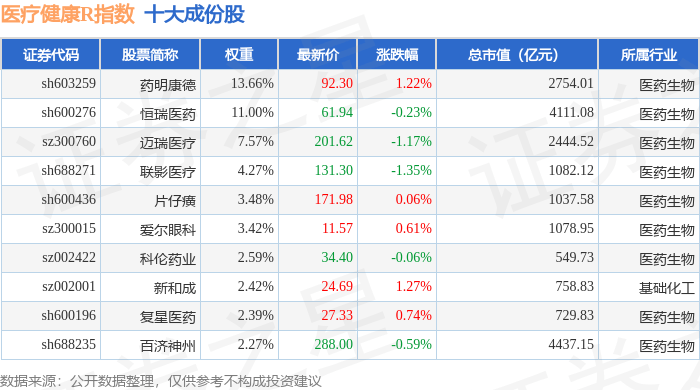
Core Insights - The Medical Health R Index (480016) closed at 7423.77 points, up 0.31%, with a trading volume of 18.443 billion yuan and a turnover rate of 0.67% [1] - Among the index constituents, 34 stocks rose while 16 fell, with Huatai Medical leading the gainers at 3.13% and Yirui Technology leading the decliners at 2.87% [1] Index Constituents Performance - The top ten constituents of the Medical Health R Index include: - WuXi AppTec (13.66% weight) at 92.30 yuan, up 1.22%, market cap of 275.401 billion yuan [1] - Hengrui Medicine (11.00% weight) at 61.94 yuan, down 0.23%, market cap of 411.108 billion yuan [1] - Mindray Medical (7.57% weight) at 201.62 yuan, down 1.17%, market cap of 244.452 billion yuan [1] - United Imaging Healthcare (4.27% weight) at 131.30 yuan, down 1.35%, market cap of 108.212 billion yuan [1] - Other notable constituents include Pianzai Shou, Aier Eye Hospital, Kelun Pharmaceutical, and Fosun Pharma, with varying performance [1] Capital Flow Analysis - The Medical Health R Index constituents experienced a net outflow of 261 million yuan from institutional investors, while retail investors saw a net inflow of 272 million yuan [1] - Detailed capital flow for specific stocks shows: - WuXi AppTec had a net inflow of 1.15 million yuan from institutional investors, but outflows from retail and speculative investors [2] - Other stocks like Jichuan Pharmaceutical and Lijun Group also showed mixed capital flows, with some experiencing significant outflows from retail investors [2] Recent Index Adjustments - In the last 10 days, the Medical Health R Index underwent adjustments, adding four new stocks and removing one [3] - New additions include: - Sanofi Guojian, Dize Pharmaceutical, Changshan Pharmaceutical, and Kanghong Pharmaceutical, all from the biopharmaceutical sector [3]


口服FXIa抑制剂asundexian预防脑卒中复发III期成功:创新药周报20251130-20251130
Huachuang Securities· 2025-11-30 14:27
Investment Rating - The report indicates a positive investment outlook for the oral FXIa inhibitor asundexian, particularly following its successful Phase III trial results for preventing recurrent strokes [21][25]. Core Insights - The oral FXIa inhibitor asundexian has shown significant efficacy in reducing the risk of ischemic stroke in patients with non-cardioembolic ischemic stroke or high-risk transient ischemic attack, achieving its primary efficacy and safety endpoints in the OCEANIC-STROKE study [21][25]. - The report highlights the potential of FXI inhibitors to provide safer anticoagulation options with lower bleeding risks compared to traditional anticoagulants [9][10]. - The report discusses the diverse potential indications for FXI/XIa inhibitors, including prevention of venous thromboembolism (VTE) in orthopedic surgeries, stroke prevention in atrial fibrillation patients, and treatment of cancer-associated VTE [13][10]. Summary by Sections Section 1: Focus on Innovative Drugs - The report reviews the recent advancements in innovative drugs, particularly in the anticoagulant space, emphasizing the role of FXI inhibitors [4][5]. Section 2: Mechanism of Action - FXIa plays a crucial role in pathological thrombus formation while having a limited role in hemostasis, making it an ideal target for developing safer anticoagulants [9][10]. Section 3: Clinical Development Progress - Asundexian has successfully completed Phase III trials, while other FXIa inhibitors like milvexian have faced challenges, including trial terminations due to efficacy concerns [30][33]. - The report details the ongoing clinical trials for various FXI inhibitors, including those by companies like Bayer, BMS, and Regeneron, highlighting their respective stages of development and potential applications [20][39][45]. Section 4: Market Potential - The report underscores the significant market potential for FXI inhibitors, given the high incidence of stroke and VTE, with approximately 12 million people affected by stroke annually worldwide [25][21].



医药生物行业跟踪周报:海外小核酸进入收获期,关注国内悦康、前沿、福元等-20251130
Soochow Securities· 2025-11-30 14:15
Investment Rating - The report maintains a rating of "Buy" for the pharmaceutical and biotechnology industry [1]. Core Insights - The overseas small nucleic acid market is entering a harvest period, with a focus on domestic companies such as Yuyuan, Frontier, and Fuyuan [1][16]. - The A-share pharmaceutical index has increased by 2.67% this week and 16.72% year-to-date, outperforming the CSI 300 by 1.03% and 1.68% respectively [4][9]. - The report highlights significant advancements in small nucleic acid drug technologies, expanding their application beyond rare diseases to chronic conditions such as cardiovascular diseases and metabolic disorders [16][18]. Summary by Sections Industry Trends - The report notes that various pharmaceutical sectors, including raw materials (+4.27%), chemical pharmaceuticals (+4.19%), and medical devices (+2.30%), have seen stock price increases [4][9]. - Key companies with notable stock performance include Haiwang Biological (+38.2%) and Guangdong Wannianqing (+36.2%) [4][9]. Research and Development Progress - Significant drug approvals include the self-immune new drug "Pikangqibai" by Innovent Biologics and the BCL2 inhibitor "Sotokura" by BeiGene, both of which have received regulatory approval [4]. - The report emphasizes the importance of delivery systems in the development of small nucleic acid drugs, with a focus on companies like Yuyuan Pharmaceutical and Frontier Biotech [16][18]. Market Insights and Regulatory Dynamics - The report ranks promising sub-industries as follows: innovative drugs > research services > CXO > traditional Chinese medicine > medical devices > pharmacies [10][12]. - Specific stock recommendations include Yuyuan Pharmaceutical, Frontier Biotech, and Heng Rui Medicine among others, based on their innovative drug pipelines and market potential [12][18].


医药行业周报:本周申万医药生物指数上涨2.7%,关注医保与创新药动态-20251130
Shenwan Hongyuan Securities· 2025-11-30 13:43
Investment Rating - The report maintains a positive outlook on the pharmaceutical industry, indicating an "Overweight" rating, suggesting that the industry is expected to outperform the overall market [28]. Core Insights - The report highlights a 2.7% increase in the Shenwan Pharmaceutical and Biological Index, outperforming the Shanghai Composite Index, which rose by 1.4% [3][5]. - The report emphasizes the importance of monitoring changes in flu epidemics and their impact on the pharmaceutical sector, particularly regarding vaccine and treatment demand [2]. - Key domestic developments include the approval of new indications for innovative drugs and significant stock purchases by company executives, indicating confidence in the sector [12][13]. Market Performance - The Shenwan Pharmaceutical and Biological Index rose by 2.7% this week, ranking 17th among 31 Shenwan first-level sub-industries [3][5]. - The overall valuation of the pharmaceutical sector stands at 29.5 times earnings, placing it 10th among 31 Shenwan first-level industries [5][10]. Recent Key Events Domestic Developments - The State Council meeting discussed enhancing the basic medical insurance system, which is expected to improve the efficiency of fund management and healthcare resource allocation [11]. - Major companies like Mindray Medical and Huyuan Bio are making significant moves, such as stock buybacks and new product approvals, which are seen as positive indicators for the industry [12][13]. International Developments - The report notes the approval of groundbreaking drugs, including the first siRNA drug for treating familial chylomicronemia syndrome, and highlights the challenges faced by other drugs in clinical trials [15][16][17]. Investment Recommendations - The report suggests focusing on innovative drug sectors and companies with strong performance metrics, including Heng Rui Pharmaceutical, Changchun High-tech, and Mindray Medical, among others [2][12]. - It also recommends monitoring companies involved in flu vaccines and treatments as flu activity increases [2].