
JAC(600418)

Search documents
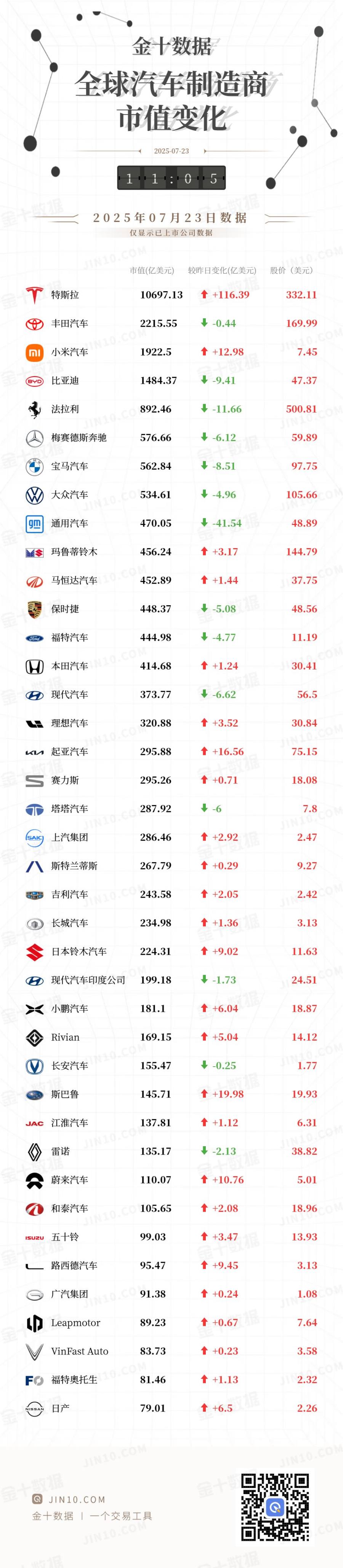
金十图示:2025年07月23日(周三)全球汽车制造商市值变化
news flash· 2025-07-23 03:07
Core Insights - The article presents the market capitalization changes of global automotive manufacturers as of July 23, 2025, highlighting significant fluctuations in values among various companies [1]. Group 1: Market Capitalization Changes - Volkswagen's market capitalization is reported at $534.61 billion, experiencing a decrease of $4.96 billion [3]. - General Motors shows a market cap of $470.05 billion, with a notable increase of $41.54 billion [3]. - Maruti Suzuki's market value stands at $456.24 billion, reflecting an increase of $3.17 billion [3]. - Mahindra & Mahindra has a market cap of $452.89 billion, with a slight increase of $1.44 billion [3]. - Porsche's market capitalization is $448.37 billion, down by $5.08 billion [3]. - Ford's market value is $444.98 billion, decreasing by $4.77 billion [3]. - Honda's market cap is $414.68 billion, with an increase of $1.24 billion [3]. - Hyundai's market capitalization is $373.77 billion, down by $6.62 billion [3]. - Li Auto's market value is $320.88 billion, reflecting an increase of $3.52 billion [3]. - Kia's market cap is $295.88 billion, with a significant increase of $16.56 billion [3]. - SAIC Motor's market capitalization is $286.46 billion, up by $2.92 billion [3]. - Geely's market value stands at $243.58 billion, with an increase of $2.05 billion [3]. - Great Wall Motors has a market cap of $234.98 billion, reflecting an increase of $1.36 billion [3]. Group 2: Emerging Players - Xpeng Motors has a market capitalization of $181.1 billion [4]. - Rivian's market value is reported at $169.15 billion, with an increase of $5.04 billion [4]. - NIO's market cap stands at $110.07 billion, reflecting an increase of $10.76 billion [4]. - Leapmotor's market value is $89.23 billion, with a slight increase of $0.67 billion [4]. - VinFast Auto has a market capitalization of $83.73 billion, showing a minor increase of $0.23 billion [4].






保时捷、福特、沃尔沃等多家车企紧急召回一批机动车
Hang Zhou Ri Bao· 2025-07-22 13:16
Group 1 - China FAW Group Corporation is recalling certain models of Jiefang vehicles due to safety hazards related to reflective markings and protective devices not meeting national standards [1][2][4] - The recall includes a total of 158 vehicles from the Qingdao base and 21 vehicles from the Changchun base, with issues such as poor reflective effects and inadequate protective installations [1][2] - The company will provide free inspections and replacements for the affected vehicles to eliminate safety risks [1][3] Group 2 - Anhui Jianghuai Automobile Group Co., Ltd. is recalling a total of 12 vehicles due to improperly fixed roof rods, which pose risks of overloading and rod detachment [6][7] - The recall also includes 10 vehicles with reflective markings that do not meet standards and 27 vehicles with inadequate side protection devices [6][7] - The company will conduct free inspections and necessary repairs to address these safety concerns [6][7] Group 3 - Beiqi Foton Motor Co., Ltd. is recalling 76 vehicles due to improperly fixed roof rods, which could lead to overloading and detachment risks [8][9] - The company will provide free reassembly and welding of the roof rods to mitigate safety hazards [9] Group 4 - China National Heavy Duty Truck Group is recalling 39 vehicles due to improperly fixed roof rods, with similar risks as noted in previous recalls [10][11] - The recall also includes 147 vehicles with reflective markings that do not meet standards and 10 vehicles with inadequate side protection devices [10][11] - The company will offer free replacements and repairs to ensure compliance with safety standards [10][11] Group 5 - Kawasaki Motors (Shanghai) Co., Ltd. is recalling 1,691 imported ZX636 motorcycles due to potential engine power loss from over-tightened crankshaft bolts [14] - The company will inspect and replace any damaged parts to eliminate safety risks [14] Group 6 - Ford Motor (China) Ltd. is recalling 2,264 Lincoln Navigator vehicles due to potential brake fluid leakage from interference between the brake line and air filter [15][16] - The recall also includes various models of Lincoln and Ford vehicles with software issues in the electric power steering system, which could lead to unexpected steering behavior [15][16] - The company will provide free inspections and necessary repairs to address these safety concerns [15][16] Group 7 - Porsche (China) Automobile Sales Ltd. is recalling 1,248 Panamera and Taycan series vehicles due to improperly installed front shock absorber clips, which could affect vehicle control [18] - The company will conduct inspections and repairs as needed to ensure safety [18]


12家整车上市公司2025半年业绩“交卷”,商用车企均“预喜”丨车市半年考⑤
Mei Ri Jing Ji Xin Wen· 2025-07-22 11:05
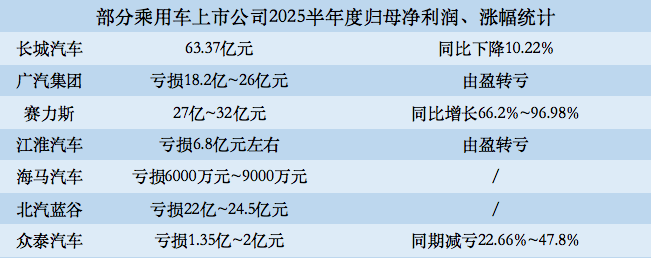
Core Insights - The automotive industry is experiencing a shift as companies disclose their 2025 semi-annual performance forecasts, serving as a test for their responsiveness to industry initiatives [1] - Among the 11 disclosed forecasts, 7 companies expect positive net profits, while 5 anticipate losses [1] Group 1: Passenger Vehicle Companies - Great Wall Motors is projected to have the highest net profit at 63.4 billion yuan, but with a decline of 10.2% year-on-year [2][3] - GAC Group and JAC Motors are expected to report significant losses, with GAC's loss estimated between 18.2 billion to 26 billion yuan, and JAC's loss around 6.8 billion yuan [3][6] - Seres is expected to achieve a net profit between 27 billion to 32 billion yuan, reflecting a substantial growth of 66.2% to 96.98% year-on-year, despite a 15.77% decline in sales volume [5][3] Group 2: Commercial Vehicle Companies - Commercial vehicle manufacturers generally report positive forecasts, with notable growth in net profits for companies like Foton Motor (7.76 billion yuan, up 87.5%) and King Long Motor (11.6 billion yuan, up 74.71%) [9][11] - The export market is a significant contributor to the performance of commercial vehicle companies, with a 10.8% increase in bus exports and a 10.5% increase in truck exports in the first half of 2025 [11] - Despite a projected profit of 1.8 million to 2.2 million yuan, FAW Jiefang anticipates a dramatic decline of 96.45% to 95.66% year-on-year due to intensified competition and market conditions [12]



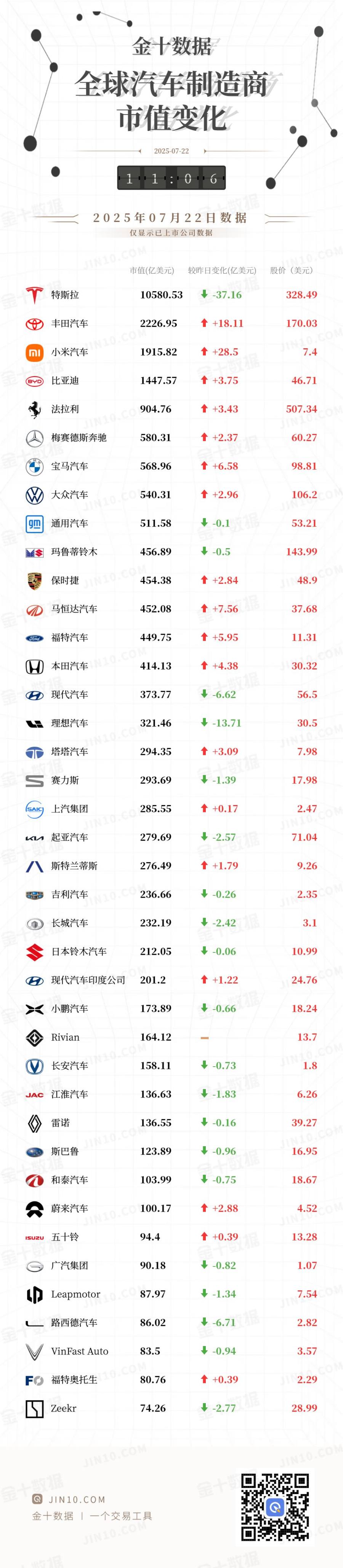
金十图示:2025年07月22日(周二)全球汽车制造商市值变化
news flash· 2025-07-22 03:12
Group 1 - The article presents the market capitalization changes of global automotive manufacturers as of July 22, 2025, highlighting significant fluctuations in their valuations [1][3][4] - Volkswagen leads with a market cap of $540.31 billion, showing an increase of 2.96% [3] - General Motors follows with a market cap of $511.58 billion, experiencing a slight decrease of 0.1% [3] - Other notable manufacturers include Maruti Suzuki at $456.89 billion, Porsche at $454.38 billion, and Mahindra & Mahindra at $452.08 billion, all showing varying percentage changes [3] Group 2 - The data indicates that Ford's market cap is $449.75 billion, reflecting a 5.95% increase [3] - Honda's market cap stands at $414.13 billion, with a 4.38% increase [3] - Hyundai's market cap is reported at $373.77 billion, showing a decrease of 6.62% [3] - Li Auto's market cap is $321.46 billion, with a significant drop of 13.71% [3] Group 3 - The article also lists other manufacturers such as Tata Motors at $294.35 billion and SAIC Motor at $285.55 billion, both showing slight increases [3] - Kia's market cap is $279.69 billion, reflecting a decrease of 2.57% [3] - The report includes smaller manufacturers like Xpeng Motors at $173.89 billion and Rivian at $164.12 billion, with no percentage changes reported [4]

中证中小国企改革指数报2142.46点,前十大权重包含江淮汽车等
Sou Hu Cai Jing· 2025-07-21 15:38
Core Viewpoint - The China Small and Medium State-Owned Enterprise Reform Index has shown significant growth, reflecting the overall performance of small and medium-sized state-owned enterprises undergoing reform [1][2]. Group 1: Index Performance - The China Small and Medium State-Owned Enterprise Reform Index reported a rise of 9.43% over the past month, 10.19% over the last three months, and 5.02% year-to-date [1]. - The index is based on companies that are part of state-owned enterprise reform initiatives and has a base date of December 31, 2013, with a starting point of 1000.0 [1]. Group 2: Index Composition - The top ten holdings in the index include Jianghuai Automobile (3.32%), China Rare Earth (3.13%), Yuntianhua (3.08%), Huagong Technology (3.0%), China Great Wall (2.8%), Western Superconducting (2.52%), AVIC High-Tech (2.39%), Goldwind Technology (2.22%), Siwei Technology (2.15%), and Shanghai Beiling (2.08%) [1]. - The index's holdings are primarily listed on the Shanghai Stock Exchange (53.60%) and Shenzhen Stock Exchange (46.40%) [1]. Group 3: Industry Breakdown - The industry composition of the index shows that industrials account for 43.54%, materials for 19.90%, information technology for 16.05%, consumer staples for 5.47%, consumer discretionary for 4.41%, utilities for 3.96%, real estate for 2.66%, healthcare for 2.54%, and communication services for 1.47% [2]. - The index samples are adjusted quarterly, with changes implemented on the next trading day following the second Friday of March, June, September, and December [2].
汽车行业2025年中期投资策略:产业升级,出海加速
Southwest Securities· 2025-07-21 12:46
Core Insights - The report highlights the acceleration of industrial upgrades and the expansion of the automotive industry into international markets, particularly focusing on smart and electric vehicles [1][3]. Smart Vehicles - Tesla's Full Self-Driving (FSD) feature is expected to enter the Chinese market, with the city Navigation on Autopilot (NOA) becoming a standard for advanced driving [4]. - The penetration rate of city NOA is projected to reach 12.2% by 2025, indicating rapid industry growth and benefiting related component manufacturers [4]. - The year 2025 is marked as the beginning of the Robotaxi era, with significant advancements from companies like Waymo and Tesla, creating vast market potential [4]. - New models and popular vehicles are expected to drive sales, with notable launches from brands like AITO and Xiaomi, indicating strong consumer interest [4]. New Energy Vehicles - The report forecasts that sales of new energy vehicles (NEVs) will reach 15.85 million units in 2025, with a penetration rate of 55% [4]. - In the first half of 2025, NEV sales reached 6.937 million units, a year-on-year increase of 40.3%, driven by supply chain improvements and favorable policies [4]. - The global expansion of Chinese automakers is anticipated to contribute significantly to industry growth, leveraging competitive advantages in cost and production capacity [4]. Commercial Vehicles - Heavy-duty truck sales are expected to reach 1.02 million units in 2025, supported by policies encouraging the replacement of older vehicles [4]. - The bus sector is also projected to grow, with sales of 526,000 units in 2024, reflecting a 6.9% increase year-on-year [4]. - The commercial vehicle market is benefiting from the renewal of old vehicles and the export of new energy buses [4]. Two-Wheelers - The electric two-wheeler segment is poised for growth due to favorable policies and the transition to new standards, with production expected to increase significantly [4]. - Motorcycle exports are also on the rise, with a 25% increase in the first half of 2025, driven by demand for larger displacement models [4]. Market Performance - The automotive sector has shown resilience, with a cumulative increase of 8.22% in the first half of 2025, outperforming other industries [7][22]. - The report notes a strong performance in commercial vehicles, with significant growth in both sales and exports [7][23]. Policy Support - The Chinese government continues to implement policies that support the automotive industry's transition to smart and electric vehicles, enhancing the overall market environment [57][59]. - Various initiatives are in place to promote the adoption of intelligent driving technologies and improve safety standards [58][60]. Investment Opportunities - The report identifies key investment targets across various segments, including smart vehicles, new energy vehicles, commercial vehicles, and two-wheelers, highlighting companies like BYD, Changan, and Aima Technology as potential beneficiaries of industry trends [6].





头部企业积极响应政策,主动召回商用车消除安全隐患!
第一商用车网· 2025-07-21 09:54
Core Viewpoint - A significant initiative to eliminate user safety hazards is being implemented across the commercial vehicle sector, highlighted by the recent recall announcements from the State Administration for Market Regulation [1][3]. Group 1: Recall Announcements - On July 16, 2025, the State Administration for Market Regulation issued six announcements regarding recalls in the commercial vehicle sector, urging manufacturers to address defective vehicles [1][2]. - The recall involves ten manufacturers, including Dongfeng Commercial Vehicle, FAW Jiefang, Anhui Jianghuai Automobile, Foton Motor, and China National Heavy Duty Truck Group, affecting 56 models and 1,675 vehicles [3][4]. Group 2: Safety Issues and Manufacturer Response - The defects primarily relate to safety standards, including issues with protective devices, roof rods, reflective markings, and driver seat exit alerts, which do not meet mandatory safety requirements [3][4]. - Manufacturers have engaged in technical exchanges with regulatory authorities and conducted self-inspections, leading to proactive recalls to eliminate safety defects and reduce risks from the source [3][4]. Group 3: Impact on Stakeholders - The proactive recall actions by leading companies in the commercial vehicle sector demonstrate a commitment to public safety and corporate responsibility, enhancing consumer confidence in the market [4]. - The recall will directly improve driving safety for vehicle owners and drivers, while the provision of free repair services will lower costs for users and strengthen brand trust [4].
穿越产业周期安徽懂“科创”更懂“生态”
Zhong Guo Fa Zhan Wang· 2025-07-21 07:55
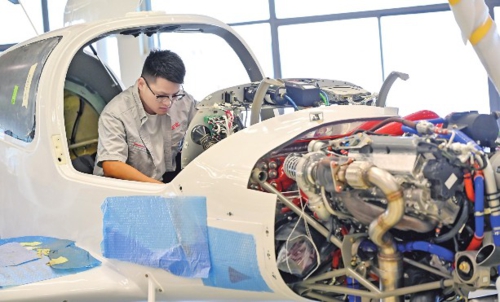
在位于安徽省芜湖市湾沚区的中电科芜湖钻石飞机制造有限公司内,工作人员在装配一架通航飞机。新 华社 中国发展改革报社记者 | 陈雯 张海帝 王健生 王传福带领比亚迪革新行业标准、尹同跃率奇瑞车队远征海外、李斌提出换电网络重塑出行模式、余承 东以鸿蒙智驾引爆市场热潮……这些改写全球新能源汽车版图的领军者,都有着"安徽籍"的创新基因。 合肥打造量子计算、人工智能等未来产业集群,芜湖低空经济产业园"不出园区造通航飞机",铜陵铜基 新材料向高端化、智能化、绿色化转型升级,蚌埠建成全国领先的MEMS晶圆生产线——这些产业矩阵 的培育,都离不开安徽"科创+生态"的底层逻辑。 是什么让安徽既能在新赛道上抢占先机,也能在传统产业升级中焕发新生?近日,本报记者跟随"活力 中国调研行"主题采访活动赴合肥、芜湖、蚌埠等多地深度调研,探寻拥有优质科创基因的安徽在现代 化产业体系建设过程中的实践经验。 产业数据: 安徽的"高光时刻" 数据印证着安徽的产业爆发力。安徽省发展改革委发布数据显示,2024年,全省汽车产量达357万辆, 占全国比重超1/9;新能源汽车产量首次跨越百万大关至168.4万辆,占全国比重超1/8。合肥集聚江淮、 比亚 ...


中际旭创上周获融资资金买入超88亿元丨资金流向周报
2 1 Shi Ji Jing Ji Bao Dao· 2025-07-21 03:12
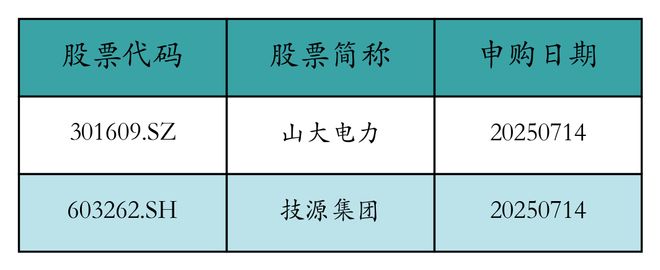
Market Overview - The Shanghai Composite Index rose by 0.69% to close at 3534.48 points, with a weekly high of 3536.01 points [1] - The Shenzhen Component Index increased by 2.04% to 10913.84 points, reaching a high of 10946.4 points [1] - The ChiNext Index saw a rise of 3.17%, closing at 2277.15 points, with a peak of 2296.91 points [1] - In the global market, the Nasdaq Composite Index increased by 1.51%, while the Dow Jones Industrial Average fell by 0.07% and the S&P 500 rose by 0.59% [1] - In the Asia-Pacific region, the Hang Seng Index rose by 2.84% and the Nikkei 225 Index increased by 0.63% [1] New Stock Issuance - Two new stocks were issued last week: Shanda Electric Power (301609.SZ) and Jiyuan Group (603262.SH), both on July 14, 2025 [2] Margin Trading - The total margin trading balance in the Shanghai and Shenzhen markets reached 18964.13 billion yuan, with a financing balance of 18832.44 billion yuan and a securities lending balance of 131.68 billion yuan [3] - The margin trading balance increased by 265.22 billion yuan compared to the previous week [3] - The Shanghai market's margin trading balance was 9613.62 billion yuan, up by 143.67 billion yuan, while the Shenzhen market's balance was 9350.51 billion yuan, increasing by 121.55 billion yuan [3] - A total of 3442 stocks had margin buying, with 89 stocks exceeding 1 billion yuan in buying amount, led by Zhongji Xuchuang (88.2 billion yuan), Xinyi Sheng (80.46 billion yuan), and Dongfang Caifu (62.35 billion yuan) [3][4] Fund Issuance - Sixteen new funds were issued last week, including various types such as mixed funds, bond funds, and money market funds [5] Share Buybacks - Seventeen companies announced share buybacks last week, with the highest amounts being TCL (2.5 billion yuan), Hangyang Co. (60.36 million yuan), and Yanshan Technology (59.99 million yuan) [7] - The sectors with the highest buyback amounts were electronics, basic chemicals, and computers [7]





90万元起征、二手车全免!超豪华车消费税7月20日起调整
Hua Xia Shi Bao· 2025-07-19 03:05
Core Viewpoint - The Ministry of Finance and the State Taxation Administration announced an adjustment to the consumption tax policy for ultra-luxury cars, lowering the threshold from 1.3 million yuan to 900,000 yuan (excluding VAT) for various types of passenger and light commercial vehicles [1][2]. Group 1: Policy Changes - The consumption tax threshold for ultra-luxury cars has been reduced from a retail price of 1.3 million yuan to 900,000 yuan, expanding the scope to include all types of powertrains, including pure electric and fuel cell vehicles [2][3]. - The new policy aims to reflect market changes and ensure tax stability, with experts suggesting that the adjustment is reasonable and aligns with market promotions [1][3]. Group 2: Market Impact - The ultra-luxury car market is relatively small, and the impact of the expanded tax range is expected to be minimal, as the price sensitivity to taxes in this segment is low [3]. - Sales data indicate that in the first half of 2025, 3,700 units of new cars priced at 900,000 yuan were sold, with only 214 being exempt electric models [3]. Group 3: Consumer Response - Consumers have responded positively to the policy change, with reports of increased interest in purchasing vehicles just above the new tax threshold [5][6]. - The policy also clarifies that no consumption tax will be levied on the sale of second-hand ultra-luxury cars, which is expected to stimulate the high-end used car market [6][7]. Group 4: Market Performance - Following the announcement, the automotive sector in the A-share market saw a rise, with stocks like Jianghuai Automobile and BYD experiencing gains [7].