KWEICHOW MOUTAI(600519)

Search documents
中国白酒追踪器_2026 年农历新年零售销售略好于预期;茅台、五粮液领衔的超高端品类表现强劲-China Spirits Tracker_ 2026 LNY retail sales slightly better than expected; Resilient super premium with Moutai-Wuliangye
2026-02-24 14:16
Summary of Key Points from the Conference Call Industry Overview - The conference call focuses on the **Chinese spirits industry**, particularly during the **2026 Lunar New Year (LNY)** period, highlighting retail sales trends and brand performances. Key Insights and Arguments 1. **LNY Consumption Sentiment**: - Pax mobility during the LNY holiday increased by approximately **9% year-over-year (yoy)**, with a total of **5.3 billion** trips recorded during the Chunyun window from February 2 to 20 [1] - Strong homecoming flows led to robust on-premise activity, with daily average sales of key retail and catering enterprises rising by **10.6% yoy** over the first two holiday days and **8.6% yoy** in the first four days [1] 2. **Retail Trends**: - Overall spirits retail demand declined by **10-15% yoy**, influenced by a high base from 2025, but the trend stabilized compared to the decline seen during the Mid-Autumn festivals [2] - Super-premium brands like **Moutai** and **Wuliangye** showed resilience, with **Feitian** sell-through up by **10-20%+ yoy** and **Common Wuliangye** recovering to near 2024 LNY volumes [2] 3. **Brand Performance**: - **39-degree Wuliangye** achieved double-digit retail sales growth, while **Fen wine's Bofen** and regional brands like **Yingji's Dongcang 6** performed well due to banquet trends [2] - Mass-market SKUs priced under **RMB 300** per bottle outperformed, particularly those under **RMB 100**, which saw positive retail growth [2] 4. **Pricing Trends**: - Wholesale prices for super-premium brands trended stronger, with **Feitian original case** wholesale price increasing by **RMB 160-195/bottle** year-to-date [2] - Significant pricing pressure was observed for SKUs priced between **RMB 600-800**, with **Junpin Xijiu** wholesale price dropping below **RMB 600** [2] 5. **Post-LNY Factors to Monitor**: - The trajectory of wholesale prices into the Lantern Festival slack period, especially for super-premium SKUs [2] - Retail channel replenishment orders over the next two weeks as holiday sell-through data becomes clearer [2] - Distributor prepayment progress, which is currently slower than the pace seen in 2025 LNY, except for Moutai, which is at **35-40%** [2] Additional Important Insights 1. **Regional Performance**: - Regions like **Sichuan** and **Henan** showed relative resilience, with retail sales down approximately **10%**, driven by super-premium brands amid banquet and gifting demand recovery [7] - **Anhui** mass-market products under **RMB 200** performed solidly due to banquet demand, with a **15% yoy decline**, which was better than pre-LNY expectations [7] 2. **Consumption Scenarios**: - Banquet and family-gathering occasions drove incremental volume, while gifting remained strong only for top-tier brands [8] - Commercial and government-related consumption remained at a structural low, putting sustained pressure on mid-tier brands [8] 3. **Wholesale Price Summary**: - Original case **Feitian Moutai** wholesale price increased by **RMB 10** to **RMB 1,700**, while **Common Wuliangye** and **Guojiao 1573** prices remained stable [9] 4. **Market Dynamics**: - The spirits market is experiencing a **dumbbell trend**, favoring super-premium and mass-market segments while the upper-mid segment remains weak [2] 5. **Valuation and Risks**: - The report outlines various valuation methodologies and key risks for major companies in the spirits sector, including potential regulatory changes and competition dynamics [45] This summary encapsulates the critical insights from the conference call, providing a comprehensive overview of the current state and trends within the Chinese spirits industry during the 2026 Lunar New Year period.






白酒春节动销符合预期,分化延续
INDUSTRIAL SECURITIES· 2026-02-24 14:13
Investment Rating - The industry investment rating is maintained as "Recommended" [1] Core Insights - The sales performance of liquor during the Spring Festival met expectations, with high-end products showing strong performance while mass-market segments remained stable. Overall sales declined by 10-20%, with regional variations noted [1] - Moutai's market-oriented reforms are showing initial positive effects, with significant user growth and improved sales data. The company is focusing on consumer-centric strategies and enhancing its direct sales system [1] - Other brands are experiencing continued differentiation, with first and second-tier brands performing relatively steadily. Strategies include rational inventory reduction and promotional sales [1] - Looking ahead, the post-festival season may see a bottoming out of prices, with potential improvements expected in Q2 due to low comparative bases from the previous year [1] Summary by Sections Sales Performance - Spring Festival liquor sales declined by 10-20%, with high-end products performing well and mass-market segments remaining stable. Specific regions like Henan and Sichuan saw around a 10% decline, while Shandong and Anhui experienced about a 20% drop [1] - Different price segments showed varied performance, with high-end products like Moutai performing strongly, while mid-tier products faced significant pressure [1] Moutai's Market Reforms - Moutai's consumer-focused market reforms are yielding positive results, with a notable increase in users and sales orders. The company is effectively managing its inventory and pricing strategies [1] Brand Differentiation - The liquor industry is seeing a continuation of brand differentiation, with first and second-tier brands maintaining stable performance. Strategies include inventory reduction and promotional activities to stimulate sales [1] Future Outlook - The industry is expected to enter a traditional consumption off-season post-Spring Festival, with potential price stabilization and improvements anticipated in Q2. The upcoming Mid-Autumn Festival will be a critical period for assessing demand recovery [1]
三部门联合推动 酒业“十五五”行动密码在哪儿
Bei Jing Shang Bao· 2026-02-24 13:45
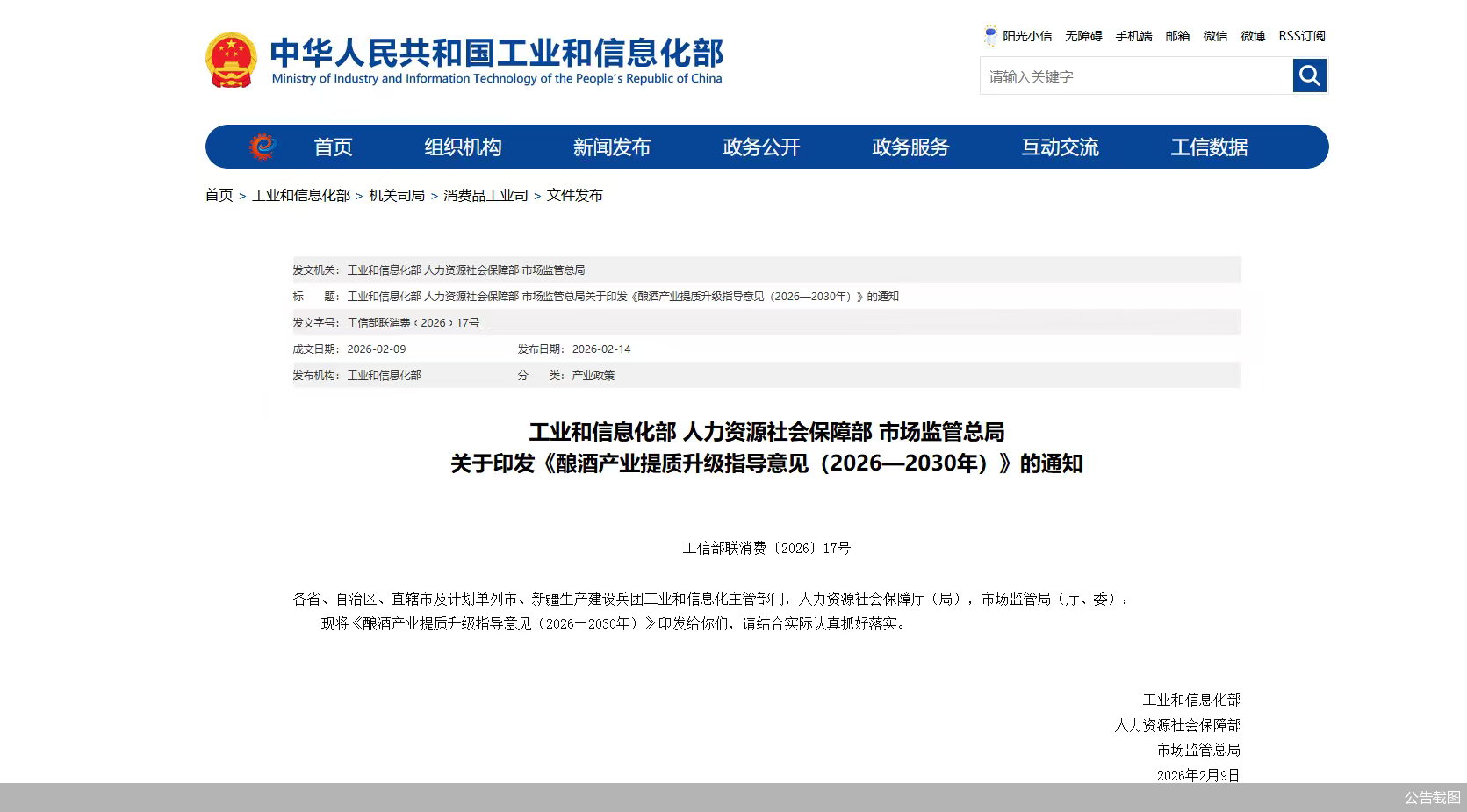
Core Viewpoint - The Chinese liquor industry has officially embarked on a five-year path of high-quality development, guided by the "Guidance on Quality Improvement and Upgrading of the Brewing Industry (2026-2030)" issued by three government departments, outlining 21 key tasks across seven major areas [1] Group 1: Upstream Supply Chain Management - The guidance emphasizes the importance of enhancing the supply of brewing raw materials and shifting from a "procurement mindset" to a "planting mindset" [4] - It highlights the need to strengthen the cultivation and promotion of specialty brewing raw materials such as sorghum, barley, and wine grapes, and encourages collaboration between universities, research institutions, and enterprises for high-yield, flavor-rich varieties [4][5] - Major liquor companies are accelerating their strategic layout in raw material bases, with examples like Fenjiu establishing over 1.4 million acres of raw grain bases nationwide [4] Group 2: Smart Brewing Transformation - The guidance identifies "promoting intelligent transformation" as a key task, supporting the application of artificial intelligence in various production processes [6] - Companies like Wuliangye and Gujing Gongjiu are implementing smart manufacturing solutions, enhancing efficiency and accuracy in production through advanced technologies [7] - The future of intelligent brewing is expected to evolve from point automation to full-chain intelligence, allowing for real-time adjustments based on environmental changes [8] Group 3: Downstream Market Dynamics - The guidance encourages innovation in sales models, promoting a shift from traditional wholesale to brand agency and chain operations, while supporting new business formats like community e-commerce and live streaming [8] - The instant retail market for liquor has surpassed 50 billion yuan in 2024, with a growth rate exceeding 35%, indicating a shift in consumer purchasing behavior towards online platforms [9] - The industry is focusing on direct consumer engagement through new channels, breaking reliance on traditional distribution networks [9][10]

白酒股节后无缘“开门红”,春节动销整体下滑但符合预期,机构看好后市复苏
Mei Ri Jing Ji Xin Wen· 2026-02-24 11:35
Core Viewpoint - The Chinese liquor industry is currently experiencing a period of adjustment due to weak demand and inventory pressure, but many investment institutions are optimistic about a marginal recovery by 2026, particularly for high-end brands like Moutai, which are seen as anchors of market confidence [1][4]. Group 1: Market Performance - The Wande Liquor Index fell by 1.32% on the first trading day of the Lunar New Year, with several stocks dropping over 2%, and the index has accumulated a decline of 3.67% year-to-date [1]. - Despite overall sales pressure, high-end brands such as Moutai and Wuliangye showed resilience, with Moutai's wholesale price stabilizing around 1700 yuan per bottle, reflecting a 70 yuan increase from early February and a 150 yuan increase since the beginning of the year [3][4]. Group 2: Sales Trends - High-end liquor sales during the Spring Festival met expectations, with Moutai and Wuliangye achieving double-digit growth, while mid-tier brands faced challenges [2][3]. - The overall retail demand for liquor saw a double-digit decline compared to the previous year, but this decline was less severe than the drop observed during the 2025 Mid-Autumn Festival [2][3]. Group 3: Industry Outlook - Investment institutions believe the liquor sector has reached a cyclical bottom, with signs of recovery in channel sentiment and expectations for improved market conditions in 2026 [4][5]. - The stabilization of Moutai's price is significant for the entire industry's pricing structure, potentially alleviating pressure on mid-tier and high-end liquor prices and supporting valuation recovery [4][5]. - The recovery path for the industry is expected to be structurally distinct, with a focus on high-end banquet and business demand, while mid-tier and regional brands may take longer to recover [5].
食品饮料春节动销总结:餐饮链超预期,茅五起势,消费韧性强
CAITONG SECURITIES· 2026-02-24 10:56
Investment Rating - The industry investment rating is "Positive" (maintained) [1][12] Core Insights - Overall industry sales performance slightly exceeded expectations; liquor met expectations while the restaurant chain outperformed [4] - The food and beverage sector showed strong sales during the Spring Festival, with a positive outlook for post-holiday inventory replenishment [7] Summary by Category - **Liquor**: Overall performance met expectations, with a projected decline in single to double digits. Notable performances from Guizhou Moutai and Wuliangye, while real estate liquor brands like Yingjia Gongjiu and Jinhui Jiu performed better [4] - **Snacks**: Maintained good sales during the Spring Festival, with double-digit growth expected. High-end gift boxes performed well, although high-priced gift boxes showed weaker sales. Positive feedback from bulk snack channels [4] - **Restaurant Chain**: B-end performance of condiments exceeded pre-holiday expectations, with overall sales expected to grow by double digits. Leading frozen food company Anjijia performed exceptionally well [4] - **Dairy Products**: Sales during the Spring Festival showed recovery, with liquid milk returning to positive growth and significant improvements in freshness, while price competition has eased [5] Investment Recommendations - Focus on the restaurant chain, followed by snacks and certain liquor brands. Recommended liquor stocks include Guizhou Moutai, Wuliangye, Yingjia Gongjiu, and Jinhui Jiu. For consumer goods, recommended stocks include Anjijia, Angel Yeast, Yihai International, Weidong, and Wancheng Group [7]
「数据看盘」多路资金联手抢筹深南电路,顶级游资扎堆通源石油
Sou Hu Cai Jing· 2026-02-24 10:27
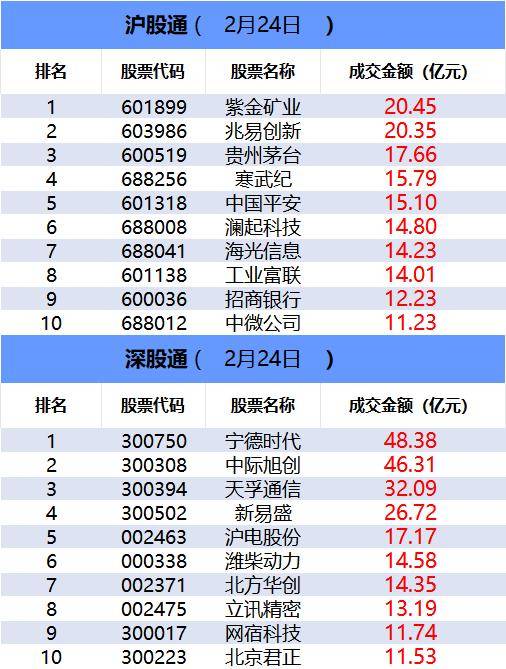
Market Overview - The stock market saw significant activity with deep South Circuit's strong performance, closing at the daily limit with institutional purchases totaling 96.32 million and a deep stock connection buying 413 million [1][12] - Oil and gas stocks led the market, with Tongyuan Petroleum hitting the daily limit and attracting a total of 154 million from three major institutional investors [1][13] Trading Volume - The total trading volume for the Shanghai Stock Connect was 145.275 billion, while the Shenzhen Stock Connect reached 171.886 billion [2] Top Stocks by Trading Volume - In the Shanghai Stock Connect, the top traded stocks included Zijin Mining at 2.045 billion, followed by Zhaoyi Innovation at 2.035 billion and Kweichow Moutai at 1.766 billion [3] - In the Shenzhen Stock Connect, the leading stocks were CATL at 4.838 billion, followed by Zhongji Xuchuang at 4.631 billion and Tianfu Communication at 3.209 billion [3] Sector Performance - The oil and gas, precious metals, cultivated diamonds, and chemical sectors showed the highest gains, while the film and television, AI applications, and other sectors experienced declines [4] Fund Flow Analysis - The non-ferrous metals sector saw the highest net inflow of funds, while the computer sector experienced the largest net outflow, totaling -12.407 billion [6] - The top stocks with net inflows included Zhongji Xuchuang at 2.218 billion and Huagong Technology at 1.33 billion [7] - Conversely, the stocks with the highest net outflows included Huasheng Tiancai at -1.638 billion and Dazhi Technology at -1.532 billion [8] ETF Trading - The top ETFs by trading volume included A500 ETF Fund at 8.3719 billion, Gold ETF at 8.2416 billion, and A500 ETF Huatai at 7.9285 billion [9] - The ETFs with the highest growth in trading volume compared to the previous trading day included S&P Oil and Gas ETF at 1.5465 billion, showing a 367.86% increase [10] Futures Market - In the futures market, the main contracts for IH, IF, and IC saw both long and short positions decrease, while the IM contract saw an increase in short positions [11]




白酒、乳业、中式滋补的2025:崩盘、变局与增长新逻辑
Xin Lang Cai Jing· 2026-02-24 09:02
Core Viewpoint - The traditional business model of the liquor industry, particularly in the high-end white liquor segment, is failing, leading to a collapse of the pricing system and the emergence of new business models and consumer behaviors driven by the Z generation [3][4][14]. Industry Overview - In 2025, the Chinese consumer market is undergoing profound changes, with high-end liquor prices, such as those of Moutai, continuously declining, raising questions about their investment and stockpiling attributes [3][4][14]. - The Z generation (born between 1995 and 2009) has become the main consumer force, reshaping market rules and consumer preferences [3][4][14]. Pricing and Sales Performance - The prices of major white liquor products have significantly dropped, with Moutai's wholesale price falling from over 2200 yuan per bottle at the beginning of the year to below 1500 yuan by December 2025 [5][16]. - The overall performance of white liquor companies has deteriorated, with 20 A-share listed companies reporting a combined revenue of 317.78 billion yuan, a year-on-year decrease of 5.90%, and a net profit drop of 6.93% [5][17]. Corporate Strategies and Changes - Many liquor companies are experiencing frequent personnel changes, with over ten major companies, including Moutai and Yanghe, adjusting their core leadership positions in 2025 [6][18]. - Companies are exploring new business models and channels, such as switching from a "payment before delivery" to a "delivery before payment" model [8][20]. New Business Models - Moutai has announced a restructuring of its product system and pricing strategy, moving towards a direct sales model through its app, aiming to connect directly with consumers [9][20]. - The rise of "health liquor" has been notable, with a growth rate of 66%, indicating a shift in consumer preferences towards healthier options [10][21].

春节后首个交易日 贵州茅台1466.80元/股收盘
Bei Jing Shang Bao· 2026-02-24 08:41
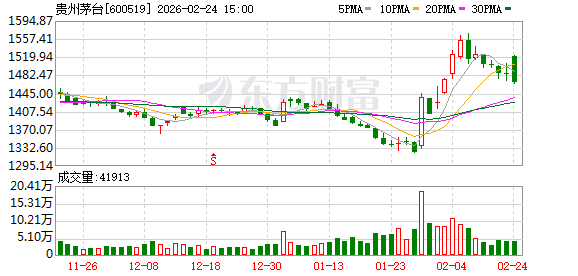
Group 1 - The Shanghai Composite Index closed at 4117.41 points, up 0.87%, while the liquor sector saw a slight increase of 0.27% to 2223.20 points, despite 14 liquor stocks declining [2] - Major liquor stocks such as Kweichow Moutai, Wuliangye, Shanxi Fenjiu, Luzhou Laojiao, and Yanghe all experienced price drops, with Kweichow Moutai closing at 1466.80 CNY per share, down 1.25% [2] Group 2 - Guosheng Securities reported a robust recovery in the 2026 Spring Festival season, highlighting structural repair and significant downward pressure on leading brands, with "Moutai and Wuliangye" sales exceeding expectations and showing year-on-year growth [3] - The demand landscape indicates a recovery in high-end gifting and casual drinking, while business banquets and group purchases remain under pressure; high-end and real estate liquor are the main sales drivers, with mid-range liquor sales slowing [3] - The supply side shows liquor companies exploring diversified business models and innovative marketing strategies for the Spring Festival, increasingly embracing social media and focusing on "ready-to-drink" and "instant" consumption scenarios [3]
东方证券:白酒周期尾部去库加速 业绩下修对股价拖累逐步弱化
智通财经网· 2026-02-24 08:37
Group 1 - The core viewpoint is that the white liquor industry has experienced a significant sales decline of nearly 20% since early 2026, with a more severe drop of 20%-25% when excluding Moutai [1][2] - The average price of white liquor products, excluding Moutai, has decreased by 10% year-on-year, while sales volume has dropped by 15%, indicating that volume is a major drag on overall performance [2][3] - The industry is currently in a passive destocking phase, with some brands showing accelerated inventory reduction in Q1 2026, but reaching the inventory bottom will take time due to the absence of business and government consumption scenarios [1][3] Group 2 - The white liquor sector is undergoing a transformation where family and daily consumption is becoming more rigid, and companies are shifting their focus from scale to channel profitability [3] - The market is expected to confirm the bottom of white liquor performance with the Q1 2026 reports, suggesting that the negative impact of performance downgrades on stock prices will diminish by 2026 [4] - The investment recommendation includes top companies like Shanxi Fenjiu, Guizhou Moutai, and Wuliangye, as well as regional leaders and flexible stocks, indicating a shift towards companies with strong market positions [5]

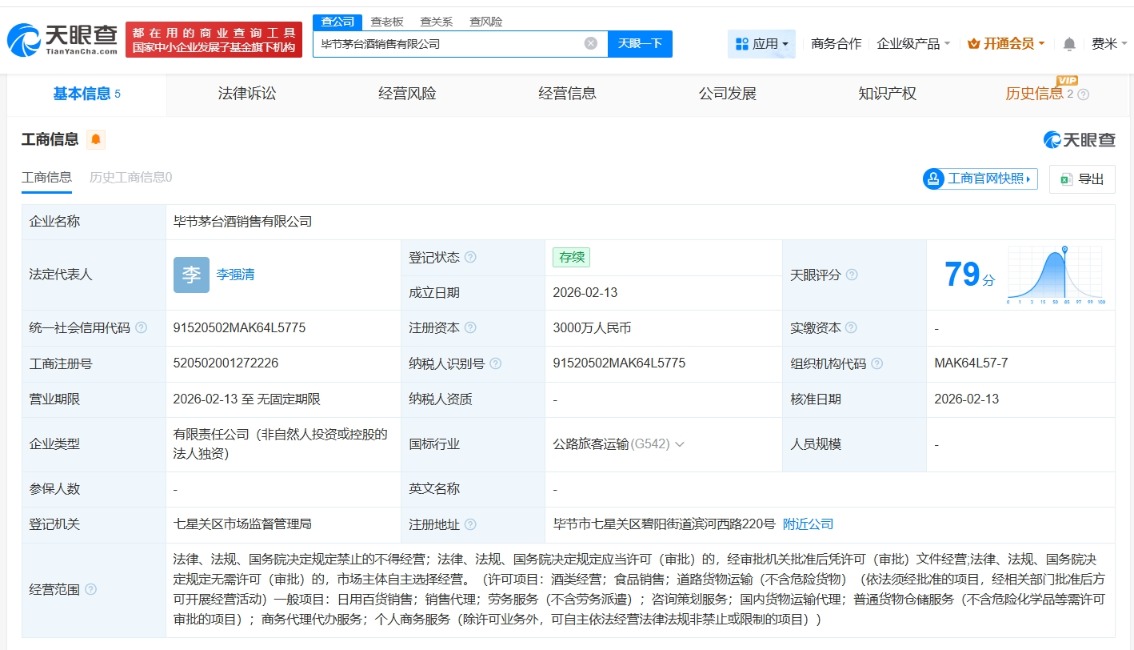
贵州茅台在毕节成立销售公司
Mei Ri Jing Ji Xin Wen· 2026-02-24 07:01
Core Insights - Bijie Moutai Wine Sales Co., Ltd. has been established with a registered capital of 30 million RMB, fully owned by Guizhou Moutai Wine Sales Co., Ltd. [1] Group 1: Company Information - The legal representative of Bijie Moutai Wine Sales Co., Ltd. is Li Qiangqing [1] - The company is registered with a capital of 30 million RMB and is involved in the sale of alcoholic beverages, food sales, and road cargo transportation [1] - The company is classified as a limited liability company and is registered under the jurisdiction of the Qixingguan District Market Supervision Administration [2] Group 2: Business Scope - The business scope includes the sale of alcoholic beverages, food sales, and road cargo transportation (excluding hazardous materials) [2] - The company is permitted to engage in various business activities, including daily necessities sales, sales agency, labor services (excluding labor dispatch), consulting and planning services, domestic cargo transportation agency, and ordinary cargo storage services [2]