HAIER SMART HOME(600690)

Search documents
“多元化+全球化”支撑家电三巨头业绩显韧性
Zheng Quan Ri Bao Zhi Sheng· 2025-08-31 17:08
Core Viewpoint - The home appliance industry in China demonstrates strong resilience and vitality amid a complex global economic environment, with the performance of the three major players serving as a key indicator of industry development [1] Group 1: Financial Performance - Midea Group achieved revenue of 252.3 billion yuan and a net profit of 26 billion yuan in the first half of the year, representing year-on-year growth of 15.7% and 25% respectively [1] - Haier Smart Home reported revenue of 156.49 billion yuan and a net profit of 12.03 billion yuan, with year-on-year growth of 10.22% and 15.59%, both reaching historical highs [1] - Gree Electric's revenue decreased by 2.46% to 97.33 billion yuan, but net profit increased by 1.95% to 14.41 billion yuan [1] Group 2: Business Diversification - Midea Group's smart home business revenue grew by 13.31% to 167.2 billion yuan, accounting for 66.58% of total revenue; its new energy and industrial technology businesses generated 64.5 billion yuan, up nearly 21%, making up 25.7% of total revenue [2] - Gree Electric's diversified business expansion led to industrial products and green energy revenue of 9.59 billion yuan and smart equipment revenue of 314 million yuan, with year-on-year growth of 17.13% and 20.9%, respectively, accounting for about 10.17% of total revenue [2] - Haier Smart Home's equipment and channel service revenue reached 18.72 billion yuan, growing nearly 35% and representing about 12% of total revenue [3] Group 3: International Expansion - Midea Group's overseas revenue was 107.19 billion yuan, Haier Smart Home's overseas revenue was 79.08 billion yuan, and Gree Electric's overseas revenue was 16.34 billion yuan, with year-on-year growth of 17.70%, 11.70%, and 10.19% respectively [3] Group 4: R&D Investment - Midea Group invested 8.76 billion yuan in R&D, an increase of 14.41% year-on-year; Haier Smart Home's R&D investment was 5.79 billion yuan, up 11.73%; Gree Electric's R&D investment reached 3.89 billion yuan, growing by 7.05% [3] Group 5: Strategic Focus - The home appliance giants are initiating a "value war" centered on technological innovation, scenario experience, and global layout, expanding their scale advantages while solidifying profit foundations and advancing channel transformation [4]



中国家电板块_估值具吸引力,等待基本面转机
2025-08-31 16:21
Summary of the Conference Call on China Home Appliance Sector Industry Overview - The China home appliance sector is favored due to its diversified product and geographic exposure, high and stable profitability, and strong management and execution [2][25] - It is one of the most cyclical sectors within the China consumer universe, alongside agrifood, luxury, and durables [2][25] Key Financial Metrics - Year-to-date, the share prices of the big and small home appliance sectors have increased by 1% and 41% respectively, compared to the SHSZ300 index which is up 13% [2] - Retail sales for the home appliance sector increased by 30.4% year-over-year (yoy) for the first seven months of 2025, significantly outpacing overall retail sales growth of 4.8% yoy [5][9] - The sector is projected to trade at 11.8x and 23.3x 2025E P/E for big and small appliances respectively, and 10.5x and 19.5x for 2026E P/E [2] Sales and Subsidy Insights - Approximately 90% of total sales are attributed to consumer purchases benefiting from trade-in subsidies, with an estimated total trade-in sales of RMB 272 billion and total subsidies paid of RMB 54 billion [10][11] - The full-year subsidy budget for 2025 is estimated to be between RMB 80-100 billion, which is expected to support strong sales through the end of 2025, although growth may slow to single-digit or negative rates [5][11] Production Adjustments - Brands are beginning to cut production plans in anticipation of slowing demand, with air-conditioning production plans lowered to 8.1% yoy for July and -11.9% yoy for August [5][16][17] - This trend is also observed in other categories such as refrigerators and washing machines [17] Future Outlook - The fourth quarter of 2025 is expected to be the worst for the sector, with deteriorating industry data likely to pressure share prices [26] - A normalization of domestic demand, an increase in overseas sales, an extension of stimulus policies, and recovery in the property and macroeconomic sectors are anticipated to lead to a fundamental improvement and valuation re-rating for the sector [26] Company Ratings and Price Targets - **Haier Smart Home Co Ltd - H**: Outperform (OW) with a price target of HKD 32.00 [3] - **Roborock Technology - A**: OW with a price target of CNY 270.00, showing a turnaround story with significant growth expected [11] - **Midea Group - A**: Neutral (N) with a price target of CNY 80.00, reflecting strong fundamentals [11] - **Gree Electric Appliances - A**: N with a price target of CNY 50.00, facing market share loss [11] - **Ecovacs Robotics - A**: N with a price target of CNY 82.00, valuation considered stretched [11] Additional Insights - The historical performance of the home appliance sector indicates that after periods of strong growth, sales can decline significantly, as seen in past trade-in subsidy programs [22] - Major players are proactively expanding overseas to support long-term sustainable growth despite domestic challenges [22] This summary encapsulates the key points from the conference call regarding the China home appliance sector, highlighting its current performance, challenges, and future outlook.


海尔智家2Q25盈利超预期,运营效率持续改善;史上首次中期股息
2025-08-31 16:21
Summary of Haier Smart Home Conference Call Company Overview - **Company**: Haier Smart Home (formerly Qingdao Haier) - **Industry**: Home Appliances - **Market Position**: One of the largest home appliance manufacturers globally, with a focus on smart home solutions and a diverse brand portfolio including Haier, Casarte, Leader, GEA, Candy, Fisher & Paykel, and AQUA [11][22]. Key Financial Highlights - **1H25 Performance**: - Revenue: 156 billion RMB, up 10% YoY - Net Profit: 12 billion RMB, up 16% YoY - 2Q25 Revenue and Net Profit growth: 10% and 16% YoY, respectively, with profits exceeding expectations due to better overseas operating margins [1][2]. - **Domestic and International Growth**: - Domestic revenue growth driven by high-end brand Casarte (over 20% YoY) and budget brand Leader (over 15% YoY) due to demand stability from trade-in subsidies and retail reforms initiated since 3Q24. - Internationally, GEA's revenue grew 2% YoY, outperforming the industry, with other markets achieving double-digit growth [2]. - **Operational Efficiency**: - Gross margin improved by 0.1 percentage points, and SG&A expenses decreased by 0.1 percentage points, attributed to digitalization and retail transformation efforts. - Operating profit margins improved across all regions, particularly in Europe (from losses to near breakeven) and the U.S. (despite tariff pressures) [2]. - **Dividend Announcement**: - The company declared its first-ever interim dividend of 2.5 billion RMB, equating to 0.269 RMB per share, which is part of a commitment to distribute at least 50% of annual profits as dividends [2]. Future Outlook - **Guidance**: The company previously guided for revenue growth in the low to high single digits. A detailed financial report will be presented in a conference call scheduled for August 29 [3]. Valuation and Investment Rating - **Target Price**: Maintained at 30.00 RMB, with a buy rating based on a DCF valuation implying a 13x PE for 2026E and a projected CAGR of 5% for EPS from 2025 to 2027, alongside a dividend yield of 5% [4][10]. Market Data - **Current Stock Price**: 25.78 RMB as of August 27, 2025 - **Market Capitalization**: 242 billion RMB (approximately 33.8 billion USD) - **52-week Price Range**: 33.12 - 23.58 RMB [5]. Important Metrics - **Projected Earnings**: - 2025E EPS: 2.21 RMB - 2026E EPS: 2.34 RMB - 2027E EPS: 2.45 RMB [7]. Risks and Challenges - Potential risks include weakening demand for refrigerators, slow adoption of smart appliances, and sustained high raw material costs [12]. Analyst Insights - The company received a score of 3 for industry structure outlook, indicating stability, and a score of 4 for regulatory environment improvement, suggesting favorable conditions ahead [14]. This summary encapsulates the key points from the conference call, highlighting Haier Smart Home's financial performance, operational strategies, future outlook, and market positioning.
空调价格战下的半年报:格力小米吵架,美的海尔得利
Di Yi Cai Jing· 2025-08-31 10:11
Core Viewpoint - The recent price war in the air conditioning market has led to a dispute between Gree and Xiaomi, while benefiting competitors like Midea and Haier. Industry experts suggest that diversification and flexibility are key to maintaining growth in this competitive landscape [2][3][5]. Company Performance - Gree Electric's stock fell by 5.88% to 42.6 CNY per share following its half-year report, which indicated revenue of 97.325 billion CNY, a 2.46% year-on-year decline, and a net profit of 14.412 billion CNY, a 1.95% increase. However, the net profit for Q2 dropped by 10% year-on-year [3][4]. - Gree's air conditioning revenue, which constitutes nearly 80% of its total revenue, decreased by 5.09% to 76.279 billion CNY in the first half of the year, despite an overall increase in domestic household air conditioning sales [3][4]. - Xiaomi's air conditioning shipments exceeded 5.4 million units in Q2, reflecting a growth rate of over 60% [5][7]. Market Dynamics - The online air conditioning market saw Midea's market share increase by 4.9 percentage points to 22.63% in May, while Gree's share decreased by 1.53 percentage points to 17.08%, and Xiaomi's share rose by 2.83 percentage points to 18.02% [4][5]. - The average price of Gree air conditioners was 3,425 CNY in May, compared to Xiaomi's average of 2,418 CNY, highlighting the price competition in the market [4][5]. - The air conditioning industry is entering a new competitive phase, with companies needing flexible pricing and multi-brand strategies to adapt to consumer segmentation [8]. Strategic Initiatives - Gree is reducing supply prices for mid-range air conditioners by approximately 10% to enhance competitiveness and is also planning to expand its overseas sales operations [8]. - Midea and Haier are also increasing their market presence by lowering prices and launching new products under sub-brands to counter Xiaomi's market share gains [5][7]. - The air conditioning market is expected to see continued growth, with Midea reporting a 15.57% increase in revenue to 251.1 billion CNY and a 25.04% increase in net profit to 26.014 billion CNY in the first half of the year [7].


太平洋给予海尔智家买入评级,海尔智家:2025Q2业绩超预期,首次中期分红增强投资者信心
Sou Hu Cai Jing· 2025-08-31 06:29
Group 1 - The core viewpoint of the report is a "buy" rating for Haier Smart Home (600690.SH) based on expected growth in both domestic and international sales [1] - The report highlights a projected double-digit growth in overseas sales by the first half of 2025, driven by the brands Casarte and Leader in the domestic market [1] - It anticipates an improvement in profitability by the second quarter of 2025, attributed to the efficiency gains from digital transformation [1] Group 2 - The report mentions potential risks including macroeconomic uncertainties, intensified industry competition, fluctuations in raw material prices, exchange rate volatility, and operational risks in overseas markets [1]
A股家电三巨头:美的领衔、海尔居中、格力掉队
Zhong Guo Ji Jin Bao· 2025-08-30 16:32
Core Viewpoint - Midea Group reported a 15.58% year-on-year increase in revenue for the first half of 2025, reaching 251.12 billion yuan, and a 25.04% increase in net profit to 26.01 billion yuan, while Gree Electric experienced a decline in revenue [1][2][3] Group 1: Performance Comparison - Haier Smart Home achieved a 10.22% increase in revenue to 156.49 billion yuan in the same period [4] - Gree Electric's revenue decreased by 2.46% to 97.32 billion yuan, with a slight net profit increase of 1.95% to 14.41 billion yuan [2][10] - Gree Electric announced no cash dividends or stock bonuses, contrasting with Midea and Haier's plans for mid-year dividends totaling 3.80 billion yuan and 2.51 billion yuan, respectively [2][3] Group 2: Business Segments - Midea's smart home business revenue grew by 13.31% to 167.20 billion yuan, accounting for 66.58% of total revenue [8][26] - Gree's consumer appliance revenue fell by 5.09% to 76.28 billion yuan, representing 78.38% of its total revenue [9][11] - Midea's commercial and industrial solutions revenue increased by 20.79% to 64.54 billion yuan, making up 25.70% of its total revenue [23][27] Group 3: Overseas Market Performance - Midea's overseas revenue reached 107.19 billion yuan, accounting for 42.69% of total revenue, with a year-on-year growth of 17.70% [14][16] - Haier's overseas revenue was 79.08 billion yuan, representing 50.53% of its total revenue, with a growth of 11.70% [16] - Gree's overseas revenue was 16.34 billion yuan, making up 16.78% of its total revenue, with a growth of 10.19% [13][16] Group 4: Future Outlook - Midea plans to increase its overseas revenue to exceed 50% of total revenue, focusing on OBM (Own Brand Manufacturing) strategies [16][19] - Haier anticipates growth in the overseas market driven by urbanization and consumer upgrades, particularly in emerging markets [16][19] - The competition in the domestic appliance market is expected to intensify in the second half of 2025, with a slight overall growth forecast for retail scale [11][12]
格力年中不分红,美的接班路径“浮出”,白电三巨头上半年成绩掰手腕
Hua Xia Shi Bao· 2025-08-30 12:37
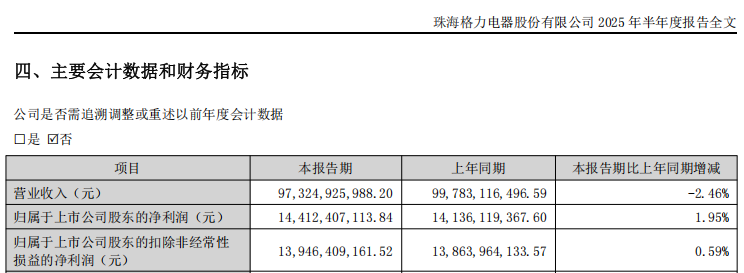
Core Insights - The performance of the three major white goods giants, Midea, Haier, and Gree, has shown significant divergence in the first half of the year, influenced by national subsidy policies and intense industry competition [2][3] Group 1: Financial Performance - Midea reported the highest revenue of approximately 251.1 billion yuan, a year-on-year increase of 15.6%, and a net profit exceeding 26 billion yuan, up 25% [3] - Haier's revenue reached about 156.5 billion yuan, with a year-on-year growth of over 10%, while its net profit was 12.03 billion yuan, also up 15.6% [3] - Gree experienced a revenue decline to 97.32 billion yuan, a year-on-year decrease of about 2.5%, although its net profit increased nearly 2% to 14.4 billion yuan, marking the slowest growth among the three [3] - Gree maintained the highest net profit margin at 14.7%, surpassing Midea by 4.35 percentage points and Haier by 7 percentage points [3] Group 2: Dividend Distribution - Gree announced no interim dividend for this year, while Midea declared a cash dividend of 5 yuan per 10 shares, totaling nearly 3.8 billion yuan, and Haier proposed a cash dividend of 2.69 yuan per 10 shares, amounting to 2.5 billion yuan [3] Group 3: Leadership Changes - Midea appointed Wang Jianguo as the executive president, marking a significant step in the succession plan as current chairman Fang Hongbo approaches retirement [4] - Haier's chairman Zhou Yunjie is nearing retirement age, while Gree's chairman Dong Mingzhu has been a focal point for succession discussions [5] Group 4: Market Competition - The competitive landscape in the air conditioning market has intensified, particularly affecting Gree, which faced a decline in its consumer electronics revenue due to aggressive pricing strategies from competitors [6][7] - The market share of low-end air conditioners has increased, with over 50% of online sales falling below 2,100 yuan, putting pressure on mid-to-high-end demand [6] Group 5: B2B Market Development - The B2B market has become a crucial growth engine for the three companies, with Midea leading in B2B revenue, which accounted for 25.7% of its total revenue, reaching 64.54 billion yuan [8] - Haier's B2B revenue from equipment and channel services grew nearly 35% to 18.72 billion yuan, representing 12% of its total revenue [9] - Gree's B2B revenue remains the lowest among the three, with only 11.52% of total revenue coming from industrial products and green energy [10]

家电周报:三大白电2025年9月排产数据发布 海尔智家推出首次中期分红
Xin Lang Cai Jing· 2025-08-30 12:31
Group 1 - The home appliance sector underperformed the CSI 300 index this week, with the Shenwan household appliance index declining by 0.9% while the CSI 300 index rose by 2.7% [1] - Key companies such as Guangfeng Technology and Ecovacs led the gains with a rise of 6.5%, while companies like Beike and Gree Electric faced declines of 6.2% and 5.6% respectively [1] - The production data for major white goods in September 2025 shows a total output of 27.07 million units, a decrease of 7.2% compared to the same period last year [1] Group 2 - In September 2025, the production of household air conditioners was 10.75 million units, down 12.0% year-on-year; refrigerators produced were 8.21 million units, down 6.3%; and washing machines saw production of 8.11 million units, down 1.1% [1] - Haier Smart Home announced its first mid-term dividend, proposing a cash dividend of RMB 2.69 per 10 shares, totaling over RMB 2.5 billion [1] Group 3 - In July 2025, the online sales volume of hair dryers decreased by 6.44% to 932,200 units, while sales revenue increased by 11.46% to RMB 209 million, with an average price rise of 19.16% to RMB 223.9 per unit [2][3] - The online sales volume of electric shavers increased by 21.32% to 927,700 units, with sales revenue rising by 23.61% to RMB 164 million, and an average price increase of 1.90% to RMB 177.0 per unit [2][3] Group 4 - The investment focus includes the white goods sector, which is characterized by low valuations, high dividends, and stable growth, with expectations for a boost from trade-in policies and rising copper prices [4] - Recommendations include leading companies such as Hisense, Midea, Haier, and Gree, as well as companies like Ousheng Electric and Dechang Co., which are expected to benefit from large customer orders and improved profitability [4] - The demand for core components in the white goods sector is expected to exceed expectations, with recommendations for companies like Huaxiang Co., Shun'an Environment, and Sanhua Intelligent Control, which are positioned to benefit from the industry's growth [4]
大比拼!A股家电三巨头,美的领衔、海尔居中、格力掉队
Zhong Guo Ji Jin Bao· 2025-08-30 10:40
Core Viewpoint - The performance of the three major home appliance giants in A-shares shows significant differentiation, with Midea leading, Haier in the middle, and Gree lagging behind in the first half of 2025 [1] Group 1: Financial Performance - Midea Group reported a revenue increase of 15.58% year-on-year to 251.12 billion yuan and a net profit increase of 25.04% to 26.01 billion yuan in the first half of 2025 [1] - Haier Smart Home achieved a revenue growth of 10.22% year-on-year to 156.49 billion yuan [7] - Gree Electric's revenue decreased by 2.46% year-on-year to 97.33 billion yuan, while its net profit increased by 1.95% to 14.41 billion yuan [2] Group 2: Dividend Policies - Midea Group and Haier Smart Home plan to implement mid-year dividends for 2025, with total dividends of 3.80 billion yuan and 2.51 billion yuan respectively [4] - Gree Electric announced plans not to distribute cash dividends or issue bonus shares [3] Group 3: Business Segments - Midea Group's smart home business revenue grew by 13.31% year-on-year to 167.20 billion yuan, accounting for 66.58% of total revenue [8] - Gree Electric's consumer appliance business revenue declined by 5.09% year-on-year to 76.28 billion yuan, making up 78.38% of total revenue [9][10] - Midea Group's commercial and industrial solutions revenue increased by 20.79% to 64.54 billion yuan, representing 25.70% of total revenue [25] Group 4: International Market Performance - In the overseas market, Midea Group, Haier Smart Home, and Gree Electric saw revenue growth of 17.70%, 11.70%, and 10.19% respectively [14] - Midea Group's overseas revenue reached 107.19 billion yuan, accounting for 42.69% of total revenue, while Haier's overseas revenue was 79.08 billion yuan, making up 50.53% of total revenue [16][17] Group 5: Future Strategies - Midea Group aims to increase its overseas revenue to exceed 50% of total revenue in the long term [20] - Haier Smart Home focuses on high-end brand strategies in overseas markets and anticipates growth in smart and green appliances due to urbanization and consumption upgrades [18] - Midea Group is also focusing on the development of humanoid robots and plans to enhance its capabilities in this area [25][27]
大比拼!A股家电三巨头 美的领衔、海尔居中、格力掉队
Zhong Guo Ji Jin Bao· 2025-08-30 10:18
Core Insights - Midea Group reported a revenue increase of 15.58% year-on-year to 251.12 billion yuan and a net profit increase of 25.04% to 26.01 billion yuan for the first half of 2025, outperforming its peers in the A-share home appliance sector [2][7] - Haier Smart Home also achieved double-digit growth, while Gree Electric Appliances lagged with a revenue decline of 2.46% to 97.32 billion yuan, despite a slight net profit increase of 1.95% to 14.41 billion yuan [2][9] - Gree Electric announced it would not distribute cash dividends or issue bonus shares, contrasting with Midea and Haier's plans for mid-year dividends [3][9] Revenue and Profit Analysis - Midea Group's smart home business revenue grew by 13.31% to 167.20 billion yuan, accounting for 66.58% of its total revenue [6][25] - Haier Smart Home's revenue increased by 10.22% to 156.49 billion yuan, with a net profit growth of 15.59% [5][25] - Gree Electric's consumer appliance revenue fell by 5.09% to 76.28 billion yuan, representing 78.38% of its total revenue [8][9] Market Trends - The domestic air conditioning market saw a retail revenue increase of 12.4% to 126.3 billion yuan in the first half of 2025, driven by policy incentives and high temperatures [9] - The overall home appliance market is expected to face intensified competition in the second half of 2025, with modest growth projections [9][11] International Market Performance - Midea Group, Haier Smart Home, and Gree Electric Appliances reported overseas revenue growth of 17.70%, 11.70%, and 10.19% respectively in the first half of 2025 [11][12] - Midea's overseas revenue reached 107.19 billion yuan, making up 42.69% of its total revenue, while Haier's overseas revenue was 79.08 billion yuan, accounting for 50.53% [12][14] Strategic Focus - Midea Group aims to increase its overseas revenue to over 50% of total revenue and is focusing on expanding its OBM (Own Brand Manufacturing) strategy [14][26] - Both Midea and Gree are transitioning towards B-end business solutions, with Midea's commercial and industrial solutions revenue growing by 20.79% to 64.54 billion yuan, representing 25.70% of its total revenue [23][25] - Midea is also investing in humanoid robotics, targeting advancements in key technology areas for industrial applications [26][27]