
HAIER SMART HOME(600690)

Search documents
全球上市提速!海尔三筒洗衣机又登意大利
Jin Tou Wang· 2025-11-03 03:28
Core Insights - Haier's three-tub washing machine was officially launched in the Italian market, filling a gap in the high-end laundry sector [1] - The innovative design features a "10kg large tub + dual 1kg small tubs" configuration, addressing common industry pain points such as color mixing and time-consuming washing processes [1][2] - The global rollout of the three-tub washing machine is part of Haier's strategy to deepen its local market presence and cater to diverse regional needs [2] Group 1 - The launch event in Milan received significant media attention and positive feedback from industry leaders and customers [1] - The three-tub washing machine incorporates advanced features like intelligent detergent dispensing and AI smart washing, enhancing user experience [1] - Haier has established itself as the first Chinese brand to export three-tub washing machines, showcasing its commitment to innovation in design and functionality [1] Group 2 - Following its debut in Italy, the three-tub washing machine will be introduced in France, Spain, Poland, and the UK between late November and mid-December, with plans to expand to the Middle East and Africa by January 2026 [2] - Haier has tailored various high-end products to meet specific regional demands, such as a large-capacity washing and drying machine in Southeast Asia and a washing machine with a "long robe washing program" in the Middle East [2] - Haier washing machines have maintained the top sales position globally for 16 consecutive years and are recognized as the leading Chinese brand in Europe [2]

三翼鸟武汉智博会展示全场景智慧家,月活提升至1300万
Jin Tou Wang· 2025-11-03 03:28
Core Insights - The 2025 International (Wuhan) Smart Construction Industry Expo emphasizes the theme of "Developing Industrial Internet, Co-creating 'Good Houses'" to promote smart living solutions [1] - The company Sanwing Bird showcases comprehensive smart home solutions that enhance user experience and redefine the concept of a "good house" [1][2] - Sanwing Bird has accumulated over 13 million monthly active users, indicating strong market acceptance and user engagement [1] Smart Home Solutions - Sanwing Bird integrates smart technology throughout the home, providing seamless experiences in various spaces such as entryways, living rooms, balconies, and kitchens [1] - The smart home experience is designed to be intuitive, allowing users to control devices with simple commands or even without speaking, enhancing convenience [2] - The company has connected over 6,600 ecological partners and 52 million devices, enabling customized scenarios for users [2] Energy Efficiency and Smart Building - The smart building segment features advanced technologies like magnetic levitation central air conditioning and AI multi-link systems, achieving significant energy savings [3] - The dual breakthrough in energy efficiency includes a 50% reduction in device energy consumption and an additional 20% savings through AI algorithms that analyze various data [3] - Sanwing Bird's smart design platform streamlines the home design process, offering over 15 million layouts and 29,000 plans, making it easier for users to create their ideal smart home [3]
海尔智家(600690):Q3内外销稳健增长并释放利润弹性
HTSC· 2025-11-03 03:27
Investment Rating - The report maintains a "Buy" rating for the company [7][5]. Core Insights - The company reported a revenue of 77.56 billion RMB in Q3 2025, representing a year-on-year increase of 9.5%, and a net profit of 5.34 billion RMB, up 12.7% year-on-year. The first three quarters of 2025 saw a total revenue of 234.05 billion RMB, a 10.0% increase year-on-year, with net profit reaching 17.37 billion RMB, up 14.7% year-on-year [1][2]. - The company has demonstrated resilience in domestic sales, achieving a 10.8% year-on-year growth in Q3 2025, despite a general decline in the home appliance market [2]. - The overseas revenue grew by 8.25% year-on-year in Q3 2025, with significant contributions from North America and emerging markets [3]. - The company’s gross margin for the first three quarters of 2025 was 27.2%, reflecting a slight increase due to cost control measures and a focus on high-end branding in overseas markets [4]. - The profit forecast for 2025-2027 has been revised upwards, with expected net profits of 21.58 billion RMB, 23.81 billion RMB, and 26.22 billion RMB respectively [5]. Summary by Sections Domestic Performance - The company achieved a 10.8% year-on-year revenue growth in Q3 2025, driven by strong performance in home air conditioning, which saw over 30% growth [2]. - The overall home appliance market in China faced a 3.2% decline in retail sales, highlighting the company's ability to outperform the market [2]. Overseas Performance - The company’s overseas revenue increased by 8.25% year-on-year in Q3 2025, with North America showing stable growth despite a cautious consumer environment [3]. - In Europe, the HVAC business saw over 30% revenue growth, and the company gained market share in key countries [3]. - Emerging markets, including South Asia and the Middle East, experienced significant growth, with revenue increases of over 25% and 60% respectively [3]. Profitability and Cost Management - The company’s gross margin improved to 27.2% in the first three quarters of 2025, attributed to effective cost management and a focus on high-end products [4]. - The report noted a decrease in sales expense ratio to 10.6%, indicating improved operational efficiency [4]. Earnings Forecast and Valuation - The earnings forecast for 2025-2027 has been adjusted upwards, with net profits expected to reach 21.58 billion RMB in 2025, reflecting a 15.16% growth [5]. - The target price for A-shares is set at 35.56 RMB, based on a 14x PE ratio for 2026, while the target price for H-shares is 33.09 HKD [5].
金融工程定期:券商金股解析月报(2025年11月)-20251103
KAIYUAN SECURITIES· 2025-11-03 03:14
- The report analyzes the performance of broker-recommended "gold stocks" for November, highlighting top recommendations such as Kingsoft Office, Zijin Mining, and Haier Smart Home, among others [2][14][15] - November's "gold stocks" are categorized into new entries and repeated recommendations, with repeated stocks like Kingsoft Office and Zijin Mining being recommended multiple times, while new entries include Haier Smart Home and China Ping An [2][14][15] - Industry-wise, November's "gold stocks" are concentrated in sectors like electronics (15.1%), power equipment (10.8%), non-ferrous metals (7.8%), and automobiles (6.2%) [2][15][18] - The weighted market capitalization and valuation levels of November's "gold stocks" have decreased, indicating a shift towards value-oriented stocks [3][19][20] - October's "gold stocks" portfolio had an overall return of -2.5%, with new entries outperforming repeated recommendations. The annualized return for all "gold stocks" was 13.8%, higher than the CSI 300 and CSI 500 indices [4][23][20] - The "Open Source Quantitative Preferred Gold Stock Portfolio" for October achieved a return of 2.2%, with an annualized return of 22.9%, outperforming the overall "gold stocks" portfolio and benchmark indices [5][26][28] - The preferred portfolio for November includes stocks like Salt Lake Co., China Life Insurance, and Shanghai Lingang, with a focus on industries such as non-bank finance, machinery, and pharmaceuticals [5][29][30]



三季度社保基金动向曝光 重仓哪些个股?
Zhong Guo Jing Ji Wang· 2025-11-03 02:36
Group 1 - The core viewpoint of the article highlights the investment trends of social security funds in the third quarter, showing a significant presence in various sectors, particularly machinery, electronics, and pharmaceuticals [1][2] - As of the end of the third quarter, social security funds were listed among the top ten shareholders of 617 companies, with new investments in 188 companies and increased holdings in 156 companies [1][2] - The largest holdings by social security funds were in Sany Heavy Industry, with a market value of 4.142 billion yuan, followed closely by BYD at 4.037 billion yuan [1][2] Group 2 - In terms of shareholding quantity, 23 companies had over 100 million shares held by social security funds at the end of the third quarter, with the highest being Focus Media at 333 million shares [2] - The most significant new investment by social security funds was in China Metallurgical Group, with 100.36 million shares acquired [2] - Social security funds have maintained long-term holdings in several companies, with the longest being in Zhongnan Media since Q1 2012, indicating a preference for stable growth stocks [2] Group 3 - The National Social Security Fund Council reported an investment income of 218.418 billion yuan for 2024, with an investment return rate of 8.10% [3] - Since its establishment, the average annual investment return rate of social security funds has been 7.39%, with a cumulative investment income of 1.9 trillion yuan [3]





中国消费脉搏 2025 年第三季度_体验式消费引领,高端需求反弹,消费市场格局分化-China Consumer Pulse 3Q25_ Experiential spending leads and Premium demand rebounds, amid mixed consumer landscape
2025-11-03 02:36
Summary of China Consumer Pulse Q3 2025 Industry Overview - **Industry**: Chinese Consumer Market - **Key Sectors Analyzed**: Alcohol, Apparel, Beauty, Travel, Luxury Goods, Autos Core Insights 1. **Mixed Consumer Sentiment**: Chinese consumer sentiment remains mixed, with a notable divergence in spending patterns across sectors [2][29][30] 2. **Experiential Spending Resilience**: Experiential categories such as restaurants (+24% YoY) and travel (+16% YoY) show resilience, indicating a shift towards experiences over goods [2][35] 3. **Premium Demand Recovery**: Onshore luxury spending has improved, with premium auto sales stabilizing and showing positive year-over-year growth in September, ending a 19-month decline [2][30] 4. **Digital Channels Outperform**: Digital retail channels continue to outperform traditional retail, although there are signs of weakness in specific segments like beauty e-commerce, which saw a -3% decline [2][29][30] 5. **GDP and Retail Growth Slowdown**: China's Q3 GDP growth slowed to 4.8% YoY, with retail growth easing to 2.1%, attributed to fading consumer incentives and macroeconomic uncertainties [3][29] 6. **Deflationary Trends**: Deflationary pressures persist across travel and hotel pricing, with moderate price declines observed [12][29] Sector-Specific Insights Premium Beverages - **Weak Demand**: Ultra-premium Baijiu prices continued to slide in Q3 due to weak demand, particularly around the Mid-Autumn Festival [4][30] Apparel and Sportswear - **Mixed Performance**: The apparel market is growing online but remains negative offline, with brands like Adidas showing over 20% growth while Nike faces challenges [5][22] Home Appliances - **Sector Contraction**: The home appliance sector contracted by 7% in Q3, with significant declines in both domestic and overseas exports [7][31] Luxury Goods - **Signs of Improvement**: Early signs of recovery in the luxury market, with brands like Hermès and Louis Vuitton performing well, while Kering struggles [8][9][30] Automotive - **Sales Growth Slowdown**: Auto sales growth slowed to +2.5% YoY in Q3, with EV sales decelerating to +12.5% YoY. However, EV penetration reached 55.1% [10][16][17] Hotels - **RevPAR Declines**: Domestic hotel RevPAR continues to decline, with luxury hotels being the only segment not experiencing persistent declines [10][23] Travel - **Resilient Growth**: The travel industry showed stable positive growth of 16% during the National Day Golden Week, reflecting ongoing domestic travel trends [11][12] Cosmetics - **Moderate Growth**: The cosmetics sector saw a +6.5% YoY increase in gross merchandise value, marking an improvement from previous quarters [13][29] Additional Considerations - **Cautious Consumer Behavior**: The macroeconomic environment is expected to lead to cautious, value-driven consumer behavior, highlighting the uneven recovery across sectors [3][32] - **Investment Implications**: The outlook for various sectors remains cautious, with potential growth in EVs and premium segments, while traditional sectors face challenges [16][17][22][23]




周专题:三大白电11月外销排产表现优于内销
HUAXI Securities· 2025-11-02 09:53
Investment Rating - Industry rating: Recommended [8] Core Insights - The report highlights that the export production of major home appliances (air conditioners, refrigerators, and washing machines) in November 2025 outperformed domestic sales, with total production of 28.47 million units, a year-on-year decrease of 17.7% [17] - Air conditioner exports showed resilience with a production of 7.46 million units, down 13.8% year-on-year, while domestic production fell by 21.2% to 5.3 million units [17] - Refrigerator production for domestic sales was 3.76 million units, down 10.9% year-on-year, while exports were 4.02 million units, down 1.5% [2][18] - Washing machine exports increased by 5.0% year-on-year to 3.75 million units, while domestic production decreased by 2.6% to 4.18 million units [3][18] - The overall air conditioner export volume for the cold year 2025 reached 88.02 million units, an increase of 12.3% year-on-year, with export value at $16.97 billion, up 13.7% [19] Summary by Sections 1. Weekly Topic: November Production Performance - Air conditioners, refrigerators, and washing machines showed stronger export performance compared to domestic sales, with significant production declines in domestic markets due to high inventory and cost pressures [17] - The report attributes the decline in domestic production to factors such as inventory management, high raw material costs, and the impact of previous government subsidy policies [17] 2. Company Announcements - Hisense Home Appliances reported a revenue of 71.533 billion yuan for Q1-Q3 2025, a year-on-year increase of 1.35%, with a net profit of 2.812 billion yuan, up 0.67% [21] - Midea Group's revenue for Q1-Q3 2025 was 364.7 billion yuan, a 14% increase year-on-year, with a net profit of 37.9 billion yuan, up 20% [24] - Haier Smart Home reported a revenue of 234.1 billion yuan for Q1-Q3 2025, a 10% increase year-on-year, with a net profit of 17.4 billion yuan, up 15% [25] 3. Data Tracking - Raw material prices showed slight increases, with copper and aluminum prices rising by 0.9% and 1.1% respectively as of October 31, 2025 [28] - Shipping rates increased, with the CCFI composite index rising by 2.89% [30] - Real estate data indicated a decline in sales area and construction activity, with year-on-year decreases of 5.5% and 15.3% respectively for the first nine months of 2025 [33]



海尔智家(600690):业绩表现亮眼,长期成长性依旧
Haitong Securities International· 2025-11-02 09:33
Investment Rating - The report maintains an "Outperform" rating for Haier Smart Home with a target price of RMB 36.16, based on a current price of RMB 26.81 [2][15]. Core Insights - Haier Smart Home has demonstrated outstanding performance with a revenue of RMB 234.05 billion for Q3 2025, reflecting a year-on-year growth of 9.98%, and a net profit of RMB 17.37 billion, up 14.68% year-on-year [4][10]. - The company's gross profit margin reached 27.2%, a slight increase of 0.1 percentage points year-on-year, indicating improved profitability driven by a high-end brand strategy [11]. - Domestic revenue growth for the first three quarters of 2025 was 9.5%, with Q3 showing a growth rate of 10.8%. The air conditioning segment saw revenue growth exceeding 30% in Q3 [12][13]. - Internationally, Haier's overseas revenue grew by 10.5% in the first three quarters, with a quarterly growth of 8.3% in Q3, supported by a localized operation strategy [13][14]. Financial Performance Summary - Revenue projections for Haier Smart Home are as follows: RMB 303.47 billion for 2025, RMB 314.74 billion for 2026, and RMB 331.79 billion for 2027, with respective growth rates of 6%, 4%, and 5% [3][9]. - Net profit estimates are RMB 21.18 billion for 2025, RMB 23.81 billion for 2026, and RMB 26.71 billion for 2027, maintaining a growth rate of approximately 12% annually [3][9]. - The diluted EPS is projected to be RMB 2.26 for 2025, RMB 2.54 for 2026, and RMB 2.85 for 2027, with a P/E ratio decreasing from 15 in 2025 to 10 in 2027 [3][9].
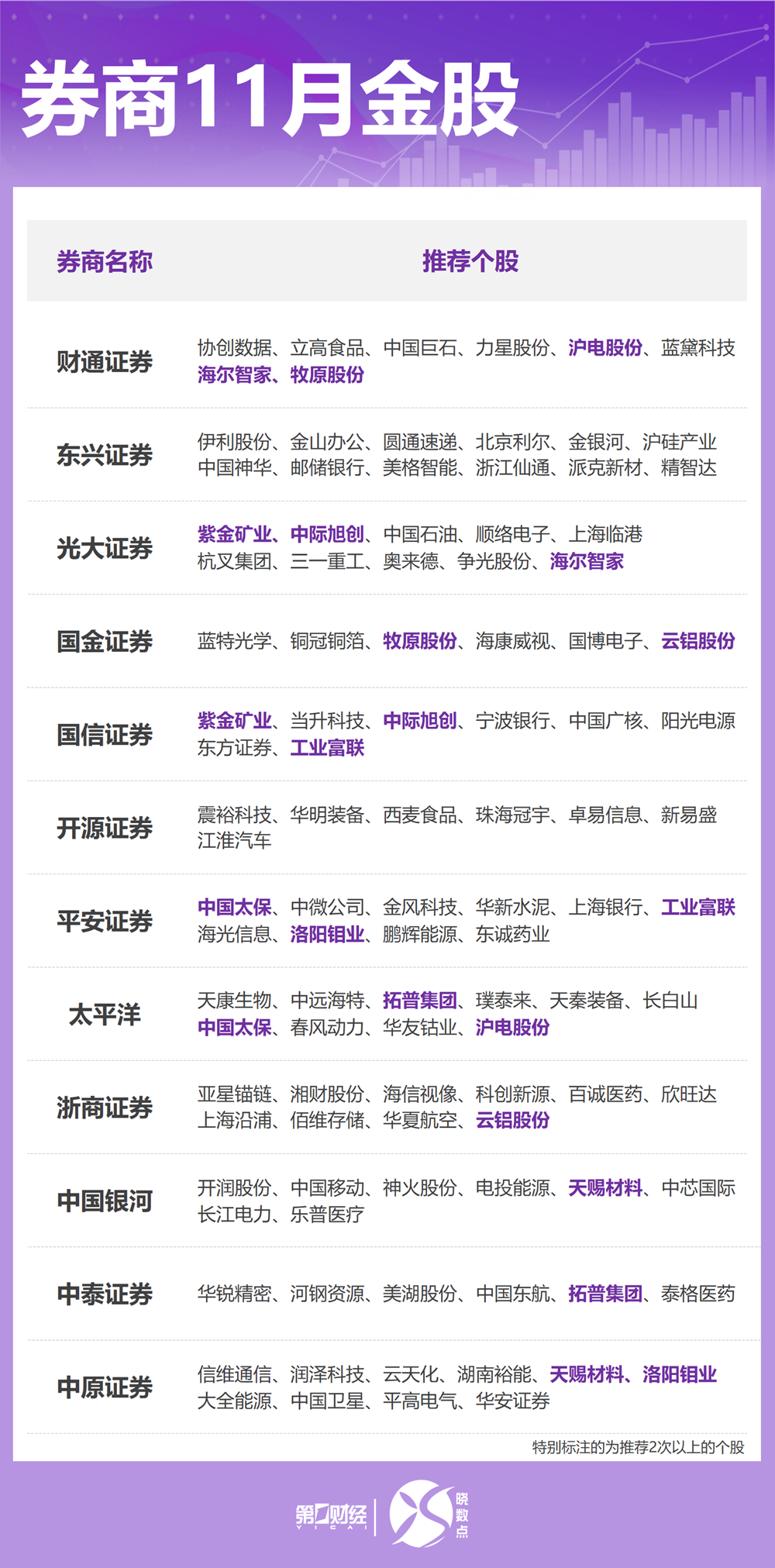
券商11月金股出炉:这些股获力挺,看好有色、医药等方向




Di Yi Cai Jing· 2025-11-02 07:21
Core Viewpoint - The A-share market showed a mixed performance in October, with the Shanghai Composite Index rising by 1.85%, while the Shenzhen Component Index and the ChiNext Index fell by 1.1% and 1.56% respectively. The focus is on identifying investment opportunities for November as multiple brokerages have released their monthly investment portfolios across various sectors [1]. Group 1: Recommended Stocks - A total of 11 stocks, including Huadian Technology, Industrial Fulian, and Yun Aluminum, received recommendations from two brokerages each [4]. - Among the recommended stocks, Zhongji Xuchuang had the highest increase in October, rising over 17% to a closing price of 473.01 yuan, while Top Group experienced the largest decline, falling over 8.9% to a closing price of 73.78 yuan [4]. Group 2: Industry Preferences - Several brokerages suggest focusing on sectors such as non-ferrous metals, brokerage firms, and pharmaceuticals, indicating a potential increase in market volatility [6]. - Guosheng Securities recommends a balanced asset allocation to navigate short-term fluctuations, emphasizing the importance of verifying economic conditions, particularly in sectors like non-ferrous metals, lithium batteries, and storage [6]. - Zhongyuan Securities anticipates a continuation of structural oscillation in the market, advising investors to consider low-volatility assets as a fundamental allocation [6]. Group 3: Investment Strategies - Donghai Securities highlights three main investment lines, including a focus on technology, particularly in artificial intelligence, and investment opportunities related to the "14th Five-Year Plan" strategic emerging industries [7]. - The expectation of increased investment in the fourth quarter is also noted, particularly regarding its impact on upstream resource demand [7].

海尔智家(600690):Q3内销增长提速,外销稳步提升,数字化变革成效持续凸显
Guotou Securities· 2025-11-01 12:58
Investment Rating - The investment rating for Haier Smart Home is maintained at "Buy-A" with a 6-month target price of 31.81 CNY [4]. Core Views - Haier Smart Home reported a revenue of 234.05 billion CNY for the first three quarters of 2025, representing a year-on-year increase of 10.0%. The net profit attributable to shareholders was 17.37 billion CNY, up 14.7% year-on-year. In Q3 alone, the company achieved a revenue of 77.56 billion CNY, a 9.5% increase year-on-year, and a net profit of 5.34 billion CNY, up 12.7% year-on-year [1][2][3]. Summary by Sections Revenue Growth - Q3 domestic revenue growth accelerated to 10.8% year-on-year, while overseas revenue grew by 8.3%. The domestic market saw significant contributions from popular products, particularly in the home air conditioning sector, which experienced over 30% revenue growth in Q3. The overseas market maintained rapid growth in emerging markets such as South Asia and Southeast Asia, while developed markets like North America and Europe showed stable operations [2][3]. Profitability Improvement - The gross margin for Q3 was 27.9%, reflecting a year-on-year increase of 0.1 percentage points. This improvement was driven by digital transformation in procurement, R&D, and manufacturing in the domestic market, alongside a high-end brand strategy and global supply chain collaboration in overseas markets [2][3]. Expense Management - The operating expense ratio in Q3 improved by 0.1 percentage points, with reductions in both sales and management expense ratios. This was attributed to enhanced operational efficiency from digital transformation and retail innovations in the overseas market [3]. Cash Flow and Financial Health - The net cash flow from operating activities in Q3 was 6.35 billion CNY, an increase of 2.9 billion CNY year-on-year, primarily due to expanded revenue scale. The company's contract liabilities at the end of the period were 4.15 billion CNY, up 17.9% year-on-year, indicating strong demand from distributors [3]. Future Outlook - The company is expected to continue benefiting from its global layout and digital transformation, leveraging its multi-brand and cross-product strategies to drive revenue and profitability growth. EPS estimates for 2025 to 2027 are projected at 2.27 CNY, 2.53 CNY, and 2.79 CNY respectively, with a PE valuation of 14x for 2025 [3][4].