GDPD(600795)

Search documents
白龙核电一期工程开始主体工程建设
Yang Shi Xin Wen· 2025-12-22 07:12
Core Viewpoint - The Guangxi Bailong Nuclear Power Project has officially commenced with the first concrete pouring for the nuclear island of Unit 1, marking the start of the main construction phase for the first phase of the project [1] Group 1: Project Overview - The Bailong Nuclear Power Project is located in Fangchenggang City, Guangxi, and plans to build six nuclear power units with a total installed capacity of 8.62 million kilowatts and a total investment of approximately 120 billion yuan [1] - The first phase of the project will utilize domestically designed third-generation advanced nuclear technology, with each unit having a capacity of 1.25 million kilowatts [1] Group 2: Environmental Impact - Upon completion and operation of the two units in the first phase, the annual electricity generation is expected to be around 20 billion kilowatt-hours, which will reduce standard coal consumption by approximately 6 million tons and cut carbon dioxide emissions by about 16 million tons [1] - The emission reduction effect is equivalent to planting approximately 44,000 hectares of broadleaf forest [1]

申万公用环保周报:11月发电增速环比放缓,进口LNG现货价格继续下跌-20251222
Shenwan Hongyuan Securities· 2025-12-22 05:41
Investment Rating - The report maintains a positive outlook on the power and environmental sectors, indicating a favorable investment environment [1]. Core Insights - The report highlights a slowdown in electricity generation growth in November, with a total generation of 779.2 billion kWh, a year-on-year increase of 2.7%. The contribution from hydropower and wind power is significant, while thermal power shows a decline [7][9]. - Natural gas prices in the US and Europe have shown slight fluctuations, with Northeast Asia's LNG prices continuing to decline, reaching $9.50/mmBtu, the lowest since May 2024 [21][34]. - The report suggests various investment opportunities across different sectors, including thermal power, hydropower, nuclear power, green energy, and gas companies, emphasizing the importance of diversified revenue streams [19][41]. Summary by Sections 1. Electricity: November Generation Growth Slows, Hydropower and Wind Power Contribute Incrementally - November electricity generation totaled 779.2 billion kWh, with thermal power decreasing by 4.2% year-on-year, while hydropower increased by 17.1%, nuclear power by 4.7%, wind power by 22.0%, and solar power by 23.4% [7][9]. - The overall growth rate of electricity generation has slowed compared to the previous month, with hydropower and wind power contributing significantly to the incremental generation [8][9]. 2. Natural Gas: Global Gas Prices Show Minor Fluctuations, Asian and US Prices Continue to Decline - As of December 19, the Henry Hub spot price in the US was $3.58/mmBtu, down 12.10% week-on-week, while the TTF spot price in Europe was €28.10/MWh, up 2.00% [21][22]. - The report notes that the LNG ex-factory price in China was 4030 yuan/ton, a decrease of 3.70% week-on-week, indicating a trend of declining costs in the natural gas sector [39]. 3. Weekly Market Review - The public utility and electricity sectors underperformed compared to the CSI 300 index, while the gas and environmental sectors outperformed [44]. 4. Company and Industry Dynamics - The report discusses various company announcements and industry developments, including stable coal production and increased oil production rates, as well as significant investments in energy projects [46][48].




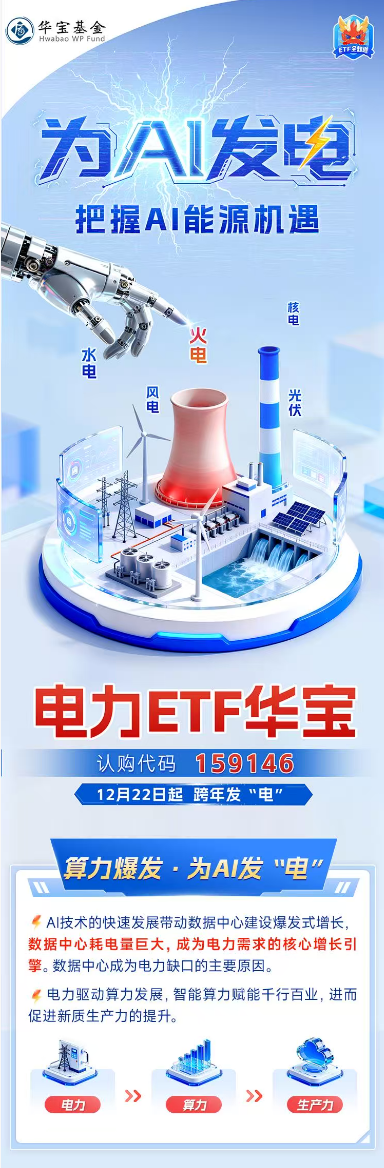
为AI发“电”!把握AI能源机遇,一图读懂电力ETF华宝(159146)
Xin Lang Cai Jing· 2025-12-22 00:53
Group 1 - The rapid development of AI technology is driving explosive growth in data center construction, which significantly increases electricity consumption and becomes a core growth engine for electricity demand [1][9] - Data centers are identified as a major reason for the electricity supply gap, highlighting the interdependence between electricity and computational power development [1][9] Group 2 - The targeted index includes various power generation methods: thermal power (42.99%), hydropower (24.21%), wind power (13.18%), nuclear power (12.17%), and photovoltaic power (6.01%), showcasing both dividend and growth attributes [3][10] - The top ten weighted stocks in the index include leading companies in the power industry, such as Changjiang Electric Power, China Nuclear Power, and Three Gorges Energy, with a combined weight of 54.21% [5][11]


公用事业行业周报(2025.12.15-2025.12.19):电量增速回落,煤价持续下行-20251221
Orient Securities· 2025-12-21 09:45
Investment Rating - The report maintains a "Positive" outlook for the utility sector [4] Core Views - The growth rate of electricity generation is slowing down, while coal prices continue to decline [2] - The utility sector is seen as a defensive asset with low valuations, making it attractive for investment [7] - The report emphasizes the need for further market-oriented pricing reforms to support the integration of renewable energy [7] Summary by Sections Electricity Generation - In November 2025, the electricity generation of large-scale power plants increased by 2.7% year-on-year, but the growth rate decreased by 5.2 percentage points compared to October 2025 [10] - The growth of renewable energy generation significantly improved, with wind power increasing by 22.0% and solar power by 23.4% year-on-year [10] - The report notes that the growth of hydropower decreased but remained high, while thermal power generation turned negative with a decline of 4.2% [10] Coal Prices - Port coal prices have been declining, with the Qinhuangdao port's Q5500 coal price at 703 RMB/ton, down 5.6% week-on-week [16] - The report indicates that high coal inventories and low demand from downstream power plants are contributing to the price drop [7] - The report anticipates that the decline in spot coal prices may gradually narrow due to improved acceptance from power plants [7] Investment Recommendations - The report suggests focusing on utility stocks, particularly in thermal power, hydropower, and nuclear power sectors, highlighting specific companies such as Huadian International and China General Nuclear Power [7] - It recommends investing in high-quality hydropower companies due to their low cost per kilowatt-hour and stable business models [7] - The report also notes the potential for growth in wind and solar sectors under carbon neutrality expectations [7] Market Performance - The utility sector index fell by 0.6%, underperforming the CSI 300 index by 0.3 percentage points [41] - Among sub-sectors, hydropower, thermal power, and wind power saw declines, while solar power showed a slight increase of 0.9% [43]





公用事业行业深度跟踪:风光贡献全部发电增量,关注板块低配高股息
GF SECURITIES· 2025-12-21 07:42
[Table_Page] 跟踪分析|公用事业 证券研究报告 [Table_Title] 公用事业行业深度跟踪 风光贡献全部发电增量,关注板块低配高股息 [Table_Summary] 核心观点: [Table_Grade] 行业评级 买入 前次评级 买入 报告日期 2025-12-21 [Table_PicQuote] 相对市场表现 -10% -3% 4% 10% 17% 24% 12/24 03/25 05/25 07/25 10/25 12/25 公用事业 沪深300 | [分析师: Table_Author]郭鹏 | | --- | | SAC 执证号:S0260514030003 | | SFC CE No. BNX688 | | 021-38003655 | | guopeng@gf.com.cn | | 分析师: 许子怡 | | SAC 执证号:S0260524010002 | | 021-38003618 | | xuziyi@gf.com.cn | | 分析师: 郝兆升 | | SAC 执证号:S0260524070001 | | 0755-82557403 | | haozhaosheng@ ...
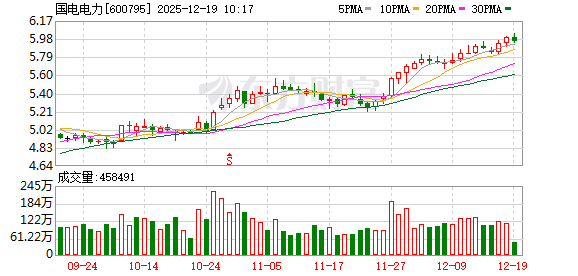
国电电力持续走强,股价再创新高
Zheng Quan Shi Bao Wang· 2025-12-19 02:16
两融数据显示,该股最新(12月18日)两融余额为8.02亿元,其中,融资余额为7.92亿元,近10日减少 8634.17万元,环比下降9.83%。 公司发布的三季报数据显示,前三季度公司共实现营业收入1252.05亿元,同比下降6.47%,实现净利润 67.77亿元,同比下降26.27%,基本每股收益为0.3800元,加权平均净资产收益率11.50%。(数据宝) (文章来源:证券时报网) 国电电力股价再创历史新高,该股近期呈不断突破新高之势,近一个月累计有10个交易日股价刷新历史 纪录。截至09:40,该股目前上涨0.33%,股价报6.01元,成交1867.76万股,成交金额1.12亿元,换手率 0.10%,该股最新A股总市值达1071.92亿元,该股A股流通市值1071.92亿元。 证券时报·数据宝统计显示,国电电力所属的公用事业行业,目前整体涨幅为0.18%,行业内,目前股价 上涨的有91只,涨幅居前的有胜通能源、中泰股份、ST金鸿等,涨幅分别为10.02%、5.34%、5.17%。 股价下跌的有21只,跌幅居前的有梅雁吉祥、美能能源、大连热电等,跌幅分别为1.93%、1.88%、 0.87%。 ...
电力行业 2026 年度投资策略:新征程,还是老轮回?
Changjiang Securities· 2025-12-17 11:31
Group 1: Core Insights - The future narrative for thermal power is expected to shift towards enhanced profitability stability and increased dividends due to rising capacity prices and deeper assessments by the State-owned Assets Supervision and Administration Commission (SASAC) [2][60] - In the short term, integrated coal power companies are likely to have a comparative advantage as coal prices rise, with a consensus forming around an increase in the coal price baseline for next year [2][6] - Renewable energy companies, despite facing challenges such as supply-demand imbalance and subsidy delays, have shown considerable absolute returns, supported by improving policies for green energy development [6][8] Group 2: Thermal Power Analysis - Historical performance of thermal power shows a certain "counter-cyclical" nature, with earnings often moving inversely to coal prices, which are now market-driven [19][26] - The current policy framework limits the duration of profitability expectations for thermal power, leading to a "high first, low second" characteristic in the market for 2023 and 2024 [6][45] - The expected increase in capacity prices across provinces by 2026 will enhance the fixed cost recovery ability of coal power plants, significantly improving profitability stability [60][64] Group 3: Renewable Energy Insights - The renewable energy sector is currently facing multiple issues, including market price pressure and subsidy delays, but the gradual improvement in policy support is expected to create investment opportunities [6][8] - Companies with low valuations, high wind power ratios, and strong regional price certainty are still worth considering for investment despite the uncertain timing of policy impacts [2][6] Group 4: Hydropower and Nuclear Power - Leading hydropower companies exhibit high earnings certainty and dividend ratios, making them attractive for long-term investment [7] - Nuclear power is anticipated to see significant capacity growth during the 14th Five-Year Plan, with stable long-term price expectations despite some market price fluctuations [8][60] Group 5: Investment Recommendations - Recommended companies include quality thermal power operators such as Huaneng International, Datang Power, and China Power, as well as leading hydropower firms like Yangtze Power and Guotou Power [9] - In the renewable sector, companies like Longyuan Power and China Nuclear Power are highlighted as potential investment opportunities [9]


国家电投山东公司:创新打造“高青模式”,“绿电”赋能乡村振兴
Zhong Guo Fa Zhan Wang· 2025-12-17 11:03
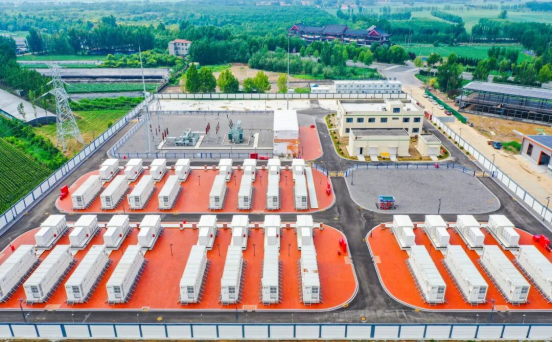
Core Viewpoint - The State Power Investment Corporation of Shandong is committed to sustainable and high-quality development during the 14th Five-Year Plan period, contributing to the balanced growth strategy of the group and integrating deeply into the local energy transition [1][3]. Group 1: Project Overview - The "Gaoqing Model" has been innovatively developed to illuminate new paths for rural revitalization and corporate sustainability through green electricity [1]. - A 100 MW/200 MWh energy storage station in Gaoqing serves as an efficient "energy regulator," participating in peak shaving and valley filling for the power grid, capable of consuming 66 million kWh of renewable energy annually, sufficient to meet the electricity needs of approximately 30,000 households [1][3]. Group 2: Challenges and Solutions - Gaoqing faced challenges such as slow industrial transformation, significant ecological protection pressure, and limited income channels for farmers [3]. - In 2023, the State Power Investment Corporation proposed a "wind-solar-storage-intelligence" clean energy matrix to address the challenges of renewable energy generation [3]. Group 3: Project Execution - The project was completed in an unprecedented 74 days, showcasing the "Gaoqing speed," despite the tight construction schedule [3]. - The total investment for the project is 260 million yuan, making it the only new-type energy storage project selected in Shandong Province for 2023, and it serves as a core support for Gaoqing County's establishment as a provincial-level green low-carbon transformation pilot county [3]. Group 4: Collaborative Mechanism - The success of the "Gaoqing Model" relies on an efficient "iron triangle" cooperation mechanism among the government, enterprises, and farmers, promoting a new development pattern of "planning together, managing together, and sharing results" [3]. Group 5: Economic Impact - In the Blacklizhai Town, a 2 MW project is expected to generate total revenue of approximately 27.5 million yuan during its operational period, increasing collective income by 780,000 yuan annually [4]. - The oil horse village photovoltaic project generated 1.08 million yuan in collective income in its first year, distributing 150,000 yuan to 120 households [4]. Group 6: Future Developments - Gaoqing is weaving a comprehensive green energy network, with clean energy penetrating various sectors from agricultural production to transportation [5]. - The 80,000 kW "Thousand Villages and Ten Thousand Villages Wind Action" project and the 100,000 kW green low-carbon energy transformation demonstration project are in the approval stage, accelerating preparations for construction [5].
25只股收盘价创历史新高
Zheng Quan Shi Bao Wang· 2025-12-17 09:42
Market Performance - The Shanghai Composite Index rose by 1.19%, with 25 stocks reaching all-time high closing prices [1] - Among the tradable A-shares, 3,626 stocks increased in price, accounting for 66.58%, while 1,635 stocks decreased, making up 30.02% [1] - A total of 58 stocks hit the daily limit up, while 27 stocks hit the limit down [1] Historical Highs - Excluding newly listed stocks from the past year, 25 stocks reached all-time high closing prices, with 19 from the main board and 6 from the ChiNext board [1] - The sectors with the most stocks reaching new highs include non-ferrous metals, electronics, and basic chemicals, with 5, 5, and 4 stocks respectively [1] Stock Performance - Stocks that reached new highs had an average price increase of 6.84%, with notable gainers including Yidong Electronics, Dongfang Iron Tower, and Yingweike [1] - The average closing price of stocks that hit new highs was 65.12 yuan, with 4 stocks priced over 100 yuan and 7 stocks priced between 50 and 100 yuan [1] - The highest closing price was for Xinyi Technology at 446.10 yuan, which increased by 9.55% [1] Capital Flow - The total net inflow of main funds into stocks reaching new highs was 3.618 billion yuan, with 18 stocks experiencing net inflows [2] - The top three stocks with the highest net inflow were Xinyi Technology (1.41 billion yuan), Yingweike (893 million yuan), and Zhongtung High-tech (356 million yuan) [2] - Conversely, 7 stocks saw net outflows, with the highest being Shanjin International (103 million yuan) [2] Market Capitalization - The average total market capitalization of stocks reaching new highs was 56.576 billion yuan, with an average circulating market capitalization of 51.054 billion yuan [2] - The stocks with the highest total market capitalization included Xinyi Technology (443.411 billion yuan), Cangge Mining (118.065 billion yuan), and Guodian Power (105.765 billion yuan) [2] - Stocks with the lowest total market capitalization included Shengtong Energy (6.096 billion yuan) and Yunzongma (6.953 billion yuan) [2] Breakthrough Trends - The ability to reach new highs is an indicator of stock strength, with Cangge Mining achieving 12 new highs in the past month, followed by Xin'ao Shares, Longxin General, and Xibu Materials with 11, 7, and 6 new highs respectively [2]


公用事业2026年度策略报告:电改深化,变中求稳-20251216
CMS· 2025-12-16 05:34
Core Insights - The report emphasizes the stability of electricity prices in 2026, with a controlled decline expected due to the recovery of coal prices and the increase in capacity electricity prices [1] - The report highlights the need to focus on the growth of hydropower installations in the short term, given the regional water supply differentiation [1] - The report indicates that the gas sector is expected to see a loosening of global LNG supply, which will likely lower price levels and stimulate demand [1] Industry Overview - The public utility sector has seen an overall increase in 2025, with the public utility sector rising by 3.61% and the environmental sector by 16.05% as of December 13, 2025 [6][12] - The electricity sector has experienced a cumulative increase of 2.73%, while the gas sector has risen by 13.30%, indicating a mixed performance across sub-sectors [12] Electricity Sector Analysis - **Thermal Power**: The report notes that coal prices have stabilized and are expected to lead to a controllable decline in electricity prices in 2026. The average price of Qinhuangdao 5500 kcal thermal coal was 820 RMB/ton as of November 27, 2025, reflecting a month-on-month increase of 7% [6][81] - **Hydropower**: The report identifies a regional differentiation in water supply, with significant growth potential in hydropower installations in areas like the Jinsha and Dadu rivers, which are expected to contribute positively to performance [6][31] - **Renewable Energy**: The report highlights that the short-term electricity prices and consumption capacity for renewable energy are under pressure, with 29 provinces having implemented the 136 document, leading to increased competition and pricing challenges [6][44] - **Nuclear Power**: The report indicates that the marketization of nuclear power is increasing, with a stable growth outlook due to the commissioning of new units, despite some pressure from market price fluctuations [6][66] Gas Sector Analysis - The report discusses the global LNG supply, which is projected to increase significantly, with 239 million tons/year of LNG capacity under construction as of October 2025. This is expected to exert downward pressure on gas prices, thereby stimulating demand recovery [6][7] - The report emphasizes the importance of diversifying gas sources to ensure stable profitability for gas companies amid geopolitical risks and price fluctuations [6][7] Investment Recommendations - The report recommends investing in companies with strong growth potential in hydropower and stable profitability in thermal power, such as Guodian Power and Huaneng International, which offers a dividend yield exceeding 7% [7] - In the gas sector, it suggests focusing on companies that are actively developing coal-to-gas projects and those with significant commercial user bases, such as Jiufeng Energy and Kunlun Energy, which are expected to benefit from demand growth as gas prices decline [7]