
Shanxi Xinghuacun Fen Wine Factory (600809)

Search documents
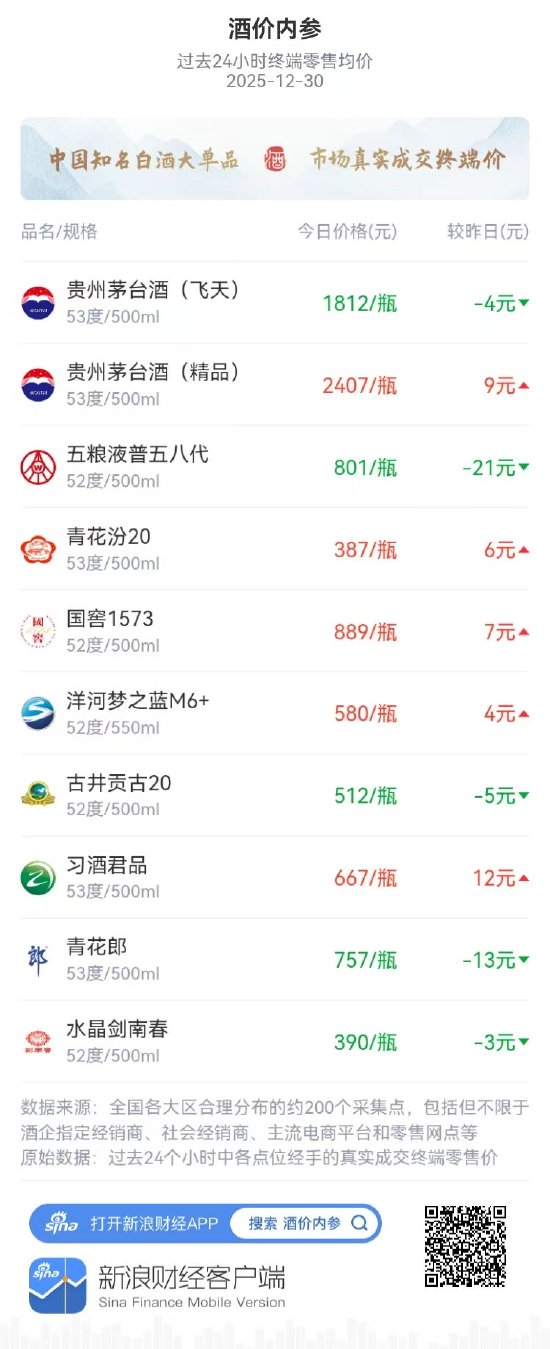
酒价内参12月30日价格发布,习酒君品上涨12元领涨
Xin Lang Cai Jing· 2025-12-30 01:17
Core Insights - The core viewpoint of the article highlights the recent trends in the Chinese liquor market, particularly focusing on the retail prices of the top ten liquor products, which have shown a slight overall decline after a period of volatility [1][6]. Price Trends - The average retail price of the top ten liquor products is currently 9,202 yuan, down by 8 yuan from the previous day [1][6]. - The market is experiencing a mixed performance with significant fluctuations in individual product prices, reflecting typical year-end trading behaviors influenced by capital and sentiment [7]. Price Increases - Notable price increases include: - Xijiu Junpin, which rose by 12 yuan per bottle, leading the market after three consecutive declines [7]. - Guizhou Moutai (premium) increased by 9 yuan per bottle, marking its third consecutive rise, now priced above 2,400 yuan [7]. - Other increases include: - Guojiao 1573: up 7 yuan per bottle - Qinghua Fen 20: up 6 yuan per bottle - Yanghe Dream Blue M6+: up 4 yuan per bottle [7]. Price Decreases - Significant price declines include: - Wuliangye Pu 58th generation, which dropped by 21 yuan per bottle, nearing the 800 yuan threshold [7]. - Qinghua Lang fell by 13 yuan per bottle after a previous increase of 45 yuan over eight days [7]. - Other decreases include: - Gujing Gonggu 20: down 5 yuan per bottle - Feitian Moutai: down 4 yuan per bottle - Shuijing Jian Nan Chun: down 3 yuan per bottle [7]. Market Dynamics - The article discusses the competitive landscape in the liquor industry, particularly the strategic moves by Langjiu to penetrate the Jiangsu market, which has been traditionally dominated by Yanghe [8]. - The competition among major brands such as Sichuan liquor, Guizhou liquor, and Anhui liquor indicates a shrinking market for smaller enterprises, necessitating larger brands to capture market share from competitors [8].





酒价内参12月30日价格发布,青花汾20上涨6元
Xin Lang Cai Jing· 2025-12-30 01:17
Core Insights - The core viewpoint of the article is that the Chinese liquor market, particularly for the top ten baijiu products, is experiencing a high-level consolidation with slight price adjustments, indicating a stable market as the year ends [1][6]. Price Trends - The average retail price for the top ten baijiu products is 9,202 yuan, down by 8 yuan from the previous day [1][6]. - Price fluctuations are noted, with some products increasing while others decrease, reflecting a typical year-end market behavior characterized by capital and emotional trading [7]. Product Performance - Notable price increases include: - Xijiu Junpin: up 12 yuan/bottle - Guizhou Moutai (Premium): up 9 yuan/bottle, reaching 2,400 yuan/bottle - Guojiao 1573: up 7 yuan/bottle - Qinghua Fen 20: up 6 yuan/bottle - Yanghe Dream Blue M6+: up 4 yuan/bottle [7][10]. - Significant price decreases include: - Wuliangye Pu 58th Generation: down 21 yuan/bottle, nearing the 800 yuan/bottle mark - Qinghua Lang: down 13 yuan/bottle - Gujing Gonggu 20: down 5 yuan/bottle - Feitian Moutai and Shuijing Jianan Chun: down 4 yuan and 3 yuan/bottle respectively [7][10]. Market Dynamics - The data for the "Liquor Price Reference" is sourced from approximately 200 collection points across major regions, including designated distributors and mainstream e-commerce platforms, aiming to provide objective and traceable market price data [2][6]. - In industry dynamics, Langjiu has announced a strategic focus on Jiangsu as a key development market, planning aggressive market penetration over the next three years, which may challenge Yanghe's traditional dominance in the region [3][8].
酒价内参12月30日价格发布 市场高位整理整体价格小幅回调
Xin Lang Cai Jing· 2025-12-30 01:12
Core Viewpoint - The Chinese liquor market is experiencing a high-level consolidation with slight price adjustments, indicating a stable end to the year after significant fluctuations in mid-December [1]. Price Trends - The overall retail price for the top ten liquor products is 9,202 yuan, down 8 yuan from the previous day [1]. - The market shows mixed performance with significant price changes among various products, reflecting typical year-end trading behaviors influenced by capital and sentiment [1]. Price Increases - Xijiu Junpin saw a price increase of 12 yuan per bottle, leading the market after three consecutive declines [1]. - Guizhou Moutai's premium product rose by 9 yuan per bottle, marking its third consecutive increase and surpassing 2,400 yuan per bottle [1]. - Other products with price increases include: - Guojiao 1573: up 7 yuan per bottle [1]. - Qinghua Fen 20: up 6 yuan per bottle [1]. - Yanghe Dream Blue M6+: up 4 yuan per bottle [1]. Price Decreases - Wuliangye Pu 58th generation experienced a notable decline of 21 yuan per bottle, barely maintaining the 800 yuan threshold [1]. - Qinghua Lang saw a decrease of 13 yuan per bottle after a previous increase of 45 yuan over eight days [1]. - Other products with price decreases include: - Gujing Gonggu 20: down 5 yuan per bottle [1]. - Feitian Moutai: down 4 yuan per bottle [3]. - Shuijing Jian'nan Chun: down 3 yuan per bottle [4].
2025胡润食品百强揭晓!山西汾酒2450亿价值稳居第四
Sou Hu Cai Jing· 2025-12-30 00:57
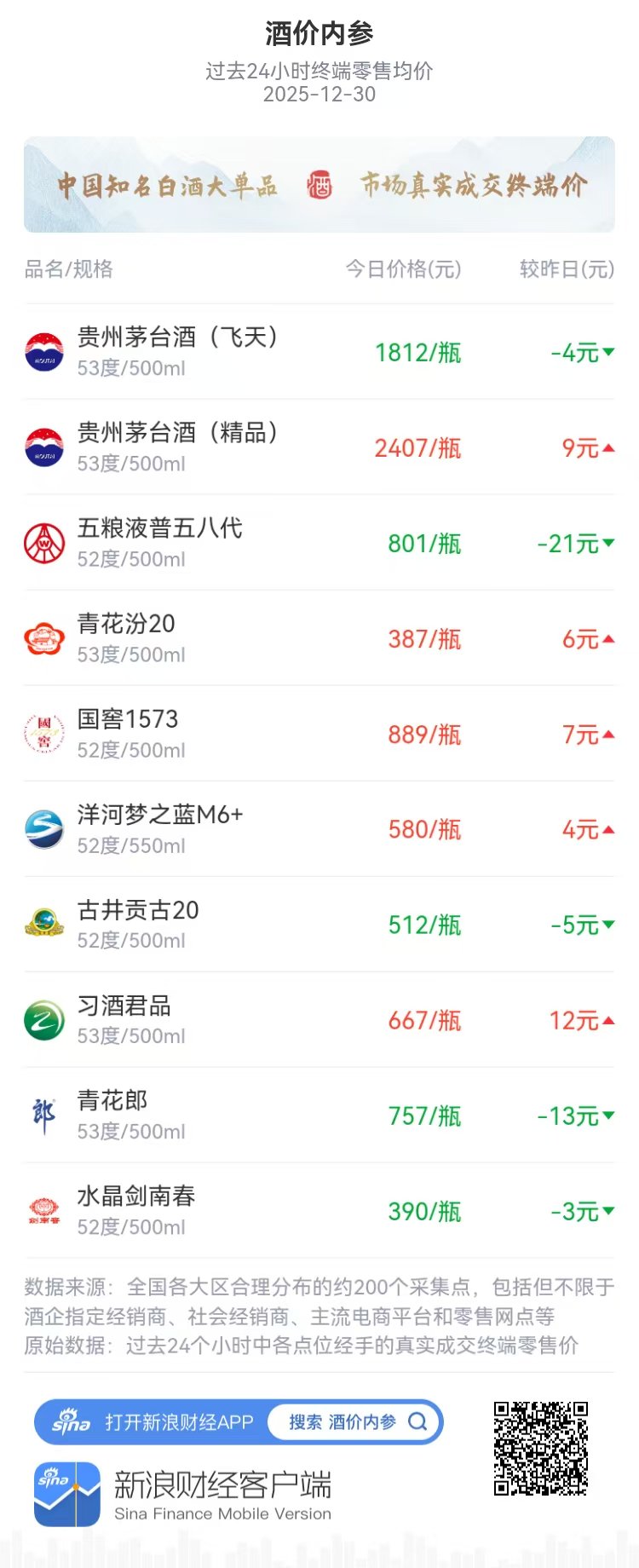
Group 1 - The core viewpoint of the article highlights Shanxi Fenjiu's resilience and growth in a challenging environment for the liquor industry, achieving a 2% increase in enterprise value to 245 billion yuan, ranking it alongside Haitian Flavoring as the fourth in the 2025 Hurun China Food Industry Top 100 list [1][2] - The total value of the top 100 companies in the list reached 7.2 trillion yuan, with the threshold for entry rising to 9 billion yuan, indicating a trend of increasing concentration among leading firms [2] - The liquor industry is facing its most severe adjustment in a decade, with an average inventory turnover period of 900 days, and the number of listed liquor companies decreasing by three compared to the previous year [2] Group 2 - Shanxi Fenjiu reported revenue of 32.924 billion yuan and a net profit of 11.405 billion yuan for the first three quarters of 2025, reflecting year-on-year growth of 5% and 0.48%, respectively, making it one of the few leading liquor companies to maintain positive growth [2] - The company's product strategy, which includes a focus on "Qinghua," strengthening mid-tier products, and stabilizing glass Fen, has created a healthy growth pyramid, while its national strategy "Qingxiang Tianxia" has driven a 12.72% increase in revenue from markets outside its home province [2] - The food industry is undergoing a clear transformation towards "health and innovation," with a reduction in the number of liquor and meat product companies, while dairy and agricultural enterprises are gaining a larger share [3]
“茅五泸汾洋”重挫,食品饮料ETF华宝(515710)收跌0.84%!茅台董事长喊话“穿越周期”,配置时机渐显?
Xin Lang Cai Jing· 2025-12-29 14:18
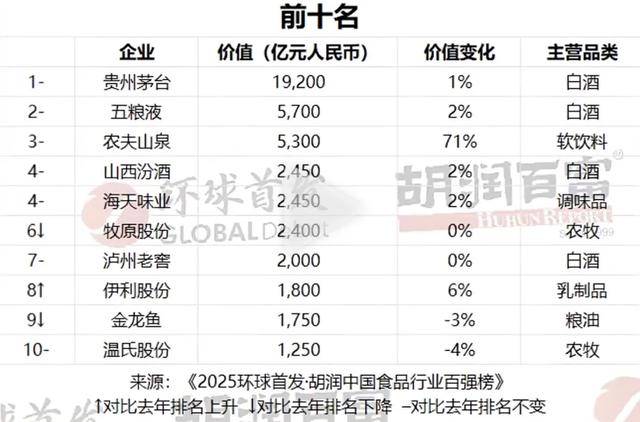
Group 1: Market Performance - The food and beverage sector experienced a decline on December 29, with the Food and Beverage ETF Huabao (515710) opening lower and dropping over 1% during the day, ultimately closing down 0.84% [1][8] - Major consumer goods and some liquor stocks performed poorly, with Miaokelan falling by 9.28%, and both Gujing Gongjiu and Jinhai Industrial dropping over 3% [1][8] Group 2: Industry Insights - The chairman of Moutai Group announced at a conference that the primary marketing task for Moutai liquor in 2026 is to focus on consumer needs and promote market-oriented transformation [1][10] - The overall liquor industry is currently in a deep adjustment phase, facing challenges such as high channel inventory and slowing growth rates, but Moutai is optimistic about navigating these challenges [3][10] - The valuation of the food and beverage sector is at a historical low, with the PE ratio of the underlying index for the Food and Beverage ETF Huabao at 20.19, placing it in the 5.77% percentile of the last decade, indicating a potential opportunity for long-term investment [3][11] Group 3: Future Outlook - Analysts predict that the demand for liquor will remain subdued in 2025, continuing the trend of weak seasonal demand, which may lead to further declines in liquor prices [4][11] - The liquor sector is entering a more favorable configuration zone, with expectations that any improvement in supply and demand could act as a catalyst for recovery [5][11] - The Food and Beverage ETF Huabao is recommended for investors looking to allocate to core assets in the food and beverage sector, with a significant portion of its holdings in leading liquor stocks [5][12]

食品饮料行业周度更新:大众品需求边际回暖,餐供链板块周度领涨-20251229
Changjiang Securities· 2025-12-29 11:29
Investment Rating - The industry investment rating is "Positive" and is maintained [9] Core Viewpoints - The liquor sector is experiencing a phase of "supply optimization and weak demand recovery," with inventory destocking expected to continue in Q4. Short-term price recovery is anticipated due to Moutai's controlled supply, with attention on Spring Festival sales and inventory turnover [2][5] - Demand for mass consumer goods is expected to show marginal recovery, with January anticipated to see a strong start due to delayed Spring Festival stocking [2][5] - The latest recommended companies include Ganhe Weiye, Guoquan, Anqi Yeast, Babi Foods, Ligao Foods, Wancheng Group, Anjii Foods, Kuaijishan, Shanxi Fenjiu, Yanghe, and Guizhou Moutai [2][5] Summary by Sections Production Data - In November, the industry production data revealed that meat and soft drinks led the growth, with meat production increasing by 16.3% and soft drinks by 0.4%. Other categories, such as alcoholic beverages, continue to face downward pressure [4][16] - Non-alcoholic categories showed stable production growth, with notable increases in fresh and chilled meat production, driven by declining prices of core items like pork, stimulating demand [20] Market Review - Since the beginning of the year, the Food and Beverage (Yangtze) Index has decreased by 4.22%, underperforming compared to the CSI 300. The market has seen significant differentiation, particularly in Q2 and Q3, due to consumption scene restrictions and a trend towards cost-effective consumption preferences [6][28] - In the past week, the restaurant supply chain sector (including food and condiments) has outperformed, while the liquor sector (including beer and wine) has shown relatively weak performance [6][28] Industry Dynamics - Companies in the soft drink sector are focusing on core categories to enhance competitiveness, such as Yuanqi Forest divesting its dairy business to concentrate on tea and sparkling water. Cross-industry innovations are also being explored, with new products like rice whiskey targeting specific dining scenarios [7][34] - Digital transformation and employee incentives are driving channel changes, with integrated online and offline strategies becoming mainstream. Companies like Luckin Coffee and Three Squirrels are rapidly expanding into high-traffic areas [7][34]
18只白酒股下跌 贵州茅台1402.00元/股收盘
Bei Jing Shang Bao· 2025-12-29 09:48
Core Viewpoint - The recent performance of the liquor sector, particularly the leading companies, indicates a strategic shift towards inventory control and channel adjustments to ensure long-term health in the industry [1] Group 1: Market Performance - The Shanghai Composite Index closed at 3965.28 points, up 0.04% [1] - The liquor sector index closed at 2184.11 points, down 1.16%, with 18 liquor stocks declining [1] - Notable individual stock performances include: - Kweichow Moutai at 1402.00 CNY/share, down 0.86% [1] - Wuliangye at 108.06 CNY/share, down 1.57% [1] - Shanxi Fenjiu at 175.00 CNY/share, down 1.52% [1] - Luzhou Laojiao at 117.21 CNY/share, down 1.83% [1] - Yanghe Brewery at 61.47 CNY/share, down 1.06% [1] Group 2: Industry Insights - CITIC Securities reports that leading liquor companies are holding important meetings to express their commitment to adjustments, reforms, and channel rebalancing, which is beneficial for the industry's long-term health [1] - Since the fourth quarter of this year, major liquor companies have implemented measures such as controlling shipments, reducing burdens on distributors, and promoting sales to lower channel inventory [1] - Considering the stabilization of sales and various factors including the consumption scenarios during the Spring Festival, actual liquor sales during the 2026 Spring Festival are expected to remain stable [1]
观酒 头部酒企集体押注低度化,白酒降度能让年轻人买账吗?
Nan Fang Du Shi Bao· 2025-12-29 07:29
Core Insights - The Chinese liquor industry is undergoing significant transformation in 2025, driven by high channel inventory and weak terminal sales, alongside new opportunities arising from changing policies, consumption patterns, and scenarios [1] - The trend towards "lower alcohol content" is becoming mainstream, with major liquor companies launching new low-alcohol products to attract younger consumers [3][4] Industry Trends - The low-alcohol wave in the liquor industry has evolved from sporadic attempts to a concentrated effort, with major brands like Wuliangye and Luzhou Laojiao leading the charge [4][10] - Wuliangye's launch of the 29-degree "Wuliangye·Yijianqingxin" has set a precedent, achieving over 100 million yuan in sales within two months [4] - Other companies, such as Shede and Gujing Gongjiu, are also introducing low-alcohol products targeting specific consumption scenarios, indicating a shift in marketing strategies [6][8] Consumer Behavior - The shift towards low-alcohol products is largely driven by generational changes in consumer behavior, with younger consumers preferring lighter, more comfortable drinking experiences [11][13] - The younger demographic, particularly those born between 1985 and 1994, now constitutes a significant portion of the liquor consumer base, leading to a demand for products that align with their lifestyle [11] Market Dynamics - The industry is facing challenges such as high inventory levels and sluggish sales, prompting companies to seek new growth avenues through low-alcohol offerings [13] - The trend towards lower alcohol content is also seen as a response to increasing health consciousness among consumers, who are more sensitive to the burdens of alcohol consumption [13][14] Strategic Implications - The low-alcohol trend is not merely about reducing alcohol content but involves a comprehensive restructuring of product offerings, including fruit wines and sparkling liquors [10][14] - Companies are exploring international markets for low-alcohol products, which may facilitate cultural export and align with global drinking preferences [14] Challenges Ahead - Despite the momentum, the industry faces the challenge of ensuring that lower alcohol products resonate with younger consumers, who may not be willing to pay for them if they lack flavor innovation [15][16] - The need for emotional connection and cultural relevance remains critical, as traditional liquor culture may alienate younger consumers [15][17]


汾酒·龙尊”,以风味与文化“汾享全球
Feng Huang Wang Cai Jing· 2025-12-29 04:32
Core Viewpoint - The Chinese liquor industry is experiencing a surge in overseas expansion despite a challenging domestic market, but the absolute sales figures from international markets remain minimal compared to total sales [1] Group 1: Current Challenges in Overseas Expansion - The trend of "famous liquor leading, small brands banding together" has characterized the overseas expansion of Chinese liquor, with major brands leveraging high-end products and resources while smaller brands struggle for market share [1] - The high-end focus of Chinese liquor exports limits the target audience to affluent consumers, making it difficult to achieve significant sales growth [1] Group 2: New Strategies for Market Penetration - A comprehensive product range covering high, medium, and low-end offerings is essential for capturing new markets, particularly with affordable products that appeal to unfamiliar consumers [2] - The launch of "Fenjiu Longzun" by Fenjiu Group aims to create an accessible product that lowers the trial cost for consumers, enhancing the opportunity for broader market penetration [3] Group 3: Product Advantages of "Fenjiu Longzun" - "Fenjiu Longzun" is expected to be priced affordably, similar to the previous export version priced around 10 USD, making it more accessible to a wider audience [3] - The product balances traditional Chinese liquor flavors with modifications to enhance aroma and smoothness, making it more appealing to international consumers [3] - The design of "Fenjiu Longzun" aligns with international aesthetic standards, featuring elegant packaging that enhances its marketability across various consumption scenarios [4] Group 4: Cultural Significance and Marketing - The cultural heritage of Chinese liquor, particularly the 4,000-year history of Qingxiang Fenjiu, serves as a fundamental driver for its global appeal [5] - Fenjiu plans to utilize national events and innovative marketing strategies to promote its cultural narrative and engage with both high-end and younger consumer segments [6]

一杯“青花汾酒·龙尊”,半部中外文明交流史
Feng Huang Wang Cai Jing· 2025-12-29 04:32
Core Perspective - The article highlights the cultural and historical significance of "Qinghua Fenjiu Longzun," portraying it as a medium of dialogue between Eastern and Western civilizations, encapsulating a rich legacy of trade and cultural exchange [1][8]. Group 1: Historical Significance - Fenjiu's journey began 800 years ago with the Mongolian westward expansion, marking the start of large-scale connectivity between Asia and Europe [2]. - The "Wanli Tea Road," established by merchants during the Ming and Qing dynasties, positioned Fenjiu as a "liquid gold" that facilitated trade across a 13,000-kilometer route from Fujian to Moscow [2]. - Fenjiu's international recognition was solidified at the 1915 Panama International Exposition, where it won a first-class medal, earning praise from former U.S. President Roosevelt [2][3]. Group 2: Cultural Exchange - Fenjiu has evolved from a mere product to a cultural symbol, as evidenced by Indian poet Tagore's remarks during a banquet in 1924, highlighting its role in fostering Sino-Indian cultural ties [3]. - The historical trajectory of Fenjiu illustrates its transformation from a trade commodity to a benchmark of quality in international exhibitions and a medium for cultural dialogue [3]. Group 3: Modern Interpretation - "Qinghua Fenjiu Longzun" embodies contemporary interpretations of cultural dialogue, with its design and flavor reflecting a blend of Eastern and Western aesthetics [4]. - The production process maintains traditional techniques while ensuring international appeal, characterized by a "clean, refreshing, and pure" flavor profile that resonates globally [4][5]. - The packaging design integrates elements of both Chinese and European cultures, symbolizing a cross-cultural expression of luxury and heritage [5]. Group 4: Role as a Cultural Medium - Fenjiu serves as a vessel of Chinese culture, encapsulating historical narratives and the spirit of the Chinese nation, while also acting as a medium for cross-cultural understanding [7]. - The vision of "Longteng Sihai, Xiangpiao Shijie" reflects the aspiration for deeper integration between China and the world, emphasizing the shared experience of enjoying Fenjiu [7][8]. - The narrative of "Qinghua Fenjiu Longzun" illustrates that cultural exchange is a two-way street, blending local heritage with global influences [8].