
YILI(600887)

Search documents
段永平再发声!吃喝板块继续上攻,食品ETF(515710)日线四连阳!机构:或可关注食饮板块左侧布局窗口
Xin Lang Ji Jin· 2025-11-12 11:45
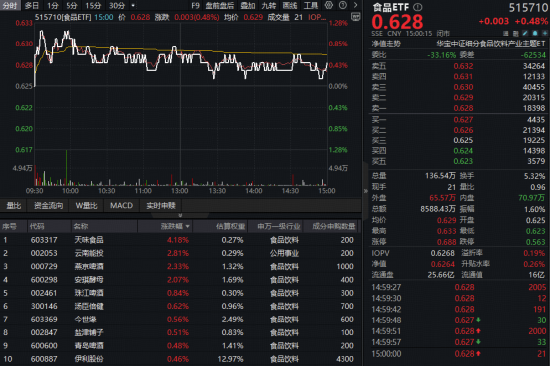
Core Viewpoint - The food and beverage sector continues to rise, with the Food ETF (515710) showing a positive trend and notable gains in key stocks like Tianwei Food and Guizhou Moutai [1][3]. Group 1: Market Performance - The Food ETF (515710) experienced a daily increase of 0.48%, marking its fourth consecutive day of gains, with an intraday peak increase of 1.28% [1]. - Major consumer goods stocks led the gains, with Tianwei Food rising by 4.18%, and other companies like Yunnan Energy Investment and Yanjing Beer also showing significant increases [1][2]. Group 2: Key Holdings - Guizhou Moutai is the largest holding in the Food ETF (515710), accounting for 14.89% of the fund's net asset value as of Q3 2025 [3][4]. - Other significant holdings include Wuliangye and Yili Group, with respective holdings of 14.65% and 12.49% [4]. Group 3: Valuation Insights - The food and beverage sector is currently at a historical low valuation, with the Food ETF's underlying index P/E ratio at 21.21, placing it in the 11.74% percentile over the past decade, indicating a favorable long-term investment opportunity [4][5]. - The liquor sector has undergone five years of adjustment, with current market sentiment improving as companies adjust their operational strategies [5][6]. Group 4: Future Outlook - Analysts suggest that the food and beverage sector is entering a potential recovery phase, with a focus on new consumption trends and low valuations [6]. - The Food ETF (515710) is recommended for investors looking to capitalize on core assets in the food and beverage sector, with a significant portion of its holdings in high-end liquor and dairy products [6].




直击进博会| 全球巨头共创潮流
盐财经· 2025-11-12 10:25
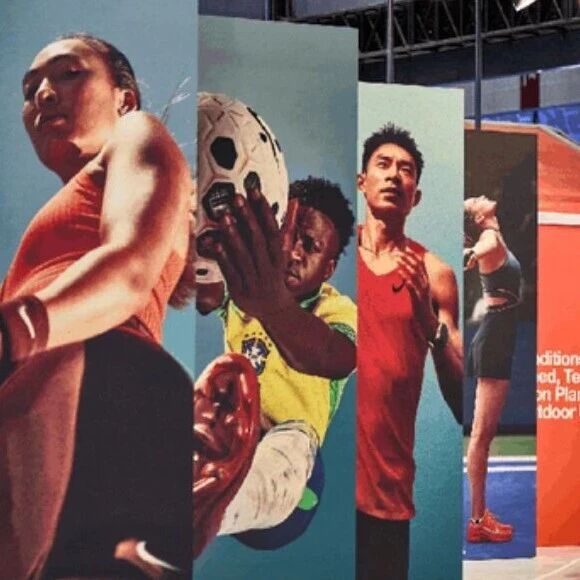
Group 1 - Nike showcased its innovative technology at the Expo, emphasizing its commitment to the Chinese market with the launch of the ICON. Shanghai creative center, marking its first outside the US [3][5] - The introduction of products like the Nike Mind shoes and G.T. Cut 4 basketball shoes highlights the integration of neuroscience and performance-driven design [5] - Nike's participation reflects its strategy to connect with local consumers and enhance China's sports industry [5] Group 2 - Ombra's smart viewing pavilion gained popularity at the Expo, featuring a fourth-generation model with a hidden air conditioning system and a 25.6% green photovoltaic conversion rate [8] - The pavilion attracted significant attention from government representatives and international guests, leading to increased order volumes compared to the previous year [8] Group 3 - Crocs emphasized its "Born Free" philosophy, showcasing collaborations with local brands and launching winter products, including the velvet whale series [11] - The brand's interactive activities at the Expo engaged visitors, reinforcing its connection with the Gen Z consumer base in China [11] Group 4 - Panasonic presented its AI strategy at the Expo, focusing on enhancing user experience through smart home products and supporting industrial needs with AI computing devices [14] - The company signed six strategic cooperation agreements during the event, indicating its commitment to local innovation and development [14] Group 5 - Nuance Audio debuted its innovative hearing glasses at the Expo, designed for individuals with mild to moderate hearing loss, combining functionality with aesthetics [17] - The product features advanced open-ear technology and has received multiple international awards, showcasing its market readiness [17] Group 6 - Amorepacific celebrated its 80th anniversary at the Expo, presenting nearly 300 products, including over 20 new launches specific to the Chinese market [21] - The brand's focus on e-commerce and sustainability reflects its commitment to innovation and social responsibility in China [21] Group 7 - Hitachi introduced a new brand image at the Expo, focusing on green energy, smart cities, and advanced technology manufacturing [24] - The company aims to deepen its collaboration in China, promoting sustainable development through integrated IT and operational technology solutions [25] Group 8 - Schneider Electric showcased its "China Center" strategy at the Expo, highlighting its commitment to innovation and AI technology applications [28] - The company reported a 26% increase in signed contracts compared to the previous year, demonstrating its market appeal [28] Group 9 - Ausnutria presented six new products at the Expo, emphasizing its "Science + Empowerment + Internationalization" strategy [29] - The company aims to leverage its global R&D system to enhance its presence in the international dairy market [29] Group 10 - Yili highlighted its commitment to quality at the Expo, showcasing its New Zealand-sourced milk products and emphasizing its stringent quality control measures [33] - The brand aims to expand its global health ecosystem through high-quality dairy products [33] Group 11 - Johnson Health Tech introduced its AI and IoT home fitness ecosystem at the Expo, featuring a comprehensive health management solution [35] - The company has achieved significant international engagement, with over 1.8 billion yuan in intended contracts from previous exhibitions [36] Group 12 - Eli Lilly announced multiple collaborations at the Expo, focusing on clinical research and digital transformation in chronic disease management [38] - The company aims to enhance public health awareness through various outreach initiatives [38] Group 13 - BD Medical showcased its innovative medical solutions at the Expo, including localized products and collaborative efforts with industry partners [41] - The company aims to contribute to the development of China's healthcare sector through its "Smart Healthcare 2025" strategy [42]


11月12日投资时钟(399391)指数跌0.01%,成份股华侨城A(000069)领跌
Sou Hu Cai Jing· 2025-11-12 10:04
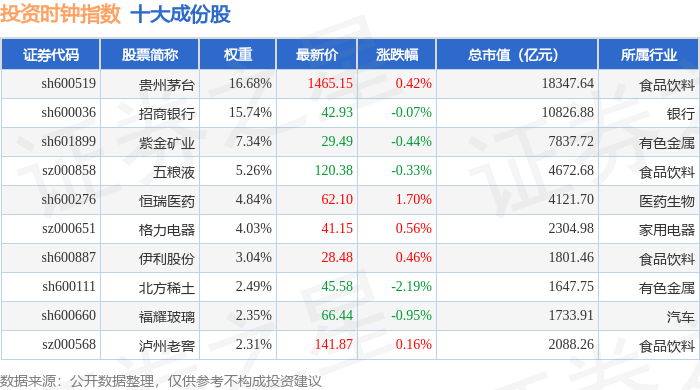
Core Viewpoint - The Investment Clock Index (399391) closed at 3417.47 points, down 0.01%, with a trading volume of 89.182 billion yuan and a turnover rate of 0.94% on November 12 [1] Group 1: Index Performance - Among the constituent stocks of the Investment Clock Index, 28 stocks rose while 71 stocks fell, with China Aluminum leading the gainers at a 6.65% increase and Overseas Chinese Town A leading the decliners at a 4.1% decrease [1] - The top ten constituent stocks of the Investment Clock Index include Kweichow Moutai, China Merchants Bank, and others, with Kweichow Moutai holding the highest weight at 16.68% [1] Group 2: Stock Details - Kweichow Moutai's latest price is 1465.15 yuan, with a slight increase of 0.42% [1] - China Merchants Bank's latest price is 42.93 yuan, with a minor decrease of 0.07% [1] - The total market capitalization of Kweichow Moutai is approximately 183.48 billion yuan, while China Merchants Bank's market cap is around 108.27 billion yuan [1] Group 3: Capital Flow - The net outflow of main funds from the constituent stocks totaled 2.074 billion yuan, while retail investors saw a net inflow of 1.909 billion yuan [1] - The detailed capital flow indicates that China Aluminum had a net inflow of 390 million yuan from main funds, while it experienced a net outflow of 278.5 million yuan from speculative funds [2]




饮料乳品板块11月12日涨0.43%,三元股份领涨,主力资金净流出9697.31万元
Zheng Xing Xing Ye Ri Bao· 2025-11-12 08:42
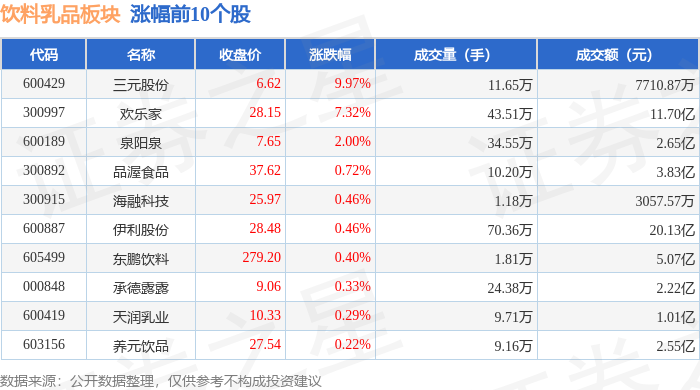
Core Insights - The beverage and dairy sector experienced a slight increase of 0.43% on November 12, with San Yuan leading the gains [1] - The Shanghai Composite Index closed at 4000.14, down 0.07%, while the Shenzhen Component Index closed at 13240.62, down 0.36% [1] Stock Performance - San Yuan (600429) saw a closing price of 6.62, with a significant increase of 9.97% and a trading volume of 116,500 shares, amounting to 77.11 million yuan [1] - Huanle Jia (300997) closed at 28.15, up 7.32%, with a trading volume of 435,100 shares, totaling 1.17 billion yuan [1] - Other notable performers include Quan Yang Quan (681009) with a 2.00% increase, and Yi Li (600887) with a 0.46% increase [1] Capital Flow - The beverage and dairy sector saw a net outflow of 96.97 million yuan from institutional investors, while retail investors contributed a net inflow of 291 million yuan [2] - The capital flow data indicates that major stocks like Yi Li (600887) experienced a net inflow of 77.74 million yuan from institutional investors, despite a net outflow from retail investors [3] - San Yuan (600429) had a net inflow of 29.83 million yuan from institutional investors, but also faced significant outflows from retail investors [3]


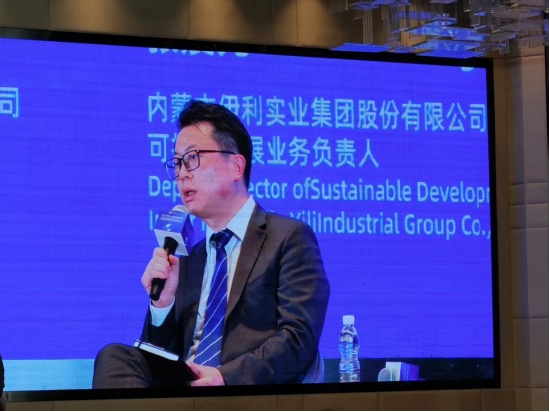
内蒙古伊利实业集团张晨光:ESG信息披露法制化助力企业跨境沟通,伊利推进排放数据全面数字化升级
Xin Lang Zheng Quan· 2025-11-12 07:33
Core Insights - The discussion at the Shanghai Stock Exchange International Investor Conference highlighted the transition of ESG information disclosure in China towards a more legal and standardized phase, presenting an opportunity for companies to reduce communication costs [1][3]. Group 1: ESG Disclosure and Regulations - The new sustainable information disclosure regulations from the Shanghai Stock Exchange align with international standards, enhancing data comparability and aiding foreign capital in understanding Chinese enterprises [3]. - Since 2025, an increasing number of investors have begun to reference the data disclosed in corporate sustainability reports, closely linked to the ongoing improvements in the Shanghai Stock Exchange regulations [3]. Group 2: Company Practices and Challenges - The main challenge for Inner Mongolia Yili Industrial Group is integrating a high-quality data management system with existing management systems, which tests both the precision of daily management and the commitment to long-term sustainable development [3]. - By 2025, Yili has fully upgraded its greenhouse gas emissions digital system, connecting various segments such as farms, storage, logistics, and raw materials, laying a solid foundation for future Scope 3 disclosures and sustainability report verification [3].
进博会消费观察|伊利强化“全家奶粉”布局,Westgold牧恩原罐进口奶粉亮相进博会
Jing Ji Guan Cha Bao· 2025-11-11 15:00
Core Insights - Yili is enhancing its "family milk powder" strategy by showcasing its products at the 8th China International Import Expo, emphasizing high-quality dairy products and adult nutrition [1][2] - The Westgold brand, under Yili, is introducing a new cold-soluble formula for its New Zealand imported milk powder, addressing convenience issues associated with traditional milk powder [1] Group 1: Product Development - Yili's Westgold New Zealand imported milk powder is designed to be easily mixed with water at temperatures between 25-37°C, improving user convenience [1] - The new packaging features an innovative spoon-cap design that resolves common issues such as difficulty in finding the spoon and keeping it clean [1] Group 2: Market Positioning - The introduction of Westgold milk powder fills a gap in Yili's high-end imported milk powder market, reinforcing its leading position in the family milk powder sector [2] - The Westgold brand has a rich history dating back to 1893 and is associated with high standards of dairy farming, including 365-day outdoor grazing and AQ grass-fed certification [2]
饮料不好卖了
2 1 Shi Ji Jing Ji Bao Dao· 2025-11-11 13:06
Group 1 - The beverage market is entering a contraction phase, with overall sales down 9% year-on-year in September, and offline channel sales down 10.4% [1] - Uni-President China reported that its overall revenue remained flat year-on-year in Q3, with beverage business revenue declining in the low single digits, while food business revenue grew in the mid to low single digits [2] - The dairy market is also facing challenges, with ready-to-drink tea beverages substituting liquid milk products, particularly impacting packaged liquid milk sales [3] Group 2 - Beverage production in China showed a significant weakening trend in Q3 compared to the first half of the year, with soft drink production declining by 0.17%, 6.79%, and 10.12% year-on-year in July, August, and September respectively [4] - Adverse weather conditions, including typhoons and heavy rain, may have also impacted beverage sales, although the external competition from food delivery services is becoming more manageable [5]
食品饮料行业第三季报总结报告:酒类渠道包袱加速去化,大众品品类表现分化
Guoxin Securities· 2025-11-11 09:48
Core Insights - The leading companies in the mass-market segment are stabilizing, while the liquor industry is experiencing accelerated pressure release, reinforcing market share logic [4][10][19] - The food and beverage industry is expected to show stable overall volume with structural differentiation by 2025, with Q1/Q2/Q3 revenues growing by +2.5%/+2.4%/-4.77% year-on-year, and net profits declining by +0.3%/-2.1%/-14.6% [4][12] - The liquor sector is entering an adjustment phase, with a consensus on deceleration in 2024, as most companies face declining performance in Q3 [4][19][39] Liquor Sector - In Q3 2025, the liquor sector's revenue and net profit declines are widening, with total revenue of 3,202 billion yuan, down 5.8% year-on-year, and net profit of 1,126 billion yuan, down 6.9% year-on-year [19][35] - The Q3 revenue for the liquor sector dropped to 787.2 billion yuan, a year-on-year decline of 18.4%, with net profit at 280.1 billion yuan, down 22.2% [19][39] - Major liquor companies are experiencing cash flow pressures, with a significant drop in sales receipts, indicating a slowdown in operational pace [40] Mass-Market Segment - The mass-market segment is benefiting from proactive inventory reduction and macro policy support, leading to improved operations for leading companies in 2025 [4][12] - Specific high-demand categories such as sugar-free tea, functional beverages, and bulk snacks are showing strong growth, with leading companies like Nongfu Spring and Dongpeng Beverage achieving significant revenue increases [4][12] - The snack sector reported a Q3 revenue growth of 22.4% year-on-year, despite rising costs from raw materials [4][12] Investment Recommendations - The report suggests focusing on liquor and restaurant supply chains, particularly companies like Kweichow Moutai, Luzhou Laojiao, and Shanxi Fenjiu, which are expected to benefit from policy sensitivity [4][12] - Stronger companies in the mass-market segment, such as Nongfu Spring and Yanjing Beer, are also recommended for investment due to their robust performance [4][12] Financial Performance - The Q3 2025 financial performance of major liquor companies shows a significant decline in net profit margins, with only Kweichow Moutai recording a slight improvement in net profit margin due to better gross margin management [35][39] - The overall gross margin for the liquor sector has decreased, reflecting intensified competition and a shift in product mix towards lower-priced offerings [31][33]


饮料乳品板块11月11日涨1.02%,欢乐家领涨,主力资金净流出1.27亿元
Zheng Xing Xing Ye Ri Bao· 2025-11-11 08:37
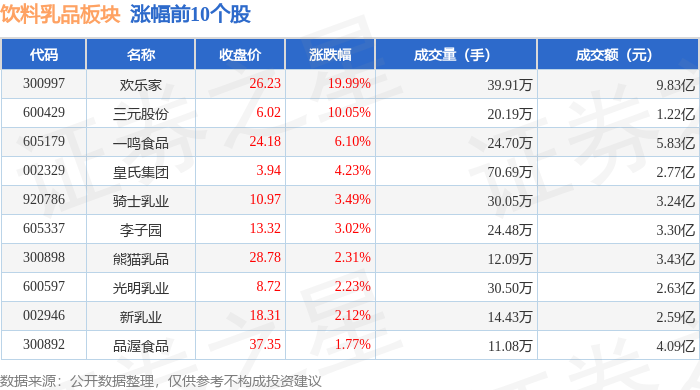
Core Viewpoint - The beverage and dairy sector experienced a 1.02% increase on November 11, with Huanlejia leading the gains, while the overall market indices, Shanghai Composite and Shenzhen Component, saw declines of 0.39% and 1.03% respectively [1] Group 1: Market Performance - The beverage and dairy sector's notable gain was primarily driven by Huanlejia, which surged by 19.99% to a closing price of 26.23 [1] - Other significant performers included Sanyuan Shares, which rose by 10.05% to 6.02, and Yiming Foods, which increased by 6.10% to 24.18 [1] - The overall trading volume for Huanlejia reached 399,100 shares, contributing to a transaction value of approximately 9.83 billion [1] Group 2: Capital Flow - The beverage and dairy sector saw a net outflow of 127 million from institutional investors, while retail investors contributed a net inflow of 155 million [2] - Notable individual stock capital flows included Yiming Foods with a net inflow of approximately 55.66 million from institutional investors, despite a net outflow from retail investors [3] - Sanyuan Shares also experienced a net inflow of 15.64 million from institutional investors, indicating strong interest from this segment [3]


消费赛道复苏预期升温 多只消费股估值具备优势
Zheng Quan Shi Bao· 2025-11-10 23:10
Core Viewpoint - The consumer sector is experiencing a collective rebound, driven by government policies aimed at boosting consumption and supporting key industries [1][3]. Group 1: Market Performance - As of November 10, 2023, various consumer indices, including food and beverage, beauty care, and retail, have shown less than 10% growth year-to-date, underperforming the Shanghai Composite Index [2]. - The food and beverage sector has been the weakest performer, with its index in a downward trend for the year [2]. Group 2: Institutional Outlook - Institutions are becoming increasingly optimistic about the future performance of the consumer sector, with several brokerages identifying potential investment opportunities [3]. - Open Source Securities notes that the food and beverage sector is nearing a bottom, with recovery expectations rising as negative factors have largely been released and policy impacts are slowing [3]. - Huachuang Securities highlights that service consumption is in a transformative phase, with strong policy support expected to make it a key investment theme [3]. - Galaxy Securities emphasizes the importance of enhancing consumer power and expanding quality consumption supply during the 14th Five-Year Plan period, as new consumption trends emerge [3]. Group 3: Valuation and Stock Performance - Many consumer stocks are currently seen as undervalued, with 123 stocks having a rolling P/E ratio below 30 and underperforming the Shanghai Composite Index year-to-date [4]. - Notable large-cap stocks include Kweichow Moutai, Midea Group, and Wuliangye, among others [4]. - 23 stocks have seen a cumulative decline of over 10% this year, with Ganyuan Food experiencing the largest drop at 33.79% [4]. Group 4: Future Growth Potential - From an institutional perspective, 43 of the 123 identified consumer stocks have an upside potential exceeding 20% based on consensus target prices [5]. - Proya Cosmetics leads with a projected upside of 49.05%, supported by its international expansion plans [5]. - Xueda Education follows with an expected upside of 48.6%, driven by its clear business expansion strategy in personalized education [5][6].
