
CNOOC(600938)

Search documents
资金动向 | 北水抛售阿里超21亿港元,连续10日加仓小米!
Ge Long Hui· 2025-10-17 10:44
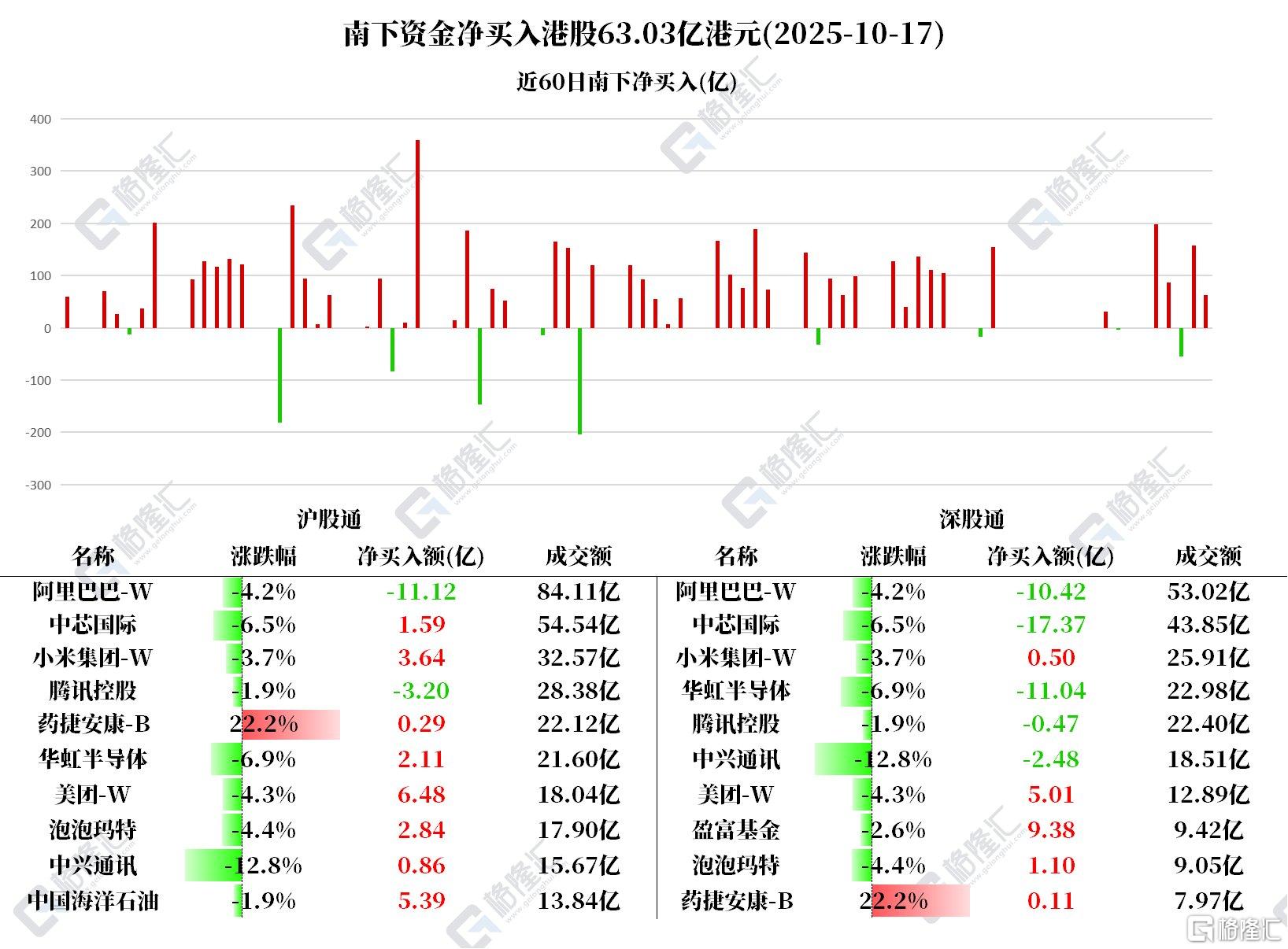
Core Insights - Southbound funds net bought Hong Kong stocks worth 6.303 billion HKD on October 17, with significant purchases in Meituan, the Tracker Fund, and CNOOC, while Alibaba and SMIC saw substantial net sell-offs [1][4]. Group 1: Stock Performance - Meituan saw a net buy of 1.149 billion HKD, with a price increase of 4.3% [1][4]. - Xiaomi Group had a net buy of 414 million HKD, with a price decrease of 3.7% [1][4]. - Alibaba experienced a net sell of 2.153 billion HKD, with a price drop of 4.2% [1][4]. - SMIC faced a net sell of 1.578 billion HKD, with a price decline of 6.5% [1][4]. - Continuous net buying of Xiaomi for 10 days totals 7.40256 billion HKD, and 4 days for Pop Mart totals 1.46812 billion HKD [4]. Group 2: Company Developments - Meituan announced a "Service Retail Assistance Fund" plan, allocating 1.2 billion HKD to support over 120,000 quality service retailers [6]. - Xiaomi's founder highlighted AI models as a future trend in smart connected vehicles, emphasizing the integration of various sensors for enhanced user interaction [6]. - UBS maintains a "Buy" rating for Pop Mart, predicting that upcoming sales data and new product launches will act as short-term catalysts [7]. - Alibaba's revenue forecast for FY26Q2 is 126.9 billion CNY, with a year-on-year growth of 11.6% [7]. - Semiconductor companies like SMIC and Huahong Semiconductor are facing market concerns about AI investment bubbles, but overall sentiment remains optimistic [8]. Group 3: Regulatory and Market Environment - The FCC has removed millions of Chinese electronic products from major e-commerce platforms, affecting companies like ZTE [9]. - The market is closely monitoring the FCC's potential expansion of bans on devices containing components from blacklisted companies [9].





油气开采板块10月17日跌1.63%,XD中国海领跌,主力资金净流出1.17亿元
Zheng Xing Xing Ye Ri Bao· 2025-10-17 08:37
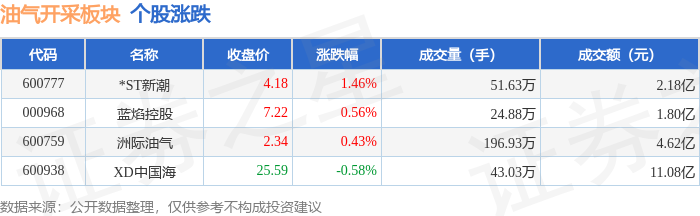
Core Points - The oil and gas extraction sector experienced a decline of 1.63% on October 17, with XD China Sea leading the drop [1] - The Shanghai Composite Index closed at 3839.76, down 1.95%, while the Shenzhen Component Index closed at 12688.94, down 3.04% [1] Sector Performance - The oil and gas extraction sector saw a net outflow of 117 million yuan from main funds, while retail investors contributed a net inflow of 43.72 million yuan [1] - Key stocks in the sector included: - *ST Xinchao: Closed at 4.18, up 1.46%, with a trading volume of 516,300 shares [1] - Blue Flame Holdings: Closed at 7.22, up 0.56%, with a trading volume of 248,800 shares [1] - Intercontinental Oil and Gas: Closed at 2.34, up 0.43%, with a trading volume of 1,969,300 shares [1] - XD China Sea: Closed at 25.59, down 0.58%, with a trading volume of 430,300 shares [1] Fund Flow Analysis - Main funds showed a significant outflow from XD China Sea, amounting to 103 million yuan, representing a net outflow of 9.29% [2] - Retail investors showed a net inflow of 50.23 million yuan into XD China Sea, indicating some interest despite the overall decline [2] - The overall fund flow in the sector indicates a mixed sentiment among different types of investors, with main funds pulling back while retail investors remained active [2]


《油气管网设施公平开放监管办法》11月1日施行 打破油气管网设施垄断壁垒
Zheng Quan Ri Bao Wang· 2025-10-17 01:30
Core Viewpoint - The newly released "Regulatory Measures for Fair Access to Oil and Gas Pipeline Facilities" marks a significant step in regulating natural monopoly sectors in the energy field, expanding oversight from electricity to all types of energy [1][4]. Summary by Relevant Sections Regulatory Framework - The "Regulatory Measures" will take effect on November 1, 2025, and aim to enhance the operational mechanisms of oil and gas pipeline facilities, which are critical in connecting upstream and downstream sectors [1]. - The measures are designed to implement the Energy Law's requirements, ensuring that energy transmission network operators provide fair and non-discriminatory access to qualified enterprises [1][2]. Key Provisions - The measures introduce new clauses regarding user registration and service acceptance, mandating operators to establish specific procedures and conditions for user registration and service allocation [2]. - A new penalty clause has been added, detailing nine violations by pipeline operators and five violations by users, with corresponding penalties to enhance enforcement capabilities [2][3]. - Information disclosure requirements have been modified, categorizing information related to fair access into different levels of public disclosure, balancing transparency with operational security [2][3]. Impact on Industry - The measures are expected to dismantle monopolistic barriers in the pipeline sector, fostering a fair competitive environment and improving the efficiency of energy resource allocation [4]. - The initiative supports the construction of a unified national market, promoting the free flow of resources and transparent rules, which is crucial for the high-quality development of the oil and gas industry [4].
国家油气管网新规11月施行 民营企业使用油气管网设施将更公平更便利
Shang Hai Zheng Quan Bao· 2025-10-16 19:01
Core Viewpoint - The newly released "Regulatory Measures for Fair and Open Access to Oil and Gas Pipeline Facilities" aims to enhance the fairness and transparency of oil and gas pipeline services, establishing a legal framework that supports market-oriented reforms in the energy sector [1][5]. Group 1: Regulatory Framework - The "Regulatory Measures" will take effect on November 1, 2025, and clarify that pipeline operating companies are responsible for providing fair and non-discriminatory services to eligible users [1][2]. - The new regulations elevate the legal status of previous normative documents by introducing penalties for violations, thereby strengthening the enforcement of energy sector laws [1][5]. Group 2: Market Structure and Efficiency - The establishment of the National Pipeline Group marks a fundamental change in the oil and gas market structure, with a total pipeline length of approximately 108,000 kilometers, covering 30 provinces and regions [2][3]. - The implementation of the "Regulatory Measures" is expected to significantly improve the efficiency of oil and gas pipeline utilization, allowing for a more diverse range of upstream resources to access the main pipeline network [4][6]. Group 3: Compliance and Penalties - The "Regulatory Measures" introduce administrative penalties for various violations of fair access, marking a shift from having guidelines to enforceable laws [5][6]. - Specific violations by operating companies and users are outlined, with a progressive penalty system designed to deter misconduct and maintain market order [6].
能源领域自然垄断环节监管迈向全品种
Zhong Guo Dian Li Bao· 2025-10-16 06:53
Core Viewpoint - The release of the "Regulatory Measures for Fair Access to Oil and Gas Pipeline Facilities" marks a significant shift in the regulatory framework for the oil and gas sector in China, transitioning from policy guidance to legally binding regulations, aimed at creating a fair and competitive market environment [1][4][8] Group 1: Regulatory Framework - The "Regulatory Measures" is the first departmental regulation in the oil and gas pipeline sector, establishing a legal framework to prevent unfair practices and ensure transparency [1][3] - The measures include clear definitions of regulatory scope, requirements, responsibilities, and penalties, thereby enhancing the legal governance of natural monopoly sectors in the oil and gas industry [3][4] - The introduction of administrative penalties for violations of fair access principles signifies a move towards a more enforceable regulatory environment [4][5] Group 2: Market Impact - The total length of China's oil and gas long-distance pipelines is projected to reach 195,000 kilometers by 2024, indicating a shift from a "single point connection" to a "comprehensive network" [2] - The new regulatory framework is expected to facilitate the participation of various market players, including private enterprises, in the oil and gas market, transforming them from passive observers to active participants [6][8] - The number of operators participating in supply assurance by the National Pipeline Group is anticipated to increase to over 230 by the 2025-2026 heating season, reflecting a 7% year-on-year growth [7] Group 3: Industry Development - The regulatory measures are seen as a milestone in the market-oriented reform of the oil and gas sector, which is essential for fostering a vibrant industry capable of contributing to national energy security and economic development [6][8] - The measures aim to enhance the efficiency of resource allocation and improve energy security by allowing diverse sources of oil and gas to enter the main pipeline network [6]

南农晨读 | 绿美岭南 翰墨千春
Nan Fang Nong Cun Bao· 2025-10-16 04:03
Group 1 - The "Ink and Paint of a Thousand Springs: Green Beauty of Lingnan - Ancient Tree Calligraphy and Painting Exhibition" opened in Guangzhou on October 15, showcasing the artistic representation of ancient trees in Lingnan to promote ecological civilization and cultural integration [4][5][6] Group 2 - On October 15, China National Offshore Oil Corporation announced that the first self-operated deep-water oil field group in China, the Liuhua Oil Field Group, has surpassed a cumulative crude oil production of 38 million tons [8][9] - The Liuhua Oil Field Group, with a maximum water depth of approximately 437 meters, currently has five oil fields in production and features the largest underwater production system in China's offshore oil and gas fields [9][10] Group 3 - The third Economic Forest Autumn Consumption Season in Guangdong Province will commence on October 16 in Qingyuan City, promoting the forestry industry as a vital sector for rural revitalization and consumption enhancement [12][13][15] - The event aims to showcase the achievements in developing economic forests and forest food products, aligning with the provincial government's initiatives to boost the economy and improve farmers' incomes [16][18] Group 4 - The rankings for the 2025 China Farmers' Harvest Festival Village Song Competition were announced, with six original village songs from Guangzhou entering the top fifteen of the southern regional competition [20][22][24]

国家能源局有关负责同志就《油气管网设施公平开放监管办法》答记者问
国家能源局· 2025-10-16 02:43
Core Viewpoint - The introduction of the "Regulatory Measures for Fair Access to Oil and Gas Pipeline Facilities" aims to enhance the fairness and openness of oil and gas pipeline operations, addressing the increasing demands from market participants for equitable access and service [2][3]. Group 1: Background of the Regulatory Measures - The regulatory measures are a response to the need for independent operation and market-oriented reforms in natural monopoly sectors, as highlighted in the 20th National Congress of the Communist Party of China [3]. - The measures are designed to implement the Energy Law, which mandates fair access and non-discriminatory service provision by energy transmission network operators [3]. - The new regulations enhance enforcement capabilities by establishing penalties for violations, thereby improving regulatory authority and effectiveness [3]. Group 2: Key Contents of the Regulatory Measures - New provisions require pipeline operators to establish user registration processes and service acceptance criteria, promoting the use of online platforms for service requests [4]. - The measures introduce penalties for nine specific violations related to fair access, along with five user-related violations to maintain market order [4]. - Information disclosure requirements have been revised, categorizing information into different levels of public access to balance transparency and security [4]. Group 3: Scope of Regulated Pipeline Facilities - The regulatory measures define oil and gas pipeline facilities to include those providing public services for the transportation, storage, and unloading of crude oil, refined oil, and natural gas, excluding certain internal and specialized pipelines [5]. - The scope encompasses facilities operated by various entities, including state-owned enterprises, local state-owned enterprises, and private companies [5]. Group 4: Implementation Considerations - The National Development and Reform Commission and the National Energy Administration will coordinate efforts to promote understanding and compliance with the new measures, ensuring that pipeline operators enhance their service levels [7].
《油气管网设施公平开放监管办法》11月1日起施行
Zhong Guo Xin Wen Wang· 2025-10-16 02:13
Core Viewpoint - The National Development and Reform Commission (NDRC) has issued the "Regulatory Measures for Fair Access to Oil and Gas Pipeline Facilities," effective from November 1, 2025, to enhance the regulation of fair access in the oil and gas sector, addressing the natural monopoly in this area and responding to increasing market demands for fair access [1][2]. Group 1: Background and Need for Regulation - The introduction of the regulatory measures is necessary to implement the decisions made by the Central Committee of the Communist Party, which emphasizes the need for independent operation in natural monopoly sectors and market-oriented reforms in competitive sectors [1]. - The measures are also aimed at fulfilling the requirements set forth in the Energy Law, which mandates that energy transmission network operators provide fair and non-discriminatory access to qualified enterprises [2]. - The new regulations enhance regulatory enforcement by establishing penalties for violations, thereby improving the authority and effectiveness of regulatory bodies [2]. Group 2: Key Contents of the Regulatory Measures - The regulatory measures include new provisions for user registration and service acceptance, requiring pipeline operators to develop specific methods for user registration and service conditions, and to facilitate service through online platforms [2][3]. - New penalty clauses for unfair access violations have been introduced, detailing nine specific violations by pipeline operators and five violations by users, with corresponding penalties to ensure market order [3]. - The measures also modify information disclosure requirements, categorizing information related to fair access and requiring operators to proactively disclose basic information to the public while safeguarding sensitive operational data [3][4]. Group 3: Scope and Implementation - The regulatory measures cover a wide range of oil and gas pipeline facilities, including those operated by state-owned enterprises, local state-owned enterprises, and private companies, while excluding certain internal and specialized pipelines [4]. - The NDRC and the National Energy Administration will coordinate efforts to promote the implementation of these measures, ensuring that pipeline operators comply with fair access regulations and enhancing the overall service level in the oil and gas sector [4].
南方的潮涌——中国海油在巴西的奋斗、合作与展望
Huan Qiu Shi Bao· 2025-10-15 11:59
Core Viewpoint - China National Offshore Oil Corporation (CNOOC) actively engages in South-South cooperation, leveraging energy as a link to foster development across various regions, including East Africa, South America, Southeast Asia, and the Caribbean [2][5]. Group 1: CNOOC's Role in South-South Cooperation - CNOOC is recognized as a pioneer in South-South cooperation, facilitating resource optimization and energy security while sharing technology and talent development experiences [2][5]. - The company has been involved in diverse practices such as aviation fuel trade, deep-sea development, agricultural assistance, youth empowerment, and community building [2]. Group 2: CNOOC's Engagement in Brazil - CNOOC has been increasingly proactive in participating in China-Brazil cooperation, focusing on energy collaboration, economic development, and community construction [7]. - Brazil is home to the world's largest deepwater salt oil fields, and CNOOC is viewed as a key international partner by Brazil's national oil company, Petrobras [8]. Group 3: Project Management and Innovation - CNOOC has played a significant role in project management for FPSO (Floating Production Storage and Offloading) projects in Brazil, particularly in the Libra block, showcasing its integrated capabilities [10][11]. - The company has successfully adapted its management experience to enhance project efficiency, earning trust and recognition from Brazilian partners [10][11]. Group 4: Achievements and Future Prospects - In 2024, CNOOC won a long-term contract for 12 million barrels of crude oil from the Mero oil field, marking its first successful bid for a long-term contract in Brazil [11]. - CNOOC's overseas net production reached 58 million barrels of oil equivalent in Q1 2025, reflecting a 1.9% year-on-year increase, primarily driven by projects in Brazil [11]. Group 5: Community Engagement and Social Responsibility - CNOOC has contributed to local community development in Brazil, providing support during natural disasters and engaging in initiatives that enhance the lives of local residents [16]. - The company emphasizes the importance of mutual support and cooperation, aligning with the principles of the Belt and Road Initiative [16][18]. Group 6: Future Directions - CNOOC aims to deepen its integration into Brazil's socio-economic development, fostering self-reliance and confidence among local communities [18]. - The company is optimistic about Brazil's potential as a new growth point in the global economy, particularly in the context of energy transition and sustainable development [18][20].

3104.21万元资金今日流出石油石化股
Zheng Quan Shi Bao Wang· 2025-10-15 09:27
Market Overview - The Shanghai Composite Index rose by 1.22% on October 15, with 29 industries experiencing gains, led by the power equipment and automotive sectors, which increased by 2.72% and 2.37% respectively [1] - The steel and oil & petrochemical industries were the biggest losers, with declines of 0.21% and 0.14% respectively [1] Capital Flow - The main capital flow showed a net outflow of 853 million yuan across the two markets, with 16 industries seeing net inflows [1] - The pharmaceutical and biological industry had the highest net inflow of 3.845 billion yuan, rising by 2.08% [1] - The power equipment sector also saw significant inflow, with a net capital inflow of 1.704 billion yuan and a daily increase of 2.72% [1] Oil & Petrochemical Industry - The oil & petrochemical industry experienced a decline of 0.14%, with a net outflow of 31.042 million yuan [2] - Among the 47 stocks in this sector, 26 rose while 18 fell [2] - The top net inflow stocks included China Petroleum with 66.071 million yuan, followed by China National Offshore Oil Corporation (CNOOC) with 64.081 million yuan, and Unification Holdings with 20.4599 million yuan [2][3] - The stocks with the highest net outflows included Tongyuan Petroleum, Yueyang Xingchang, and *ST Xinchao, with outflows of 52.6373 million yuan, 39.026 million yuan, and 38.9098 million yuan respectively [2][3]

