CSEC,China Shenhua(601088)

Search documents
煤炭行业周报(7月第2周):社会库存首次下降,夏季需求持续可期-20250713
ZHESHANG SECURITIES· 2025-07-13 08:09
Investment Rating - The industry rating is "Positive" [1] Core Views - Social inventory has decreased for the first time, and summer demand is expected to remain strong. Domestic power plants are increasing daily coal consumption, leading to rising coal prices. Policies to control production and improve quality are being emphasized, supporting the fundamentals of both coking coal and thermal coal [6][29] - The report highlights that the overall level of social inventory is stable, with a significant increase in daily consumption expected due to hot weather and ongoing replenishment needs at power plants. The coking coal sector may see marginal improvements in performance due to potential declines in capacity utilization driven by environmental factors [6][29] Summary by Sections Coal Sector Performance - The coal sector saw a weekly increase of 0.71%, underperforming the CSI 300 index, which rose by 0.82%. A total of 34 stocks in the sector increased in price, while 3 declined. Meijin Energy had the highest weekly increase at 10.8% [2] - Key monitored enterprises reported an average daily coal sales volume of 7.21 million tons from July 4 to July 10, 2025, a week-on-week increase of 3.7% and a year-on-year increase of 2.8% [2] Price Trends - As of July 11, 2025, the price of thermal coal (Q5500K) in the Bohai Rim was 662 CNY/ton, a week-on-week decrease of 0.3%. The price index for imported thermal coal rose by 1.21% to 750 CNY/ton [3] - The price of coking coal at Jingtang Port was 1310 CNY/ton, up 4.8% week-on-week, while the price of metallurgical coke remained stable at 1320 CNY/ton [4] Supply and Demand Dynamics - The cumulative coal sales volume for key monitored enterprises was 131.73 million tons as of July 10, 2025, a year-on-year decrease of 3.8%. The demand from the power and chemical industries showed a year-on-year decrease of 3% and an increase of 16.6%, respectively [2][28] - The report indicates that the daily coal consumption in the power sector is expected to rise significantly, with the total social inventory of coal at 32.86 million tons, a week-on-week decrease of 2.6% [2][28] Investment Recommendations - The report suggests focusing on high-dividend thermal coal companies and coking coal companies that may experience a turnaround. Key companies to watch include China Shenhua, Shaanxi Coal and Chemical Industry, and Meijin Energy among others [6][29]



高温驱动日耗跃升,煤价仍具上涨动能
Xinda Securities· 2025-07-13 07:35
Investment Rating - The investment rating for the coal mining industry is "Positive" [2] Core Viewpoints - The current phase is the early stage of a new upward cycle in the coal economy, with a resonance between fundamentals and policies, making it an opportune time to accumulate coal sector investments [11][12] - The underlying investment logic of coal capacity shortages remains unchanged, with short-term supply-demand balance and long-term gaps still present [11][12] - Coal prices have established a bottom and are trending towards a new platform, with high profitability, cash flow, return on equity (ROE) of 10-20%, and dividend yields over 5% for quality coal companies [11][12] - The coal sector is relatively undervalued, with overall valuation expected to improve, supported by high premiums in the primary mining rights market and a price-to-book (PB) ratio around 1 for most companies [11][12] - The coal sector is expected to maintain a tight supply-demand balance over the next 3-5 years, with quality coal companies exhibiting high barriers to entry, cash flow, dividends, and yield characteristics [11][12] Summary by Sections Coal Price Tracking - As of July 12, the market price for Qinhuangdao port thermal coal (Q5500) is 624 CNY/ton, an increase of 8 CNY/ton week-on-week [28] - The price for coking coal at Jing Tang port is 1310 CNY/ton, up 60 CNY/ton week-on-week [30] Coal Supply and Demand Tracking - The capacity utilization rate for sample thermal coal mines is 93.7%, down 0.3 percentage points week-on-week, while the utilization rate for coking coal mines is 85.52%, up 1.7 percentage points [11][46] - Daily coal consumption in coastal provinces increased by 6.10 thousand tons/day (+2.92%) week-on-week, while inland provinces saw a decrease of 9.50 thousand tons/day (-2.61%) [11][47] Coal Inventory Situation - As of July 10, coal inventory in coastal provinces decreased by 785 thousand tons (-2.18%) week-on-week, while inland provinces saw a slight decrease of 0.70 thousand tons (-0.01%) [11][47] Key Companies to Watch - Focus on stable and robust performers such as China Shenhua, Shaanxi Coal and Chemical Industry, and China Coal Energy [12] - Attention to companies with significant upside potential like Yanzhou Coal Mining, China Power Investment, and Guanghui Energy [12]


供需边际改善料持续,煤价反弹有望超预期
ZHONGTAI SECURITIES· 2025-07-12 13:20
Investment Rating - The report maintains a rating of "Increase" for the coal industry [5]. Core Viewpoints - The coal price rebound is expected to exceed expectations due to continuous improvement in supply and demand margins [1]. - The report highlights strong support for coal prices driven by increased electricity demand during high-temperature weather, with significant historical peaks in power load recorded [7]. - The "anti-involution" policy is anticipated to create long-term uncertainties in domestic coal supply, while short-term supply is affected by heavy rainfall [6][8]. Summary by Sections 1. Industry Overview - The coal industry consists of 37 listed companies with a total market value of 17,077.38 billion yuan and a circulating market value of 16,672.70 billion yuan [2]. 2. Price Tracking - The report notes that the price of thermal coal at the Qinhuangdao port was 637 yuan/ton, reflecting a week-on-week increase of 9 yuan/ton [8]. - The average daily production of thermal coal from 462 sample mines was 5.642 million tons, showing a slight decrease compared to the previous week [8]. 3. Supply and Demand Dynamics - The report indicates that the demand for thermal coal is expected to rise due to increased electricity consumption during the summer heat, with a historical peak load of 2.52 million kilowatts recorded in the southern power grid [7]. - The supply side is constrained by heavy rainfall affecting production capacity, with the utilization rate of coal mines in the Shanxi, Shaanxi, and Inner Mongolia regions at 80.4% [6]. 4. Company Performance and Recommendations - Key companies recommended for investment include Yancoal Energy, Guohui Energy, and Shanxi Coal International, which are expected to benefit from the rebound in coal prices [6][7]. - The report emphasizes the importance of focusing on high-elasticity stocks in the coal sector, particularly those related to thermal and coking coal [6][7].


煤炭行业今日净流出资金2.90亿元,美锦能源等14股净流出资金超千万元
Zheng Quan Shi Bao Wang· 2025-07-11 09:24
Market Overview - The Shanghai Composite Index rose by 0.01% on July 11, with 19 sectors experiencing gains, led by non-bank financials and steel, which increased by 2.02% and 1.93% respectively [1] - Conversely, the banking and building materials sectors saw declines of 2.41% and 0.67% [1] - The coal industry ranked third in terms of decline for the day [1] Capital Flow Analysis - The main capital outflow from the two markets totaled 6.21 billion yuan, with 7 sectors seeing net inflows [1] - The non-bank financial sector led with a net inflow of 8.21 billion yuan, corresponding to its 2.02% increase [1] - The computer sector followed with a daily increase of 1.93% and a net inflow of 6.20 billion yuan [1] Coal Industry Performance - The coal industry experienced a decline of 0.60% with a net capital outflow of 290 million yuan [2] - Among the 37 stocks in the coal sector, 14 stocks rose while 19 stocks fell [2] - Notably, Shanxi Coking Coal had the highest net inflow of 63.39 million yuan, followed by Xinji Energy and Anyuan Coal with inflows of 50.73 million yuan and 28.34 million yuan respectively [2][3] Individual Stock Movements in Coal Sector - Major stocks with significant capital outflows included Meijin Energy, China Shenhua, and Zhengzhou Coal Electricity, with outflows of 205 million yuan, 59.98 million yuan, and 38.00 million yuan respectively [2][3] - The capital flow data for the coal sector indicates a mixed performance among individual stocks, with some stocks like Anyuan Coal and Xinji Energy showing positive inflows despite the overall sector decline [2][3]


什么情况?沪市核心权重股尾盘集合竞价遭抛售,中国电信中国神华等大幅下挫
Jin Rong Jie· 2025-07-11 08:37
Group 1 - Core stocks in the Shanghai market, including China Telecom, China Shenhua, Beijing-Shanghai High-Speed Railway, Postal Savings Bank, and Industrial and Commercial Bank, experienced significant selling pressure during the closing auction phase, reflecting cautious sentiment among investors [1] - China Telecom, as a leading company in the telecommunications sector, has recently made moves in the eSIM business, but the market remains watchful regarding its short-term performance [1] - China Shenhua, a key player in the coal industry, also faced selling pressure, indicating that its price movements directly impact related index performance [1] Group 2 - The total trading volume in the Shanghai and Shenzhen markets reached 17,368.99 billion yuan, indicating active overall trading despite the concentrated selling of core stocks [2] - The unusual fluctuations in core stocks during the closing auction phase may suggest adjustments in fund allocation strategies, often associated with institutional rebalancing, index fund redemptions, or block trades [2] - The price discovery function during the closing auction is crucial, as it reflects supply and demand dynamics, allowing the market to correct stock prices and provide preliminary expectations for the next day's performance [2]



中证香港300资源指数报2664.33点,前十大权重包含兖矿能源等
Jin Rong Jie· 2025-07-10 08:25
Group 1 - The core viewpoint of the article highlights the performance of the China Hong Kong 300 Resource Index, which has shown a 2.39% increase over the past month, a 22.23% increase over the past three months, and a 9.29% increase year-to-date [1] - The index is composed of securities from various industry themes such as banking, transportation, resources, infrastructure, logistics, and leisure, reflecting the overall performance of different thematic listed companies in the Hong Kong market [1] - The index's top ten holdings include China National Offshore Oil (29.27%), PetroChina (13.19%), Zijin Mining (10.84%), China Shenhua Energy (9.38%), Sinopec (9.08%), China Hongqiao Group (4.51%), China Coal Energy (3.47%), Zhaojin Mining (3.08%), Luoyang Molybdenum (2.86%), and Yanzhou Coal Mining (2.39%) [1] Group 2 - The industry composition of the index shows that oil and gas account for 51.92%, precious metals for 15.97%, coal for 15.72%, industrial metals for 14.86%, rare metals for 0.91%, and other non-ferrous metals and alloys for 0.62% [2] - The index samples are adjusted biannually, with adjustments implemented on the next trading day following the second Friday of June and December each year [2] - In special circumstances, the index may undergo temporary adjustments, such as when a sample company is delisted or undergoes mergers, acquisitions, or splits [2]



金十图示:2025年07月10日(周四)富时中国A50指数成分股午盘收盘行情一览:保险、石油、证券板块全线走高,银行板块多数飘红
news flash· 2025-07-10 03:45
Group 1: Market Overview - The FTSE China A50 Index components showed a positive trend with insurance, oil, and securities sectors rising significantly, while the banking sector also performed well [1][6]. Group 2: Sector Performance - The insurance sector, including companies like China Life and Ping An, saw increases in market capitalization, with China Life at 1,387.12 billion and Ping An at 1,036.22 billion, reflecting gains of 2.05% and 2.04% respectively [3]. - The oil sector, represented by Sinopec and PetroChina, also experienced growth, with Sinopec's market cap at 698.73 billion and PetroChina at 1,588.62 billion, both showing positive changes of 1.17% and 1.41% respectively [3]. - The semiconductor industry, including Northern Huachuang and Cambrian, faced slight declines, with Northern Huachuang down by 1.43% [3]. - The beverage sector, particularly Kweichow Moutai, reported a market cap of 1,780.16 billion, with a minor decrease of 0.13% [3]. Group 3: Trading Volume - Trading volumes varied across sectors, with the insurance sector leading with a total trading volume of 24.01 billion for Ping An, while the semiconductor sector had lower volumes, with Northern Huachuang at 9.73 billion [3][4]. - The automotive sector, represented by BYD, had a significant trading volume of 47.62 billion, indicating strong investor interest [3].








上证A股指数下跌0.13%,前十大权重包含中国神华等
Jin Rong Jie· 2025-07-09 08:08
Group 1 - The A-share index closed mixed, with the Shanghai A-share index down by 0.13% at 3661.33 points, with a trading volume of 595.285 billion [1] - Over the past month, the Shanghai A-share index has increased by 3.32%, by 11.20% over the past three months, and by 4.34% year-to-date [1] - The index is composed of eligible A-shares listed on the Shanghai Stock Exchange, reflecting the overall performance of A-share prices in the Shanghai market [1] Group 2 - The top ten weighted stocks in the Shanghai A-share index include Industrial and Commercial Bank of China (3.81%), Agricultural Bank of China (3.56%), Kweichow Moutai (3.24%), China Petroleum (2.53%), and others [1] - The financial sector accounts for 28.18% of the index, followed by industrials at 18.36%, information technology at 10.73%, and materials at 8.19% [2] - The index includes stocks that have ranked in the top 10 by average total market capitalization in the Shanghai market after three months of listing, while other stocks are included after one year [2]



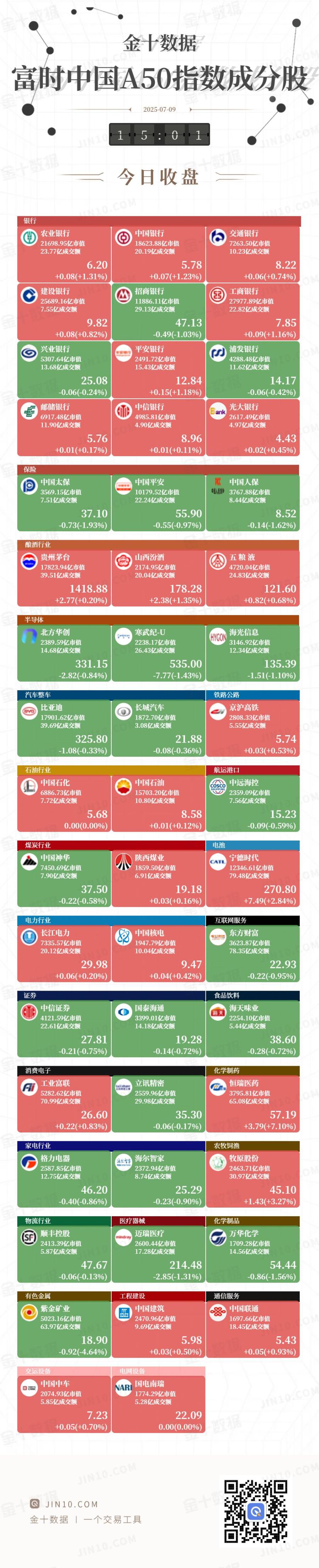
金十图示:2025年07月09日(周三)富时中国A50指数成分股今日收盘行情一览:酿酒板块全天走高,半导体板块午后全数转跌
news flash· 2025-07-09 07:07
Market Overview - The FTSE China A50 Index components showed varied performance, with the liquor sector rising throughout the day while the semiconductor sector experienced a decline in the afternoon [1] Insurance Sector - China Life Insurance, China Pacific Insurance, and Ping An Insurance had market capitalizations of CNY 376.78 billion, CNY 356.91 billion, and CNY 1,017.95 billion respectively, with trading volumes of CNY 0.75 billion, CNY 2.22 billion, and CNY 0.84 billion [3] - The stock prices changed as follows: China Life Insurance decreased by CNY 0.73 (-1.93%), China Pacific Insurance decreased by CNY 0.55 (-0.97%), and Ping An Insurance decreased by CNY 0.14 (-1.62%) [3] Liquor Industry - Kweichow Moutai, Shanxi Fenjiu, and Wuliangye had market capitalizations of CNY 1,782.39 billion, CNY 217.50 billion, and CNY 472.00 billion respectively, with trading volumes of CNY 3.95 billion, CNY 2.00 billion, and CNY 2.48 billion [3] - Stock price changes included Kweichow Moutai increasing by CNY 2.38 (+1.35%), Shanxi Fenjiu increasing by CNY 0.82 (+0.68%), and Wuliangye increasing by CNY 2.77 (+0.20%) [3] Semiconductor Sector - Northern Huachuang, Cambricon Technologies, and Hygon had market capitalizations of CNY 238.96 billion, CNY 223.82 billion, and CNY 314.69 billion respectively, with trading volumes of CNY 1.47 billion, CNY 1.23 billion, and CNY 2.64 billion [3] - The stock prices changed as follows: Northern Huachuang decreased by CNY 7.77 (-1.43%), Cambricon Technologies decreased by CNY 1.51 (-1.10%), and Hygon decreased by CNY 2.82 (-0.84%) [3] Automotive Sector - BYD, Great Wall Motors, and Beijing-Shanghai High-Speed Railway had market capitalizations of CNY 187.27 billion, CNY 1,790.16 billion, and CNY 280.83 billion respectively, with trading volumes of CNY 3.97 billion, CNY 0.31 billion, and CNY 0.56 billion [3] - Stock price changes included BYD decreasing by CNY 1.08 (-0.33%), Great Wall Motors decreasing by CNY 0.08 (-0.36%), and Beijing-Shanghai High-Speed Railway increasing by CNY 0.03 (+0.53%) [3] Shipping and Oil Sector - COSCO Shipping Holdings, Sinopec, and PetroChina had market capitalizations of CNY 235.91 billion, CNY 688.67 billion, and CNY 1,570.32 billion respectively, with trading volumes of CNY 0.77 billion, CNY 1.08 billion, and CNY 0.76 billion [3] - The stock prices changed as follows: COSCO Shipping Holdings remained unchanged, Sinopec decreased by CNY 0.09 (-0.59%), and PetroChina increased by CNY 0.01 (+0.12%) [3] Coal and Battery Sector - China Shenhua, Shaanxi Coal and Chemical Industry, and CATL had market capitalizations of CNY 185.95 billion, CNY 745.07 billion, and CNY 1,234.66 billion respectively, with trading volumes of CNY 0.79 billion, CNY 0.69 billion, and CNY 7.95 billion [3] - Stock price changes included China Shenhua increasing by CNY 7.49 (+2.84%), Shaanxi Coal and Chemical Industry decreasing by CNY 0.22 (-0.58%), and CATL increasing by CNY 0.03 (+0.16%) [3] Other Sectors - Various sectors such as food and beverage, electronics, and pharmaceuticals showed mixed performance in terms of market capitalization and stock price changes [4]




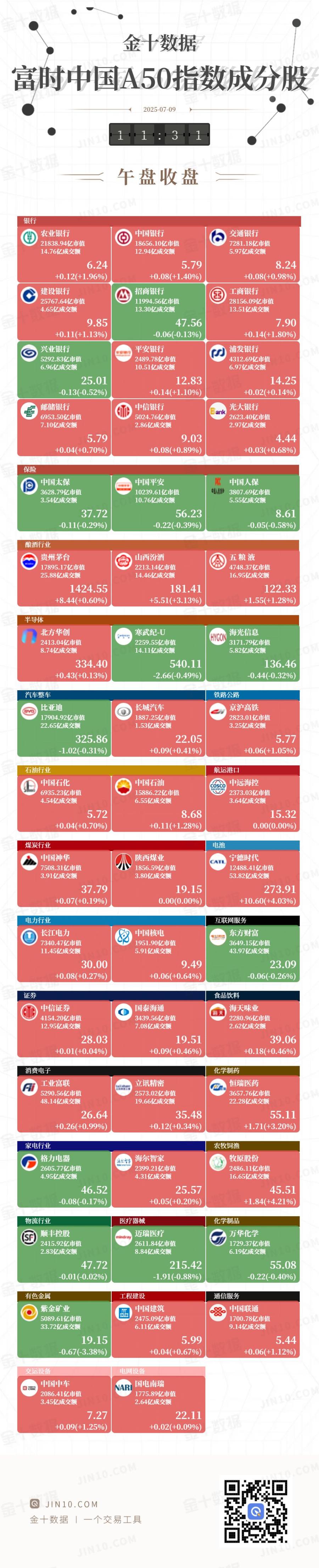
金十图示:2025年07月09日(周三)富时中国A50指数成分股午盘收盘行情一览:银行板块多数走高,半导体板块涨跌不一
news flash· 2025-07-09 03:34
Financial Sector - The banking sector showed a general upward trend with notable performances from major banks such as China Life Insurance and Ping An Insurance, with market capitalizations of 380.77 billion and 1,023.96 billion respectively [4] - China Life Insurance experienced a slight decline of 0.29% while Ping An Insurance decreased by 0.58% [4] Semiconductor Sector - The semiconductor sector displayed mixed results, with North Huachuang's market capitalization at 241.30 billion and a decrease of 0.32% [4] - Cambrian's stock price increased slightly by 0.13%, while Haiguang Information saw a decline of 0.49% [4] Automotive Sector - The automotive sector, led by BYD with a market capitalization of 1,790.49 billion, experienced a minor decline of 0.31% [4] - Great Wall Motors and China Railway High-speed also showed slight increases of 0.41% and 1.05% respectively [4] Energy Sector - In the energy sector, China Petroleum and China Petrochemical had market capitalizations of 1,588.62 billion and 693.52 billion respectively, with China Petroleum increasing by 1.28% [4] - China Shipping Development remained stable with no change [4] Coal Industry - The coal industry saw Shaanxi Coal and China Shenhua with market capitalizations of 750.83 billion and 185.66 billion respectively [4] - China Shenhua's stock price increased by 4.03% while Shaanxi Coal remained unchanged [4] Food and Beverage Sector - The food and beverage sector included major players like Haitian Flavor Industry with a market capitalization of 228.10 billion, which increased by 0.46% [5] - Other companies in this sector showed stable performances with minor fluctuations [5] Electronics and Pharmaceuticals - The electronics sector, represented by Hon Hai Precision Industry, had a market capitalization of 365.78 billion and a slight increase of 0.34% [5] - In pharmaceuticals, Hengrui Medicine's market capitalization was 529.06 billion, with a notable increase of 0.99% [5] Logistics and Medical Devices - The logistics sector, led by SF Holding, had a market capitalization of 2,415.92 billion, experiencing a decline of 0.88% [5] - In medical devices, Mindray Medical's market capitalization was 172.94 billion, with a minor decrease of 0.02% [5] Metals and Construction - The non-ferrous metals sector included Zijin Mining with a market capitalization of 247.51 billion, which saw a decline of 3.38% [5] - China State Construction had a market capitalization of 1,700.78 billion, with a slight increase of 0.67% [5]