
CSEC,China Shenhua(601088)

Search documents
煤炭行业周报:封航影响去库,供给收缩预计支撑淡季煤价-20250420
Shenwan Hongyuan Securities· 2025-04-20 10:44
Investment Rating - The coal industry is rated as "Overweight" indicating a positive outlook for the sector [1]. Core Insights - The report highlights that the coal prices have reached the cost line for some mines, leading to an expected reduction in production. The supply side is constrained due to regular safety inspections and maintenance on major railways, which is anticipated to support coal prices during the off-season [1]. - The report emphasizes that while electricity demand is entering a low season, the combination of maintenance on railways and reduced import volumes is expected to stabilize coal prices [1]. - The report recommends several companies for investment, including China Shenhua, Shaanxi Coal, and China Coal Energy, which are characterized by stable operations and high dividends. It also suggests关注淮北矿业, 平煤股份, and 电投能源 for their undervalued potential [1]. Recent Industry Policies and Developments - The report notes that the Xinjiang coal transportation project has been approved, which will enhance coal transportation capacity significantly, thus reducing logistics costs and supporting energy security [5]. - The report mentions the implementation of a differentiated electricity pricing mechanism in Shandong to optimize power resource allocation [9]. Price Trends - As of April 18, 2025, the prices for various types of coal have shown mixed trends, with some prices remaining stable while others have seen slight declines. For instance, the price for Shanxi's main coking coal remains at 1380 RMB/ton, unchanged from the previous week [10][13]. - The report indicates that international coal prices have fluctuated, with Indonesian coal prices decreasing while South African prices have increased [11]. Supply and Demand Dynamics - The report states that the average daily coal inflow to the Bohai Rim ports has decreased by 4.10% week-on-week, while the outflow has dropped significantly by 20.04% due to adverse weather conditions [22]. - The coal inventory at the Bohai Rim ports has increased by 6.93% week-on-week, indicating a buildup of stock amid declining demand [22]. Shipping Costs - Domestic coastal shipping costs have risen by 6.95% week-on-week, reflecting increased transportation expenses [32]. - International shipping rates have shown mixed trends, with some routes experiencing slight increases while others have decreased [32]. Company Valuation - The report provides a valuation table for key companies in the coal sector, highlighting their stock prices, market capitalization, and earnings per share (EPS) projections for the coming years [36].





如何看待经济稳速与用电低速、煤炭高产与电厂去库的背离?
Changjiang Securities· 2025-04-20 05:17
Investment Rating - The report maintains a "Positive" investment rating for the coal industry [9]. Core Insights - The report highlights two significant divergences in the first quarter economic data: 1) the divergence between GDP growth and electricity consumption growth; 2) the increase in raw coal production while power plant inventories are decreasing. The GDP growth of 5.4% contrasts with a mere 2.5% increase in electricity consumption, primarily due to economic structural transformation and unexpected weather impacts on residential electricity use. Additionally, despite high raw coal production, power plant inventories have declined due to weak power generation demand and structural inventory accumulation at ports and pits [2][7]. Summary by Sections Market Performance - The coal index (Yangtze) increased by 2.56%, outperforming the CSI 300 index by 1.98 percentage points, ranking 3rd out of 32 industries. The thermal coal market price as of April 18 is 663 RMB/ton, showing a slight decrease of 2 RMB/ton week-on-week [6][20]. Thermal Coal Market - The report notes that while seasonal demand for coal is weak, the market is expected to stabilize as the negative factors affecting coal stocks are likely to diminish. The report suggests a positive outlook for coal stocks due to high dividend yields and narrowing second-order effects of falling coal prices [6][20]. Coking Coal Market - The coking coal price at Jing Tang Port remains stable at 1380 RMB/ton. The report emphasizes the need to monitor potential domestic demand stimulus policies and the sustainability of steel production increases [6][21]. Economic Divergences - The report elaborates on the divergence between GDP growth and electricity consumption, attributing it to structural upgrades in the economy and unexpected weather impacts. The first quarter saw a raw coal production increase of 9.704 million tons (8.1% year-on-year), while power plant inventories decreased by approximately 21.03 million tons since the beginning of the year [7][8]. Investment Recommendations - The report recommends marginal allocations to long-term stable profit leaders such as China Shenhua (A+H) and Shaanxi Coal, as well as growth-oriented companies like Xinji Energy and Electric Power Investment Energy. It also highlights flexible growth stocks such as Yanzhou Coal Mining (A+H) and Shanxi Coking Coal [8].

为保税收,印尼政策新规致煤炭出口采矿权税率提高1%
GOLDEN SUN SECURITIES· 2025-04-20 03:31
Investment Rating - The report maintains a "Buy" rating for key companies in the coal mining sector, including China Shenhua, Shaanxi Coal, and others [3][6]. Core Insights - Indonesia's new regulations have increased the coal export mining rights tax rate by 1%, which is expected to impact miners' profitability. The tax rate will vary based on calorific value and mining method, with higher rates applicable when the coal reference price exceeds $90 per ton [2][3]. - The report highlights that Indonesia's non-tax state revenue from the mining and coal sector is projected to reach 140.5 trillion Indonesian Rupiah (approximately $8.33 billion) in 2024, accounting for 52.1% of the country's non-tax revenue [2]. - The report suggests that some miners may shift towards domestic supply to mitigate tax pressure, although the domestic market's absorption capacity remains uncertain, potentially leading to production cuts and capacity constraints [2]. Summary by Sections Coal Mining - The report notes fluctuations in global energy prices, with Brent crude oil futures rising by 7.31% to $67.96 per barrel and WTI crude oil futures increasing by 7.67% to $64.68 per barrel [1]. - Coal prices showed mixed trends, with Newcastle coal (6000K) FOB price at $95.1 per ton (up 0.2%), while European ARA coal price decreased by 0.7% to $99.9 per ton [1][34]. Key Companies - The report identifies key investment targets in the coal sector, including China Shenhua, Shaanxi Coal, and others, with projected earnings per share (EPS) and price-to-earnings (PE) ratios indicating strong growth potential [6]. - Specific companies are highlighted for their stock repurchase plans, indicating confidence in their future performance [3]. Market Trends - The report provides a graphical representation of coal mining sector trends, indicating a potential recovery in the market after recent declines [4]. - It emphasizes the importance of monitoring coal prices and regulatory changes in Indonesia, which could significantly impact the sector's dynamics [2][3].

上证180行业分层等权重指数下跌0.48%,前十大权重包含中国石油等
Sou Hu Cai Jing· 2025-04-18 08:23
Core Viewpoint - The A-share market indices showed mixed performance, with the Shanghai 180 Industry Layered Equal Weight Index declining by 0.48% to 10,897.68 points, with a trading volume of 98.172 billion yuan. Over the past month, this index has decreased by 3.04%, increased by 0.81% over the last three months, and has fallen by 2.88% year-to-date [1]. Group 1 - The Shanghai 180 Industry Layered Equal Weight Index and the Shanghai 180 Equal Weight Index share the same sample, but the former uses an industry-layered equal weighting method, while the latter employs a simple equal weighting approach. This results in different risk-return characteristics to cater to diverse investor preferences [1]. - The top ten holdings of the Shanghai 180 Industry Layered Equal Weight Index include Poly Development (4.43%), Zhangjiang Hi-Tech (4.26%), China Telecom (2.85%), China Mobile (2.53%), China Unicom (2.42%), China Satellite Communications (2.16%), China Petroleum (1.13%), Dongpeng Beverage (1.11%), China Shenhua (1.1%), and China National Offshore Oil Corporation (1.08%) [1]. Group 2 - The Shanghai Stock Exchange accounts for 100% of the holdings in the Shanghai 180 Industry Layered Equal Weight Index. The industry distribution of the index includes Communication Services (9.96%), Consumer Staples (9.64%), Information Technology (9.60%), Materials (9.32%), Financials (9.24%), Healthcare (9.23%), Utilities (9.07%), Real Estate (8.69%), Industrials (8.53%), Consumer Discretionary (8.48%), and Energy (8.25%) [2]. - The index samples are adjusted biannually, with adjustments occurring on the next trading day after the second Friday of June and December each year. The sample adjustment typically does not exceed 10%, and the weight factors are adjusted accordingly. In special circumstances, temporary adjustments may be made [2].






中证资源优选指数报2273.45点,前十大权重包含盐湖股份等
Jin Rong Jie· 2025-04-18 08:06
Core Viewpoint - The China Securities Resource Selection Index has shown a decline in performance over the past month, three months, and year-to-date, indicating a challenging environment for resource-related companies in the A-share market [2]. Group 1: Index Performance - The China Securities Resource Selection Index closed at 2273.45 points, with a decline of 6.22% over the past month, 2.91% over the past three months, and 2.37% year-to-date [1][2]. - The index reflects the overall performance of listed companies in the energy and materials sectors, with a base date of December 31, 2004, set at 1000.0 points [2]. Group 2: Index Composition - The top ten weighted companies in the index include Zijin Mining (8.09%), China Shenhua (3.57%), Wanhua Chemical (2.85%), China Petroleum (2.5%), and China Petrochemical (2.3%) [2]. - The index's holdings are primarily listed on the Shanghai Stock Exchange (67.70%) and the Shenzhen Stock Exchange (32.30%) [2]. Group 3: Sector Allocation - The sector allocation of the index shows that non-ferrous metals account for 37.26%, chemicals for 26.79%, energy for 21.79%, steel for 7.21%, non-metallic materials for 5.70%, and paper and packaging for 1.25% [2]. Group 4: Index Adjustment Mechanism - The index samples are adjusted semi-annually, with adjustments occurring on the next trading day after the second Friday of June and December [3]. - Weight factors are generally fixed until the next scheduled adjustment, with special circumstances allowing for temporary adjustments [3].



现金为王的时代,如何把握“真金白银”投资机遇?
Sou Hu Cai Jing· 2025-04-18 04:17
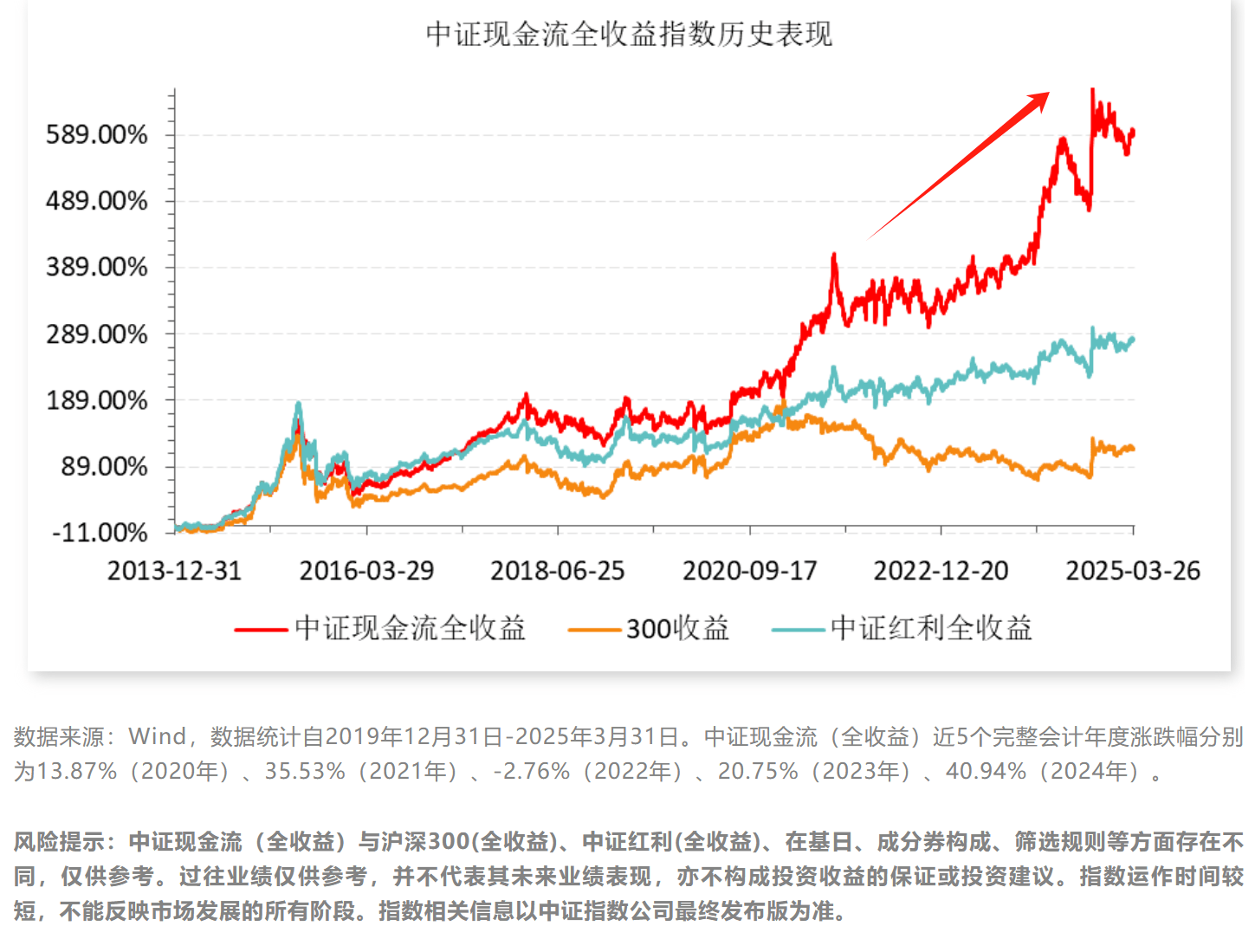
Core Viewpoint - The stability of cash flow, rather than the scale of assets, is crucial for quality of life and investment success, especially in uncertain market conditions [1] Group 1: Cash Flow Index ETFs - A new batch of cash flow index ETFs has emerged, focusing on companies that generate real cash flow, serving as a strategy to navigate market volatility [1] - The China Securities Cash Flow Total Return Index has achieved a remarkable annual return of 40% in a turbulent market [2] Group 2: Investment Strategies - The free cash flow strategy is based on three winning logic points: 1. It focuses on real profitability by looking beyond financial statements, as free cash flow is based on actual cash inflows and outflows [4] 2. It combines high dividend yields with growth potential, providing a dual revenue engine [5] 3. It employs a dynamic rebalancing mechanism to capture undervalued stocks, allowing for timely adjustments to the index [9] Group 3: Performance Metrics - The index demonstrated resilience during bear markets, with a mere 2.76% decline in 2022 when the CSI 300 fell by 21.6% [6] - In bull markets, it outperformed with a 40.94% increase in 2024, achieving an excess return of 27 percentage points [6] - Since its inception in 2013, the index has accumulated a total return of 587.53% [6] Group 4: Index Composition - The index employs a "barbell strategy," including both cash-rich cyclical leaders like coal and petrochemicals, and high ROE growth sectors such as home appliances and automobiles [7] - The top ten constituent stocks, including China Shenhua and Midea Group, account for over 60% of the index, providing stable dividends while retaining growth potential [7] Group 5: Future Outlook - The market is expected to reassess value anchors, with state-owned enterprises facing value re-evaluation as cash flow assets become essential for risk-averse investments [9] - The upcoming issuance of the China Securities Cash Flow ETF may capture more certainty in the era of cash being king [9]




中证能源指数上涨0.89%,前十大权重包含中国海油等
Jin Rong Jie· 2025-04-16 09:38
Group 1 - The core index of the A-share market showed mixed performance, with the China Securities Energy Index rising by 0.89% to 2609.76 points, with a trading volume of 9.268 billion yuan [1] - Over the past month, the China Securities Energy Index has decreased by 2.70%, down 8.34% over the last three months, and down 13.01% year-to-date [1] - The top ten weighted stocks in the China Securities Energy Index include China Shenhua (15.98%), China Petroleum (13.33%), and China Petrochemical (12.31%) [1] Group 2 - The China Securities Energy Index is composed entirely of energy sector stocks, with a 100% industry representation [2] - The index samples are adjusted biannually, with adjustments occurring on the next trading day after the second Friday of June and December [2] - Temporary adjustments to the index samples occur when the China Securities 800 Index undergoes changes, and companies that experience special events affecting their industry classification will also lead to adjustments in the index [2]



中证沪港深500能源指数报2024.62点,前十大权重包含中国石油化工股份等
Jin Rong Jie· 2025-04-16 08:36
Group 1 - The China Securities Index for the Hong Kong-Shanghai-Shenzhen 500 Energy Index closed at 2024.62 points, with a decline of 3.20% over the past month, 8.92% over the past three months, and 12.35% year-to-date [1] - The index is composed of 11 industry categories, reflecting the overall performance of different industry securities within the index series [1] - The top ten weighted stocks in the index include China National Offshore Oil Corporation (15.64%), China Shenhua Energy (12.01%), and China Petroleum & Chemical Corporation (8.40%) [1] Group 2 - The industry composition of the index shows that coal accounts for 37.51%, integrated oil and gas companies for 34.93%, and fuel refining for 20.53% [2] - The index samples are adjusted biannually, with adjustments occurring on the next trading day after the second Friday of June and December [2] - Special circumstances may lead to temporary adjustments to the index samples, such as delisting or corporate actions like mergers and acquisitions [2]

中国神华20250328
2025-04-15 14:30
Summary of Conference Call Records Industry Overview - The conference call primarily discusses the coal industry in China, focusing on the performance and strategies of China Shenhua Energy Company Limited in 2024 and beyond [1][9]. Key Points and Arguments 1. **Macroeconomic Environment**: - The Chinese government maintains a stable economic approach, with GDP growth of 5.0% in 2024. The energy security strategy is being advanced, optimizing the energy structure [1][9]. - National raw coal production reached 4.76 billion tons, a year-on-year increase of 1.3%, while coal imports rose to 540 million tons, up 14.4% [1]. 2. **Operational Performance**: - The company achieved a total coal production of 327 million tons, a 0.8% increase year-on-year, and coal sales of 459 million tons, up 2.1% [2]. - Total power generation was 223.2 billion kWh, reflecting a 5.2% increase [2]. 3. **Financial Results**: - The net profit for 2024 was 58.7 billion RMB, a decrease of 1.7% year-on-year. The profit margin in the coal mining sector dropped by 22.2% [2]. - The average selling price of coal was 527 RMB per ton, down 21 RMB from the previous year [4]. 4. **Dividends and Shareholder Returns**: - The board proposed a final dividend of 2.26 RMB per share for 2024, with a payout ratio of 76.5%, an increase of 1.3 percentage points year-on-year [3]. - A plan for shareholder returns from 2025 to 2027 was introduced, setting a minimum dividend payout of 65% of net profit [3]. 5. **Resource Management and Development**: - The company increased its coal reserves by 1.78 billion tons by the end of 2024, with significant growth in key mining areas [6]. - New projects, including the New Street and Temple Mine areas, are underway to enhance resource availability [6]. 6. **Technological Innovation**: - The company invested approximately 4.15 billion RMB in R&D, resulting in 637 authorized patents, focusing on smart mining and automation [7]. - The green mining initiatives accounted for 84% of operations by the end of 2024, aligning with carbon reduction strategies [7]. 7. **Future Outlook**: - The company anticipates challenges in coal demand and price volatility in 2025 but remains confident in the coal industry's role in energy supply and transition to low-carbon solutions [9]. - Production targets for 2025 include coal output of 334.8 million tons and power generation of 227.1 billion kWh [10]. 8. **Strategic Focus Areas for 2025**: - Emphasis on energy security, project construction, technological innovation, and low-carbon transition [11]. - Plans to enhance integrated operations and expand capital expenditures, with a total planned investment of approximately 41.8 billion RMB [10]. Additional Important Content - The company has received multiple awards for investor relations and information disclosure, reflecting its commitment to transparency and shareholder engagement [8]. - The average utilization hours for coal-fired units were reported at 5,030 hours, exceeding the national average by 402 hours [5]. This summary encapsulates the key insights from the conference call, highlighting the company's performance, strategic initiatives, and outlook for the coal industry in China.
煤炭进口情况更新
2025-04-15 14:30
Summary of Conference Call Industry Overview - The conference call primarily discusses the coal industry, focusing on pricing trends, inventory levels, and market dynamics in both domestic and international contexts [1][2][3][4][5][6]. Key Points and Arguments 1. **Price Trends**: - As of the last week, port prices for coal have dropped to 688, with some prices falling below 686, indicating a continued downward trend [1]. - The price at the pit has seen a slight increase of 2% to 3% after significant previous declines, but overall, prices are still in a phase of gradual bottoming out without a clear upward trend [1][6]. 2. **Inventory Levels**: - High inventory levels at ports are contributing to the downward pressure on prices, with total inventory at northern ports reported at 3,111 million tons, down slightly from 3,158 million tons but still at historically high levels [5]. - Power plants are also experiencing high inventory levels, leading to a lack of purchasing activity [5][6]. 3. **Market Dynamics**: - There is a notable price inversion between pit and port prices, with pit prices around 740 while port prices remain below 690, leading to reduced shipping activity to ports [2]. - Internationally, Australian and Indonesian coal prices are stable or increasing, with Indonesian prices rising nearly 1% to 83.7 USD, but still showing a significant price inversion compared to domestic prices [3]. 4. **Policy and Regulation**: - There are rumors regarding potential restrictions on coal imports, but the likelihood of significant policy changes is considered low due to the ongoing focus on energy security [12][13]. - The discussion includes the impact of stricter inspections on imported coal, which may delay procurement but is not expected to significantly alter overall import volumes [15][16]. 5. **Future Outlook**: - The coal market is expected to remain weak in the short term, with prices likely to continue fluctuating downwards, although there is potential for a bottoming out phase to begin around late April to early May [22][24]. - Long-term investment in coal stocks, particularly in dividend-paying companies like China Shenhua and Northeast Energy, is recommended as a defensive strategy [23][24]. Other Important but Overlooked Content - The call highlights the cautious sentiment among power plants regarding future coal purchases, with expectations that long-term contracts will not be signed aggressively due to current market conditions [17][18]. - The potential for a price rebound is acknowledged, but it is suggested that any significant upward movement in coal prices will take time and may not occur until the market stabilizes [24]. - The focus on maintaining price stability through inventory management strategies by major coal companies is emphasized, indicating a strategic approach to mitigate price volatility [21][22].