
SHCI(601225)

Search documents
2026年煤炭行业投资策略:资源民族主义觉醒,高估的煤炭供给
Shenwan Hongyuan Securities· 2025-11-17 09:41
Investment Strategy Overview - The report highlights the resurgence of resource nationalism driven by de-globalization, emphasizing coal's strategic importance for national energy security. Major coal-producing countries like Indonesia, Mongolia, and the USA are tightening control over coal resources, integrating them into national strategies to bolster energy independence and support domestic industrial and power needs [3][4][5]. Supply Side Analysis - The coal industry is undergoing a significant restructuring, with safety and environmental regulations leading to a more rational supply order. The release of production capacity is expected to be steady but cautious, promoting high-quality development in the coal sector [3][4]. - Domestic supply costs are rising, and coal imports are tightening marginally due to increased scrutiny and regulations [4][32]. Demand Side Analysis - The report anticipates a stable and slight increase in overall coal demand, driven by the rigid growth in electricity consumption and the irreplaceable role of coal in peak regulation and energy security. The expected price range for thermal coal in 2026 is projected to be between 750-800 RMB per ton [3][4][29]. - The resilience of coal power generation is highlighted, particularly in the context of fluctuating renewable energy output, indicating that coal will continue to play a crucial role in the energy mix [3][4]. Investment Recommendations - The report recommends investing in stable, high-dividend companies such as China Shenhua, Shaanxi Coal and Chemical Industry, and China Coal Energy. It also suggests paying attention to companies with price elasticity like Jinkong Coal Industry, Huayang Co., Tebian Electric Apparatus, and Shanxi Coal International [3][4]. - Growth-oriented companies in coal-electricity joint ventures, such as Xinji Energy, are also recommended for consideration [3][4]. Regional Insights - Indonesia's coal production is expected to decline in 2025 due to new resource tax regulations, which will increase export costs and support domestic coal prices [11][12]. - Mongolia's coal production and sales are affected by ongoing political instability, impacting the stability of coal imports [17][18]. - The USA is implementing favorable policies to revitalize its coal industry, including reducing royalty rates and increasing federal land available for coal exploration [21][22]. Future Capacity and Production Trends - Future coal production capacity is expected to be limited, with only about 67 million tons of new capacity projected over the next three years. The focus is shifting towards regions like Xinjiang, which has significant coal reserves and favorable mining conditions [61][67]. - The report notes that the overall coal production in China is unlikely to see significant growth in 2026 due to ongoing safety inspections and regulatory measures [51][53].




煤炭开采板块11月17日涨1.07%,大有能源领涨,主力资金净流出4.86亿元
Zheng Xing Xing Ye Ri Bao· 2025-11-17 09:00
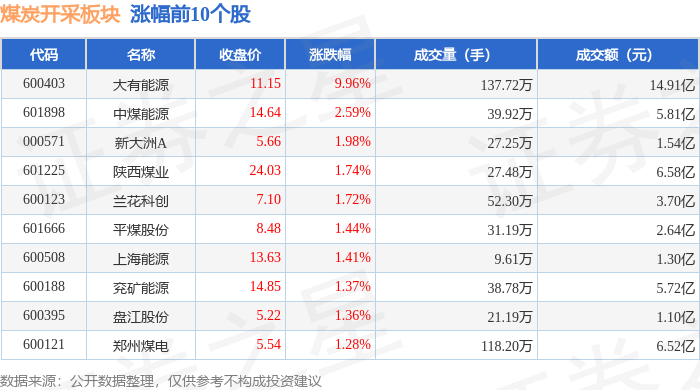
Core Insights - The coal mining sector experienced a rise of 1.07% on November 17, with Dayou Energy leading the gains [1] - The Shanghai Composite Index closed at 3972.03, down 0.46%, while the Shenzhen Component Index closed at 13202.0, down 0.11% [1] Coal Mining Sector Performance - Dayou Energy (600403) closed at 11.15, up 9.96% with a trading volume of 1.3772 million shares and a transaction value of 1.491 billion [1] - Other notable performers included: - Zhongmei Energy (601225) at 24.03, up 1.74% [1] - Shanxi Coal (000571) at 5.66, up 1.98% [1] - The sector saw a net outflow of 486 million from main funds, while retail investors contributed a net inflow of 359 million [2][3] Fund Flow Analysis - Main funds showed a net outflow in several companies, including: - Electric Power Investment Energy (002128) with a net outflow of 114 million [3] - Shanxi Jiao Coal (000983) with a net outflow of 20.07 million [3] - Retail investors showed positive net inflows in companies like: - Zhengzhou Coal Electricity (600121) with a net inflow of 1.309 million [3] - New Dazhou A (000571) with a net inflow of 1.243 million [3]


OPEC预期供给过剩,本周油价下跌:能源周报(20251110-20251116)-20251117
Huachuang Securities· 2025-11-17 08:34
Investment Strategy - The oil and gas capital expenditure trend is declining, leading to a slowdown in supply growth. Since the signing of the Paris Agreement in 2015, global capital expenditure in the oil and gas upstream sector has significantly decreased, with a notable drop of nearly 22% from the 2014 peak to $351 billion in 2021. This trend is expected to continue as major energy companies face pressure from policies aimed at carbon reduction and are shifting focus towards energy transition and renewable projects [10][27]. - The current active drilling rig count in the US remains low, and the cost of new wells is close to current oil prices, limiting profit margins. This suggests that the growth rate of US oil production is likely to slow down, with evidence of this trend emerging in the first half of 2025 [10][27]. - OPEC+ has implemented production cuts that exceed expectations, indicating that there will be limited supply growth in the coming year [10][27]. Oil Industry - OPEC has shifted its outlook from a supply shortage to an anticipated oversupply in the global oil market, resulting in a significant drop in oil prices. Brent crude oil prices fell to $63.14 per barrel, down 2.56% week-on-week, while WTI prices decreased to $59.69 per barrel, down 0.65% [11][32]. - The report suggests monitoring companies that may benefit from the mid-high price fluctuations of oil, such as China National Offshore Oil Corporation (CNOOC), China Petroleum & Chemical Corporation (Sinopec), and China National Petroleum Corporation (PetroChina) [11]. Coal Industry - The market for thermal coal remains stable, with prices experiencing fluctuations. The average market price for thermal coal at Qinhuangdao Port was reported at 817.1 yuan per ton, an increase of 4.67% from the previous week. However, downstream demand remains cautious, with many buyers adopting a wait-and-see approach [12][13]. - The report highlights the importance of domestic coal companies like China Shenhua Energy and Shaanxi Coal and Chemical Industry Group, which are expected to benefit from the stable pricing environment and their resource advantages [13]. Natural Gas Industry - There is a growing demand for LNG imports in Asia, driven by energy transition efforts in major economies such as China, Japan, and South Korea. This has led to active negotiations for long-term contracts with major LNG exporting countries [15][16]. - The average price of natural gas in the US increased to $4.5 per million British thermal units, reflecting a 4.6% rise from the previous week [15][30]. Oilfield Services Industry - The oilfield services sector is expected to maintain its growth due to government policies aimed at ensuring energy security. In 2023, the total capital expenditure of the three major oil companies reached 583.3 billion yuan, reflecting a compound annual growth rate of 4.9% since 2018 [17][18]. - The report indicates that despite falling oil prices, capital expenditures remain high, which is likely to sustain the industry's overall health [17].



华源证券:煤炭Q3政策支撑下企稳回升 冬季煤价有望保持强势
智通财经网· 2025-11-17 03:29
Core Viewpoint - The coal sector is expected to stabilize and rebound in prices due to the "check overproduction" policy, benefiting thermal coal companies through improved long-term contract performance and coal-electricity integration, while coking coal companies face pressure due to lagging contract pricing [1][7]. Group 1: Financial Performance - In Q3 2025, the coal sector saw a positive revenue growth, with thermal coal companies experiencing a better net profit growth compared to coking coal companies [1]. - The price of Qinhuangdao 5500 kcal thermal coal increased from 621 CNY/ton on June 30, 2025, to 699 CNY/ton on September 30, 2025, marking a cumulative increase of 12.6% in Q3 [1]. - The overall performance of the coal industry is expected to continue improving due to increased heating demand and tight supply-side policies in Q4 [1][6]. Group 2: Production and Sales - The "check overproduction" policy in Q3 2025 led to stable production among leading thermal coal companies, while coking coal production saw a noticeable decline [2]. - Most listed coal companies did not significantly reduce their output in Q3, with some midstream companies experiencing high sales growth and accelerated inventory reduction due to improved supply-demand dynamics [2]. Group 3: Pricing Dynamics - In Q3 2025, the self-produced coal prices decreased year-on-year by 10% to 20%, while the sales prices of coal companies showed narrow fluctuations or slight increases, with most increases being less than 10% [3]. - The lag in price transmission from market coal prices to listed companies' sales prices is attributed to long-term contract pricing mechanisms and order delivery cycles [3]. Group 4: Cost Management - In H1 2025, coal companies shifted their strategies from volume-based to cost control, which became crucial in facing low coal prices and high inventory levels [4]. - Leading thermal coal companies maintained cost control in Q3 2025, achieving a decrease in unit costs, while some coking coal companies experienced an increase in unit sales costs, negatively impacting their performance [4]. Group 5: Future Outlook - The combination of stable production, rising prices, and cost reductions for thermal coal companies is expected to lead to improved profitability, while coking coal companies may see significant price rebounds in Q4 as long-term contracts adjust to higher market prices [5]. - The coal market is currently in a phase of tightening supply and increasing demand, with winter coal prices expected to remain strong due to seasonal heating needs and ongoing supply-side policies [7]. Group 6: Investment Recommendations - The report suggests actively monitoring robust thermal coal companies such as China Shenhua, China Coal Energy, and Shaanxi Coal and Chemical Industry, as well as high-elasticity coal companies like Yanzhou Coal Mining, Jincheng Anthracite Mining, and Shanxi Coal International [8].

陕西煤业涨2.03%,成交额2.85亿元,主力资金净流入782.38万元
Xin Lang Cai Jing· 2025-11-17 03:06
Core Viewpoint - Shaanxi Coal Industry's stock price has shown fluctuations with a year-to-date increase of 9.64%, while recent trading days have seen a decline of 2.35% over the last five days and an increase of 5.24% over the last twenty days [1][2]. Financial Performance - For the period from January to September 2025, Shaanxi Coal Industry reported a revenue of 1180.83 billion, reflecting a year-on-year decrease of 5.86%. The net profit attributable to shareholders was 127.13 billion, down 20.26% year-on-year [2]. - The company has distributed a total of 816.45 billion in dividends since its A-share listing, with 473.31 billion distributed over the last three years [3]. Shareholder Information - As of September 30, 2025, the number of shareholders increased to 105,000, up by 2.07% from the previous period. The average number of circulating shares per person decreased by 2.02% to 92,312 shares [2]. - The top circulating shareholders include China Securities Finance Corporation with 195 million shares, unchanged from the previous period, and Hong Kong Central Clearing Limited with 133 million shares, which decreased by 10.7 million shares [3].
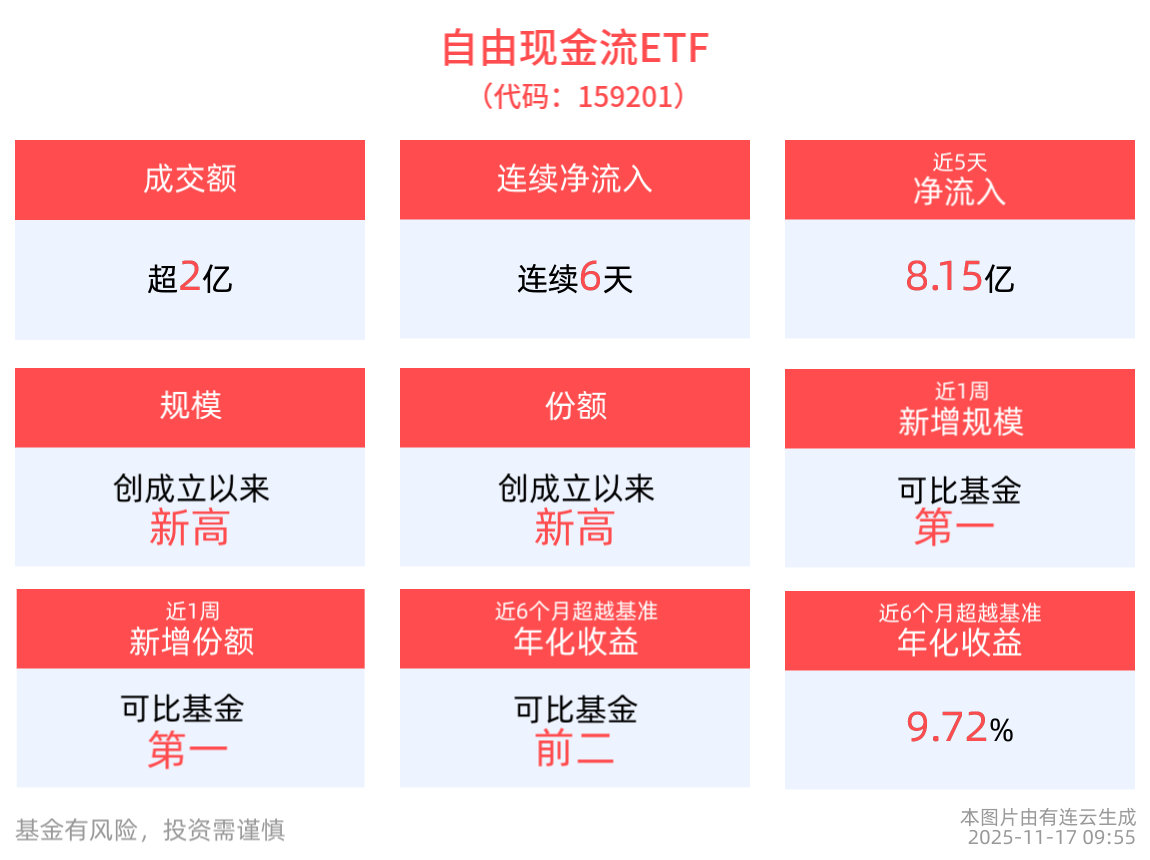
成交额超2亿元,自由现金流ETF(159201)连续6天净流入,合计“吸金”8.88亿元
Sou Hu Cai Jing· 2025-11-17 02:18
Core Insights - The Guozheng Free Cash Flow Index has decreased by 0.86% as of November 17, 2025, with mixed performance among constituent stocks [1] - The Free Cash Flow ETF (159201) has dropped by 1.07%, currently priced at 1.21 yuan, with a trading volume of 2.02 billion yuan [1] - Over the past six days, the Free Cash Flow ETF has seen continuous net inflows, totaling 8.88 billion yuan, with a daily average net inflow of 1.48 billion yuan [1][4] Performance Metrics - The Free Cash Flow ETF has achieved a net value increase of 22.85% over the past six months [4] - Historical performance shows a maximum monthly return of 7%, with the longest consecutive monthly gain of 6 months and a total gain of 22.69% [4] - The ETF has a monthly profit percentage of 87.5% and a historical 100% profit probability for holding over six months [4] Fund Details - The management fee for the Free Cash Flow ETF is 0.15%, and the custody fee is 0.05% [5] - As of October 31, 2025, the top ten weighted stocks in the Guozheng Free Cash Flow Index account for 54.79% of the index, including China National Offshore Oil Corporation and SAIC Motor [5] Stock Performance - The top ten stocks in the index have shown varied performance, with notable declines in stocks like Gree Electric Appliances (-1.08%) and China Aluminum (-2.57%) [7]




动力煤上穿800元之上的第四目标,煤价逻辑逐一兑现 | 投研报告
Zhong Guo Neng Yuan Wang· 2025-11-17 01:24
Core Viewpoint - The report indicates that the price of thermal coal has recently increased, with Qinhuangdao Q5500 thermal coal closing at 834 RMB/ton as of November 14, marking a slight increase. The price at Guangzhou Port has reached 880 RMB, surpassing the previously indicated target of 750 RMB for coal-electricity profit sharing, and is currently within the expected fourth target price range of 800-860 RMB [1][2]. Thermal Coal Market Analysis - The recent increase in thermal coal prices is attributed to a combination of supply contraction and a surge in demand, particularly due to heating needs from a cold wave in northern regions and accelerated port restocking [2]. - The price of coking coal at Jing Tang Port is reported at 1860 RMB/ton, rebounding from a low of 1230 RMB in July, while coking coal futures have risen from 719 RMB in June to 1192 RMB, reflecting a cumulative increase of 65.79% [2]. Investment Logic - The price of thermal coal is expected to follow a four-step process: restoring central and local long-term contracts, achieving coal-electricity profit sharing, and surpassing the breakeven point for power plants, which is projected at 860 RMB [3]. - The price of coking coal is influenced more by market dynamics, with a significant correlation to thermal coal prices. The current ratio of coking coal to thermal coal prices is 2.4, suggesting target prices for coking coal of 1608 RMB, 1680 RMB, 1800 RMB, and 2064 RMB corresponding to the four target levels of thermal coal [3]. Investment Recommendations - The coal sector is positioned for potential gains due to both cyclical recovery and dividend stability. The current prices of thermal and coking coal are still at historical lows, providing room for upward movement [4][5]. - The report highlights four main investment lines: 1. Cyclical logic with stocks like Jinko Coal and Yanzhou Coal for thermal coal, and Pingmei Shenma and Huabei Mining for metallurgical coal 2. Dividend logic with companies like China Shenhua and Zhongmei Energy 3. Diversified aluminum elasticity with companies like Shenhuo Co. and Electric Power Investment 4. Growth logic with companies like Xinjie Energy and Guanghui Energy [5].


煤炭开采行业10月数据全面解读:10月供需缺口显著,煤价大幅上涨
Guohai Securities· 2025-11-16 15:22
Investment Rating - The report maintains a "Buy" rating for the coal mining industry [1] Core Views - The coal mining industry is experiencing a tightening supply due to reduced production and imports, with October coal production down 2.3% year-on-year, and imports down 9.76% [6][25] - Demand has significantly improved in October, primarily driven by increased coal consumption in thermal power and chemical industries, while the construction and metallurgy sectors have shown a decline [6][26] - The report highlights a notable increase in coal prices, with port prices rising by 56 yuan/ton in October, reflecting the improved supply-demand dynamics [10][11] Supply Side Summary - Coal production in October was 407 million tons, a decrease of 2.3% year-on-year, with daily production averaging 13.12 million tons, down 596,000 tons from the previous month [4][19] - The decline in production is attributed to maintenance, adverse weather, and stricter safety checks [6][19] - Coal imports in October were 41.74 million tons, down 9.76% year-on-year, with a cumulative import of 388 million tons from January to October, reflecting an 11.0% decrease [25][26] Demand Side Summary - Thermal power generation increased by 7.3% year-on-year in October, reversing a decline from September [6][26] - The total industrial electricity generation in October was 800.2 billion kWh, up 7.9% year-on-year, with a daily average of 25.81 billion kWh [5][18] - Chemical industry coal consumption rose significantly, with a year-on-year increase of 35.38% in October [10][26] Inventory Summary - By the end of October, coal inventories at production enterprises decreased by 135,000 tons, while inventories at northern ports increased by 432,000 tons [10][11] - The report notes that inland power plants have increased their coal inventories, indicating a trend towards replenishment as winter approaches [10][11] Investment Recommendations - The report suggests focusing on robust coal companies such as China Shenhua, Shaanxi Coal, and China Coal Energy, which exhibit strong cash flow and profitability [10][12] - It emphasizes the value attributes of the coal sector, particularly in light of the current market conditions and potential for price increases [10][11]

煤炭开采行业周报:静待旺季日耗提升,后续煤价依然稳中偏强-20251116
Guohai Securities· 2025-11-16 15:21
Investment Rating - The report maintains a "Recommended" rating for the coal mining industry [2] Core Viewpoints - The coal price is expected to remain stable and slightly strong, with the northern port coal price reaching 834 RMB/ton, an increase of 17 RMB/ton week-on-week, as the industry anticipates an increase in daily consumption during the winter peak season [4][14][71] - The supply-demand balance in the coal market remains favorable, with stable production and a slight increase in port inventories, while non-electric demand from sectors like metallurgy and chemicals continues to support coal consumption [5][14][71] - The report highlights the investment value of coal companies, particularly those with strong cash flows and high dividend yields, amidst market volatility and external economic pressures [7][73] Summary by Sections 1. Thermal Coal - The northern port thermal coal price increased to 834 RMB/ton, with production capacity utilization in the Sanxi region stable at 89.79% [14][21] - Daily consumption at coastal and inland power plants showed a week-on-week change of -8.0 and +12.3 thousand tons, respectively, indicating a recovery phase [14][24] - The report notes a decrease in coal imports due to rising prices and lower acceptance from downstream users, while supply constraints from Indonesia and Russia are expected to limit import availability [14][71] 2. Coking Coal - Coking coal production capacity utilization increased by 0.37 percentage points to 84.2%, driven by recovery in some mines in Shanxi [5][72] - The average customs clearance volume at Ganqimaodu port rose to 1,366 trucks, indicating stable supply [5][72] - The report anticipates that despite short-term market sentiment fluctuations, coking coal prices will remain stable due to low production and inventory levels [6][72] 3. Coke - The supply-demand balance for coke remains stable, with some steel mills accepting a price increase of 50-55 RMB/ton, effective from November 15 [6][51] - The report indicates that independent coking plants have seen a decrease in production rates, while iron output has increased, supporting demand for coke [6][58] 4. Investment Focus - The report emphasizes the importance of focusing on robust coal companies such as China Shenhua, Shaanxi Coal, and Yanzhou Coal, which exhibit strong fundamentals and growth potential [7][9][73] - It suggests that investors should consider the value attributes of the coal sector, particularly in light of ongoing market dynamics and regulatory changes [7][73]


煤炭开采行业周报:强调3个观点-20251116
GOLDEN SUN SECURITIES· 2025-11-16 13:07
Investment Rating - The report maintains an "Accumulate" rating for the coal mining industry [4] Core Views - The adjustment in coal prices is a normal digestion of previous rapid increases, with the core logic of rising coal prices (supply constraints) remaining unchanged [1][2] - In the context of limited supply, the initiation of demand (whether speculative or real) will lead to rising coal prices, with expectations for coal prices to peak at the end of the year, potentially exceeding market expectations [2] - The continuous rise in coal prices suggests that stock prices should not be a concern, and a more proactive approach is recommended, focusing on leading companies with absolute valuation advantages [2] Summary by Sections Market Review - The CITIC Coal Index was at 3991.33 points, down 0.78%, outperforming the CSI 300 Index by 0.3 percentage points, ranking 22nd among CITIC sectors [1] Supply and Demand Analysis - In October, China's raw coal production fell by 2.3% year-on-year, with a further decline in the rate compared to September [2] - The coal import volume in October decreased month-on-month, reaching a near three-month low, with international coal supply, especially from Indonesia, facing bottlenecks [2] - The upcoming cold wave is expected to increase daily coal consumption at power plants, potentially driving coal prices higher [2][7] Price Trends - As of November 14, the price of thermal coal at North Port was reported at 831 CNY/ton, an increase of 22 CNY/ton week-on-week, marking a new high for the year [6][39] - The report indicates that coal prices are likely to continue rising due to supply constraints, with demand determining the slope and final height of price increases [2][39] Key Investment Targets - The report recommends several stocks with "Buy" ratings, including China Shenhua, Shaanxi Coal, and Xinji Energy, among others, highlighting their strong performance and favorable valuations [11][12]


