
SHCI(601225)

Search documents
陕西煤业:4月自产煤销量为1310.33万吨 同比增长0.76%
news flash· 2025-05-07 07:35
陕西煤业(601225)公告,2025年4月煤炭产量为1424.23万吨,同比下降1.78%;自产煤销量为1310.33 万吨,同比增长0.76%。2025年累计煤炭产量为5818万吨,同比增长3.98%;累计自产煤销量为5265万 吨,同比增长4.51%。 ...

方正证券:煤价下行煤企业绩承压 关注高长协高股息龙头
Zhi Tong Cai Jing· 2025-05-07 07:25
Core Viewpoint - The coal industry is expected to face significant pressure in 2024 due to falling coal prices, leading to an estimated 18.8% year-on-year decline in net profit attributable to shareholders, with a further decline of 29.7% anticipated in Q1 2025 [1][2]. Industry Summary - The total revenue for the coal industry in 2024 is projected to be 1.3574 trillion yuan, a decrease of 4.9% year-on-year, with a net profit of 146.8 billion yuan, reflecting an 18.8% decline [2]. - In Q1 2025, the coal industry is expected to generate 279.5 billion yuan in revenue, down 17.7% year-on-year, and a net profit of 28.65 billion yuan, representing a 29.7% decline [2]. - The supply-demand dynamics for thermal coal are expected to weaken, with a notable increase in coal imports and the release of production capacity in the latter half of 2024, leading to further price pressures [2]. Coal Segment Analysis - The coking coal segment is anticipated to see a revenue decline of 11.4% in 2024, with net profit expected to drop by 45.5% due to weak demand and policy constraints [3]. - Coking coal prices are influenced by the overall health of the black metal industry, with a decrease in demand from key sectors like real estate and infrastructure contributing to price declines [3]. Investment Logic - High-dividend coal companies are expected to exhibit defensive characteristics, with recommendations to focus on firms with strong resource endowments and stable performance, such as China Shenhua (601088), Shaanxi Coal (601225), and China Coal Energy (601898) [4]. - The coal-electricity joint operation model is seen as a way to mitigate cyclical fluctuations and benefit from price differentials between market and long-term contract coal prices, with suggested companies including Xinjie Energy (601918), Shaanxi Coal, and China Shenhua [5]. - The cyclical sector may benefit from economic stimulus policies, with expectations of increased domestic demand driven by government fiscal measures, recommending attention to Shanxi Coking Coal (000983), Huaibei Mining (600985), and Pingdingshan Coal (601666) [6].


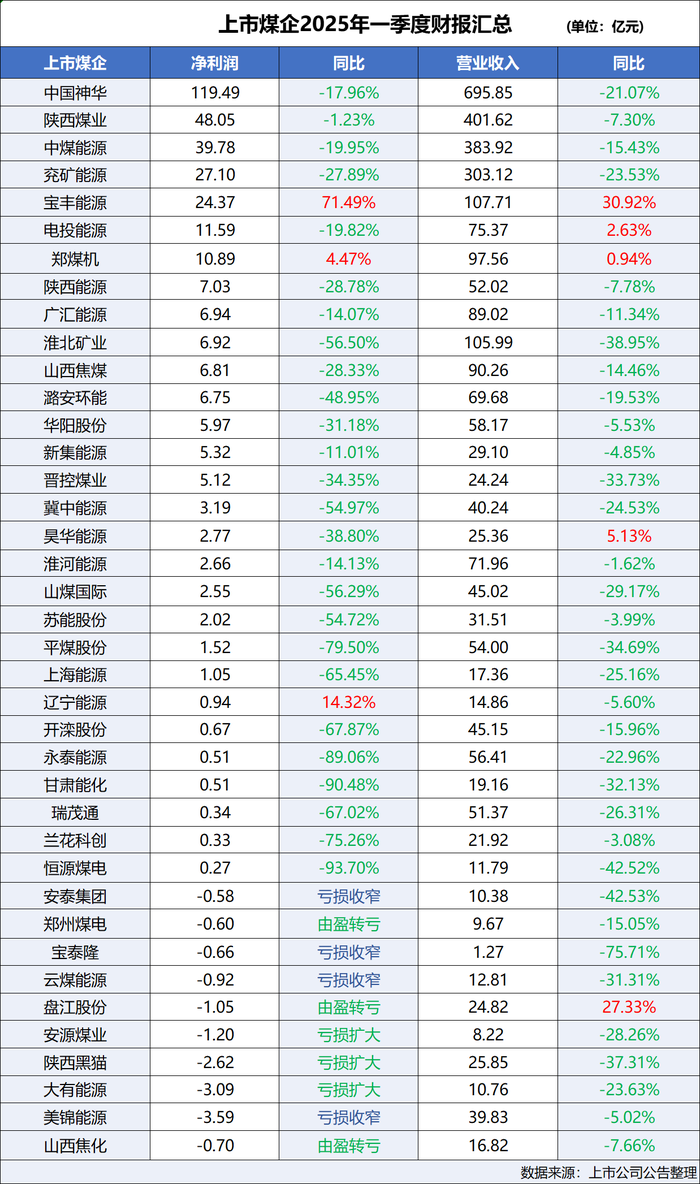
煤企业绩喜忧参半,宁夏首富一枝独秀
Xin Lang Cai Jing· 2025-05-07 03:06
Core Insights - The coal industry in China reported mixed results for Q1 2025, with over 70% of listed coal companies remaining profitable, yet most experienced significant declines in net profit year-on-year, with some companies even reporting losses [1][4][12] - Baofeng Energy, led by Ningxia's richest man, achieved a remarkable net profit growth of 71.49%, standing out in an otherwise declining industry [1][8] Financial Performance Summary - Major coal companies reported the following net profits and year-on-year changes: - China Shenhua: 11.949 billion, -17.96% - Shaanxi Coal and Chemical: 4.805 billion, -1.23% - Baofeng Energy: 2.437 billion, +71.49% [2] - A total of 32 out of 39 listed coal companies saw a decline in net profit, with 12 companies experiencing declines over 30% [4][12] Factors Behind Profit Decline - Market price fluctuations have directly impacted coal company profits, with average prices for major coal types, such as thermal coal, dropping approximately 25% year-on-year [5][6] - The supply-demand imbalance is exacerbated by a warm winter and increased renewable energy generation, which saw a 18.7% year-on-year increase in wind and solar power output [5][12] - Rising production costs due to deeper mining and increased safety and environmental expenditures have further squeezed profit margins [6][12] Baofeng Energy's Growth Strategy - Baofeng Energy's success is attributed to its integrated "coal-coke-chemical" business model, which allows it to convert raw material advantages into high-value products [8][9] - The company's olefin project has become a significant profit driver, with a production efficiency that exceeds industry averages [8][9] - Investment in technology and digital transformation has enhanced operational efficiency and reduced costs, contributing to its strong performance [9][11] Industry Challenges - The coal industry faces significant challenges from the dual carbon goals and the increasing competitiveness of renewable energy sources [12][13] - The average utilization hours for thermal power plants have decreased, indicating a decline in coal demand [13][14] - The industry is experiencing a supply surplus, with total coal production capacity exceeding 4.5 billion tons per year, while consumption is projected at around 4.2 billion tons [13][14] Conclusion - The Q1 2025 performance of the coal industry reflects the urgent need for transformation amid evolving energy dynamics, with a clear divide emerging between companies that adapt and those that do not [16]



大能源行业2024年报及2025一季报回顾
Hua Yuan Zheng Quan· 2025-05-06 12:58
Investment Rating - The report maintains a "Positive" investment rating for the large energy sector [5] Core Viewpoints - The report emphasizes the stable performance of hydropower, the negative impact of wind conditions on short-term performance, and the differentiation in thermal power profitability [6][31][37] Hydropower Summary - Hydropower performance is expected to be stable with improved rainfall in 2024, contributing to an increase in electricity generation in Q1 2025. The national rainfall is projected to be 9% above normal, with hydropower utilization hours increasing by 6.9% year-on-year [20][21] - Major hydropower companies are expected to see performance align with expectations, with notable growth in Q1 2025 for companies like Changjiang Power and Huaneng Hydropower [25][26] - The report highlights the importance of local hydropower pricing advantages and the stability of the business model and policy environment as key factors for investment [28][29] Renewable Energy Summary - Wind power operators are facing short-term performance declines due to poor wind conditions, while solar power operators are impacted by falling electricity prices and increased curtailment rates [31][36] - The report suggests focusing on long-term value in wind power operators despite current challenges, as the market is expected to favor those with sustainable development returns [36][37] Thermal Power Summary - The thermal power sector is experiencing improved profitability due to declining coal prices, although there is significant regional differentiation in performance [37] - The report notes that while northern thermal power operators are seeing better performance, regions like Guangdong are facing challenges due to market price declines [8][37] Investment Recommendations - The report provides three stock selection strategies: focusing on state-owned enterprises undergoing asset integration, selecting resilient hydropower assets, and identifying undervalued wind power operators [9][11] - Key recommended stocks include: - Hydropower: Guotou Power, Changjiang Power, Chuan Investment Energy - Wind Power: Longyuan Power, Xintian Green Energy, Datang Renewable - Thermal Power: Wan Energy, Shanghai Electric, Huaneng International [9]



首只险资私募证券基金重仓股揭晓
news flash· 2025-05-06 11:53
首只险资私募证券基金重仓股揭晓 金十数据5月6日讯,随着A股上市公司2025年一季报发布完毕,我国首只保险系私募证券基金——鸿鹄 志远私募证券投资基金的A股持仓情况也浮出水面。根据上市公司一季报,鸿鹄志远分别重仓了伊利股 份、陕西煤业以及中国电信3只A股股票。具体来看,截至一季度末,鸿鹄志远持有伊利股份约15276.4 万股,较去年底增加约1351.26万股;持有陕西煤业约11633.89万股,较去年底增加约1503.77万股;持 有中国电信约76174.22万股,与去年底持平。 (银柿财经) ...


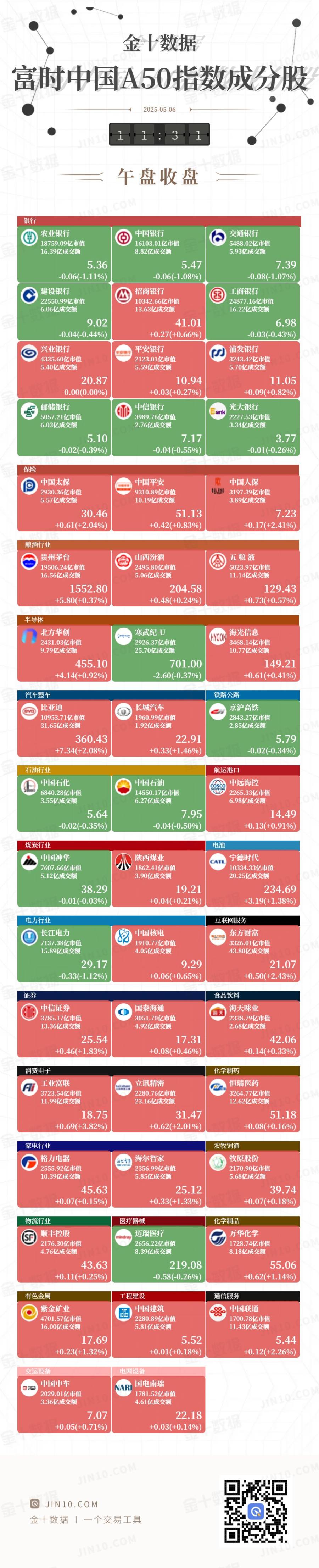
金十图示:2025年05月06日(周二)富时中国A50指数成分股午盘收盘行情一览:保险、白酒汽车板块上涨,银行、半导体板块涨跌不一,电力等板块走弱
news flash· 2025-05-06 03:40
Market Overview - The FTSE China A50 index components showed mixed performance with insurance and liquor sectors rising, while banking and semiconductor sectors had varied results, and the power sector weakened [1][4]. Insurance Sector - China Pacific Insurance, Ping An Insurance, and China Life Insurance had market capitalizations of CNY 293.04 billion, CNY 931.09 billion, and CNY 319.74 billion respectively, with trading volumes of CNY 557 million, CNY 1.019 billion, and CNY 389 million [3]. - China Pacific Insurance rose by 2.04%, Ping An by 0.83%, and China Life by 2.41% [3]. Liquor Industry - Kweichow Moutai, Wuliangye, and Shanxi Xinghuacun Fenjiu had market capitalizations of CNY 1,950.62 billion, CNY 249.58 billion, and CNY 502.40 billion respectively, with trading volumes of CNY 1.656 billion, CNY 506 million, and CNY 1.114 billion [3]. - Kweichow Moutai increased by 0.37%, Wuliangye by 0.24%, and Shanxi Xinghuacun by 0.57% [3]. Semiconductor Sector - Northern Huachuang, Cambricon Technologies, and Haiguang Information had market capitalizations of CNY 243.10 billion, CNY 292.64 billion, and CNY 346.81 billion respectively, with trading volumes of CNY 979 million, CNY 2.570 billion, and CNY 1.077 billion [3]. - Northern Huachuang rose by 0.92%, while Cambricon Technologies fell by 0.37% and Haiguang Information increased by 0.41% [3]. Automotive Sector - BYD, Great Wall Motors, and Beijing-Shanghai High-Speed Railway had market capitalizations of CNY 196.10 billion, CNY 284.33 billion, and CNY 1,095.37 billion respectively, with trading volumes of CNY 3.165 billion, CNY 192 million, and CNY 285 million [3]. - BYD increased by 2.08%, Great Wall Motors by 1.46%, while Beijing-Shanghai High-Speed Railway decreased by 0.34% [3]. Power Sector - China Yangtze Power, China Nuclear Power, and China Power had market capitalizations of CNY 713.74 billion, CNY 191.08 billion, and CNY 332.60 billion respectively, with trading volumes of CNY 1.589 billion, CNY 405 million, and CNY 4.380 billion [4]. - China Nuclear Power rose by 2.43%, while China Yangtze Power fell by 1.12% [4]. Other Sectors - Various sectors including food and beverage, electronics, and pharmaceuticals showed diverse performances with notable market capitalizations and trading volumes [4][5].




首只险资私募证券基金重仓股揭晓 超千亿元长钱“在路上”
Zheng Quan Ri Bao· 2025-05-05 16:18
Core Viewpoint - The first insurance-backed private equity fund in China, Honghu Zhiyuan, has disclosed its A-share holdings, indicating a significant entry of long-term capital into the market with an expected total of approximately 112 billion yuan from the second batch of insurance-backed private equity funds [1][5]. Group 1: Fund Performance and Holdings - As of the end of Q1 2025, Honghu Zhiyuan has heavily invested in three A-share stocks: Yili Group, Shaanxi Coal and Electricity, and China Telecom, with notable increases in holdings for Yili and Shaanxi Coal compared to the end of the previous year [3][4]. - The fund has achieved performance metrics that are lower in risk and higher in returns than benchmarks, with the first phase of 50 billion yuan fully invested by early March 2025 [2][3]. Group 2: Investment Strategy and Characteristics - The selected stocks are characterized by high dividend yields and strong industry leadership, aligning with the insurance capital's need for stable returns and risk diversification [4][6]. - Shaanxi Coal has a dividend yield exceeding 7%, Yili Group over 4%, and China Telecom plans to increase cash distributions to 75% of its profits over the next three years, providing stable cash flow [4]. Group 3: Regulatory Environment and Future Prospects - The National Financial Regulatory Administration has approved a second batch of long-term stock investment trials, allowing eight insurance companies to access a total of 112 billion yuan for long-term stock investments [5][6]. - New private equity funds are being established, such as the proposed Honghu Zhiyuan Phase II, which aims to invest in large A+H shares that meet specific governance and operational criteria [5][6].
煤炭行业周报:淡季煤价承压,进口收缩预计托底煤价-20250505
Shenwan Hongyuan Securities· 2025-05-05 14:42
Investment Rating - The report maintains a positive outlook on the coal industry, indicating an "Overweight" rating [1]. Core Insights - The report highlights that coal prices are under pressure during the off-season, with a forecasted contraction in imports expected to support prices [1]. - The report emphasizes that domestic coal production is expected to stabilize, with a potential rebound in coking coal prices as demand increases in the peak season [1]. - Key recommended stocks include China Shenhua, Shaanxi Coal, and China Coal Energy for stable operations and high dividends, while Huabei Mining and Pingmei Shenma are noted for their undervalued growth potential [1]. Summary by Sections Recent Industry Policies and Dynamics - New energy consumption limits for various industries, including coal, are set to take effect, potentially saving 24.52 million tons of standard coal annually [9]. - Coal production in major provinces like Shanxi and Inner Mongolia has seen significant year-on-year growth, contributing to a record high in domestic coal output [9]. Price Trends - As of April 30, 2025, the prices for various grades of thermal coal have seen slight declines, with Q4500, Q5000, and Q5500 thermal coal prices reported at 508, 570, and 650 CNY/ton respectively [1][10]. - Coking coal prices have remained stable, with key prices reported at 1380 CNY/ton for Shanxi's main coking coal [1][13]. Inventory and Demand - The average daily coal inflow to the Bohai Rim ports increased by 4.62% to 1.9614 million tons, while the outflow decreased by 1.14% to 1.9894 million tons [21]. - Port inventories decreased slightly to 31.035 million tons, reflecting a 0.21% drop [21]. Shipping Costs - Domestic coastal shipping costs have risen slightly, with average freight rates reported at 37.57 CNY/ton, marking a 0.31% increase [28]. - International shipping rates have also seen increases, particularly for coal from Indonesia and Australia [28]. Company Valuations - The report includes a valuation table for key companies, highlighting their stock prices, market capitalizations, and earnings per share (EPS) forecasts for 2024 to 2027 [34].


煤炭开采行业周报:煤价淡季或逐步趋稳,关注迎峰度夏补库情况
Xinda Securities· 2025-05-05 08:23
Investment Rating - The investment rating for the coal industry is "Positive" [2] Core Viewpoints - The current phase is seen as the beginning of a new upward cycle for the coal economy, with a resonance between fundamentals and policies, making it an opportune time to accumulate coal sector investments [11][12] - The underlying investment logic of coal capacity shortages remains unchanged, with a short-term supply-demand balance and a long-term gap still present [11][12] - The trend of coal prices establishing a bottom and moving to a new platform is expected to continue, with high profitability, cash flow, return on equity (ROE) of 10-20%, and dividend yields over 5% for quality coal companies [11][12] - The coal sector is considered undervalued, with overall valuation expected to improve, supported by high premiums in the primary mining rights market and a price-to-book (PB) ratio around 1 for most companies [11][12] Summary by Sections Coal Price Trends - As of May 4, the market price for Qinhuangdao port thermal coal (Q5500) is 652 CNY/ton, down 3 CNY/ton week-on-week [3][30] - The price for Shanxi-produced coking coal at Jingtang port remains stable at 1400 CNY/ton [32] Supply and Demand Tracking - The capacity utilization rate for sample thermal coal mines is 93.9%, down 0.3 percentage points week-on-week, while the utilization rate for coking coal mines is 89.74%, up 1.36 percentage points [4][47] - Daily coal consumption in inland provinces decreased by 18.40 thousand tons/day (-6.21%), while consumption in coastal provinces increased by 9.30 thousand tons/day (+5.27%) [4][48] Inventory and Transportation - As of April 29, coal inventory in inland provinces increased by 2.59% week-on-week, while coastal provinces saw a 0.77% increase [48] - The daily coal consumption in coastal provinces is showing an upward trend, indicating a potential increase in demand as the summer peak approaches [4][48] Investment Recommendations - Focus on stable and robust performers such as China Shenhua, Shaanxi Coal, and China Coal Energy, as well as companies with high elasticity like Yanzhou Coal and China Power Investment [12]

煤价淡季或逐步趋稳,关注迎峰度夏补库情况
Xinda Securities· 2025-05-05 07:22
Investment Rating - The investment rating for the coal industry is "Positive" [2] Core Viewpoints - The current phase is seen as the beginning of a new upward cycle for the coal economy, with a resonance between fundamentals and policies, making it an opportune time to accumulate coal sector investments [11][12] - The underlying investment logic of coal capacity shortages remains unchanged, with a short-term supply-demand balance and a long-term gap still present [11] - The trend of coal prices establishing a bottom and moving to a new platform is expected to continue, with high profitability, cash flow, return on equity (ROE) of 10-20%, and dividend yields over 5% for quality coal companies [11][12] - The coal sector is considered undervalued, with overall valuation expected to improve, supported by high premiums in the primary mining rights market and a price-to-book (PB) ratio around 1 for most companies [11][12] Summary by Sections Coal Price Trends - As of May 4, the market price for Qinhuangdao port thermal coal (Q5500) is 652 CNY/ton, down 3 CNY/ton week-on-week [3][30] - The price for Shanxi-produced coking coal at Jingtang port remains stable at 1400 CNY/ton [32] Supply and Demand Tracking - The capacity utilization rate for sample thermal coal mines is 93.9%, down 0.3 percentage points week-on-week, while the utilization rate for coking coal mines is 89.74%, up 1.36 percentage points [4][47] - Daily coal consumption in inland provinces decreased by 18.40 thousand tons/day (-6.21%), while consumption in coastal provinces increased by 9.30 thousand tons/day (+5.27%) [4][48] Inventory and Transportation - As of April 29, coal inventory in inland provinces increased by 2.59% week-on-week, while coastal provinces saw a 0.77% increase [48] - The daily coal consumption in coastal provinces is showing an upward trend, indicating a potential increase in demand as the summer peak approaches [4][48] Investment Recommendations - Focus on stable and robust performers such as China Shenhua, Shaanxi Coal, and China Coal Energy, as well as companies with high elasticity like Yanzhou Coal and China Power Investment [12]