
GAC GROUP(601238)

Search documents
中汽协:前7月汽车销量排名前十位的企业(集团)共销售1535.4万辆
Xin Lang Cai Jing· 2025-08-18 08:12
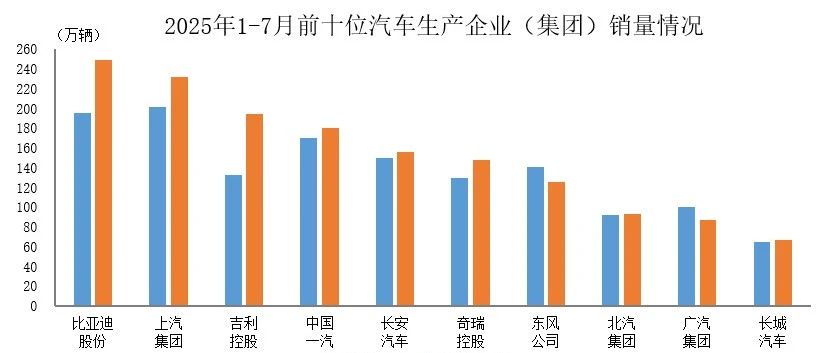
据中国汽车工业协会统计分析,2025年1-7月,汽车销量排名前十位的企业(集团)共销售1535.4万辆,占汽车销售总 量的84%。在上述十家企业中,与上年同期相比,东风公司和广汽集团销量下降,其他企业销量均呈不同程度增长。 ...



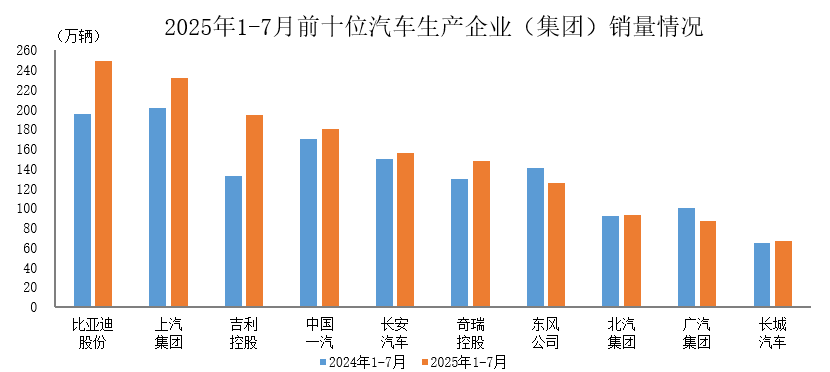
数据简报 | 2025年1-7月前十位汽车生产企业(集团)销售情况简析
中汽协会数据· 2025-08-18 08:02
Group 1 - The core viewpoint of the article highlights that among the ten companies analyzed, Dongfeng Motor and GAC Group experienced a decline in sales compared to the same period last year, while other companies showed varying degrees of growth [1] - According to the China Association of Automobile Manufacturers, the top ten automotive companies (groups) sold a total of 15.354 million vehicles from January to July 2025, accounting for 84% of the total automotive sales [3]
销量难掩隐忧,车企利润率创10年新低
3 6 Ke· 2025-08-18 06:25
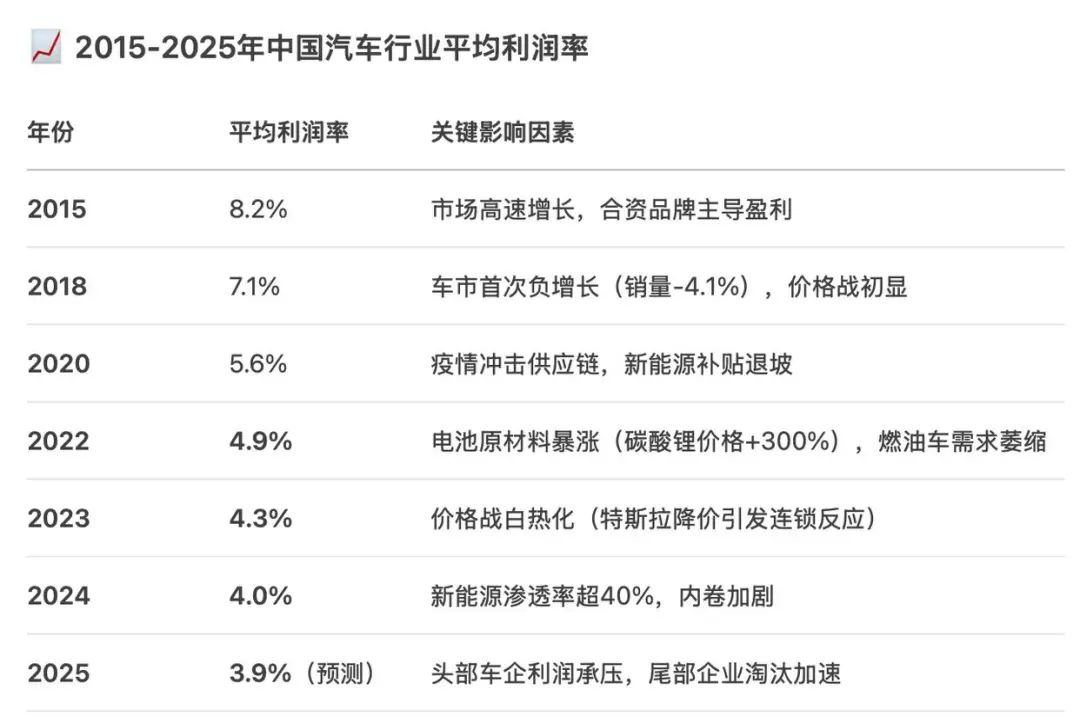
Core Insights - The Chinese automotive market is experiencing a paradox of high sales but low profit margins, with many companies facing significant financial challenges despite increased production and sales figures [1][2][3] Group 1: Sales and Production Data - In July 2025, retail sales of passenger vehicles reached 1.826 million units, a year-on-year increase of 6.3%, while cumulative retail sales for the year reached 12.728 million units, up 10.1% [3] - Wholesale volume for passenger vehicles in July hit a historical high of 2.221 million units, representing a 13.0% year-on-year growth, and production reached 2.229 million units, up 12.1% [3] - From January to July 2025, passenger vehicle production totaled 15.458 million units, reflecting a 13.2% year-on-year increase [3] Group 2: Profit Margin Trends - The average profit margin in the automotive industry has been declining, with projections indicating a drop to 3.9% in 2025, the lowest in history [4][5] - Historical profit margins have decreased from 8.2% in 2015 to 4.3% in 2023, with significant factors including price wars and rising costs of raw materials [4][5] - In the first half of 2025, the automotive industry reported revenues of 509.17 billion yuan, costs of 447.80 billion yuan, and profits of 24.44 billion yuan, resulting in a profit margin of 4.8% [5] Group 3: Company Performance and Challenges - Major companies like BYD, SAIC, Great Wall, and Changan accounted for 76.2% of industry revenue and 94.77% of net profit in Q1 2025, highlighting a growing disparity in profitability among firms [6] - SAIC Motor Corporation reported a revenue decline of 15.73% in 2024, with a net profit drop of 88%, indicating challenges in the fuel vehicle market and ongoing price wars [8] - NIO's 2024 financial report showed a revenue increase of 18.2% but a net loss of 22.4 billion yuan, reflecting a significant drop in gross margin from 18.9% to 7.6% [10] Group 4: Industry Dynamics and Future Outlook - The automotive industry is facing a "price war" and "internal competition," which are eroding profit margins and creating a negative cycle [12][18] - Companies are encouraged to focus on core technologies, optimize cost structures, and enhance brand differentiation to improve profitability [13][15] - Global expansion is seen as a potential avenue for growth, allowing companies to mitigate domestic market pressures and achieve higher profit margins through localized production and marketing strategies [17]





2025年这6家企业发布电堆新品
势银能链· 2025-08-18 04:03
Core Viewpoint - The fuel cell industry is facing challenges such as high manufacturing costs, inadequate infrastructure, intense market competition, and reduced policy subsidies, leading to a decline in sales of fuel cell vehicles. However, several companies are committed to technological research and development, resulting in significant advancements in fuel cell stack innovation and commercialization [2][4]. Summary by Sections Industry Overview - The sales of fuel cell vehicles in 2024 were 7,131 units, a year-on-year decrease of 6.8%. In the first half of 2025, the sales further dropped to 1,967 units, reflecting a year-on-year decrease of 22.0% and a quarter-on-quarter decrease of 57.3% [2]. Technological Innovations - **Jichong Hydrogen Energy**: Launched the MH290 metal plate fuel cell stack with a peak power of 410.9 kW, setting a new industry record. The stack has a design life of 30,000 hours, addressing the issue of frequent core component replacements [2][4]. - **Xie Hydrogen New Energy**: Released its first mass-produced 20 kW air-cooled hydrogen fuel cell, achieving a new record for single-stack power output [5]. - **Shenli Technology**: Introduced the Gen4 stack, capable of power coverage from 180 kW to 400 kW, targeting heavy transport and energy storage applications [6]. - **Hydrogen Pioneering Energy**: Unveiled two new stacks, ST280VID and ST1D4AII, with significant improvements in power density and flexibility for various applications [7]. - **GAC Group**: Developed a 140 kW fuel cell stack, achieving a power density of 7 kW/L and reducing size and weight by 30% and 25% respectively [9]. - **Dongfeng Motor**: Released a 400 kW fuel cell stack designed for heavy-duty trucks, with capabilities for low-temperature cold starts and significant fuel efficiency improvements [10]. Market Outlook - Jichong Hydrogen Energy aims for profitability over diesel vehicles by 2025 under specific conditions (fuel cell price ≤ 800 RMB/kW and hydrogen price ≤ 32 RMB/kg) and complete commercialization by 2027 with further price reductions [4].

城市“无形之战”白热化:京深沪杭凭什么领跑?
Mei Ri Jing Ji Xin Wen· 2025-08-16 23:52
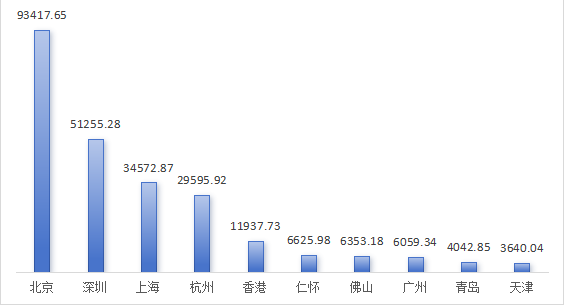
Core Insights - The competition among cities has evolved beyond tangible resources, focusing increasingly on intangible assets, particularly brand value, which is becoming a crucial lever in reshaping China's urban landscape [1][2] - The "2025 China Listed Company Brand Value Blue Book" has been released, ranking the brand values of listed companies across various cities, highlighting the importance of brand value in economic development [1][2] Group 1: Brand Value Rankings - The top three cities, Beijing, Shenzhen, and Shanghai, collectively hold a brand value of 17.9 trillion yuan, accounting for 62.8% of the total brand value of the top 100 cities [2][3] - The brand value of the top three cities has increased from 132,951.86 billion yuan in 2022 to 179,245.80 billion yuan in 2025, indicating a significant upward trend [7] - The brand value of Hangzhou, ranked fourth, is close to 3 trillion yuan, largely driven by Alibaba's contribution of over 18,335.42 billion yuan [7][21] Group 2: City Performance and Trends - Cities like Nanjing and Wuhan are facing challenges due to a lack of new listed companies, leading to a decline in brand value [2][15] - Ningde has shown remarkable growth, with its brand value soaring from 287.06 billion yuan in 2022 to 1,876.91 billion yuan in 2025, primarily due to the success of CATL [11][13] - Guangzhou's brand value has stagnated, with a slight increase from 5,751.10 billion yuan in 2022 to 6,059.34 billion yuan in 2025, reflecting a slow growth rate of 5.36% [8][21] Group 3: Industry Insights - The brand value of traditional industries in cities like Wuhan and Nanjing is declining, particularly in sectors such as real estate and retail, which are experiencing significant drops [15][19] - The automotive and pharmaceutical sectors in Wuhan have seen a substantial decrease in brand value, primarily due to the decline of major local companies [19][20] - The shift towards high-value industries such as digital economy and renewable energy is becoming essential for cities to maintain competitive brand value [2][11]





从小米到腾讯:互联网大厂为何都在造“员工社区”
Mei Ri Jing Ji Xin Wen· 2025-08-16 11:00
Group 1: Tencent's Headquarters Development - Tencent's headquarters park has been completed by 30% and will enter trial operation in October [1] - The park, located in Shenzhen, covers an area of 809,000 square meters and is designed to accommodate over 80,000 employees [1] - The construction of employee apartments aims to address housing difficulties for young employees and enhance their sense of belonging [1][2] Group 2: BYD's New Racing Facility - BYD's all-terrain racetrack in Zhengzhou has officially opened, featuring various unique track types [2] - The racetrack includes a 1,758-meter course with nine bends and a straight acceleration section of 550 meters, allowing speeds over 220 km/h [2] - This facility serves as a platform to showcase BYD's technical capabilities and supports performance validation for electric vehicles [2] Group 3: Lenovo's Financial Performance - Lenovo reported a record revenue of 136.2 billion yuan for Q1 of the 2025/2026 fiscal year, a 22% year-on-year increase [3] - Net profit also grew by 22% to 2.816 billion yuan, driven by the implementation of a hybrid AI strategy [3] - The infrastructure solutions segment saw a revenue increase of 35.8%, with AI infrastructure revenue doubling [3] Group 4: China Unicom's Revenue Growth - China Unicom's revenue surpassed 200 billion yuan in the first half of the year, marking a 1.5% increase [4] - The company's profit totaled 17.7 billion yuan, reflecting a 5.2% year-on-year growth [4] - The growth is attributed to the stability of traditional communication services and advancements in smart network services [4][5] Group 5: GAC Group's New Automotive Initiative - GAC Group has launched the Huawang Automotive city recruitment plan, focusing on a "less business, more stores" strategy [5] - The plan aims to create a diversified and professional store matrix to enhance brand penetration [5] - This initiative is expected to reduce channel costs and boost sales for GAC's new energy vehicles [5] Group 6: Xiaomi's User Engagement Strategy - Xiaomi's CEO Lei Jun initiated a poll regarding the renaming of the Xiaomi YU7 model, with over 70% of voters supporting no name change [6] - This reflects Xiaomi's commitment to user participation in brand decisions, reinforcing its user-oriented approach [6] - The strong user support for the current product positioning is crucial for Xiaomi's market share in the competitive smart electric vehicle sector [6] Group 7: JD Group's Strategic Partnership - JD Group has signed a strategic cooperation agreement with Dongfeng Motor Group to enhance collaboration in various sectors [7] - The partnership will focus on full-channel marketing for passenger vehicles and green intelligent logistics for commercial vehicles [7] - This collaboration aligns with the trend of integrating online and offline operations in the automotive industry [7]




100观察丨从小米到腾讯:互联网大厂为何都在造“员工社区”
Mei Ri Jing Ji Xin Wen· 2025-08-16 10:56
Group 1: Tencent Headquarters Development - Tencent's headquarters park has been completed 30% as of August 14, with trial operations set to begin in October [2] - The park, located in Shenzhen, covers an area of 809,000 square meters and is designed to accommodate over 80,000 employees [1][2] - The construction of employee apartments aims to address housing difficulties for young workers, enhancing their sense of belonging and recognition towards the company [1][2] Group 2: BYD's New Racing Facility - BYD's all-terrain racetrack in Zhengzhou officially opened on August 14, featuring various specialized tracks [3] - The racetrack includes a 1,758-meter course with nine turns and a maximum straight-line acceleration of 550 meters, allowing speeds over 220 km/h [3] - This facility serves as a platform to showcase BYD's technical capabilities and provides a testing ground for electric vehicle performance [3] Group 3: Lenovo's Financial Performance - Lenovo reported a record revenue of 136.2 billion yuan for Q1 of the 2025/2026 fiscal year, marking a 22% year-on-year increase [4][5] - The company's net profit also grew by 22% to 2.816 billion yuan, driven by the successful implementation of its hybrid AI strategy [4][5] - The infrastructure solutions segment saw a revenue increase of 35.8%, while AI infrastructure revenue doubled, contributing to Lenovo's competitive advantage [5] Group 4: China Unicom's Revenue Growth - China Unicom's revenue surpassed 200 billion yuan in the first half of the year, reflecting a 1.5% year-on-year growth [6] - The company's profit reached 17.7 billion yuan, up 5.2% from the previous year, supported by stable traditional communication services and growth in smart network services [6] - The smart network services segment generated 45.4 billion yuan, accounting for 22.7% of total revenue, indicating a shift towards digital infrastructure [6] Group 5: GAC Group's New Automotive Initiative - GAC Group launched the Huawang Automotive city recruitment plan, focusing on a "few businesses, many stores" strategy [7] - The plan aims to create a diversified and professional store matrix to enhance brand penetration and reduce channel costs [7] - This initiative is expected to drive sales growth for GAC's new energy vehicles if successfully implemented [7] Group 6: Xiaomi's User Engagement Strategy - Xiaomi's CEO Lei Jun initiated a poll regarding the renaming of the Xiaomi YU7 standard version, with over 70% of voters supporting no name change [8] - The strong user support reflects recognition of the product's positioning and reinforces Xiaomi's user-centric brand identity [8] - This approach is crucial for Xiaomi to maintain its market share in the competitive smart electric vehicle sector [8] Group 7: JD Group's Strategic Partnership - JD Group signed a strategic cooperation agreement with Dongfeng Motor Group to enhance collaboration in various automotive sectors [9] - The partnership will focus on full-channel marketing for passenger vehicles and green intelligent logistics for commercial vehicles [9] - This collaboration aligns with the trend of integrating online and offline operations in the automotive industry [9]

中国汽车半年出口超300万辆 车企海外建厂加速
Zhong Guo Jing Ying Bao· 2025-08-15 20:29
Core Insights - The resilience of Chinese automotive exports is evolving from "product export" to "system export," focusing on local production, technology transfer, and brand development to enhance global competitiveness [1][3][6] Group 1: Export Growth and Market Expansion - In the first half of this year, China's automotive exports reached 3.083 million units, a year-on-year increase of 10.4% [1] - GAC Group has established a presence in five major regions, including the Middle East, Americas, Africa, Southeast Asia, and Eastern Europe, to enhance local production and ecological expansion [1][3] - BYD's overseas sales exceeded 470,000 units in the first half of the year, representing a growth of over 130% compared to the previous year [1][4] Group 2: Local Production and Strategic Initiatives - Companies like Xpeng Motors and Changan Automobile are investing in local production facilities to reduce trade barriers and transportation costs [3][4] - Changan's factory in Thailand has officially commenced production, with plans to achieve global sales of 5 million units by 2030, including 3 million smart connected new energy vehicles [3][4] - BYD is expanding its production bases in Thailand, Brazil, Hungary, and Uzbekistan, with a target of over 800,000 units in overseas sales by 2025 [4][5] Group 3: Globalization Strategies and Challenges - The trend of overseas factory establishment is coupled with localized operations, emphasizing stable supply chains and collaboration with local suppliers [2][6] - Companies are also exploring capital market strategies to accelerate globalization, as seen with Seres' H-share issuance plan [6][7] - The Asian market is projected to account for over 40% of China's new energy vehicle exports by 2024, driven by favorable policies and competitive pricing in Southeast Asia and the Middle East [7][8] Group 4: Recommendations for Sustainable Development - Industry experts suggest that companies should focus on product adaptation, partner selection, and after-sales service to build a resilient global system [7][8] - Establishing a mixed service network and a dedicated regulatory certification team is recommended to ensure smooth market entry and compliance [8]

广汽集团股价微涨0.67% 冯兴亚建言全固态电池技术攻关
Jin Rong Jie· 2025-08-15 19:58
Group 1 - The latest stock price of GAC Group is 7.55 yuan, with an increase of 0.05 yuan or 0.67% compared to the previous trading day's closing price [1] - GAC Group is a major automotive manufacturer in China, involved in the research, manufacturing, sales, and service of vehicles and components [1] - GAC Group has its own brands such as GAC Trumpchi and GAC Aion, and has joint ventures with international car companies like Honda and Toyota [1] Group 2 - GAC Group's chairman, Feng Xingya, suggested that Guangdong should focus resources on overcoming solid-state battery technology challenges and nurturing related industrial chains [1] - Guangdong's production of new energy vehicles accounts for about one-fourth of the national total, but the region's capabilities in computing chips and in-vehicle operating systems remain relatively weak [1] - GAC Group recently increased its investment in Huawang Automotive by 600 million yuan, which is a high-end smart car brand developed in collaboration with Huawei [1] Group 3 - Huawang Automotive plans to launch pure electric and range-extended models targeting the 300,000 yuan market segment, expected to be released in 2026 [1] - On August 15, GAC Group experienced a net inflow of main funds amounting to 1.0378 million yuan, while the net outflow over the past five days was 8.1277 million yuan [1]
广汽冯兴亚:全固态电池技术已成竞争焦点,建议广东集中资源攻克
2 1 Shi Ji Jing Ji Bao Dao· 2025-08-15 15:02
Group 1 - The core viewpoint emphasizes that smart connected vehicles represent the integration of new productive forces such as new energy vehicles, artificial intelligence, and big data, which is essential for high-quality development in the automotive industry [1] - Guangdong is the leading province in China for automotive production and consumption, with new energy vehicle production accounting for approximately one-fourth of the national total [1][3] - Challenges remain in innovation collaboration and results transformation for Guangdong's new energy vehicles, particularly in the industrialization of third-generation lithium metal batteries and the domestic production of automotive chips [1][2] Group 2 - In 2024, Guangdong's automotive revenue is projected to reach 1,281.273 billion yuan, with a total profit of 31.806 billion yuan, and an automotive production volume of 5.7074 million units, maintaining the top position in the country for eight consecutive years [3] - The production of new energy vehicles in Guangdong is expected to exceed 50% of the national market share this year, reflecting a significant increase in market penetration [3] - Recommendations include strengthening core capabilities in the main business sector, establishing targeted support policies, and enhancing the development of domestic chip production and application scenarios [2][3]