
PING AN OF CHINA(601318)

Search documents
警企联动、一地一策!中国平安发起2026春节风险减量行动
Guang Zhou Ri Bao· 2026-02-10 13:27
Core Viewpoint - The company, Ping An Property & Casualty Insurance, is launching the "2026 'Safe Journey Home' Spring Festival Risk Reduction Initiative" to enhance road safety during the Spring Festival travel period, focusing on proactive risk management and prevention measures [2][3]. Group 1: Initiative Overview - The initiative is a comprehensive upgrade of Ping An's 15-year tradition of providing safety services during the Spring Festival, extending its focus from post-event support to preemptive risk management [2][3]. - The action targets regions with historically high daily claim volumes, specifically seven provinces including Sichuan, Anhui, Henan, Hunan, Jiangxi, Guizhou, and Chongqing, while also being implemented in other provinces like Shandong and Hubei [3]. Group 2: Risk Reduction Strategies - The company employs a "data analysis + police-enterprise collaboration + localized strategies" model to address the challenges posed by increased traffic and potential hazards during the Spring Festival [3]. - Specific measures include deploying service stations, implementing smart traffic alerts, and enhancing rural road safety through infrastructure improvements [3][4]. Group 3: Localized Actions - In Sichuan, the company collaborates with traffic police to set up service points in high-risk areas, distributing free anti-skid chains and educating drivers on safe driving in icy conditions [4]. - In Guizhou, 224 micro-weather stations have been installed to monitor road freezing risks, allowing for real-time alerts and coordinated responses with traffic management [5]. - In Hunan, the introduction of drone surveillance for highways aims to improve the detection and management of incidents, significantly reducing response times [5]. Group 4: Community Engagement - The initiative includes community outreach, such as providing free vehicle safety checks and distributing reflective materials to enhance nighttime visibility for drivers [6][7]. - The company has also initiated a "tail-light" campaign for large trucks to improve nighttime safety and reduce rear-end collisions [6][7]. Group 5: Long-term Commitment - Ping An plans to continue its efforts in road safety and risk reduction, emphasizing the transition from reactive compensation to proactive, comprehensive support throughout the entire lifecycle of road safety [7]. - The company has already made significant contributions, including the donation of over 10,000 traffic safety facilities and training for more than 200,000 villagers in traffic safety and financial consumer protection [7].


沧源金融监管支局同意平安产险沧源支公司变更营业场所
Xin Lang Cai Jing· 2026-02-10 12:39
Core Viewpoint - The Cangyuan Financial Regulatory Bureau approved the request from China Ping An Property & Casualty Insurance Company to change the business location of its Cangyuan branch to a new address in Mengdong Town, Cangyuan Wa Autonomous County, Yunnan Province [1] Group 1 - The new business location is specified as Room 101, 1-2 floors, Building 9, Auto Trading Market, Mengdong Town, Cangyuan Wa Autonomous County, Yunnan Province [1] - The company is required to handle the change and obtain the necessary permits in accordance with relevant regulations [1]
股降债升,板块偏向创业板:公募基金2025年四季报剖析
Xiangcai Securities· 2026-02-10 11:50
1. Report Industry Investment Rating - No relevant content provided. 2. Core Viewpoints - In 2025, the number and scale of existing public - funds increased, and the ETF market was much more popular. The new - issuance quantity and share of ETFs increased significantly, with annual growth rates of 114.79% and 119.10% respectively, far exceeding the 37.00% increase in the total number and - 0.69% change in the total share of public funds [2][17]. - In Q4 2025, stock - type, bond - type, and hybrid - type funds generally showed a decrease in stock positions and an increase in bond positions. Public funds shifted from Hong Kong stocks and the Science and Technology Innovation Board to the Growth Enterprise Market [3]. - In Q4 2025, the industries with a relatively large increase in the active position - adjustment ratio were non - banking finance, non - ferrous metals, and communications, while those with a relatively large decrease were electronics, media, and biomedicine. There was an obvious shift from growth and consumption styles to the cyclical style [4]. - Since 2025, the scale of FOF funds has increased against the trend, and the proportion of bond - type funds in the top - five heavy - position funds of FOF in the Q4 2025 report is relatively high [6]. 3. Summary by Directory 3.1 Public Fund Market Overview 3.1.1 Fund Market Composition and Issuance - As of the end of Q4 2025, there were 13,618 public funds in the market, with an increase of 1,259 this year. In terms of quantity, they were mainly composed of hybrid, bond, and stock - type funds, accounting for 35.33%, 29.32%, and 25.33% respectively. The total scale was 37.67 trillion yuan, an increase of 4.84 trillion yuan compared to the end of 2024, with a 12.85% increase in Q4 2025. In terms of scale, they were mainly composed of money - market, bond, and stock - type funds, accounting for 39.84%, 29.50%, and 16.06% respectively [14]. - From 2021 to 2025, the number and share of newly - issued public funds showed a downward trend, but they increased in 2025. In Q4 2025, 406 public funds were newly issued, with a total issuance share of 280.081 billion shares. In terms of quantity, stock - type funds accounted for 47.29%, and in terms of share, stock - type and bond - type funds accounted for 31.70% and 31.24% respectively [15]. - In 2025, the new - issuance volume and share of ETFs increased significantly. In Q4 2025, the quarterly growth rates of the cumulative number and share of ETFs were 5.81% and 12.17% respectively, exceeding the 2.38% and 3.15% growth rates of public funds. The annual growth rates of the new - issuance quantity and share of ETFs in 2025 were 114.79% and 119.10% respectively, far higher than those of public funds [17]. 3.1.2 Investor Structure - According to the semi - annual report of public funds in 2025, the proportion of institutional holders changed little compared to 2024. The increase in the proportion of institutional investors was mainly reflected in QDII funds and hybrid - type funds, while the proportion of institutional investors in bond - type and hybrid funds increased slightly. The proportion of individual investors increased mainly in alternative investment funds and FOF funds, and also increased in money - market funds [20]. - As of mid - 2025, the holding net values of institutional and individual investors were 16.51 trillion yuan and 17.71 trillion yuan respectively, accounting for 48.25% and 51.75%. Since H2 2017, the proportion held by individual investors has been slightly higher than that by institutional investors [23]. 3.2 Stock - type Funds 3.2.1 Q4 Position Changes - In Q4 2025, compared with Q3, stock - type, bond - type, and hybrid - type funds generally showed a decrease in stock positions and an increase in bond positions, while FOF funds increased their stock positions, mainly in stock - type FOF funds, with an increase of 1.83 pct [25]. - The stock positions of four types of active funds (partial - stock hybrid, flexible allocation, common stock, and balanced hybrid) decreased, and their positions in Hong Kong stocks also decreased, but their bond positions increased [27][28]. 3.2.2 Sector Allocation - In Q4 2025, public funds shifted from Hong Kong stocks and the Science and Technology Innovation Board to the Growth Enterprise Market. The allocation market value of the Growth Enterprise Market increased by 2.65%, and the allocation ratio increased by 1.98%, reaching 18.61% at the end of Q4, second only to the main board [37]. 3.2.3 Industry and Style Allocation - In Q4 2025, 16 Shenwan primary industries had an increase in the active position - adjustment ratio, and 15 had a decrease. The industries with a relatively large increase were non - banking finance, non - ferrous metals, and communications, while those with a relatively large decrease were electronics, media, and biomedicine [43]. - There was an obvious shift from growth and consumption styles to the cyclical style in Q4 2025. The cyclical style had the largest increase in market - value proportion after removing the passive increase caused by the increase in Q4, with an active position - adjustment ratio increase of 2.06% [48]. 3.2.4 Individual Stock Allocation - As of the end of Q4 2025, the top 3 stocks in terms of market value of shares held were Zhongji Innolight, Xinyisheng, and Contemporary Amperex Technology, and the top 3 in terms of the proportion of market value of shares held to the floating market value were BeiGene - U, Reagent Biotech, and Ninebot Inc. - WD [4][49]. - In Q4 2025, the top 3 stocks with active position - increases were Ping An Insurance (Group) Company of China, Shandong Precision, and Tianhua New Energy, and the top 3 with active position - decreases were Foxconn Industrial Internet, Alibaba Group Holding Limited, and Semiconductor Manufacturing International Corporation [4]. 3.3 Bond - type Funds - As of the end of Q4 2025, there were 3,993 bond - type funds, an increase of 57 compared to the previous quarter, with a total scale of 11.11 trillion yuan, an increase of 373.431 billion yuan compared to the previous quarter. The increase in the scale was mainly due to the increase in the scale of passive index - type bond funds and hybrid bond - type secondary funds [63]. - In Q4 2025, except for convertible bond - type funds and enhanced index - type bond funds, the durations of other types of bond - type funds changed little. The durations of mixed - level - 1 bonds, mixed - level - 2 bonds, medium - and long - term pure - bond funds, and partial - bond hybrid funds showed a downward trend in the second half of 2025 after reaching a historical high at the end of Q2 2025 [5]. 3.4 FOF Funds - Since 2025, the scale of FOF funds has increased against the trend. In Q4 2025, the total scale of FOF funds increased by 50.699 billion yuan, with a faster growth rate than in Q3. The top 3 FOF funds in terms of scale proportion were partial - bond hybrid, partial - stock hybrid, and target - date FOF funds, accounting for 60.92%, 14.50%, and 11.01% respectively [70]. - Among the 43 FOF funds issued in Q4 2025, 41 were hybrid - type FOF funds. E Fund Ruyi Ying'an 6 - month Holding A had the largest issuance share of 3.164 billion shares [71]. - According to the top - ten heavy - position funds of FOF funds in the Q4 2025 report, the top - five heavy - position funds were all bond - type funds, and most of the FOF heavy - position funds were bond - type funds, with Haifutong CSI Short - term Financing Bond ETF having the highest total holding market value of 5.976 billion yuan [76].



中国平安发起2026春节风险减量行动,重点聚焦四川、安徽等7地
Bei Jing Shang Bao· 2026-02-10 10:59
Core Viewpoint - Ping An Property & Casualty Insurance is launching the "2026 'Ten Thousand Families Safe Journey' Spring Festival Risk Reduction Action" to proactively address risks during the Spring Festival travel period, utilizing historical claims data and a collaborative approach with law enforcement and technology [1] Group 1: Action Overview - The initiative is part of the "Ping An Guardian" campaign, focusing on risk reduction services tailored to high-risk areas identified through historical data [1] - The action targets seven key regions with significant increases in average daily claims during the same period, including Sichuan, Anhui, Henan, Hunan, Jiangxi, Guizhou, and Chongqing, while also being implemented in multiple provinces nationwide [1] Group 2: Risk Reduction Strategy - The risk reduction model combines data analysis, collaboration with law enforcement, and localized strategies to address the challenges posed by high traffic volumes and potential hazards during the Spring Festival [1] - Specific measures include deploying service station networks, implementing smart intersection warnings, rural road improvements, tidal flow guidance, and ice hazard management, all aimed at ensuring road safety [1]
行业研究|行业周报|投资银行业与经纪业:回调后建议积极配置,持续关注板块绩优个股-20260210
Changjiang Securities· 2026-02-10 08:44
Investment Rating - The report maintains a "Positive" investment rating for the industry [7] Core Insights - The non-bank financial sector has shown weak overall performance this week, with a recommendation to seize allocation opportunities in the brokerage sector as market trading has slightly declined but remains at historical highs. In the insurance sector, the long-term outlook is optimistic due to improved return on equity (ROE) and valuation recovery potential, suggesting a positive allocation strategy for insurance stocks [2][4] - The report continues to recommend stable dividend-paying stocks such as Jiangsu Jinzhong, China Ping An, and China Pacific Insurance, which exhibit strong profitability and market positions. Additionally, it highlights companies like New China Life, China Life, Hong Kong Stock Exchange, CITIC Securities, Dongfang Caifu, Tonghuashun, and Jiufang Zhitu Holdings based on performance elasticity and valuation [4] Summary by Sections Market Performance - The non-bank financial index decreased by 0.6% this week, with an excess return of +0.7% relative to the CSI 300, ranking 20th out of 31 sectors. Year-to-date, the non-bank financial index is down 1.1%, with an excess return of -1.4% compared to the CSI 300, ranking 29th out of 31 [5] - The average daily trading volume in the two markets was 24,066.54 billion yuan, down 21.43% week-on-week, with a daily turnover rate of 2.36%, down 60.83 basis points [5][35] Insurance Sector Insights - In December 2025, the cumulative insurance premium income reached 61,194 billion yuan, reflecting a year-on-year increase of 7.43%. Life insurance premiums increased by 8.91%, while property insurance premiums rose by 3.92% [20][21] - The total assets of insurance companies reached 41.31 trillion yuan, with life insurance companies holding 36.39 trillion yuan, representing 88.09% of the total [25][26] Brokerage and Investment Business - The brokerage business is experiencing a gradual recovery in profitability, with the average daily trading volume exceeding the 2025 average. The report notes that the commission fee rates are stabilizing, which is expected to support the profitability of the brokerage sector [35][41] - In January 2026, the equity financing scale rebounded to 134.86 billion yuan, up 103.4% month-on-month, while bond financing decreased by 15.6% [45] Asset Management and Fund Issuance - The report indicates a recovery in the issuance of collective asset management products, with January 2026 seeing a new issuance of 9.104 billion units, up 40.1% from the previous month. The new fund issuance also increased to 1,094.51 billion units, reflecting a 41.3% month-on-month rise [47][49]


招商证券:保险行业2025年稳健收官 2026年开门红值得期待
Zhi Tong Cai Jing· 2026-02-10 06:08
Core Viewpoint - The insurance industry maintains a recommended rating, supported by a "slow bull" market trend that benefits both asset returns for insurance companies and sales of floating income-type dividend insurance [1] Group 1: Life Insurance Companies - In 2023, life insurance companies achieved a cumulative premium income of 43,624 billion, with a year-on-year growth of 8.9%, slightly down from 9.1% [3] - December's premium income for life insurance companies was 2,152 billion, showing a year-on-year increase of 6.0%, with life insurance premiums at 1,683 billion, up 10.1% [3] - The strong performance in life insurance is expected to continue into 2026, particularly in the bancassurance channel, where new single premiums are anticipated to double [3] Group 2: Property Insurance Companies - Property insurance companies reported a cumulative premium income of 17,570 billion in 2023, with a stable year-on-year growth of 3.9% [4] - December's premium income for property insurance was 1,413 billion, with a year-on-year increase of 4.4%, and auto insurance premiums at 977 billion, up 2.2% [4] - Non-auto insurance premiums in December reached 437 billion, showing a significant year-on-year growth of 9.6%, driven by low base effects from the previous year [4] Group 3: Overall Industry Performance - The total premium income for the insurance industry in 2023 was 61,194 billion, reflecting a year-on-year growth of 7.4% [5] - By the end of December, the total assets of the insurance industry reached 413,145 billion, a 15.1% increase from the beginning of the year, while net assets grew by 10.2% to 36,640 billion [5] - Investment recommendations include China Ping An, New China Life, China Life, and China Taiping, with a focus on the long-term investment value of China Property Insurance [5]


2026险资入市规模或达0.9万亿
HTSC· 2026-02-10 02:35
Investment Rating - The report recommends a "Buy" rating for several insurance companies, including China Pacific Insurance, China Life Insurance, and China Property & Casualty Insurance [5]. Core Insights - The insurance industry is expected to see significant growth in investable funds, with estimates of 3.1 trillion yuan in 2026, driven by strong premium growth and a balanced allocation between equities and bonds [6][31]. - The secondary equity investment is projected to reach 0.9 trillion yuan in 2026, slightly lower than the previous year, while bond investments are expected to increase significantly [6][30]. - The report emphasizes the importance of dividend stocks as a key investment strategy for insurance companies, aiming to secure cash dividends to offset declining interest income [7][48]. Summary by Sections Investment Scale and Growth - In 2025, the insurance sector is estimated to have an additional investable fund of 2.3 trillion yuan, with secondary equity investments around 1 trillion yuan, marking a significant increase from previous years [12][36]. - By 2026, the total investment scale in the insurance industry is projected to reach 42 trillion yuan, with a secondary equity allocation expected to rise to 18% [30][35]. Premium and Fund Sources - The total premium for the insurance industry is expected to reach 6.9 trillion yuan in 2026, with a year-on-year growth of approximately 13% [31][34]. - New single premiums are projected to be 2 trillion yuan, reflecting a 25% increase, while renewal premiums are expected to grow by 11% to 3 trillion yuan [31][34]. Asset Allocation and Strategy - The report indicates a shift in asset allocation, with a decrease in non-standard, deposit, and alternative assets, while equities and bonds are expected to see increased investment [30][41]. - The focus on dividend stocks is highlighted as a strategy to stabilize cash flow and reduce profit volatility, with an anticipated annual increase in high-dividend stock allocations of 300 to 500 billion yuan [7][55]. Market Dynamics - The report notes that the insurance sector's secondary equity position reached a historical high of 16% by the end of 2025, driven by favorable market conditions and policy support [12][20]. - The anticipated regulatory changes in asset-liability management are expected to further influence investment strategies within the insurance industry [6][30].


未知机构:东吴非银孙婷团队继续看好以平安国寿等头部保险股兼具配置价值和贝塔属性-20260210
未知机构· 2026-02-10 02:00
Summary of Key Points from Conference Call Industry Overview - The focus is on the insurance sector, particularly leading companies such as Ping An and China Life, which are noted for their investment value and beta characteristics [1][2]. Core Insights and Arguments 1. **Insurance Stock Performance**: The A-share insurance index increased by 2.4%, outperforming the market, with China Life rising over 3% and H-shares of Ping An, China Life, and Taikang rising over 4% [1][2]. 2. **New Policy Premium Growth**: There is a clear trend of concentration among leading companies, with new single premium growth expected to be around 50%, with Ping An leading the industry [1][2]. 3. **Transformation of Dividend Insurance**: The acceleration in the transformation of dividend insurance is expected to optimize liability costs and alleviate pressure from interest spread losses [3]. 4. **Stable Asset Performance**: The stock market performance is stable, and the yield on 10-year government bonds is expected to rise, which is generally viewed positively by insurance companies regarding long-term bond rates. This could benefit fixed-income investments and interest spread recovery for insurance stocks [3]. 5. **Profit Growth Projections**: It is anticipated that net profits will maintain high growth in the first half of 2026, with a projected 33% year-on-year increase in net profits for listed insurance companies in the first three quarters of 2025, indicating a significant overall profit growth for the year [3]. 6. **Valuation and Public Fund Holdings**: Current valuations of insurance stocks and public fund holdings are at historical lows. The demand for allocation to insurance stocks is expected to increase in the context of public fund reforms [3][4]. Additional Important Points - The improvement in the fundamental aspects of the insurance sector suggests a positive outlook for upward valuation potential [4].
中证粤港澳大湾区发展主题指数上涨0.02%,大湾区ETF(512970)成立以来超越基准年化收益达3.32%
Sou Hu Cai Jing· 2026-02-10 01:43
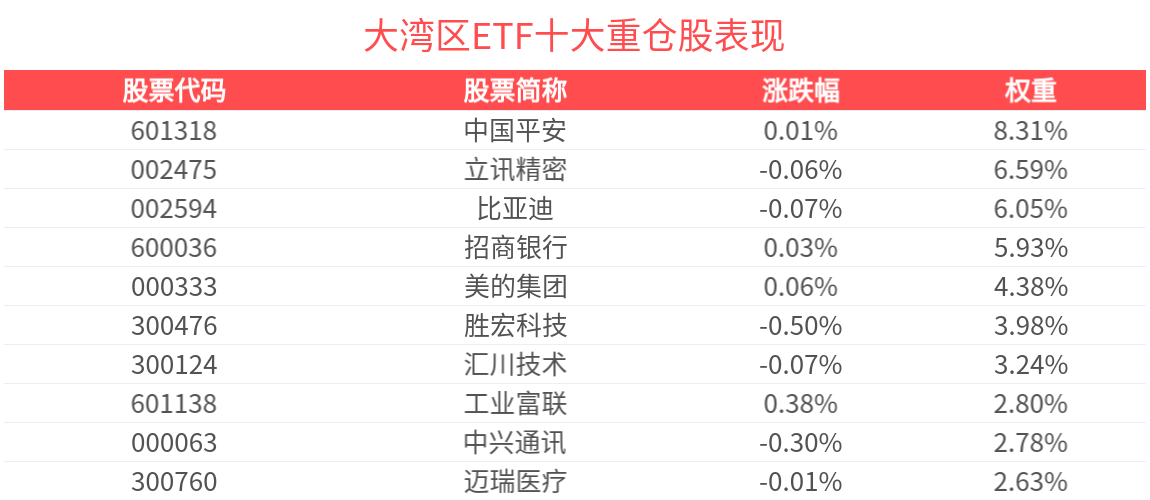
Core Viewpoint - The performance of the Zhuhai-Hong Kong-Macao Greater Bay Area Development Theme Index and its related ETF reflects the overall performance of companies benefiting from the development of the Greater Bay Area, with notable movements in specific constituent stocks [1][2]. Group 1: Index Performance - As of February 10, 2026, the Zhuhai-Hong Kong-Macao Greater Bay Area Development Theme Index (931000) increased by 0.02%, with notable gains from stocks such as Zhaochi Co. (+9.96%) and Mingyang Smart Energy (+1.56%) [1]. - The Greater Bay Area ETF (512970) showed a mixed performance, with a recent price of 1.52 yuan and a cumulative increase of 2.91% over the past week as of February 9, 2026 [1]. Group 2: Liquidity and Trading Data - The trading volume for the Greater Bay Area ETF was reported at 0.00 yuan, with an average daily trading volume of 711,700 yuan over the past month [1]. - The Sharpe ratio for the Greater Bay Area ETF over the past year was 1.41, indicating a favorable risk-adjusted return [1]. Group 3: Drawdown and Fees - The maximum drawdown for the Greater Bay Area ETF year-to-date was 5.52%, with a relative benchmark drawdown of 0.02% [1]. - The management fee for the Greater Bay Area ETF is set at 0.15%, while the custody fee is 0.05% [1]. Group 4: Index Composition - As of January 30, 2026, the top ten weighted stocks in the Zhuhai-Hong Kong-Macao Greater Bay Area Development Theme Index accounted for 44.55% of the index, with China Ping An, Luxshare Precision, and BYD among the leading constituents [2][3]. - The index includes a maximum of 50 Hong Kong market securities, 300 companies from the Shanghai-Hong Kong-Shenzhen market, and 100 mainland market securities, all selected based on their alignment with the Greater Bay Area development theme [2].




宜宾监管分局同意平安产险南溪支公司变更营业场所
Jin Tou Wang· 2026-02-09 15:04
中国平安 中国平安-R 中国平安 分时图 日K线 周K线 月K线 68.70 1.80 2.69% 3.23% 2.15% 1.08% 0.00% 1.08% 2.15% 3.23% 64.74 65.46 66.18 66.90 67.62 68.34 69.06 09:30 10:30 11:30/13:00 14:00 15:00 0 104万 208万 311万 2026年2月2日,国家金融监督管理总局宜宾监管分局发布批复称,《关于平安产险南溪支公司变更营业 场所的请示》(平保产川分宜宾中支发〔2026〕1号)收悉。经审核,现批复如下: 一、同意中国平安(601318)财产保险股份有限公司南溪支公司将营业场所变更为:四川省宜宾市南溪 区丽雅时代商业D座第二层2-3号。 二、平安产险应按照有关规定及时办理变更及许可证换领事宜。 ...