
lu'an EED(601699)

Search documents
煤炭行业基金持仓 2025Q4 季报总结:Q4 基金持仓持续回升,板块拐点确认
GUOTAI HAITONG SECURITIES· 2026-01-30 05:36
Investment Rating - The report assigns an "Overweight" rating to the coal industry [5][27]. Core Insights - The coal sector's fund holdings have rebounded from historical lows, confirming the cyclical bottom in Q2 2025, with a reversal in the supply-demand dynamics now evident [3][5]. - The report recommends core stocks such as China Shenhua, Shaanxi Coal, and China Coal Energy, while also suggesting continued investment in Yanzhou Coal and Jinneng Holding [5][6]. Summary by Sections Fund Holdings - As of Q4 2025, the coal sector's fund holdings increased by 0.03% to 0.61%, with the top ten coal stocks' market value ratio rising from 0.49% in Q3 to 0.53% [5][9]. - The number of coal stocks in the top ten holdings decreased from 26 in Q3 2025 to 22 in Q4 2025, indicating a higher allocation to industry leaders with strong profit certainty [5][9]. Major Holdings - The top five coal stocks held by funds are China Shenhua (0.58%), Shaanxi Coal (1.70%), Yanzhou Coal (2.93%), Lu'an Environmental Energy (5.86%), and China Coal Energy (1.60%) [9][12]. - Notable increases in holdings were observed in Shanxi Coal International (5.00%), Pingmei Shenma (4.82%), and Hengyuan Coal Power (2.44%) [13]. Market Performance - The coal industry index outperformed the CSI 300 index in Q4 2025, indicating a positive market trend for coal stocks [6][18]. - The report highlights significant changes in holdings by the Shanghai-Hong Kong Stock Connect, with increased stakes in Jiangxi Tungsten, Zhengzhou Coal, and Kailuan Energy [13][14]. Valuation Metrics - The report provides valuation metrics for key coal companies, with China Shenhua's estimated PE ratio for 2025 at 15.50 and for 2026 at 14.62, indicating a favorable investment outlook [21][22].





煤炭行业热点事件复盘及投资策略系列深度:产能预计收紧、进口预期收缩,看好旺季煤价反弹
Shenwan Hongyuan Securities· 2026-01-29 14:41
证 券 研 究 报 告 www.swsresearch.com 证券研究报告 2 ◼ 煤炭行业供给端正面临深层次格局重塑。2025年12月国家六部门印发《煤炭清洁高效利用重点领域标杆水平 和基准水平(2025年版)》,将燃煤发电供热煤耗、煤制天然气等纳入管控范围,叠加安监、环保常态化监 管持续从严,供给秩序进一步向理性化、高质量转型;叠加主产区产能置换与新增产能严格审批,行业产能释 放预计延续稳中有紧态势,优质合规产能话语权持续提升。逆全球化浪潮推动资源民族主义持续觉醒,煤炭作 为关键战略能源,其保障国家能源安全的核心价值被重新凸显。2025年12月以来,印尼明确下调2026年煤炭 生产目标,重启1%-5%煤炭出口关税并收紧外汇管理,通过产量调控、税费调节巩固资源主动权。 ◼ 需求端,2025年12月全社会用电刚性增长底色未改,煤电需求韧性犹存;煤化工领域则迎来增长新动能,煤 制油、煤制烯烃等项目加速落地,12月化工耗煤同比增长7%延续高增态势,成为需求增长核心拉动力,综合 来看2026年整体煤炭需求将维持稳定并实现小幅增长。 ◼ 投资分析意见:看好动力煤价格持续反弹,建议关注成长性标的特变电工、晋控煤业、华 ...


潞安环能:控股股东依托自身区域资源优势赋能上市公司
Zheng Quan Ri Bao Wang· 2026-01-28 14:11
证券日报网讯1月28日,潞安环能(601699)在互动平台回答投资者提问时表示,在煤炭行情持续下 行、安全、环保压力不断加大的条件下,控股股东依托自身区域资源优势赋能上市公司,在业务、资 金、产业链等方面给予大力支持,强化公司内在价值,提高公司市场竞争力应对各种冲击和挑战,以致 公司持续保持平稳运行。集团资产注入承诺事项请关注公司年报相关内容,公司将与控股股东共同推动 符合条件的资产适时注入公司。 ...
潞安环能:截至2026年1月20日股东人数81000多户
Zheng Quan Ri Bao Wang· 2026-01-28 10:14
证券日报网讯1月28日,潞安环能(601699)在互动平台回答投资者提问时表示,截至2026年1月20日, 公司的股东人数是81000多户。 ...
全面走强!煤炭板块震荡走高掀上涨潮,山西焦化涨停领涨!
Jin Rong Jie· 2026-01-28 09:56
Group 1: Market Performance - The A-share coal sector is experiencing a strong upward trend, with sub-sectors like coking coal and thermal coal rising in tandem, indicating a sustained profit-making effect [1] - Shanxi Coking Coal has hit the daily limit up, becoming the leading stock in the sector, while Lu'an Environmental Energy has increased by over 8%, leading the coking coal sub-sector [1] - Other stocks such as Jinko Coal, Electric Power Energy, Shaanxi Black Cat, and Haohua Energy are also seeing synchronized gains, reflecting a significant increase in market activity [1] Group 2: Industry Outlook - The coal price is expected to rise by approximately 5-7% in 2026, with improved performance for listed companies anticipated to follow suit [2] - Coal inventory has significantly decreased, with a total of 22.59 million tons reported, marking a week-on-week decline of 2.9% and a year-on-year drop of 20.4%, indicating a tight supply-demand balance [2] - The implementation of stricter safety regulations and continued restrictions on imported coal are expected to accelerate the elimination of outdated production capacity, leading to an increase in industry concentration [2] Group 3: Related Industries - The coal chemical industry is expected to benefit from rising coal prices and stable supply, with a projected 6% growth in coal consumption driven by new coal chemical projects [3] - The power industry, particularly thermal power, is seeing a resilient coal demand, with a 3.3% year-on-year increase in coal consumption since the beginning of 2026 [3] - The steel industry is also benefiting from the improved coal sector, with a 1.5% year-on-year increase in pig iron production and a 0.9% week-on-week increase in coking coal sales, highlighting the synergy within the steel-coal supply chain [3]


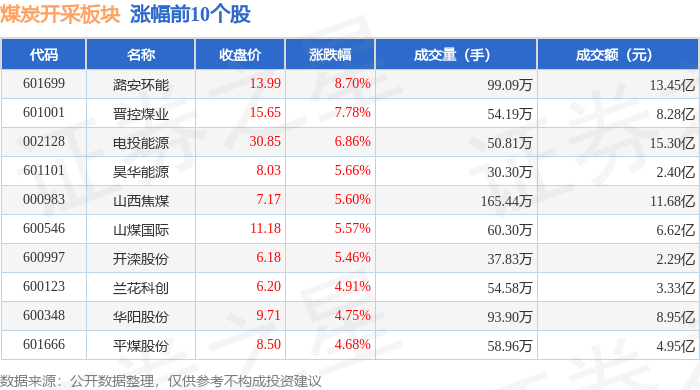
煤炭开采板块1月28日涨2.79%,潞安环能领涨,主力资金净流入7.96亿元
Zheng Xing Xing Ye Ri Bao· 2026-01-28 09:04
从资金流向上来看,当日煤炭开采板块主力资金净流入7.96亿元,游资资金净流出5252.34万元,散户资 金净流出7.44亿元。煤炭开采板块个股资金流向见下表: | 代码 | 名称 | 主力净流入(元) | 主力净占比 游资净流入 (元) | | 游资净占比 散户净流入(元) | | 散户净占比 | | --- | --- | --- | --- | --- | --- | --- | --- | | 600157 | 永泰能源 | 2.71亿 | 10.66% | -1.42 乙 | -5.56% | -1.30 Z | -5.10% | | 600348 | 天明服务 | 1.26 Z | 14.12% | -7234.67万 | -8.08% | -5408.74万 | -6.04% | | 000983 山西焦煤 | | C 1.01亿 | 8.62% | 1546.92万 | 1.32% | -1.16 Z | -9.94% | | 601225 | 陕西煤业 | 8144.38万 | 3.72% | 1.06亿 | 4.82% | -1.87 亿 | -8.54% | | 601898 中煤能源 | ...


2025年报业绩预告开箱(二):半导体高歌猛进,化工靠涨价赚翻,天价授权照亮全年业绩
市值风云· 2026-01-27 10:09
Core Viewpoint - The report highlights the significant growth driven by technology in certain sectors, while also noting the substantial losses due to cyclical downturns in others [1] Performance Growth Highlights - **Zhongwei Company (688012)**: Expected net profit between 208 million to 218 million yuan, a year-on-year increase of 28.74% to 34.93%, driven by increased recognition of plasma etching equipment and a surge in market demand [5] - **Lianchuang Optoelectronics (600363)**: Expected net profit between 43.5 million to 53.2 million yuan, a year-on-year increase of 80.36% to 120.57%, attributed to significant growth in laser business and improved profitability in traditional sectors [6] - **Ruixin Microelectronics (603893)**: Expected net profit between 102.3 million to 110.3 million yuan, a year-on-year increase of 71.97% to 85.42%, driven by rapid growth in the AIoT market and recognition of new AI technology [7] - **Sangfor Health (688336)**: Expected net profit around 290 million yuan, a year-on-year increase of approximately 311.35%, due to a significant collaboration with Pfizer and advancements in clinical research [8] - **Pulite (002324)**: Expected net profit growth of 155.76% to 194.73%, driven by the demand for high polymer materials in the automotive lightweight trend [9] - **Tonghua Dongbao (600867)**: Expected net profit around 124.21 million yuan, turning from loss to profit, driven by market share gains in insulin products [10] - **Suotong Development (603612)**: Expected net profit between 73 million to 85 million yuan, a year-on-year increase of 167.98% to 212.03%, due to rising prices and demand in the prebaked anode industry [11] Major Performance Declines - **China Shipbuilding Technology (600072)**: Expected net loss between -260 million to -340 million yuan, a year-on-year decline of over 24 times, due to cyclical downturns in shipbuilding and high material costs [12] - **Silver Nonferrous Metals (601212)**: Expected net loss between -45 million to -67.5 million yuan, transitioning from profit to loss due to legal disputes affecting financial performance [13] - **China Metallurgical Group (601618)**: Expected net profit between 130 million to 160 million yuan, a year-on-year decline of 76.28% to 80.73%, impacted by the downturn in the construction industry [14] - **Jindi Group (600383)**: Expected net loss between -1.11 billion to -1.35 billion yuan, with increased losses due to declining sales and inventory impairments [15] - **Jianfa Co. (600153)**: Expected net loss between -1 billion to -520 million yuan, transitioning from profit to loss due to increased impairments in real estate [16] Industry Trend Analysis - **Technology and Innovation-Driven Sectors**: Companies in semiconductor equipment, laser military applications, and innovative pharmaceuticals are experiencing rapid growth due to high demand in AIoT, national defense, and biomedicine [23] - **Traditional Cyclical Industries**: Sectors like coal and engineering machinery are facing significant adjustments due to demand shortages and price declines, leading to widespread performance pressures [24] - **Pharmaceutical Industry Disparities**: Innovative drugs are seeing explosive growth through external licensing, while traditional formulations and raw materials are significantly impacted by procurement policies [24] - **External Environment Uncertainties**: Factors such as international trade tensions and regulatory changes are significantly affecting corporate performance, necessitating enhanced risk management [24] - **Asset Quality Risks**: Many companies are reporting substantial asset impairment provisions, indicating potential inefficiencies in previous investments [24]




焦煤行业研究深度报告:黑金破晓,焦煤崛起
ZHESHANG SECURITIES· 2026-01-27 07:29
证券研究报告 黑金破晓,焦煤崛起 ——焦煤行业研究深度报告 行业评级:看好 2026年1月27日 分析师 樊金璐 邮箱 fanjinlu@stocke.com.cn 电话 13466717654 证书编号 S1230525030002 投资建议:焦煤作为战略资源,其地位源于稀缺性与不可替代性。美国能源部将炼钢用冶金煤(炼焦煤)列入关键材料清单,体现了焦煤的全 球价值。2024年以来,受蒙煤进口增量、国内钢铁需求下行等因素影响,焦煤价格持续下行,焦煤企业面临经营压力。随着焦煤供应刚性和需 求抬升,焦煤价值有望重塑。展望"十五五",全球焦煤供弱需强,供需格局逆转,产量下降,需求向上,价格有望抬升,叠加成本下行,预 计业绩显著改善;焦煤产能刚性,若价格上涨供给难增,价格弹性较大。根据我们年度策略报告的观点,动力煤价格中枢800-850元/吨,考虑 焦煤供需格局逆转,焦煤/动力煤比价提高到约2.5倍,焦煤价格中枢提高到约2000元/吨,价格区间1500-2500元/吨。维持行业"看好"评级。 建议关注有增量和吨煤市值低的焦煤企业平煤股份、恒源煤电、山西焦煤、冀中能源、潞安环能、淮北矿业等。 1、全球焦煤供给收缩,重点 ...


华源证券:均价回升煤企业绩或环比续增 供给政策持续煤价弹性可期
智通财经网· 2026-01-27 06:25
Core Viewpoint - The coal market is expected to see a recovery in performance in Q4 2025, driven by rising coal prices and a favorable supply-demand balance, with potential for a spring rally in Q1 2026 [1][7]. Price Trends - The average price of Qinhuangdao 5500 kcal thermal coal increased from 672 CNY/ton in Q3 2025 to 765 CNY/ton in Q4 2025, marking a 13.8% increase [3]. - In Q4 2025, the price fluctuated significantly, peaking at 834 CNY/ton before dropping to a low of 670 CNY/ton, yet still achieving a notable average increase [2]. Profitability Outlook - The profitability of coal companies is expected to improve, with thermal coal prices rising and coking coal prices also showing significant increases, particularly in long-term contracts [4]. - The average price for coking coal at Jing Tang Port rose to 1726 CNY/ton in Q4 2025, a 10.5% increase from Q3 [4]. Production Dynamics - The "overproduction check" policy has led to a mixed production performance among listed coal companies, with some reporting declines while others saw increases in output [5]. - Major coal producers like China Shenhua and China Coal Energy reported production decreases of 5.0% and 2.1% respectively, while Shaanxi Coal and Yanzhou Coal Energy reported increases of 3.6% and 1.0% [5]. Cost Management - Cost control remains a priority for coal companies, with strategies shifting from volume-driven to cost-focused approaches due to previous low coal prices [6]. - Despite a slight increase in costs expected in Q4 due to rising coal prices and year-end expense settlements, companies have managed to maintain a focus on cost efficiency [6]. Future Supply and Demand - The exit of certain coal supply capacities is anticipated to significantly improve the coal supply-demand balance, with a potential reduction of around 100 million tons if implemented nationwide [8]. - This policy aligns with previous market predictions and is expected to lead to a notable reduction in coal inventories, enhancing price elasticity in 2026 [8]. Investment Recommendations - Companies to watch include stable large-cap thermal coal firms such as China Shenhua, China Coal Energy, and Shaanxi Coal, as well as high-elasticity coal firms like Yanzhou Coal Energy and Jin Coal Industry [9].
25Q4煤炭行业基金持仓分析:基金持仓环比小幅提升,但仍处于较低水平
Guolian Minsheng Securities· 2026-01-26 15:03
Investment Rating - The report maintains a "Recommended" rating for the coal industry, indicating a positive outlook for the sector [2][3]. Core Insights - The report highlights a slight increase in fund holdings in the coal sector, with total market value rising to 6.874 billion yuan in Q4 2025, up 12.13% from Q3 2025, but still at a low level compared to historical data [9]. - The report notes that the coal sector's fund holding ratio is at its lowest in three years, suggesting low investment crowding in the sector [9]. - Key companies such as China Shenhua and Zhongmei Energy are favored by funds, with significant increases in holdings for Yancoal Energy and Shanxi Coal International [9]. - Short-term supply tightening and ongoing replenishment demand are expected to stabilize and potentially rebound coal prices, projected to fluctuate between 750-1000 yuan per ton [9]. - The report recommends focusing on companies with high spot market elasticity, such as Jinko Coal Industry and Shanxi Coal International, as well as industry leaders like China Shenhua and Shaanxi Coal Industry [9]. Summary by Sections Fund Holdings Analysis - Fund holdings in coal stocks increased to 6.874 billion yuan in Q4 2025, a 12.13% rise from Q3 2025, with a holding ratio of approximately 0.36% of total fund holdings [9]. - The report identifies the top five companies by fund holdings, including China Shenhua and Shaanxi Coal Industry, with notable increases in holdings for Yancoal Energy and Shanxi Coal International [9]. Price Outlook - The report anticipates that coal prices will stabilize and rebound due to supply constraints and replenishment needs, with a seasonal fluctuation expected between 750-1000 yuan per ton [9]. - The analysis indicates that the coal industry is likely to return to a state of basic supply-demand balance in 2023-2024, driven by production cuts and regulatory normalization [9].

