
CHINA COAL ENERGY(601898)

Search documents
2025Q1全球海运煤炭贸易量同比下降6.7%
GOLDEN SUN SECURITIES· 2025-05-11 06:31
Investment Rating - The report maintains an "Overweight" rating for the coal mining industry [4]. Core Viewpoints - The current phase of coal price adjustment is nearing its end, with the market having a clear understanding of the price decline. The industry is at a critical stage of price bottoming, and confidence should be maintained [3]. - The global seaborne coal trade volume decreased by 6.7% year-on-year in Q1 2025, with significant declines in coal exports from major countries [2][6]. - Domestic coal companies are facing increasing losses, with over half (54.8%) reporting losses as of March 2025, leading to a higher probability of production cuts [6]. Summary by Sections Coal Mining Trade - In Q1 2025, the international seaborne coal trade volume was 307 million tons, down 6.7% year-on-year [2]. - Major exporting countries saw declines: Indonesia's exports fell by 10.7% to 114.5 million tons, Australia by 9.4% to 76.6 million tons, and the U.S. by 4.9% to 20.8 million tons [6]. Price Trends - As of May 9, 2025, coal prices showed slight increases: European ARA port coal at $97.1/ton (+1.9%), Newcastle port coal at $98.9/ton (+0.9%), while South African Richards Bay coal futures fell slightly to $89.0/ton (-0.1%) [1][37]. - The report indicates that coal prices are stabilizing after a prolonged decline since Q4 2021 [3]. Recommendations - The report recommends increasing positions in key coal companies such as China Shenhua, China Coal Energy, and others, highlighting their potential for recovery and performance [6][7].



中煤能源(601898):煤炭业务成本管控积极 煤化工业务盈利稳中向好
Xin Lang Cai Jing· 2025-05-09 06:29
Core Viewpoint - The company reported a decline in net profit and revenue in Q1 2025, with a focus on cost control and strategic development in coal and chemical sectors [1][2][4]. Group 1: Financial Performance - In Q1 2025, the company achieved revenue and net profit of 38.39 billion and 3.98 billion yuan, respectively, representing a year-on-year decline of 15.4% and 20% [1]. - The self-produced coal output increased by 1.9% year-on-year, while the comprehensive selling price decreased by 18% [1]. - The unit cost of self-produced coal was 270 yuan/ton, showing a year-on-year decrease of 7.3% [1]. - The gross profit margin for self-produced coal was 222 yuan/ton, down 27.6% year-on-year [1]. Group 2: Coal and Chemical Products - In Q1 2025, the sales volume of major coal chemical products such as polyolefins, urea, and methanol were 355,000, 600,000, and 529,000 tons, respectively, with methanol showing a significant year-on-year increase of 33.6% [2]. - The average selling prices for polyolefins, urea, and methanol were 6,876, 1,702, and 1,794 yuan/ton, with urea experiencing a notable decline of 23.9% year-on-year [2]. - The gross profit margins for polyolefins, urea, and methanol were 16%, 21.2%, and 21.2%, respectively, with significant quarter-on-quarter increases [2]. Group 3: Strategic Development - The company is advancing the construction of key coal mines and coal-electricity integration projects, with significant progress reported in the construction of the Libu and Weizigou coal mines [2]. - Plans for capital expenditure in 2025 are set at 21.68 billion yuan, a 41.7% increase from 2024, aimed at optimizing the industrial layout [3]. - The company is exploring the coupling development of new energy and chemicals, with ongoing projects in Shaanxi and the "Liquid Sunshine Project" [2][3]. Group 4: Investment Outlook - The company is expected to maintain stable performance in its coal business, with improved cost control and governance, leading to a more positive dividend attitude [4]. - Projected net profits for 2025-2027 are estimated at 17 billion, 18.5 billion, and 19.8 billion yuan, corresponding to a price-to-earnings ratio of 8.1, 7.5, and 7 times for 2025 [4].
上市煤企全解析(二):“五宗最”之换个角度看财报
GOLDEN SUN SECURITIES· 2025-05-09 01:23
Investment Rating - The report maintains an "Increase" rating for the coal mining industry [4] Core Viewpoints - The current coal price adjustment has been ongoing for nearly four years since the peak in Q4 2021, and the market is well aware of the price decline. The industry is at a critical stage of price bottoming, and the report emphasizes the importance of understanding the industry's fundamental attributes and maintaining confidence [7][63] - Key recommendations include major coal enterprises such as China Shenhua (H+A) and China Coal Energy (H+A), as well as companies showing signs of recovery like Qinfa [8][64] Summary by Sections Cash King - Since the supply-side reform in 2016, the historical burden on coal companies has significantly decreased. Despite the continuous decline in coal prices since early 2024, some companies have cash balances (cash and cash equivalents + trading financial assets) far exceeding their interest-bearing debts. As of Q1 2025, the top five companies with the highest cash balances are China Shenhua, Shaanxi Coal, Jinkong Coal, China Coal Energy, and Lu'an Environmental Energy [1][17] Low Debt - As of Q1 2025, the asset-liability ratio for large coal enterprises is 60.3%, an increase of 0.5 percentage points year-on-year. Most sampled coal companies have asset-liability ratios lower than the industry average. The companies with the lowest asset-liability ratios are China Shenhua, Jinkong Coal, Electric Power Investment Energy, Yitai B, and Shanghai Energy [20][21] Strong Foundation - Special reserves are funds set aside by coal companies for safety production and maintaining simple reproduction. The top five companies with the highest net increase in special reserves from the end of 2023 to Q1 2025 are China Shenhua, Shaanxi Coal, Yitai B, Lu'an Environmental Energy, and Gansu Energy [25][31] High Potential - Considering the cyclical nature of coal prices, coal companies may enhance cost control to ensure steady improvement in profitability. The report evaluates potential profit release using the ratio of operating cash flow minus net profit, depreciation, and financial expenses to net profit. The companies with the highest potential for profit release are Haohua Energy, Yitai B, Huabei Mining, China Coal Energy, and Shanmei International [2][51] Dividend King - The top five companies in terms of cumulative cash dividends over the past three years are China Shenhua, Shaanxi Coal, Yunkang Energy, China Coal Energy, and Lu'an Environmental Energy. The report highlights the high dividend attributes of coal companies, driven by reduced historical burdens and a cautious approach to reinvesting in traditional businesses [3][55]


沪深300能源指数下跌0.31%,前十大权重包含中煤能源等
Sou Hu Cai Jing· 2025-05-08 12:43
Core Viewpoint - The Shanghai Composite Index opened lower but rose throughout the day, while the CSI 300 Energy Index experienced a slight decline of 0.31%, closing at 2091.25 points with a trading volume of 3.741 billion yuan [1] Group 1: Index Performance - The CSI 300 Energy Index has increased by 5.18% over the past month, decreased by 5.26% over the last three months, and has fallen by 13.60% year-to-date [1] - The CSI 300 Industry Index series categorizes 300 sample stocks into 11 primary industries, 35 secondary industries, over 90 tertiary industries, and more than 200 quaternary industries, providing analytical tools for investors [1] Group 2: Index Composition - The top ten weighted stocks in the CSI 300 Energy Index are: China Shenhua (24.96%), China Petroleum (17.91%), China Petrochemical (16.29%), Shaanxi Coal and Chemical Industry (14.81%), China National Offshore Oil Corporation (10.27%), Yanzhou Coal Mining (4.37%), China Coal Energy (3.64%), Shanxi Coking Coal (3.59%), Lu'an Environmental Energy (2.59%), and CNOOC Services (1.56%) [1] - In terms of industry composition, coal accounts for 50.37%, integrated oil and gas companies for 34.20%, fuel refining for 10.27%, coke for 3.59%, and oilfield services for 1.56% within the index [2] Group 3: Sample Adjustment - The index samples are adjusted biannually, with adjustments implemented on the next trading day following the second Friday of June and December each year [2] - Weight factors are generally fixed until the next scheduled adjustment, but can be modified in the event of temporary adjustments due to changes in the CSI 300 Index samples or special events affecting a sample company's industry classification [2]
煤炭行业七问七答:煤炭红利:不确定性中确定性
Changjiang Securities· 2025-05-08 11:16
Investment Rating - The report maintains a "Positive" investment rating for the coal industry [3]. Core Viewpoints - The coal industry is experiencing a paradigm shift from performance-driven growth to valuation-driven growth, influenced by supply constraints and stable coal prices [10][16]. - The long-term contracts in the coal sector are enhancing the stability of earnings, providing a buffer against market volatility [24][28]. - The report highlights that despite recent price declines, the coal sector's defensive attributes may offer unique advantages in uncertain market conditions [60][66]. Summary by Sections 1. What to Invest in the Coal Industry? - The focus is on long-term contracts and stable coal prices as key investment areas [8]. 2. Why Shift from Performance to Valuation? - Supply elasticity is decreasing, leading to enhanced stability in return on equity (ROE) [18][21]. - The increase in capital expenditures since 2021 has been significant, with new coal mine approvals becoming more complex and costly [19][20]. - The long-term contract mechanism is crucial for stabilizing earnings expectations in the coal sector [24][27]. 3. Why Has the Coal Sector Seen Significant Corrections Since H2 2024? - The fundamental issue stems from strong supply and weak demand, leading to a surplus in coal supply [39][41]. - The decline in electricity prices has pressured profit margins across the coal-electricity supply chain [39][41]. 4. Can the Sector Still Rise Despite Weak Demand? - Concerns about demand are driven by a slowdown in electricity consumption growth and the increasing substitution of coal by renewable energy sources [48][53]. - The report suggests that even with demand concerns, coal's defensive characteristics may still provide stability in performance [60][66]. 5. Long-term Outlook for Thermal Coal - The report anticipates a marginal improvement in coal supply-demand dynamics by late May 2025, with potential support for coal prices [66][67].
中证香港300上游指数报2304.31点,前十大权重包含中煤能源等
Jin Rong Jie· 2025-05-08 08:18
Core Viewpoint - The China Securities Hong Kong 300 Upstream Index (H300 Upstream) has shown a recent increase of 12.00% over the past month, despite a decline of 2.47% over the last three months and a year-to-date decrease of 2.19% [2]. Group 1: Index Performance - The H300 Upstream Index reported a value of 2304.31 points [1]. - The index is based on the China Securities Hong Kong 300 Index, which selects securities according to industry classification to reflect the overall performance of various thematic securities listed on the Hong Kong Stock Exchange [2]. Group 2: Index Holdings - The top ten weighted stocks in the H300 Upstream Index are: - China National Offshore Oil Corporation (29.2%) - PetroChina Company Limited (12.49%) - Zijin Mining Group (10.46%) - China Shenhua Energy Company (9.9%) - China Petroleum & Chemical Corporation (9.54%) - China Hongqiao Group (3.74%) - China Coal Energy Company (3.28%) - Zhaojin Mining Industry Company (3.26%) - Yanzhou Coal Mining Company (2.64%) - Luoyang Molybdenum Co., Ltd. (2.41%) [2]. Group 3: Sector Composition - The H300 Upstream Index is fully composed of stocks listed on the Hong Kong Stock Exchange [3]. - The sector composition of the index includes: - Oil and Gas: 51.64% - Coal: 17.92% - Precious Metals: 15.77% - Industrial Metals: 10.00% - Rare Metals: 3.17% - Oil and Gas Extraction and Oilfield Services: 1.07% - Other Non-ferrous Metals and Alloys: 0.43% [3]. Group 4: Index Adjustment - The index samples are adjusted semi-annually, with adjustments occurring on the next trading day after the second Friday of June and December each year. Temporary adjustments may occur under special circumstances [3].
广发证券:煤炭龙头公司韧性较强 预计下半年趋势向好
Zhi Tong Cai Jing· 2025-05-08 05:58
Group 1: 2024 Performance Overview - The coal sector's overall net profit excluding non-recurring items is expected to decline by 20% year-on-year, with an average ROE of approximately 10% [1] - The total profit of large coal enterprises is projected to be 604.6 billion yuan, a year-on-year decrease of 22.2% [1] - Key coal companies are expected to achieve a net profit attributable to shareholders of 157.3 billion yuan and a net profit excluding non-recurring items of 155.5 billion yuan, down 18.6% and 19.7% year-on-year, respectively [1] Group 2: 2024 Operational Overview - The total coal production of 28 key coal companies is estimated at 1.34 billion tons, a year-on-year increase of 2.0% [2] - The weighted average net profit per ton of coal is approximately 131 yuan, reflecting a year-on-year decline of 25% [2] - The weighted average coal price and cost are projected to decrease by 7% and remain stable, respectively [2] Group 3: Q1 2025 Performance Overview - The sector's profit is expected to decline by 27% year-on-year, with an average net profit margin of around 11% [3] - The total net profit attributable to shareholders for Q1 2025 is projected to be 31 billion yuan, down 27.3% year-on-year [3] - The average gross profit margin and net profit margin for Q1 2025 are expected to drop to 25% and 11%, respectively [3] Group 4: Q1 2025 Operational Overview - The coal production of 24 companies is expected to reach 304 million tons, a year-on-year increase of 5.7% [4] - The weighted average net profit per ton of coal is projected to decrease to 97 yuan, with coal prices and costs declining by 18% and 15%, respectively [4] - Some companies, such as Shaanxi Energy and Yancoal, are expected to maintain a net profit per ton exceeding 100 yuan [4] Group 5: Industry Outlook - Seasonal demand for thermal coal is expected to improve marginally after May, with expectations of increased industrial demand and reduced coal imports [5] - Coal prices are anticipated to gradually recover after inventory declines, despite a potential downward trend in the price center for 2025 [5] Group 6: Key Companies - Companies with stable profits and high dividends include Shaanxi Coal and China Shenhua [6] - Companies with low valuations and long-term growth potential include China Coal Energy and Yancoal [6] - Companies benefiting from positive demand expectations and low PB ratios include Huabei Mining and Shanxi Coking Coal [6]

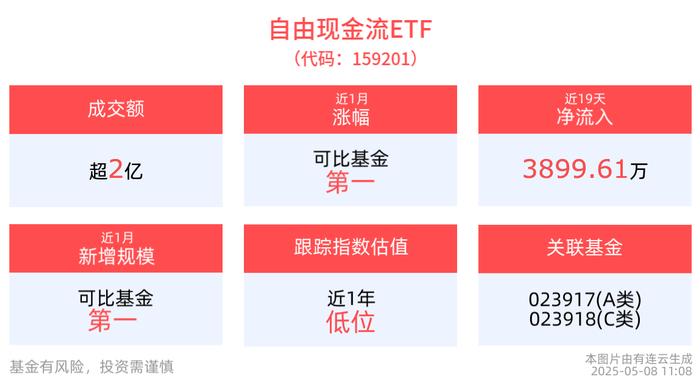
自由现金流ETF(159201)近2周涨幅排名可比基金首位,低位布局“现金牛”资产
Xin Lang Cai Jing· 2025-05-08 03:42
Core Insights - The Guozheng Free Cash Flow Index has seen a slight increase of 0.07%, with notable gains in constituent stocks such as Chanzhan Optoelectronics and others [1] - The Free Cash Flow ETF (159201) is experiencing a tight market with a latest price of 0.98 yuan, and has shown a cumulative increase of 1.56% over the past two weeks [1] - The ETF has recorded a significant liquidity with a turnover rate of 6.27% and a transaction volume of 206 million yuan [1] - The ETF's average daily trading volume over the past year is 302 million yuan, ranking first among comparable funds [1] - The Free Cash Flow ETF has seen a net inflow of 57.37 million yuan recently, accumulating a total of 38.99 million yuan over the last 19 trading days [1] Fund Performance - The latest financing buy-in amount for the Free Cash Flow ETF is 3.147 million yuan, with a financing balance of 51.24 million yuan [3] - The tracking error for the ETF year-to-date is 0.163%, the lowest among comparable funds [3] - The current price-to-earnings ratio (PE-TTM) for the index is 11.78, indicating a valuation lower than 80.41% of the time over the past year, suggesting a historical low [3] Top Holdings - As of April 30, 2025, the top ten weighted stocks in the Guozheng Free Cash Flow Index include Midea Group, China National Offshore Oil Corporation, and others, collectively accounting for 56.66% of the index [3]






煤企业绩喜忧参半,宁夏首富一枝独秀
Xin Lang Cai Jing· 2025-05-07 03:06
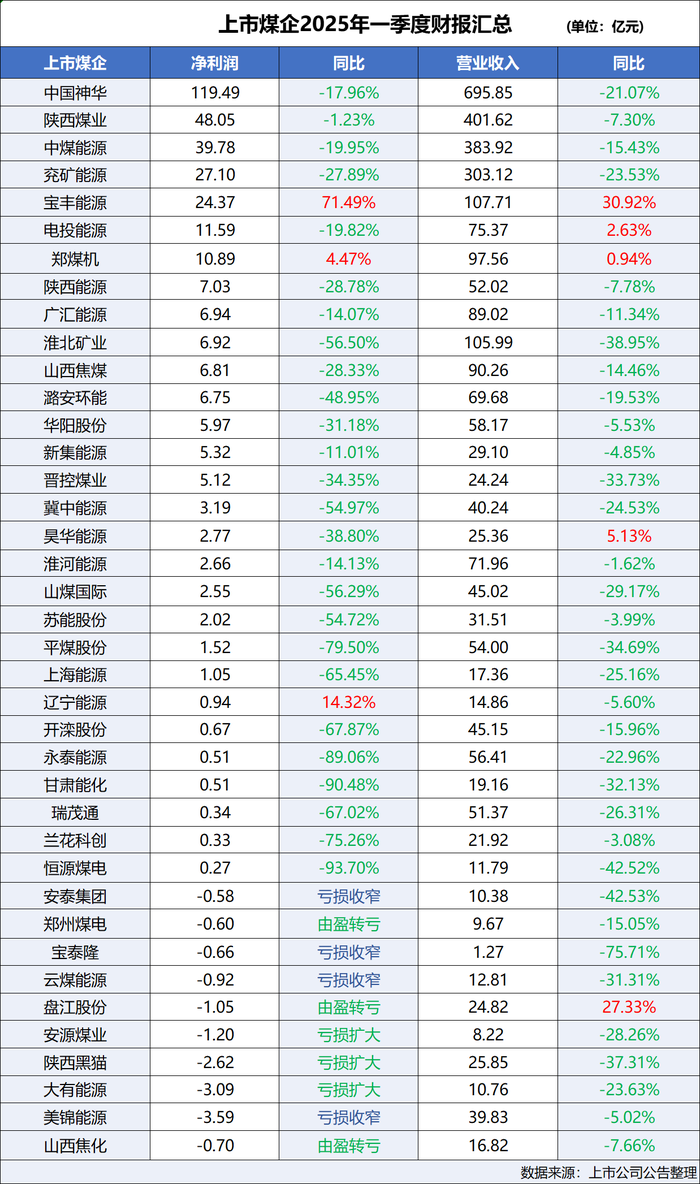
Core Insights - The coal industry in China reported mixed results for Q1 2025, with over 70% of listed coal companies remaining profitable, yet most experienced significant declines in net profit year-on-year, with some companies even reporting losses [1][4][12] - Baofeng Energy, led by Ningxia's richest man, achieved a remarkable net profit growth of 71.49%, standing out in an otherwise declining industry [1][8] Financial Performance Summary - Major coal companies reported the following net profits and year-on-year changes: - China Shenhua: 11.949 billion, -17.96% - Shaanxi Coal and Chemical: 4.805 billion, -1.23% - Baofeng Energy: 2.437 billion, +71.49% [2] - A total of 32 out of 39 listed coal companies saw a decline in net profit, with 12 companies experiencing declines over 30% [4][12] Factors Behind Profit Decline - Market price fluctuations have directly impacted coal company profits, with average prices for major coal types, such as thermal coal, dropping approximately 25% year-on-year [5][6] - The supply-demand imbalance is exacerbated by a warm winter and increased renewable energy generation, which saw a 18.7% year-on-year increase in wind and solar power output [5][12] - Rising production costs due to deeper mining and increased safety and environmental expenditures have further squeezed profit margins [6][12] Baofeng Energy's Growth Strategy - Baofeng Energy's success is attributed to its integrated "coal-coke-chemical" business model, which allows it to convert raw material advantages into high-value products [8][9] - The company's olefin project has become a significant profit driver, with a production efficiency that exceeds industry averages [8][9] - Investment in technology and digital transformation has enhanced operational efficiency and reduced costs, contributing to its strong performance [9][11] Industry Challenges - The coal industry faces significant challenges from the dual carbon goals and the increasing competitiveness of renewable energy sources [12][13] - The average utilization hours for thermal power plants have decreased, indicating a decline in coal demand [13][14] - The industry is experiencing a supply surplus, with total coal production capacity exceeding 4.5 billion tons per year, while consumption is projected at around 4.2 billion tons [13][14] Conclusion - The Q1 2025 performance of the coal industry reflects the urgent need for transformation amid evolving energy dynamics, with a clear divide emerging between companies that adapt and those that do not [16]

煤炭行业周报:淡季煤价承压,进口收缩预计托底煤价-20250505
Shenwan Hongyuan Securities· 2025-05-05 14:42
Investment Rating - The report maintains a positive outlook on the coal industry, indicating an "Overweight" rating [1]. Core Insights - The report highlights that coal prices are under pressure during the off-season, with a forecasted contraction in imports expected to support prices [1]. - The report emphasizes that domestic coal production is expected to stabilize, with a potential rebound in coking coal prices as demand increases in the peak season [1]. - Key recommended stocks include China Shenhua, Shaanxi Coal, and China Coal Energy for stable operations and high dividends, while Huabei Mining and Pingmei Shenma are noted for their undervalued growth potential [1]. Summary by Sections Recent Industry Policies and Dynamics - New energy consumption limits for various industries, including coal, are set to take effect, potentially saving 24.52 million tons of standard coal annually [9]. - Coal production in major provinces like Shanxi and Inner Mongolia has seen significant year-on-year growth, contributing to a record high in domestic coal output [9]. Price Trends - As of April 30, 2025, the prices for various grades of thermal coal have seen slight declines, with Q4500, Q5000, and Q5500 thermal coal prices reported at 508, 570, and 650 CNY/ton respectively [1][10]. - Coking coal prices have remained stable, with key prices reported at 1380 CNY/ton for Shanxi's main coking coal [1][13]. Inventory and Demand - The average daily coal inflow to the Bohai Rim ports increased by 4.62% to 1.9614 million tons, while the outflow decreased by 1.14% to 1.9894 million tons [21]. - Port inventories decreased slightly to 31.035 million tons, reflecting a 0.21% drop [21]. Shipping Costs - Domestic coastal shipping costs have risen slightly, with average freight rates reported at 37.57 CNY/ton, marking a 0.31% increase [28]. - International shipping rates have also seen increases, particularly for coal from Indonesia and Australia [28]. Company Valuations - The report includes a valuation table for key companies, highlighting their stock prices, market capitalizations, and earnings per share (EPS) forecasts for 2024 to 2027 [34].


