WuXi AppTec(603259)

Search documents
2026年医药年度策略:创新出海开启新篇章,内需改善积蓄强动能
Guotou Securities· 2025-11-16 15:15
Group 1 - The core view of the report indicates that the innovative drug market is expected to drive continuous valuation recovery in the pharmaceutical sector, supported by improving fundamentals and overseas expansion catalysts [2][7][10] - The pharmaceutical sector's overall performance shows a slight revenue growth of 0.2% year-on-year in Q3 2025, while net profit attributable to the parent company decreased by 12.87% [4][3] - The report highlights that the revenue of domestic biotech innovative drug companies reached 52.13 billion yuan in H1 2025, marking a 14% year-on-year increase, indicating that commercialization is entering a rapid growth phase [21][24] Group 2 - The report notes that the total overseas licensing business development (BD) transaction amount in the innovative drug sector exceeded 100 billion USD in 2025, with expectations for continued growth in 2026 [27][30][33] - The report emphasizes that the innovative drug sector's valuation remains at a historically low level, with the median PE ratio for the pharmaceutical sector at 34.21 times, suggesting potential for further recovery [10][57] - Institutional enthusiasm for the biotech innovative drug sector is reflected in the increasing proportion of holdings, with the weight of all funds in the biotech sector rising to 2.66% in Q3 2025 [11][35][38] Group 3 - The report identifies key companies to watch, including Sanofi Biopharma, which has licensed a PD-1/VEGF dual antibody to Pfizer, indicating high certainty for future overseas sales growth [63] - The report also highlights the potential of Union Pharmaceuticals' UBT251, which has shown promising results in weight loss and is licensed to Novo Nordisk [63] - The report suggests that Kolon Biotech's TROP2 ADC, licensed to Merck, has demonstrated excellent data and is expected to have significant market potential [63]



创新药行业复盘:创新出海2.0:BD之后,我们应该关注什么
Guoxin Securities· 2025-11-16 14:57
Group 1 - The innovative drug sector is expected to perform well in 2025, driven by overseas expansion expectations and rapid sales growth. The sector has shown significant excess returns in the first three quarters of 2025, primarily due to continuous business development (BD) overseas, excellent clinical data, and policy support. The sector is in a rapid sales growth phase, with several major products approved and included in medical insurance, leading to a surge in domestic sales and overseas revenue growth [5][6][56] - Chinese innovative drugs are demonstrating global competitiveness, with a significant increase in the number and value of outbound licensing deals. The proportion of Chinese assets in multinational corporation (MNC) drug transactions rose from approximately 5% in 2020-2021 to over 15% in the first three quarters of 2025. The total transaction amount for Chinese assets reached $47.6 billion, accounting for about 25% of MNC transactions [5][6][64] - After BD, attention should be focused on global clinical advancements and key data readouts. Since 2023, more Chinese assets have entered global registration clinical phases, with several expected to report phase III clinical data starting in 2026, potentially giving them a competitive edge through superior clinical data [5][6][64] Group 2 - The innovative drug sector's revenue has rapidly increased, with a reported revenue of 48.83 billion yuan (+22.1%) and a net profit of -460 million yuan (+71.4%) in the first three quarters of 2025. The third quarter alone saw revenues of 19.21 billion yuan (+51.0%) and a net profit of 1.11 billion yuan (+147.1%) [5][56] - The rapid growth in commercial sales of innovative drug products is attributed to the continued release of major products, medical insurance coverage, and the expansion of new indications. Additionally, overseas sales have become a key driver of revenue growth, alongside milestone payments from licensing agreements [5][56] - The investment recommendation highlights companies with differentiated innovation capabilities, suggesting a focus on Keren Biotechnology, Kangfang Biologics, Sanofi Pharmaceutical, Yingen Biotech, and Zai Lab [5][6]

医药行业周报:本周申万医药生物指数上涨3.3%,关注流感疫情变化-20251116
Shenwan Hongyuan Securities· 2025-11-16 07:44
Investment Rating - The report maintains a positive outlook on the pharmaceutical industry, indicating an "Overweight" rating, suggesting that the industry is expected to outperform the overall market [29]. Core Insights - The pharmaceutical sector saw a weekly increase of 3.3%, outperforming the Shanghai Composite Index, which decreased by 0.2% during the same period [4][6]. - The overall valuation of the pharmaceutical sector is at 30.9 times earnings, ranking it 10th among 31 primary sectors [6][12]. - Key segments within the pharmaceutical industry showed varied performance, with raw materials up by 5.1%, chemical preparations by 4.4%, and traditional Chinese medicine by 4.1% [6][4]. Market Performance - The pharmaceutical index ranked 5th among 31 sub-industries, with notable increases in various segments such as biopharmaceuticals (+2.7%), medical services (+1.8%), and medical devices (+1.8%) [4][6]. - The report highlights the performance of specific companies, recommending a focus on innovative drug sectors and companies with strong earnings growth potential [3][21]. Recent Developments - Roche's BTK inhibitor Fenebrutinib achieved significant milestones in clinical trials for treating relapsing multiple sclerosis, suggesting potential investment opportunities in related companies [3][13]. - The Chinese government has updated regulations on the export of controlled chemicals, impacting companies involved in this sector [3][14]. - The report notes an expected peak in influenza activity in China during late December and early January, prompting recommendations to monitor related vaccine and treatment companies [3][15][16]. Key Company Valuations - The report provides a valuation table for key companies in the pharmaceutical sector, indicating projected earnings per share (EPS) and price-to-earnings (PE) ratios for 2025 and beyond [21]. - Companies highlighted include Mindray Medical, Hengrui Medicine, and WuXi AppTec, with varying market capitalizations and growth forecasts [21]. Investment Recommendations - The report suggests focusing on innovative drug sectors and companies with improving performance in medical devices and upstream segments, listing specific companies to watch [3][21]. - It emphasizes the importance of monitoring flu vaccine manufacturers and antiviral drug producers as flu activity rises [3][15].


深度 | 基金经理都加仓的 6 大产业链!(2025三季度全市场基金持仓拆解)
Sou Hu Cai Jing· 2025-11-16 02:48
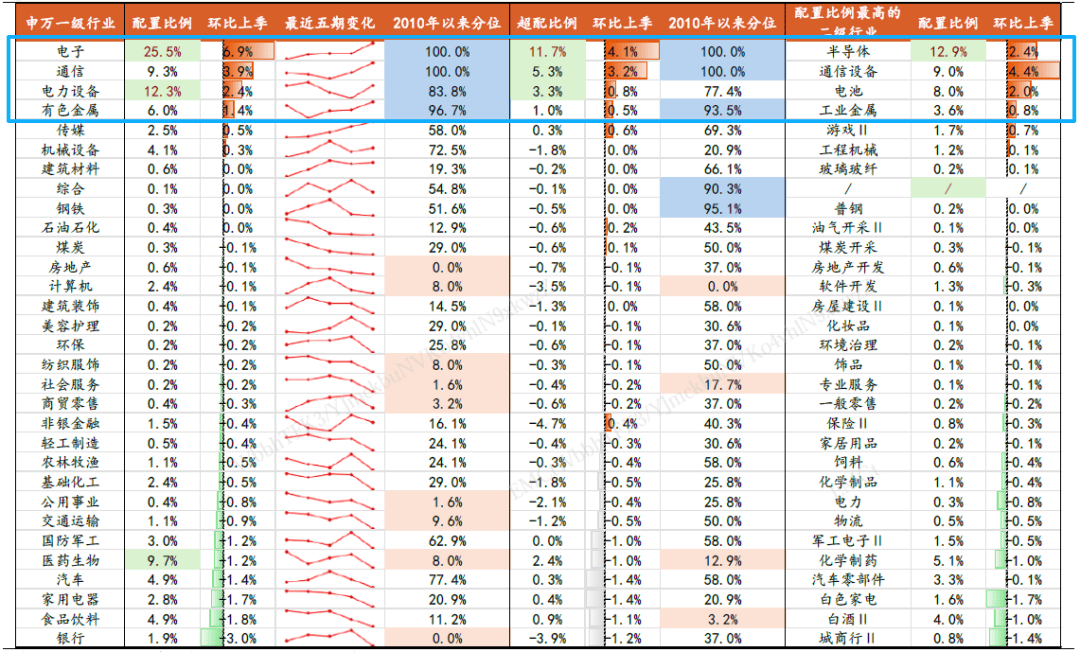
Core Viewpoint - The Q3 2025 public fund reports indicate a shift in investment strategies towards large-cap growth stocks, with increased allocations to A-shares and reduced positions in Hong Kong stocks. The electronics sector has seen a significant rise in allocation, reaching over 25%, marking the highest level since 2015, reflecting institutional confidence in the technology sector [1][2]. Fund Holdings Summary - The overall style of actively managed equity funds has shifted towards large-cap growth stocks, with a quarter-on-quarter increase in positions [1]. - The electronics sector's allocation has increased to 25.5%, a rise of 6.9% from the previous quarter, making it the highest allocation since 2010 [2]. - The semiconductor sub-sector within electronics has a 12.9% allocation, up by 2.4% [2]. Sector Allocation Insights - The communication sector's allocation is at 9.3%, increasing by 3.9% [2]. - The power equipment sector has a 12.3% allocation, up by 2.4% [2]. - The non-ferrous metals sector's allocation is at 6.0%, increasing by 4% [2]. Top Holdings in A-shares - The top holdings in actively managed equity funds include: - CATL (宁德时代) with a market value of 743.1 billion, down 9.3% quarter-on-quarter [5]. - Xinyisheng (新易盛) with a market value of 560.1 billion, up 1.8% [5]. - Zhongji Xuchuang (中际旭创) with a market value of 557.5 billion, up 28.9% [5]. - Other notable holdings include Luxshare Precision (立讯精密), Industrial Fulian (工业富联), and Zijin Mining (紫金矿业) [5]. Industry Chain Opportunities - The report outlines six major industry chains with significant investment potential: 1. AI Computing Infrastructure Chain: Driven by the exponential growth in AI model training and inference needs, with a projected global data center market reaching $1 trillion by 2030 [7][10]. 2. Semiconductor Domestic Substitution Chain: Accelerated by geopolitical tensions and the push for supply chain autonomy [11][12]. 3. New Energy Chain: Supported by dual carbon goals and global energy transition, with significant growth in solar and energy storage sectors [16][17]. 4. Humanoid Robot Chain: Driven by advancements in technology and increasing demand for core components [18][19]. 5. Innovative Drug Chain: Enhanced by AI in drug development and supportive policies for internationalization [22][23]. 6. Non-ferrous Metals Chain: Benefiting from structural demand driven by new energy systems and geopolitical factors [27][28].




创新链系列:创新链板块 2025Q3 业绩综述:海外和国内需求持续向好
Changjiang Securities· 2025-11-15 08:58
Investment Rating - The investment rating for the healthcare industry is "Positive" and maintained [10] Core Insights - The performance of the innovation chain sector is outstanding, showing significant growth in the pharmaceutical sub-sectors, particularly in CXO and life sciences services, driven by improving domestic and overseas demand [2][6] - The innovation chain sector has become the fastest-growing segment in the pharmaceutical industry, with a revenue growth rate exceeding 10% in both Q2 and Q3 of 2025 [6][26] - The overall revenue for the innovation chain sector reached 956.8 billion yuan in the first three quarters of 2025, marking a year-on-year increase of 10% [26] Summary by Sections Overseas Demand - The overseas demand is on an upward trend, supported by a favorable industrial cycle and the emergence of new technologies such as peptides and ADCs, leading to a significant recovery in the biopharmaceutical investment and financing amounts [7] - Chinese CDMO companies have seen a noticeable improvement in new orders and backlog amounts, with year-on-year growth rates recovering to over 15% [7] Domestic Demand - The domestic demand for innovative drug research and development is improving, with diversified funding sources and new business models accelerating the drug development and commercialization process [8] - Companies with strong capabilities in drug discovery CRO, such as Kanglong Chemical and Hongbo Pharmaceutical, are experiencing improved revenue performance [8] CXO and Life Sciences Services - The CXO sector maintained double-digit revenue growth, contributing significantly to the overall revenue of the innovation chain sector, with a total revenue of 708.4 billion yuan in the first three quarters of 2025, up 13% year-on-year [41] - The life sciences services sector is also showing positive trends, with revenue growth accelerating and profitability steadily improving [6][41]

11月14日医疗健康(980016)指数跌0.65%,成份股奕瑞科技(688301)领跌
Sou Hu Cai Jing· 2025-11-14 10:33
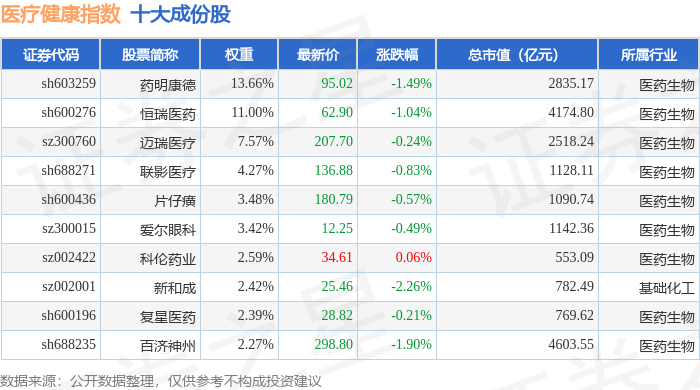
Core Viewpoint - The Medical Health Index (980016) closed at 6572.66 points, down 0.65%, with a trading volume of 23.397 billion yuan and a turnover rate of 0.87% on November 14 [1] Group 1: Index Performance - Among the index constituents, 16 stocks rose while 33 stocks fell, with Ganli Pharmaceutical leading the gainers at a 2.0% increase and Yirui Technology leading the decliners at a 3.74% decrease [1] - The top ten constituents of the Medical Health Index include major companies such as WuXi AppTec, Hengrui Medicine, and Mindray Medical, with respective weights of 13.66%, 11.00%, and 7.57% [1] Group 2: Market Capitalization and Stock Prices - The total market capitalization of the top ten constituents ranges from 553.09 billion yuan for Kelun Pharmaceutical to 4603.55 billion yuan for Rihai Shenzhou, with stock prices varying from 12.25 yuan to 298.80 yuan [1] - The performance of the top ten stocks shows a mix of slight declines, with WuXi AppTec down 1.49% and Hengrui Medicine down 1.04% [1] Group 3: Capital Flow - The Medical Health Index constituents experienced a net outflow of 472 million yuan from major funds, while retail investors saw a net inflow of 388 million yuan [1] - Detailed capital flow data indicates that Ganli Pharmaceutical had a net inflow of 62.98 million yuan from major funds, despite a net outflow from retail investors [2]



医疗服务板块11月14日跌0.47%,数字人领跌,主力资金净流出2.38亿元
Zheng Xing Xing Ye Ri Bao· 2025-11-14 08:58
Market Overview - The medical services sector declined by 0.47% on November 14, with the digital human sector leading the drop [1] - The Shanghai Composite Index closed at 3990.49, down 0.97%, while the Shenzhen Component Index closed at 13216.03, down 1.93% [1] Stock Performance - Notable declines in individual stocks include: - Digital Human: closed at 17.28, down 4.85% with a trading volume of 80,400 shares and a turnover of 1.411 million [1] - Haoyuan Pharmaceutical: closed at 77.20, down 3.54% with a trading volume of 30,800 shares and a turnover of 2.4212 million [1] - Yinos: closed at 48.69, down 2.62% with a trading volume of 14,300 shares and a turnover of 7132.217 [1] - Other notable declines include Taige Pharmaceutical, MediX, and WuXi AppTec, all showing declines between 1.28% and 2.08% [1] Capital Flow - The medical services sector experienced a net outflow of 238 million yuan from institutional investors, while retail investors saw a net inflow of 181 million yuan [3] - Notable capital flows for specific stocks include: - Ruizhi Pharmaceutical: net inflow of 38.93 million yuan from institutional investors, but net outflows from retail and speculative investors [3] - Chengda Pharmaceutical: net inflow of 37.96 million yuan from institutional investors, with significant outflows from speculative investors [3] - Other stocks like Sanbo Brain Science and Jinyu Medical also showed varying net inflows and outflows among different investor types [3]





医疗创新ETF(516820)冲击3连涨,机构看好医药行业业绩改善
Sou Hu Cai Jing· 2025-11-14 02:50
Core Insights - The healthcare innovation sector is showing positive momentum, with the China Securities Medicine and Medical Device Innovation Index (931484) rising by 0.31% as of November 14, 2025, and several key stocks, including Sanofi and Ganli Pharmaceutical, experiencing significant gains [1] Group 1: Market Performance - The China Securities Medicine and Medical Device Innovation Index has seen a 0.31% increase, with notable stock performances: Sanofi up 4.64%, Ganli Pharmaceutical up 3.28%, and Jiutian Pharmaceutical up 1.83% [1] - The Medical Innovation ETF (516820) has also risen by 0.26%, marking its third consecutive increase [1] Group 2: Clinical Developments - AstraZeneca announced successful Phase III clinical trials for Baxdrostat, which significantly reduced 24-hour average systolic blood pressure in patients with resistant hypertension over 12 weeks, indicating a new treatment pathway for hypertension [1] Group 3: Industry Trends - According to Dongfang Caifu Securities, the pharmaceutical industry showed improvement in Q3 2025, with the medical device sector experiencing a turning point, achieving positive year-on-year revenue growth and a notable narrowing of net profit declines [1] - The CXO sector performed exceptionally well in the first three quarters of 2025, with medical R&D outsourcing revenue increasing by 12.2% and net profit rising by 56.8%, particularly in ADC CDMO and peptide CDMO fields [2] - The index reflects the performance of 30 profitable and growth-oriented companies in the pharmaceutical and medical device sectors, with the top ten stocks accounting for 64.12% of the index [2]


特朗普“降药价”新政下,中国药企谁是赢家?
虎嗅APP· 2025-11-14 00:01
Core Viewpoint - The article discusses the significant price reductions for Novo Nordisk's drugs under the Trump administration's "Most Favored Nation Pricing" policy, which is expected to reshape the pharmaceutical landscape in both the U.S. and China, creating new opportunities and challenges for various companies in the industry [6][8]. Policy Background - The "Most Favored Nation Pricing" policy aims to address the high drug prices in the U.S. by requiring that drug prices be aligned with the lowest prices in OECD countries, with penalties for non-compliance [8][9]. - The policy has evolved from previous attempts and is now being implemented through a combination of voluntary negotiations and Medicare coverage exchanges, reducing legal risks for the government [9]. Opportunities for Chinese Companies - Three categories of Chinese companies are identified as potential beneficiaries of the new pricing policy: 1. **Leading CDMO Companies**: Companies like WuXi AppTec are positioned to benefit from cost-cutting collaborations with multinational pharmaceutical firms, as they can provide both technical and cost advantages [14][15]. 2. **Innovative Drug BD Leaders**: Chinese companies are increasingly involved in business development transactions with multinational firms, leading to a surge in the licensing market for innovative drugs [16]. 3. **Specialty API Manufacturers**: The growth of GLP-1 drugs is expected to create significant demand for high-purity intermediates, with Chinese firms holding a substantial share of global production capacity [17]. Risk Management Strategies - Companies facing pressure from the new pricing policy are advised to adopt specific strategies: 1. **Innovative Drug Companies**: Firms like BeiGene are diversifying their markets to mitigate pricing risks, focusing on expanding into Europe and Southeast Asia [20]. 2. **Small CDMO Firms**: These companies should enhance their capabilities in niche markets or expand regionally to differentiate themselves from larger competitors [22]. Investment Logic - The article outlines three main investment lines in the Chinese pharmaceutical sector: 1. **Core Line**: Focus on leading CDMO firms and innovative drug BD leaders that have secured significant contracts and collaborations [29][30]. 2. **Elastic Line**: Specialty API manufacturers that are experiencing growth due to increased demand for GLP-1 drugs [31]. 3. **Optimization Line**: Companies that are expanding their international presence and improving their operational capabilities to adapt to the changing market landscape [31].

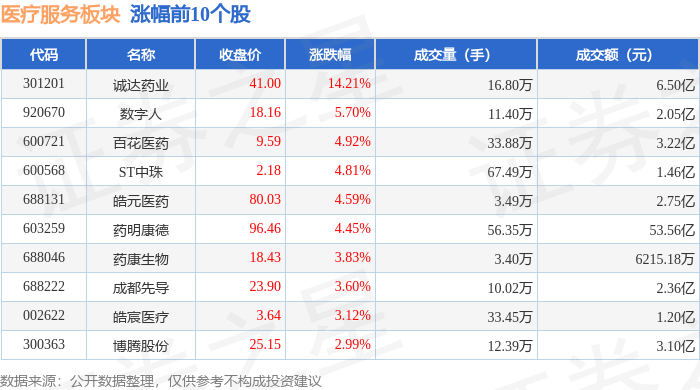
医疗服务板块11月13日涨2.17%,诚达药业领涨,主力资金净流入4.54亿元
Zheng Xing Xing Ye Ri Bao· 2025-11-13 08:44
Market Overview - The medical services sector increased by 2.17% on November 13, with Chengda Pharmaceutical leading the gains [1] - The Shanghai Composite Index closed at 4029.5, up 0.73%, while the Shenzhen Component Index closed at 13476.52, up 1.78% [1] Top Gainers in Medical Services - Chengda Pharmaceutical (301201) closed at 41.00, up 14.21% with a trading volume of 168,000 shares and a transaction value of 650 million [1] - Digital Human (920670) closed at 18.16, up 5.70% with a trading volume of 114,000 shares [1] - Mucai Pharmaceutical (600721) closed at 9.59, up 4.92% with a trading volume of 338,800 shares [1] - Other notable gainers include ST Zhongzhu (600568) and Haoyuan Pharmaceutical (688131) with increases of 4.81% and 4.59% respectively [1] Market Capital Flow - The medical services sector saw a net inflow of 454 million from institutional investors, while retail investors experienced a net outflow of approximately 20.9 million [2] - The overall trend indicates a strong interest from institutional investors despite the outflow from retail investors [2] Individual Stock Performance - WuXi AppTec (603259) had a significant net inflow of 590 million, representing 11.01% of its trading volume, while it faced a net outflow of 361 million from speculative funds [3] - Other companies like Kanglong Chemical (300759) and Baihua Pharmaceutical (600721) also showed mixed capital flows, with institutional inflows but outflows from speculative and retail investors [3]