
Eastroc Beverage(605499)

Search documents
研报掘金丨西部证券:首予东鹏饮料“买入”评级,赛道龙头地位稳固
Ge Long Hui A P P· 2026-01-08 06:57
Core Viewpoint - Dongpeng Beverage is solidifying its leading position in the energy drink market as the market expands, with a projected market size of 62.8 billion yuan by 2025, reflecting a 4% year-on-year growth [1] Industry Summary - The energy drink market in China is expected to reach a size of 62.8 billion yuan by 2025, with a growth rate of 4% [1] - The energy drink segment is experiencing significant expansion, indicating a favorable environment for market leaders like Dongpeng [1] Company Summary - Dongpeng's 500ml bottled energy drink is anticipated to become one of the best-selling products in the Chinese soft drink market by 2024 [1] - The company is focusing on enhancing its national layout and actively pursuing overseas development, which is expected to drive growth [1] - The introduction of new products is maturing, and there is potential for cultivating new growth drivers in various price-sensitive segments [1] - Given the company's strong growth potential, it has been assigned a "buy" rating for the first time [1]

今日124只个股跨越牛熊分界线
Zheng Quan Shi Bao Wang· 2026-01-08 04:06
Market Overview - The Shanghai Composite Index closed at 4089.45 points, above the annual line, with a slight increase of 0.09% [1] - The total trading volume of A-shares reached 17815.48 billion yuan [1] Stocks Breaking Annual Line - A total of 124 A-shares have surpassed the annual line today, with notable stocks showing significant deviation rates [1] - The stocks with the highest deviation rates include: - Keta Power (300153) with a deviation rate of 11.05% and a daily increase of 12.50% [1] - Tianjian Technology (002977) with a deviation rate of 9.75% and a daily increase of 10.00% [1] - Hongbo Pharmaceutical (301230) with a deviation rate of 9.27% and a daily increase of 10.27% [1] Additional Stocks with Notable Performance - Other stocks with significant performance include: - Hongdu Aviation (600316) with a daily increase of 8.58% and a deviation rate of 8.08% [1] - Jiuliang Co. (300808) with a daily increase of 5.79% and a deviation rate of 5.21% [1] - Zhongcheng Technology (920207) with a daily increase of 22.67% and a deviation rate of 4.84% [1] Summary of Stocks with Smaller Deviation Rates - Stocks that have just crossed the annual line with smaller deviation rates include: - Dongfang Guoxin (东方国信) and Fuchun Environmental (富春环保) with minimal deviation rates [1] - The table lists various stocks along with their daily performance metrics, including turnover rates and latest prices [1]



西部证券晨会纪要-20260108
Western Securities· 2026-01-08 01:28
Group 1: Macro Trends - The report outlines ten macro trends for 2026, indicating that the economy will continue to experience restorative growth, with real estate being a key variable affecting economic performance [6][7][8] - It predicts a moderate recovery in domestic inflation, leading to an acceleration in nominal GDP growth, expected to rise from 4% in 2025 to 5% in 2026 [6][7] - The report anticipates a more proactive fiscal policy in 2026, maintaining a budget deficit rate of 4% and supporting domestic demand and technological innovation [6][7] Group 2: Eastroc Beverage (605499.SH) - Eastroc Beverage is expected to benefit from a comprehensive national layout and active overseas expansion, with its main product line showing strong growth potential [11][12] - The energy drink market is projected to reach 62.8 billion yuan by 2025, with Eastroc's 500ml bottled energy drink becoming one of the best-selling products in its category [11][12] - The company plans to enhance its distribution network, aiming for nearly 100% coverage of prefecture-level cities and increasing the number of freezers deployed to 600,000 over the next three to five years [12][13] - Revenue forecasts for Eastroc are 21.2 billion yuan in 2025, 26.3 billion yuan in 2026, and 31.6 billion yuan in 2027, with net profits expected to be 4.6 billion yuan, 5.7 billion yuan, and 7.1 billion yuan respectively [11][12] Group 3: Jinhua New Materials (920015.BJ) - Jinhua New Materials is positioned as a "small giant" in the fine chemicals sector, with stable growth expected in its silane crosslinking agent business and strong progress in high-margin hydroxylamine aqueous solution [16][17] - The company has successfully developed electronic-grade hydroxylamine aqueous solution, which has been validated by several chip manufacturers, indicating a strong market demand [16][17] - Revenue projections for Jinhua are 1.04 billion yuan in 2025, 1.40 billion yuan in 2026, and 1.84 billion yuan in 2027, with net profits expected to be 200 million yuan, 280 million yuan, and 390 million yuan respectively [16][17]
东鹏饮料(605499):东风已至,鹏路翱翔
Western Securities· 2026-01-07 12:15
Investment Rating - The report gives a "Buy" rating for the company Dongpeng Beverage (605499.SH) [6] Core Insights - The energy drink market in China is expected to expand, with Dongpeng maintaining a strong position as a market leader. The market size is projected to reach 62.8 billion yuan by 2025, growing at a rate of 4% [1][39] - Dongpeng is actively pursuing global expansion, with significant potential in overseas markets such as Vietnam, India, Thailand, the Philippines, and Indonesia, which are expected to grow at CAGRs of 8% to 53% from 2020 to 2025 [1][39] - The company has established a robust national distribution network, covering nearly 100% of prefecture-level cities in China, with over 4.2 million retail outlets and plans to deploy an additional 600,000 refrigerators in the next three to five years [2][39] - The report highlights the successful launch of the "Brewed Water" product line, which is expected to capture a significant market share in the sports drink segment, with sales projected to reach 33.55 billion yuan by 2027 [3][14] Summary by Sections Energy Drink Market Expansion - The energy drink market in China is experiencing rapid growth, with a projected market size of 62.8 billion yuan by 2025, reflecting a 4% increase [1][39] - Dongpeng's flagship product, the 500ml bottled energy drink, is expected to become one of the best-selling products in the Chinese soft drink market by 2024 [1][39] - The company is well-positioned to benefit from the ongoing market expansion and increasing consumer demand [1][39] Channel Development - Dongpeng has built a large sales team and extensive distribution network, achieving nearly complete coverage of prefecture-level cities in China [2][39] - The company has invested in over 400,000 refrigerators to enhance product visibility and accessibility at retail points [2][39] - Revenue growth in key regions such as North China and Southwest China has been significant, with increases of 73% and 49% respectively [2][39] New Product Development - The "Brewed Water" product line is gaining traction, with sales expected to surpass competitors in the sports drink category [3][14] - The company is focusing on high-value, cost-effective products to capture market share in price-sensitive segments [3][14] - The report anticipates continued revenue growth from new product lines, with projections of 21.2 billion yuan in 2025 and 31.6 billion yuan by 2027 [3][14] Financial Projections - Revenue is expected to grow significantly, with estimates of 21.2 billion yuan in 2025, 26.3 billion yuan in 2026, and 31.6 billion yuan in 2027 [3][4] - Net profit is projected to reach 4.56 billion yuan in 2025, with a growth rate of 37% [4][3] - The company's price-to-earnings ratio is expected to decrease from 31 times in 2025 to 20 times by 2027, indicating strong growth potential [3][4]
前任董秘离任俩月后,东鹏饮料宣布“接棒者”,对港股IPO进程影响多大?
Sou Hu Cai Jing· 2026-01-07 11:02
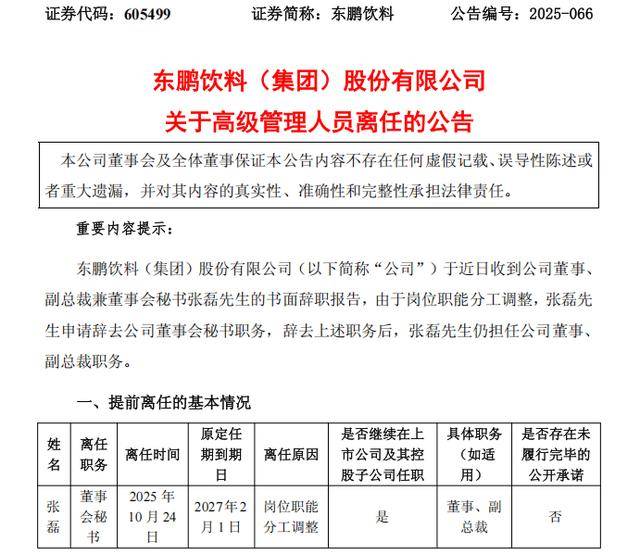
Core Viewpoint - The appointment of a new company secretary, Zhan Honghui, at Dongpeng Beverage is crucial during the sensitive period of its IPO process, especially given the recent resignation of the previous secretary, Zhang Lei, which occurred two months prior to this announcement [1][3]. Group 1: Appointment and Transition - Dongpeng Beverage officially appointed Zhan Honghui as the company secretary on December 29, 2025, following the resignation of Zhang Lei [1]. - Zhang Lei's resignation occurred during a critical phase when the company's initial application for a Hong Kong IPO had expired, leading to a second submission [3]. - The company emphasized that the transition was a planned handover rather than an unexpected departure, with Zhang Lei continuing to serve as a director and vice president [4]. Group 2: Qualifications and Experience - Zhan Honghui holds an MBA from Peking University and is a qualified CPA in China and ACCA in the UK, with extensive experience in financial auditing and capital operations [4]. - Prior to his appointment, Zhan served in various roles within Dongpeng Beverage, including deputy director and director of the financial management department [4]. Group 3: Market Implications and Performance - The company is currently working on establishing a dual capital platform (A+H shares) and faces challenges in regulatory communication and investor relations during the IPO process [5]. - Dongpeng Beverage reported a revenue of 16.844 billion yuan for the first three quarters of 2025, a year-on-year increase of 34.13%, and a net profit of 3.761 billion yuan, up 38.91% [7]. - Despite a slight decrease in gross margin by 0.6 percentage points due to a higher proportion of low-margin products, the company effectively managed expenses, reducing the sales expense ratio by 2.6 percentage points [7].

东鹏饮料跌2.01%,成交额3.01亿元,主力资金净流出3403.80万元
Xin Lang Zheng Quan· 2026-01-07 03:35
Group 1 - The core viewpoint of the news is that Dongpeng Beverage's stock has experienced fluctuations, with a recent decline of 2.01% and a total market capitalization of 141.657 billion yuan [1] - As of January 7, the stock price is reported at 272.41 yuan per share, with a trading volume of 3.01 billion yuan and a turnover rate of 0.21% [1] - The company has seen a year-to-date stock price increase of 1.88%, with a 5-day increase of 1.63% and a 20-day increase of 4.77%, while experiencing a 60-day decline of 8.16% [1] Group 2 - As of September 30, the number of shareholders for Dongpeng Beverage has increased to 16,000, representing a growth of 21.82%, while the average circulating shares per person decreased by 17.91% to 32,533 shares [2] - For the period from January to September 2025, Dongpeng Beverage achieved a revenue of 16.844 billion yuan, marking a year-on-year growth of 34.13%, and a net profit attributable to shareholders of 3.761 billion yuan, reflecting a year-on-year increase of 38.91% [2] Group 3 - Dongpeng Beverage has distributed a total of 6.6 billion yuan in dividends since its A-share listing, with 5.4 billion yuan distributed over the past three years [3] - As of September 30, 2025, Hong Kong Central Clearing Limited is the second-largest circulating shareholder, holding 52.0051 million shares, an increase of 540,700 shares compared to the previous period [3] - Huatai-PB CSI 300 ETF is the tenth-largest circulating shareholder, holding 3.7895 million shares, which is a decrease of 22,000 shares from the previous period [3]
东鹏饮料20260106
2026-01-07 03:05
Summary of Dongpeng Beverage Conference Call Company Overview - Dongpeng Beverage is positioned as a leading player in the energy drink industry, with a focus on high cost-performance strategies and channel expansion to enhance management efficiency and ensure long-term profitability. The company has completed nationwide expansion with 4.3 million terminal outlets [2][5]. Key Insights and Arguments - **Valuation and Growth Potential**: Dongpeng Beverage is currently valued at approximately 24 times PE for 2026, indicating it is undervalued. Even with a potential slowdown to single-digit growth, maintaining a 20 times valuation is highly probable [2][3]. - **Cost Leadership and Efficiency**: The company’s core competitive advantage lies in its total cost leadership strategy and the empowerment of its information systems. The manufacturing cost per ton is projected to be 216 RMB in 2024, significantly lower than competitors' costs of 500-600 RMB [2][6]. - **Supply Chain Efficiency**: Dongpeng Beverage effectively utilizes supply chain efficiencies to pass cost savings back to channels and consumers, fostering a win-win situation. The sales force currently manages 587 terminal outlets per person, indicating room for improvement in personnel configuration [2][8][9]. - **Market Expansion**: The company plans to diversify into tea and coffee categories, leveraging its high cost-performance and channel penetration to tap into new user demographics, particularly blue-collar workers and young people in small towns [3][10]. Industry Dynamics - **Energy Drink Market**: The energy drink sector is experiencing rapid expansion, driven by the demand for energy-boosting products among urban blue-collar workers and white-collar professionals. Dongpeng has successfully identified and targeted previously untapped consumer segments [3][10]. - **Electrolyte Water Segment**: The electrolyte water market is expected to grow significantly, with Dongpeng's "Bushi La" product priced competitively at 5 RMB for 1 liter, outperforming other brands. The company anticipates sales exceeding 3 billion RMB by 2025 [3][11]. - **Emerging Categories**: The company is exploring opportunities in sugar-free tea and RTD coffee, both of which are in growth phases with undefined market structures. Dongpeng has introduced differentiated products like "Beihao Tea" and aims to capitalize on the growing demand for convenience and high-quality offerings [3][13][14]. Additional Important Points - **Management Efficiency**: Dongpeng Beverage's management efficiency is crucial for maintaining competitive advantage, especially in a slowing industry growth environment. The company aims to become a platform enterprise by nurturing blue ocean markets and capturing shares in red ocean markets [5][6]. - **Future Product Lines**: The introduction of juice tea and plans for Hong Kong-style milk tea in 2026 are part of the company's strategy to enhance its product portfolio and leverage existing channels [12][14]. - **Consumer Trends**: The company is responding to increasing consumer demand for high cost-performance products, which is expected to drive future growth across its various beverage categories [14].
饮料乳品板块1月5日涨1.1%,东鹏饮料领涨,主力资金净流入8097.05万元
Zheng Xing Xing Ye Ri Bao· 2026-01-05 08:59
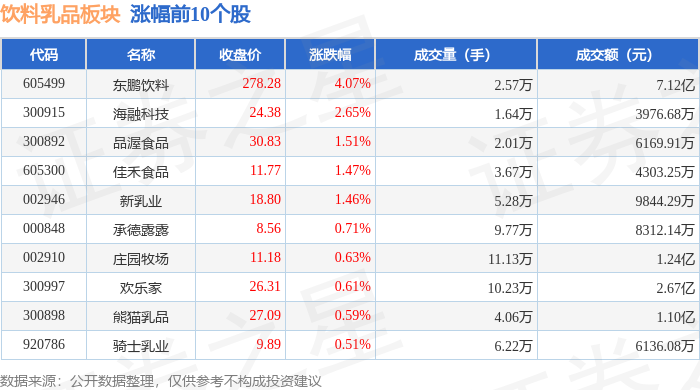
Market Overview - The beverage and dairy sector increased by 1.1% on January 5, with Dongpeng Beverage leading the gains [1] - The Shanghai Composite Index closed at 4023.42, up 1.38%, while the Shenzhen Component Index closed at 13828.63, up 2.24% [1] Stock Performance - Dongpeng Beverage (code: 6655599) closed at 278.28, with a rise of 4.07% and a trading volume of 25,700 lots, amounting to 712 million yuan [1] - Other notable performers included: - Huirong Technology (code: 300915) at 24.38, up 2.65% [1] - Aluminum Wine Food (code: 300892) at 30.83, up 1.51% [1] - Jiahe Food (code: 605300) at 11.77, up 1.47% [1] - New Dairy (code: 002946) at 18.80, up 1.46% [1] Capital Flow - The beverage and dairy sector saw a net inflow of 80.97 million yuan from main funds, while retail investors experienced a net outflow of 154 million yuan [2] - The main funds' net inflow for Yili Co. (code: 600887) was 85.24 million yuan, representing 5.99% of its trading volume [3] - Dongpeng Beverage had a main fund net inflow of 23.73 million yuan, accounting for 3.33% of its trading volume [3]

食品饮料行业周度更新:魔芋零食市场格局正如何演绎?-20260104
Changjiang Securities· 2026-01-04 13:10
Investment Rating - The industry investment rating is "Positive" and is maintained [10] Core Insights - The konjac snack market is currently a standout growth category within the snack market, achieving a 17.45% year-on-year growth during the MAT202511 period (December 2024 to November 2025) despite an overall decline in the snack market [2][4][17] - The market share of the top three groups (CR3) in the konjac snack industry increased from 67% to 75%, indicating a significant concentration trend [4][26][28] - The konjac snack category is expected to continue expanding, with the number of SKUs increasing by 53% and the number of participating groups growing by 41% from December 2023 to November 2025 [26][33] Summary by Sections Konjac Snack Market Dynamics - The konjac snack category has shown remarkable growth, with a 17.45% year-on-year increase during the MAT202511 period, contrasting with an 11.94% decline in overall snack sales [2][17] - The spicy flavor remains the most stable and dominant in the konjac snack category, maintaining over 35% market share [18] - The market share of traditional snacks like spicy strips is declining, while konjac snacks are gaining traction, with their market share surpassing 2% for the first time in May 2025 [17][18] Supply and Market Concentration - The supply side of the konjac snack category is expanding, with SKU numbers rising from 2,718 to 4,158, and brand numbers increasing from 859 to 1,261 [26] - The CR3 group's market share has increased significantly, indicating a trend towards market concentration, while the CR10 group now holds 84.3% of the market [26][28] Competitive Landscape - Major brands like Weilong and Yanjin are adapting their strategies, with Yanjin's sub-brand "Big Demon King" rapidly gaining market share, while Weilon's sub-brand "Little Witch" has seen a decline [31][33] - The konjac snack market is characterized by strong competition, with both established and emerging brands vying for market share, highlighting its attractiveness and growth potential [33]


2025年1-11月中国饮料产量为16560.6万吨 累计增长3.3%
Chan Ye Xin Xi Wang· 2026-01-04 03:36
Group 1 - The core viewpoint of the article highlights the growth trends in China's beverage industry, with a reported production of 10.46 million tons in November 2025, reflecting a year-on-year increase of 0.4% [1] - Cumulative beverage production from January to November 2025 reached 165.61 million tons, showing a cumulative growth of 3.3% [1] - The article references several listed companies in the beverage sector, including Yangyuan Beverage (603156), Chengde Lolo (000848), Dongpeng Beverage (605499), and Junyao Health (605388) [1] Group 2 - The data source for the beverage production statistics is the National Bureau of Statistics, with additional analysis provided by Zhiyan Consulting [2] - Zhiyan Consulting is recognized as a leading industry consulting firm in China, specializing in in-depth industry research reports and tailored consulting services [2] - The report titled "Analysis of the Market Operation Pattern and Future Prospects of the Beverage Industry in China from 2026 to 2032" is mentioned as a relevant document for further insights [1]


