
CHANGAN AUTOMOBILE-B(000625)

Search documents
长安汽车明年发布车载组件机器人,人形机器人小安亮相
Xin Lang Ke Ji· 2025-11-24 09:51
Core Insights - Changan Automobile is planning to launch a humanoid robot named "Xiao An" next year as part of its investment in the robotics sector [1] - The company is adopting a "1+N+X" strategic layout to develop intelligent automotive robotics technology and business [1] Company Strategy - Changan's robotics strategy focuses on core scenarios and aims to integrate technology and business in a commercial + technical closed loop [1] - The company plans to collaborate with leading partners to develop humanoid robots, addressing key technologies such as the robot's "brain," "energy," and "drive" [1] Product Development - The humanoid robot "Xiao An" has a height of 169 cm, weight of 69 kg, speed of 0.8 m/s, and features 40 degrees of freedom with a battery life exceeding 2 hours [1] - The robot is designed to interact with humans, demonstrate martial arts, and assist in work, with additional functionalities under development and testing [1] Future Plans - Changan aims to gradually release prototypes starting next year, with the first vehicle-mounted component robot expected in the first quarter [1] - The company will showcase humanoid robot products at the 2025 Guangzhou Auto Show [1]



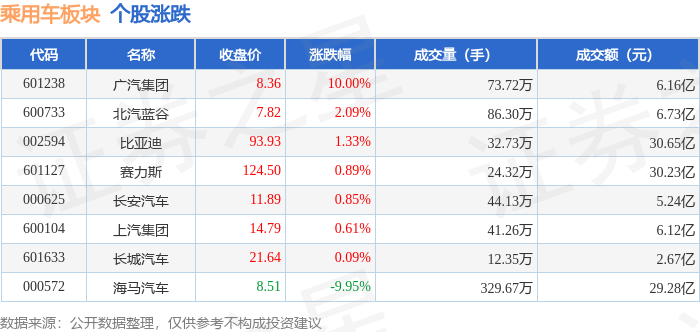
乘用车板块11月24日涨1.25%,广汽集团领涨,主力资金净流入4.03亿元
Zheng Xing Xing Ye Ri Bao· 2025-11-24 09:03
Core Viewpoint - The passenger car sector experienced a 1.25% increase on November 24, with GAC Group leading the gains, while the overall market indices showed modest increases [1] Group 1: Market Performance - The Shanghai Composite Index closed at 3836.77, up 0.05%, and the Shenzhen Component Index closed at 12585.08, up 0.37% [1] - GAC Group's stock price rose by 10.00% to 8.36, with a trading volume of 737,200 shares and a transaction value of 616 million [1] - Other notable performers included BAIC Blue Valley, which increased by 2.09%, and BYD, which rose by 1.33% [1] Group 2: Fund Flow Analysis - The passenger car sector saw a net inflow of 403 million from main funds, while retail investors experienced a net outflow of 44.18 million [1] - GAC Group attracted a net inflow of 259 million from main funds, accounting for 42.00% of its trading volume, while retail investors had a net outflow of 105 million [2] - BYD also saw a significant net inflow of 189 million from main funds, but retail investors withdrew 133 million [2]




兵装重组概念涨4.00%,主力资金净流入5股
Zheng Quan Shi Bao Wang· 2025-11-24 08:45
Group 1 - The core viewpoint of the news is that the military equipment restructuring concept has seen a significant increase of 4.00%, ranking 7th among concept sectors in terms of growth [1] - Within the military equipment restructuring sector, seven stocks experienced gains, with Changcheng Military Industry hitting the daily limit, and other notable performers including Construction Industry, Zhongguang Optical, and Huachuang Technology, which rose by 4.81%, 3.33%, and 3.32% respectively [1] Group 2 - The military equipment restructuring sector had a net inflow of 1.01 billion yuan from main funds today, with five stocks receiving net inflows, led by Changcheng Military Industry with a net inflow of 984 million yuan [2] - The top three stocks in terms of net inflow ratio were Changcheng Military Industry at 16.77%, Hunan Tianyan at 8.95%, and Huachuang Technology at 7.46% [3] - The trading volume and turnover rates for the leading stocks in the military equipment restructuring sector were notable, with Changcheng Military Industry showing a turnover rate of 14.75% and a daily increase of 10.00% [3]


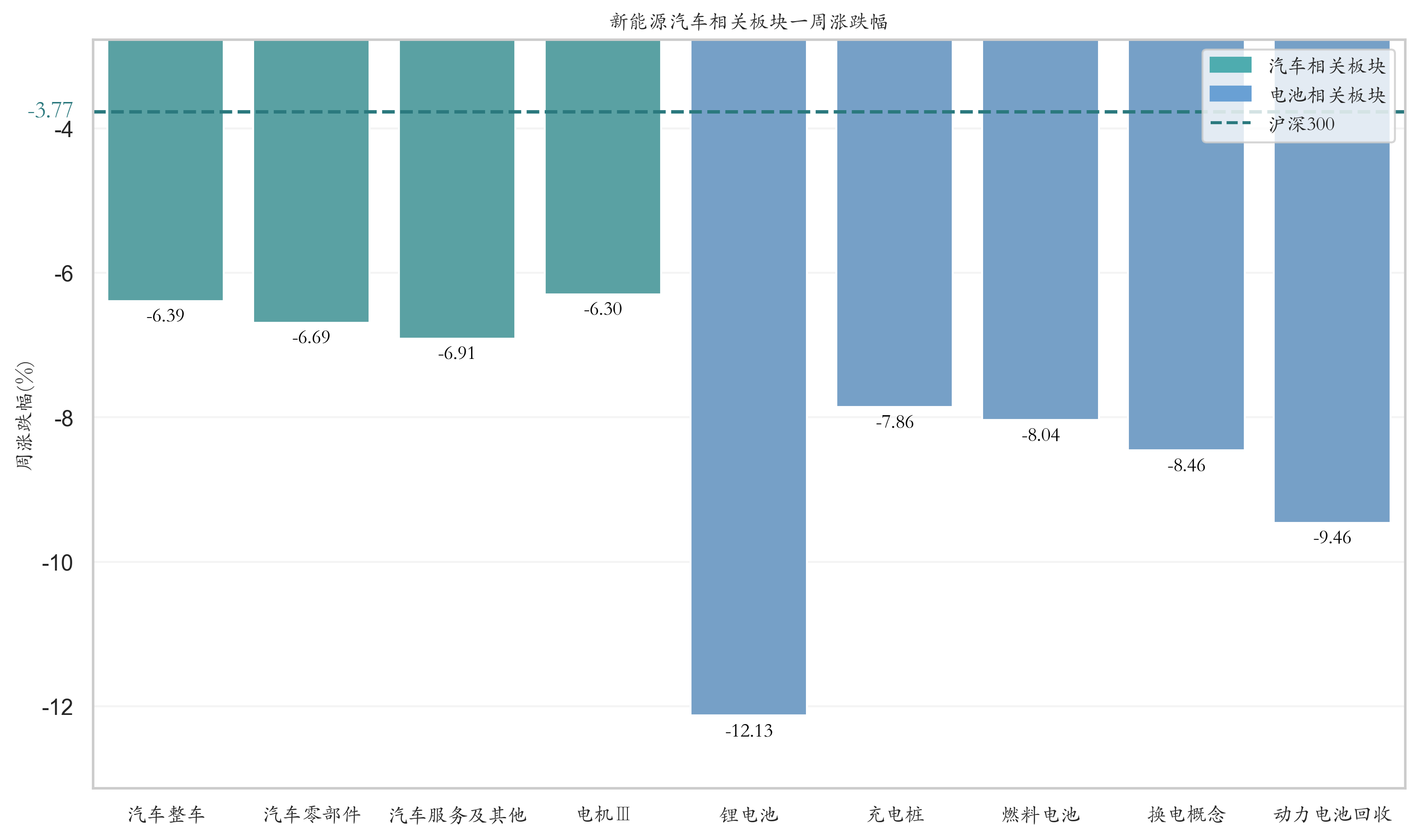
新能源汽车指数下跌7.25% 磷酸铁锂平均报价上涨2850元/吨丨行业周报
2 1 Shi Ji Jing Ji Bao Dao· 2025-11-24 04:59
Market Performance - The new energy vehicle index (885431.TI) fell by 7.25% from November 17 to November 21, underperforming the CSI 300 index by 3.48% [1] - The best-performing sector within the automotive-related segments was the motor index (884085.TI), which declined by 6.30% [1] - Among battery-related sectors, the charging pile index (885461.TI) had the highest decline at 7.86% [1] Company Stock Prices - Notable closing prices for new energy vehicle manufacturers include BYD at 92.7 yuan, Great Wall Motors at 21.62 yuan, and Jianghuai Automobile at 48.26 yuan [3] - In the automotive parts sector, notable stocks include Fuyao Glass at 64.03 yuan and Top Group at 60.32 yuan [5] - For battery manufacturers, CATL closed at 370.0 yuan, while other companies like Gotion High-tech and EVE Energy closed at 37.77 yuan and 71.74 yuan respectively [7] Industry Data - In October, the production of new energy vehicles reached 1,772,000 units, a year-on-year increase of 21.1%, with cumulative production at 13,015,000 units, up 33.1% [37] - The wholesale sales of new energy vehicles in October were 1,621,000 units, reflecting an 18.6% year-on-year increase and an 8.5% month-on-month increase [37] - The installed capacity of power batteries in October was 84,100 MWh, marking a 42.1% year-on-year increase [37] Price Trends of Key Materials - As of November 21, the average price of battery-grade lithium hydroxide was 83,900 yuan/ton, up 1,000 yuan/ton from November 14 [12] - The price of lithium hexafluorophosphate increased to 175,000 yuan/ton, rising by 17,500 yuan/ton since November 14 [30] - The market price for lithium iron phosphate was 38,100 yuan/ton, which increased by 2,850 yuan/ton from November 14 [18]


摆平用户害怕的“别、匝、黑”!在广州车展被天枢智能“圈粉”
Jin Tou Wang· 2025-11-24 04:57
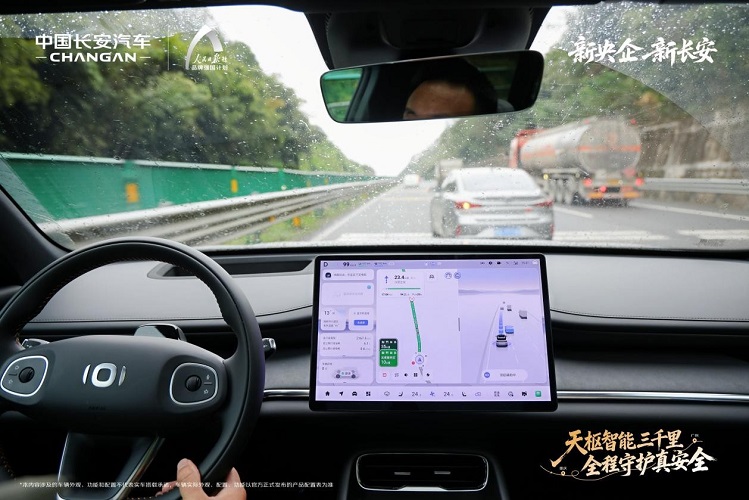
Core Insights - The article emphasizes the importance of intelligent technology in the automotive industry, particularly at the Guangzhou Auto Show, where companies are competing to win user trust through safety and practicality [1][9] - Changan Automobile's intelligent brand "Tianshu Intelligent" shifts the safety paradigm from "passive safety" to "active intelligent safety," expanding the concept of safety to include driving safety, health safety, psychological safety, and privacy safety [1][9] Group 1: Intelligent Driving Solutions - The Tianshu Intelligent Driving Assistance Laser Version utilizes multi-dimensional dynamic safety control technology to instantly recognize risks such as sudden lane changes and adjust speed to avoid collisions [3] - The system employs centimeter-level positioning technology and optimal path planning algorithms to ensure a 98% success rate in navigating complex highway ramps [5] - Tianshu's multi-source sensor fusion technology allows for enhanced perception in low-light conditions, enabling the vehicle to identify obstacles and risks up to 200 meters ahead while driving at high speeds [7] Group 2: Safety Performance Validation - Changan Automobile conducted an extreme long-distance test titled "Tianshu Intelligent 3000 Miles, Full Protection of True Safety," where vehicles equipped with Tianshu technology completed a 3000-mile journey without accidents or scratches, demonstrating the system's reliability in real-world scenarios [9] - The focus on safety is reiterated as the company aims to address both new and old safety risks through intelligent technology, highlighting that the application of such technology is not merely for show but for practical safety solutions [9]
峰飞航空发布eVTOL零碳水上机场,低空经济加速“入水”;长安汽车预计明年一季度将发布首款车载组件机器人丨智能制造日报
创业邦· 2025-11-24 04:00
Group 1 - The core viewpoint of the article highlights the advancements in low-altitude economy and the introduction of innovative insurance products for humanoid robots [2][3] Group 2 - Fengfei Aviation Technology launched the "eVTOL Zero Carbon Water Airport" and "Sea-Air Integrated Low-Altitude Economic Solution," extending low-altitude infrastructure to water bodies, enabling eVTOL aircraft to take off from water [2] - The water airport utilizes pure electric drive and solar panels for energy storage, allowing flexible relocation to various riverbank locations, complementing land-based eVTOL operations [2] - The insurance industry is responding to the rise of humanoid robots by developing specialized insurance products to mitigate risks associated with their use, addressing concerns like "fear of use" and "cost of damage" [2] - Major domestic property insurance companies, including Ping An Insurance and China Pacific Insurance, have launched dedicated insurance products for humanoid robots since September [2] - Changan Automobile plans to release its first vehicle-mounted robot in the first quarter of next year, focusing on commercial and technical integration across various applications [3] - Elon Musk announced that the Starship could potentially transport around 300 GW of solar energy satellites annually, with a goal of achieving over 100 TW of energy output through lunar manufacturing and mass drivers [3]

金融界财经早餐:俄乌冲突现和平曙光,美联储紧急救市,摩尔线程今日申购,宁德时代或重启重要锂矿(11月24日)
Sou Hu Cai Jing· 2025-11-24 00:47
Group 1: Industry Highlights - The domestic first large-capacity all-solid-state battery production line has been completed and is currently in small-batch testing, with reports indicating that it will be installed in vehicles by 2027, making 1000 km range for electric vehicles a possibility [4] - The Federal Reserve is managing interest rate cut expectations, with two officials calming the market after a significant drop, indicating a 69% probability of a rate cut in December, leading to a rebound in US stocks [5] - The lithium carbonate futures price has surged recently, prompting CATL to plan the earliest restart of an important lithium mine in Yichun next month, with significant gains in related market concept stocks [5] Group 2: Company Developments - Baillie Tianheng's self-developed dual-antibody ADC drug, iza-bren, has had its market application accepted, aimed at treating locally advanced or metastatic nasopharyngeal carcinoma [7] - Huawei has released Flex:ai AI container software, which utilizes computing power slicing technology to divide a single GPU/NPU computing power card into multiple virtual computing units, enabling simultaneous support for multiple AI workloads [8] - Longxin Storage has launched DDR5 and LPDDR5X memory products, with both product series reportedly ranking at the top tier in terms of speed and capacity in the industry [8] - JinkoSolar's Tiger 3 modules have officially entered mass production, with global orders reaching 15 GW [8] - Chang'an Automobile plans to gradually release prototype vehicles starting next year and will launch its first vehicle-mounted component robot in the first quarter of next year [8] - The company Nenghui Technology signed a contract with Company X for a total estimated price of 10 million yuan for new energy power battery assembly [8] - Guotai Microelectronics' major shareholder and its concerted actors plan to reduce their holdings by no more than 2.24% [8]




热门赛道新进展!国内已建成首条大容量全固态电池产线 目前正在小批量测试生产
Zheng Quan Shi Bao· 2025-11-23 21:53
Core Insights - The domestic first large-capacity all-solid-state battery production line has been established, currently undergoing small-scale testing production, marking a significant milestone in the all-solid-state battery technology [1] - The all-solid-state battery is recognized as the "holy grail of next-generation battery technology," offering higher energy density, inherent safety, longer lifespan, and wider temperature range compared to traditional liquid lithium batteries [2] - Multiple companies are advancing their solid-state battery projects, with plans for small-scale vehicle integration and mass production set for 2027 [4] Industry Developments - The all-solid-state battery technology is included in the national strategic development plan, indicating its importance for future energy storage solutions [2] - Major players like CATL and Changan Automobile are targeting 2027 for mass production, with significant improvements in battery safety and energy density [2] - The industry is expected to see a peak in pilot production lines in 2026, with small-scale commercialization anticipated by 2027 [3] Company Progress - GAC Group has completed the first large-capacity all-solid-state battery production line, capable of producing batteries with an energy density nearly double that of current batteries [1] - SAIC Group and Penghui Energy have also reported advancements in their solid-state battery production lines, with plans for sample production and vehicle testing in the near future [4] - Companies are focusing on overcoming technical bottlenecks related to manufacturing costs, cycle life, and environmental adaptability to facilitate the industrial application of solid-state batteries [4]


2025出海标杆榜单揭晓:做好世界的合伙人
虎嗅APP· 2025-11-23 13:41
Core Insights - The article discusses the transformation of Chinese companies in their overseas expansion, marking the beginning of "Overseas 2.0" era, characterized by a shift from price competition to organizational strength, innovation, and localized operations [2][3]. Group 1: Strategic Upgrades - In the past year, there has been a significant upgrade in overseas strategies, with more companies establishing global operational systems, transitioning from product export to brand export [3]. - Many manufacturing and emerging consumer brands are setting up localized teams and data management units in specific regions, enhancing innovation, service, and marketing at community and user touchpoints [3][4]. Group 2: External Challenges - The external environment for overseas expansion is becoming increasingly complex, with geopolitical factors significantly impacting companies' strategies [4]. - Trade barriers in Europe and the U.S., data protection regulations in Southeast Asia, and market access issues in the Middle East require companies to possess higher strategic sensitivity and local adaptability [4][5]. Group 3: Local Adaptation and Risk Management - Compliance has become a critical threshold, necessitating that Chinese companies develop cross-border risk control and emergency response capabilities [5]. - Companies are moving from a "hit-and-run" approach to a more rooted strategy, focusing on local talent, data, ecosystems, and teams to withstand external risks and achieve resilient growth [5][6]. Group 4: Evolving Competitive Landscape - The competitive landscape and philosophies of Chinese companies are evolving, transitioning from product sales to creating value ecosystems [6]. - The most promising sectors for overseas expansion by 2025 include smart manufacturing, consumer electronics, renewable energy, and cross-border e-commerce brands [7][8]. Group 5: Benchmark Enterprises - The article emphasizes that true benchmark enterprises are not just defined by high revenue or size but by their continuous evolution of capabilities and ecological innovation [11][12]. - The evaluation criteria for benchmark enterprises include innovation capability, localization, organizational resilience, and sustainable growth [12]. Group 6: Award Winners - The article lists several companies recognized for their outstanding performance in overseas markets, including Haier, Lenovo, Midea, Didi, and Changan Automobile, highlighting their contributions to global brand building and market penetration [16][19][20][21][22][23][24][25][26][27][28]. - New emerging companies like United Imaging, Baseus, and Fantuan are also acknowledged for their rapid rise and innovative business models in overseas markets [30][31][32][33][34][35][36][37][38][39]. Group 7: Service Providers - The article identifies key service providers that support overseas enterprises, including logistics, marketing, and payment solutions, which help lower the barriers for Chinese brands to reach global users [41][42][43][44][45][46][47][48][49][50][51]. Group 8: Future Outlook - The future of Chinese companies' overseas expansion is expected to be defined by the integration of localization capabilities, data-driven strategies, and ecological collaboration [51]. - The evolution of Chinese brands in the global market is not a sprint but a long-term contest of organizational strength, innovation, and belief [51].






长安汽车:预计明年一季度将发布首款车载组件机器人
Xin Lang Cai Jing· 2025-11-23 12:49
Core Viewpoint - Chang'an Automobile (000625.SZ) is planning to develop a range of intelligent robots through a phased approach, integrating commercial and technological aspects, with prototypes expected to be released starting next year [1] Group 1: Business Strategy - The company is focusing on various application scenarios including factories, stores, homes, and special applications [1] - The development strategy is structured in three phases: near-term, mid-term, and long-term [1] Group 2: Product Development - Multiple intelligent robot products are being developed, with the first prototype expected to be unveiled next year [1] - The first vehicle-mounted component robot is anticipated to be released in the first quarter of next year [1]