
CHANGAN AUTOMOBILE-B(000625)

Search documents
2月4日增减持汇总:长安汽车等4股增持 盛科通信等19股减持(表)




Xin Lang Zheng Quan· 2026-02-04 14:14
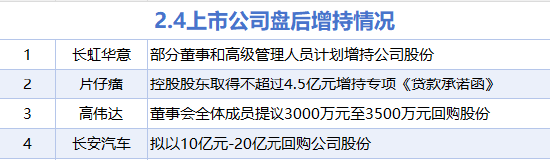
Summary of Key Points Core Viewpoint - The article highlights the recent stock buyback and reduction activities of various A-share listed companies, indicating potential shifts in investor sentiment and company strategies in the market [1]. Group 1: Stock Buyback Activities - Changhong Huayi: Some directors and senior management plan to increase their shareholding in the company [2]. - Pianzihuang: The controlling shareholder has obtained a special loan commitment for a buyback of up to 450 million yuan [2]. - Gaweida: The board proposes a share repurchase plan amounting to 30 million to 35 million yuan [2]. - Changan Automobile: Plans to repurchase shares worth between 1 billion to 2 billion yuan [2]. Group 2: Stock Reduction Activities - Shengke Communication: Recently, the National Integrated Circuit Industry Investment Fund reduced its stake by 0.6% of the total share capital [2]. - Furi Technology: Shareholders plan to reduce their holdings by up to 2% of the total share capital [2]. - Pulit: Shareholders Zhou Wu and executive Li Hong plan to collectively reduce their holdings by up to 0.57% [2]. - Nankuang Group: The executive vice president plans to reduce his stake by up to 1% [2]. - Qinda Environmental Protection: Shareholder Binglun Environment plans to reduce holdings by up to 3% [2]. - Fuchuang Precision: Shareholder Guotou Chuangyi plans to reduce holdings by up to 3% [2]. - Shuangqiang Technology: Director Zhou Zhaocheng plans to reduce holdings by up to 0.32% [2]. - Debi Group: The controlling shareholder plans to reduce holdings by up to 1.92% [2]. - Jinpu Garden: Shareholders plan to reduce their stakes by 1% each [2]. - Kangsi Te: Shareholders plan to reduce their holdings [2]. - Guangda Jiabao: Shareholders plan to reduce their holdings by up to 1% [2]. - Baogang Jin: Director Yuan Xiaofeng plans to reduce holdings by up to 0.0923% [2]. - ST Lutong: Shareholders plan to reduce their holdings by up to 3.33% [2]. - Zhang Xiaoqin: Shareholder plans to reduce holdings by up to 0.31% [2]. - Yuxing Co.: Shareholder Huang Shiliu plans to reduce holdings by up to 0.22% [2]. - Guai Bao Pet: Shareholders plan to reduce their holdings by up to 1.90% [2]. - Kaipu Biological: Shareholder plans to reduce holdings by up to 3% [2]. - Jiangshan Oupai: Shareholder Wang Zhong plans to reduce holdings by up to 3% [2]. - Fuguang Co.: Shareholder plans to reduce holdings by up to 3% [2].

长安汽车:关于筹划回购公司股份的提示性公告
Zheng Quan Ri Bao· 2026-02-04 14:06
证券日报网讯 2月4日,长安汽车发布公告称,公司基于对公司战略发展前景及内在价值的坚定信心, 为积极维护公司价值及股东权益,优化公司资本结构,增厚每股收益,结合公司当前财务状况及未来经 营规划,目前正在筹划回购公司股份事项。回购股份的资金总额:计划回购资金总额不低于人民币10亿 元(含)且不超过人民币20亿元(含)。其中,计划回购A股不低于人民币7亿元(含)且不超过人民 币14亿元(含);计划回购B股不低于人民币3亿元(含)且不超过人民币6亿元(含)。回购股份的方 式:通过深圳证券交易所交易系统以集中竞价交易方式回购股份。实施期限:自股东会审议通过最终回 购股份方案之日起,不超过12个月。 (文章来源:证券日报) ...

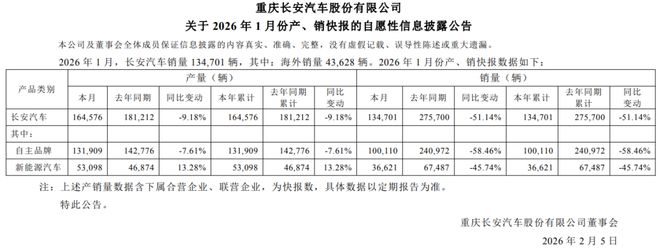
长安汽车(000625.SZ):2026年1月长安汽车销量13.47万辆,同比下降51.14%%
Ge Long Hui· 2026-02-04 13:41
Group 1 - Changan Automobile reported a total sales volume of 134,700 units in January 2026, representing a year-on-year decline of 51.14% [1] - Of the total sales, overseas sales accounted for 43,600 units [1]
长安汽车间隔近14年,拟出资10亿元至20亿元回购股份
Zhong Guo Ji Jin Bao· 2026-02-04 13:31
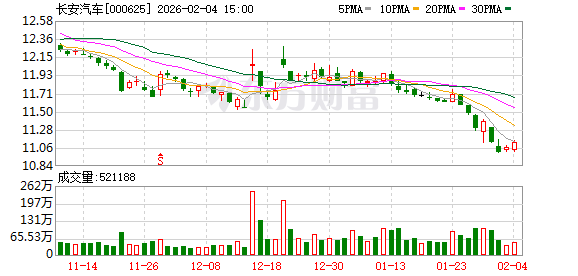
【导读】长安汽车间隔近14年,拟出资10亿元至20亿元回购股份 中国基金报记者 邱德坤 2月4日晚间,长安汽车发布公告称,公司正在筹划回购股份事项,拟回购股份金额不低于10亿元(含) 且不超过20亿元(含)。 这是长安汽车时隔近14年,再次筹划回购股份事项。 长安汽车的间接控股股东中国长安汽车集团有限公司,系三大汽车央企之一。2026年,央企的重点工作 包括加强旗下上市公司质量和市值管理。 2月4日收盘,长安汽车股价报11.13元/股,涨幅达0.54%,总市值为977.50亿元。截至2025年9月30日, 公司股东人数达62.15万户。 拟以自有资金回购股份 涉及A股与B股股份 公告显示,长安汽车计划通过集中竞价交易方式回购股份,回购股份的价格上限不高于其董事会审议通 过回购股份方案决议前30个交易日长安汽车股票交易均价的150%。 长安汽车公告称,公司计划回购股份的资金总额为10亿元(含)至20亿元(含),其中计划回购A股股 份的资金为7亿元(含)至14亿元(含);计划回购B股股份的资金为3亿元(含)至6亿元(含)。 截至2012年3月20日,长安汽车累计出资约6.10亿港元(含税费),回购其B股股份约1. ...
氪星晚报 |腾讯混元AI Infra核心技术开源;小米:辽宁营口SU7起火事故系车内遗留火源引燃周边可燃物所致
3 6 Ke· 2026-02-04 13:02
Group 1: Company Updates - Gong Youliang, the director and executive vice president of South Mining Group, plans to reduce his stake by up to 1%, amounting to 2.0172 million shares, due to personal funding needs [1] - Changan Automobile reported January sales of 134,701 units, a year-on-year decline of 51.14%, with new energy vehicle sales at 36,621 units, down 45.74% [1] - Yum China achieved fourth-quarter revenue of $2.82 billion, an 8.8% year-on-year increase, with adjusted earnings per share of $0.40, surpassing estimates [3] - Toyota plans to increase hybrid vehicle production by approximately 30% by 2028, targeting 6.7 million units, compared to a production plan of 5 million units for 2026 [4] - Panasonic announced the establishment of a Chief Artificial Intelligence Officer position to enhance AI application in customer solutions and internal operations [5] Group 2: Financing and Investments - Cloud Data Infrastructure provider "Yunqi Technology" completed a Series B financing round led by ALC Capital, with total funding exceeding 700 million yuan [6] Group 3: New Products and Innovations - Tencent's Mix Yuan AI Infra team launched an open-source high-performance LLM inference core operator library, HPC-Ops, which improved model inference performance by 30% for Mix Yuan and 17% for DeepSeek [7]



长安汽车1月销量腰斩
Di Yi Cai Jing Zi Xun· 2026-02-04 12:59
Summary of Key Points Core Viewpoint - Changan Automobile reported a significant decline in sales for January 2026, with total sales dropping by 51.14% year-on-year, indicating potential challenges in the market and operational performance [1][3]. Sales Performance - Total sales for Changan Automobile in January 2026 were 134,701 units, down from 275,700 units in the same month last year, reflecting a decrease of 51.14% [1][3]. - The sales of Changan's self-owned brands were 100,110 units, which is a 58.46% decline compared to 240,972 units in January 2025 [1][3]. - New energy vehicle sales reached 36,621 units, marking a 45.74% decrease from 67,487 units in the previous year [1][3]. Production Data - The production figures for Changan Automobile in January 2026 were 164,576 units, which is a 9.18% decrease from 181,212 units in January 2025 [3]. - The production of self-owned brands was 131,909 units, down 7.61% from 142,776 units year-on-year [3]. - New energy vehicle production increased by 13.28% to 53,098 units compared to 46,874 units in the same month last year [3].
长安汽车1月销量腰斩
第一财经· 2026-02-04 12:53
Core Viewpoint - Changan Automobile reported a significant decline in sales for January 2026, with total sales dropping by 51.14% year-on-year, indicating potential challenges in the market and operational performance [1][3]. Group 1: Sales Performance - In January 2026, Changan Automobile's total sales reached 134,701 units, a decrease of 51.14% compared to the same month last year [1][3]. - The sales of Changan's self-owned brands were 100,110 units, reflecting a year-on-year decline of 58.46% [1][3]. - The sales of new energy vehicles (NEVs) amounted to 36,621 units, down 45.74% year-on-year [1][3]. Group 2: Production Data - The production for Changan Automobile in January 2026 was 164,576 units, which is a 9.18% decrease compared to the same month last year [3]. - The production of self-owned brands was 131,909 units, showing a decline of 7.61% year-on-year [3]. - The production of new energy vehicles increased by 13.28% to 53,098 units compared to the same month last year [3].
长安汽车筹划10亿元至20亿元回购公司股份
Xin Lang Cai Jing· 2026-02-04 12:39
2月4日晚,长安汽车公告称,公司拟以10亿元20亿元回购股份。其中,计划回购A股不低于7亿元且不 超过14亿元;计划回购B股不低于3亿元且不超过6亿元。此次回购股份的用途为减少公司注册资本。 ...
长安汽车(000625) - 关于2026年1月份产、销快报的自愿性信息披露公告
2026-02-04 12:15
证券代码:000625(200625) 证券简称:长安汽车(长安 B) 公告编号:2026-06 重庆长安汽车股份有限公司 关于 2026 年 1 月份产、销快报的自愿性信息披露公告 2026 年 1 月,长安汽车销量 134,701 辆,其中:海外销量 43,628 辆。2026 年 1 月份产、销快报数据如下: | 产品类别 | | | 产量(辆) | | | | | | 销量(辆) | | | | | --- | --- | --- | --- | --- | --- | --- | --- | --- | --- | --- | --- | --- | | | 本月 | 去年同期 | 同比变动 | 本年累计 | 去年同期 | 同比 | 本月 | 去年同期 | 同比变动 | 本年累计 | 去年同期 | 同比 | | | | | | | 累计 | 变动 | | | | | 累计 | 变动 | | 长安汽车 | 164,576 | 181,212 | -9.18% | 164,576 | 181,212 | -9.18% | 134,701 | 275,700 | -51.14% | 134,701 | 2 ...
长安汽车:筹划回购股份 资金总额不低于10亿元且不超过20亿元
Sou Hu Cai Jing· 2026-02-04 11:21
长安汽车公告称,基于对公司战略发展前景及内在价值的坚定信心,为积极维护公司价值及股东权益、 优化资本结构、增厚每股收益,结合当前财务状况及未来经营规划,目前正在筹划回购公司股份事项。 拟回购股份种类为人民币普通股(A股)股票、境内上市外资股(B股)股票,用途为减少公司注册资 本,资金来源为自有资金。回购方式为通过深圳证券交易所交易系统以集中竞价交易方式,价格上限不 高于董事会审议通过回购方案决议前30个交易日公司股票交易均价的150%,资金总额不低于人民币10 亿元(含)且不超过人民币20亿元(含)(其中A股不低于7亿元且不超过14亿元,B股不低于3亿元且 不超过6亿元),实施期限自股东会审议通过最终回购股份方案之日起不超过12个月。目前该事项处于 筹划阶段,尚需履行相关审批程序,存在不确定性。 声明:市场有风险,投资需谨慎。本文为AI基于第三方数据生成,仅供参考,不构成个人投资建议。 来源:市场资讯 ...