
CHANGAN AUTOMOBILE-B(000625)

Search documents
中国智驾驶入“脱手”时代!
Xin Lang Cai Jing· 2025-12-18 14:24
导读 行业普遍认为,L3级是从"辅助驾驶"到"完全自动驾驶"的重要过渡,后续的L4级自动驾驶将实现更大突破——在固定区域内,车辆可完全脱离人类干预, 真正实现无人驾驶。 12月15日,工业和信息化部正式公布了我国首批L3级有条件自动驾驶车型准入许可名单并附条件许可了长安旗下深蓝汽车SL03(L3版)、极狐阿尔法S6(L3 版)这两款车型产品。这是我国L3级自动驾驶从测试阶段迈入商业化应用的关键一步,对高阶智驾进入按法规要求交付、运营并接受监管的新阶段具有重 要意义。 12月15日,工业和信息化部正式公布了我国首批L3级有条件自动驾驶车型准入许可名单并附条件许可了长安旗下深蓝汽车SL03(L3版)、极狐阿尔法S6(L3 版)这两款车型产品。获批车型将分别在重庆指定拥堵路段和北京指定高速路段开展上路试点,最高运行速度分别被限制在50km/h和80km/h。这一举措不 仅是我国L3级自动驾驶从测试阶段迈入商业化应用的关键一步,还意味着高阶智驾不再仅停留于技术展示,而是进入了按法规要求交付、运营并接受监 管的新阶段。 深蓝汽车SL03(L3版)和极狐阿尔法S6(L3版)能够获批搭载L3级自动驾驶功能的智能网联汽车产品 ...




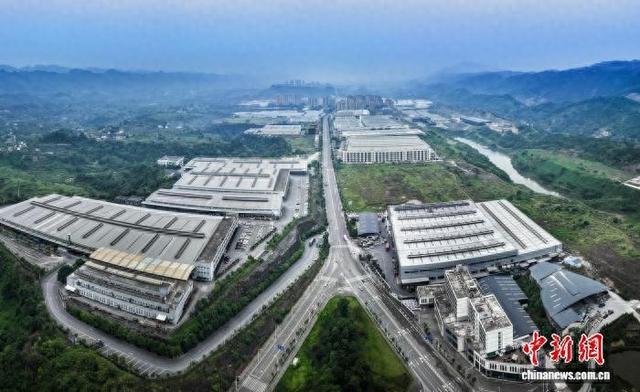
“腾笼换鸟”赋能产业升级 重庆合川闲置资产“焕”新生
Zhong Guo Xin Wen Wang· 2025-12-18 09:16
Core Viewpoint - The article discusses how Hechuan District in Chongqing is revitalizing idle assets and resources, particularly focusing on the automotive industry, to drive economic growth and development through strategic planning and targeted investments [1][3]. Group 1: Asset Utilization Strategy - Hechuan District has adopted a strategy of "revitalizing existing assets to generate new growth," focusing on idle factories and land left by companies like BAIC Ruixiang and Bisu Auto [1][3]. - The district has identified approximately 1,557.55 acres of industrial land and 837,000 square meters of vacant factory space, prioritizing these for high-growth projects [3][6]. Group 2: Project Development and Investment - Since August 2024, Hechuan has signed 64 projects with a total investment of 15.393 billion yuan, including 37 automotive parts projects worth 11.275 billion yuan [3][6]. - The district aims to attract high-quality enterprises by creating a "chain master-chain subordinate" model, focusing on companies with high technical content and growth potential [3][6]. Group 3: Industry Focus and Future Goals - Hechuan is concentrating on developing the intelligent connected new energy vehicle parts industry, with plans to create a billion-level industrial cluster centered on chassis systems, lightweight structural components, and intelligent cockpit parts [6][8]. - By the end of 2026, Hechuan aims to introduce over 20 quality projects, increasing the local supply rate to over 60% and contributing significantly to the high-quality development of the automotive industry in the Chengdu-Chongqing economic circle [8].

天迈科技:未与长安汽车,北汽新能源,浙江世宝等车企开展合作
Mei Ri Jing Ji Xin Wen· 2025-12-18 07:49
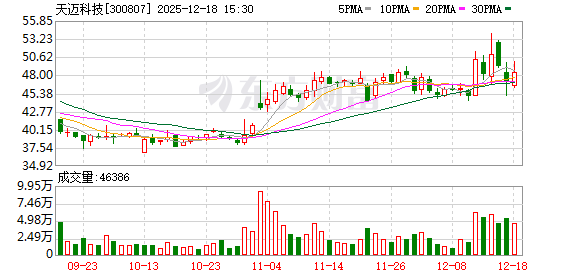
Group 1 - The company, Tianmai Technology, primarily focuses on the public transportation sector and has not established partnerships with the mentioned electric vehicle manufacturers such as Changan Automobile, BAIC New Energy, and Zhejiang Sebao [2]
A股开盘:沪指跌0.34%、创业板指跌1.17%,CPO、离境退税概念股走低,中金、东兴证券复牌后涨停
Jin Rong Jie· 2025-12-18 01:36
Market Overview - On December 18, A-shares opened lower with the Shanghai Composite Index down 0.34% at 3857.26 points, the Shenzhen Component Index down 0.85% at 13112.61 points, and the ChiNext Index down 1.17% at 3138.66 points [1] - Key sectors such as CPO, tax refunds for outbound travelers, and fiberglass saw significant declines [1] - Notable stocks included Baida Group, which opened up 4.49%, and Shengtong Energy, which reached a limit up after a change in control [1] Company News - SpaceX has entered a "regulatory quiet period," signaling the initiation of the largest IPO in history [2] - Vanke A proposed a 12-month extension for the principal repayment of its medium-term notes, with a total outstanding amount of 3.7 billion yuan [2] - CATL launched the world's first humanoid robot production line for battery PACKs, marking a significant milestone in intelligent manufacturing [2] - China CNR signed several major contracts totaling approximately 53.31 billion yuan, representing 21.6% of its projected 2024 revenue [3] - Huayi Brothers reported a reduction in shareholding by Alibaba's venture capital arm, decreasing its stake from 3.47% to 2.40% [3] Industry Insights - The global optical module market is experiencing a rapid shift from copper cables to fiber optics, with 1.6T products expected to see significant growth starting in 2026 [6] - The Yichun Natural Resources Bureau plans to revoke 27 mining licenses, including one for Jiangte Electric's lithium-containing ceramic stone mine with an annual capacity of 1.2 million tons [7] - Travel bookings for the upcoming New Year holiday have increased by nearly 30% compared to the same period last year, indicating a recovery in the tourism sector [8] - A successful clinical trial of an invasive brain-computer interface was completed, allowing a paralyzed patient to control a smart wheelchair using brain signals [9] - The upcoming FORCE conference by Volcano Engine is expected to introduce new AI models, enhancing performance and reducing costs [10] - The fifth International AIDC Liquid Cooling Supply Chain Summit will discuss the growing importance of liquid cooling technology in data centers due to rising AI server demands [11] - The founder of Hailin Energy predicts that global electricity demand will surge by 2050, emphasizing the critical role of energy storage in addressing energy challenges [12][13] Institutional Perspectives - CITIC Securities highlights structural opportunities in the express delivery sector, focusing on cost reduction across the entire supply chain [14] - CICC notes that the food and beverage industry is nearing a bottom, with a focus on high-quality growth driven by product innovation and channel expansion [15] - Huatai Securities anticipates that the recent approval of L3 autonomous driving vehicles will accelerate value reconstruction in the smart driving industry, with significant investment opportunities emerging in 2026 [16]





AI加速“上车” 智能汽车操作系统迈向千亿级市场
Xin Hua Cai Jing· 2025-12-18 01:09
Core Insights - Major automotive companies are increasingly adopting AI as a core strategy for future development, with significant investments in AI technologies and models [1] - The automotive software industry is undergoing structural changes, shifting the value focus from traditional hardware manufacturing to software and services, with projections indicating a rise in software profit share from 6% in 2020 to 25% by 2030 [2][3] - The integration of software is fostering a new ecosystem that bridges various sectors, enhancing collaboration and resource efficiency across the automotive industry [3][4] Group 1: Industry Trends - The automotive software industry's value is transitioning from a "one-time sale" model to a "full-cycle service" model, with hardware profit share decreasing from 79% in 2020 to an expected 59% by 2030 [2] - The commercial value of in-vehicle operating systems is becoming increasingly significant, with the market projected to reach approximately 600 billion yuan by 2025 and exceed 1 trillion yuan by 2030 [3] - The future of automotive software development is expected to focus on integration, moving towards highly adaptive intelligent operating systems that support comprehensive resource management [4] Group 2: Challenges and Solutions - The automotive industry faces challenges in establishing a unified and open software and hardware ecosystem, with varying levels of openness and interface standards among chip manufacturers [7] - Collaboration between companies remains inefficient, often requiring extensive customization and debugging, which hampers the overall efficiency of solutions [7] - The industry is encouraged to adopt open-source models to build a unified technical foundation, reducing costs and fostering innovation through community collaboration [5][9] Group 3: Future Directions - The integration of advanced safety features and the expansion of collaborative boundaries are essential for building sustainable competitive advantages in the automotive sector [11] - The industry is exploring the incorporation of satellite technology into existing vehicle-road-cloud systems to enhance data and computational networks [12] - The relationship between AI and the automotive industry is expected to evolve, with AI becoming a critical component in the development of intelligent vehicles and applications [12]



【汽车】国内首批L3级自动驾驶车型获准入许可,高阶智驾商业化或迎拐点——汽车和汽车零部件行业跟踪报告(倪昱婧/邢萍)
光大证券研究· 2025-12-17 23:04
Core Viewpoint - The approval of the first L3-level conditional autonomous driving models in China marks a significant step towards the commercialization of L3 autonomous driving technology [4][5]. Group 1: Approval of L3 Autonomous Driving Models - The Ministry of Industry and Information Technology officially announced the first batch of L3-level conditional autonomous driving models, including the Changan Deep Blue SL03 and the Arcfox Alpha S6, which are set to undergo road trials in designated areas of Chongqing and Beijing [4]. - The approval indicates a transition from testing to commercial application for L3 autonomous driving in China [4]. Group 2: Conditions and Limitations of Approval - The approved models have specific limitations: 1. Changan Deep Blue SL03 is designed for congested traffic environments with a maximum speed of 50 km/h, while Arcfox Alpha S6 can operate at up to 80 km/h [5]. 2. The operational areas are restricted to designated routes in Chongqing and Beijing [5]. 3. The usage is limited to specific companies, with Changan Deep Blue SL03 operated by Chongqing Changan Car Networking Technology Co., Ltd. and Arcfox Alpha S6 by Beijing Travel Automobile Service Co., Ltd. [5]. Group 3: Future Prospects and Market Opportunities - The approval process requires strict safety guarantees, suggesting that L3 autonomous driving may expand to more cities and vehicles in the future [5]. - The current focus on B-end applications is expected to gradually shift towards C-end as national legislation evolves [5]. - There is a significant difference between L3 and L2 driving systems, with L3 capable of handling all dynamic driving tasks under certain conditions, leading to increased demand for advanced components such as hands-free detection systems and driving assistance data recording systems [6].


技术优势助品牌转型,海外销售成关键动力,瑞银研报:中国车企全球市占率2030年有望达1/3
Huan Qiu Shi Bao· 2025-12-17 22:57
Core Insights - UBS predicts that Chinese automakers are expected to capture one-third of the global automotive market by 2030, up from one-fourth this year, driven by advantages in electric vehicle technology, an improving distribution network, and increasing brand recognition [1][2] Market Share Projections - By 2030, Chinese automakers' global market share is projected to rise from below 20% in 2022 and 25% this year to over 33% [2] - In Western Europe, the market share of Chinese automakers is expected to grow from approximately 5% to 15% [2] - Chinese automakers are anticipated to achieve a 25% market share in other global markets [2] Globalization Strategy 2.0 - Chinese automakers are entering a "Globalization Strategy 2.0" phase, focusing on enhancing brand recognition and expanding localized manufacturing [4] - The overseas sales currently account for 20% of the total sales in the Chinese automotive industry, contributing 40%-50% of revenue for some companies [4] Competitive Landscape - Chinese electric vehicle manufacturers are increasingly comparable to typical Western brands, with significant growth in market share despite rising protectionism in developed markets [6] - The retail price of Chinese electric vehicles in overseas markets has reached around $30,000, aligning with mid-range brands [6] Future Outlook - By 2030, the market share of Chinese domestic brands in the local market is expected to rise from approximately 50% in 2022 to 85% [6] - The report emphasizes the need for Chinese automakers to build brand trust, expand sales channels, and accelerate local production overseas to navigate market volatility and competition [6]



我国自动驾驶迈入L3级时代
Shen Zhen Shang Bao· 2025-12-17 14:30
Core Viewpoint - The official approval of two L3 autonomous driving models marks a significant advancement in the transition from assisted driving to higher levels of automation in China [1][6]. Group 1: L3 Autonomous Driving Models - The Ministry of Industry and Information Technology has granted permission for two L3 autonomous driving models: Changan SC7000AAARBEV and Arcfox BJ7001A61NBEV [1][3]. - L3 level is a critical threshold in autonomous driving, allowing the system to perform all driving tasks under specific conditions, unlike L2 which requires driver supervision [2][3]. Group 2: Conditions and Limitations - The approved models are subject to strict conditions, including limitations on vehicle types, designated areas, and speed restrictions [3]. - Changan's model can operate at a maximum speed of 50 km/h in specific urban and highway conditions, while Arcfox's model can reach 80 km/h, both limited to single-lane operations in designated routes [3]. Group 3: Technological Background - Changan's SC7000AAARBEV features the self-developed "Tianshu Intelligent" driving system, while Arcfox's model is equipped with Huawei's ADS [4][5]. - Both companies have a strong technological foundation, with extensive testing and data accumulation to support their L3 capabilities [4][5]. Group 4: Strategic Importance - The selection of Changan and Arcfox for this pilot program reflects their early strategic positioning and technological readiness in the autonomous driving sector [4][5]. - The testing locations in Chongqing and Beijing are chosen for their complex terrains and traffic scenarios, allowing for comprehensive system adaptability testing [5]. Group 5: Future Implications - The approval of L3 models is seen as a pivotal step towards enhancing the reliability and commercial viability of autonomous driving in China [6][7]. - Industry experts believe this will accelerate the transition from technology validation to mass production applications in the autonomous vehicle sector [7].
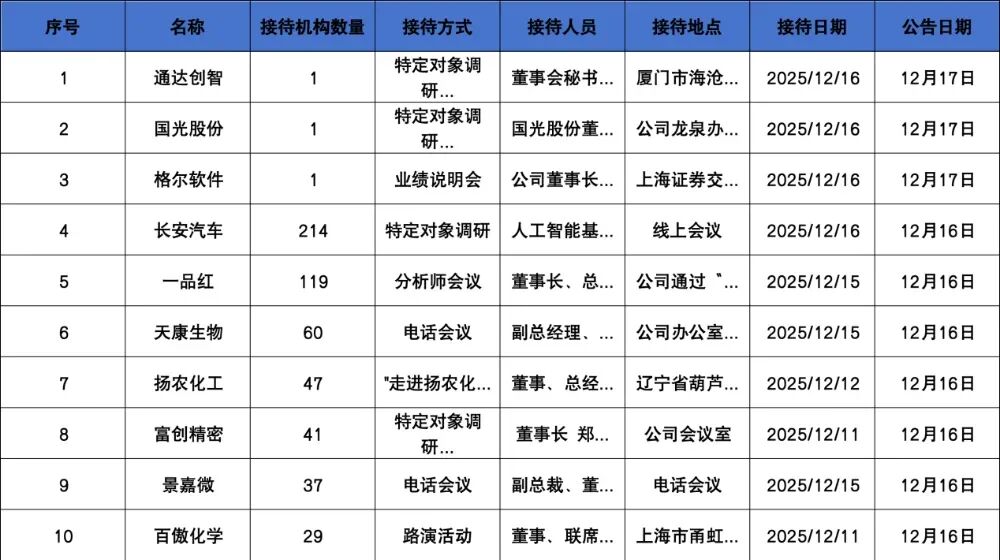
调研汇总:易方达、中欧、富国基金等214家明星机构调研长安汽车!
Xin Lang Cai Jing· 2025-12-17 14:20
| 序号 | 名称 | 接待机构数量 | 接待方式 | 接待人员 | 接待地点 | 接待日期 | 公告日期 | | --- | --- | --- | --- | --- | --- | --- | --- | | 1 | 通达创智 | 1 | 特定对象调 研 ... | 董事会秘书 ... | 厦门市海沧 ... | 2025/12/16 | 12月17日 | | 2 | 国光股份 | 1 | 特定对象调 | 国光股份董 ... | 公司龙泉办 ... | 2025/12/16 | 12月17日 | | | | | 研 ... | | | | | | 3 | 格尔软件 | 1 | 业绩说明会 | 公司董事长 ... | 上海证券交 ... | 2025/12/16 | 12月17日 | | 4 | 长安汽车 | 214 | 特定对象调研 | 人工智能基 ... | 线上会议 | 2025/12/16 | 12月16日 | | 5 | 一品红 | 119 | 分析师会议 | 董事长、总 ... | 公司通过" ... | 2025/12/15 | 12月16日 | | 6 | 天康生物 | 60 | 电话会议 ...
首批L3车型获准上路,自动驾驶“拐点”来了?丨财经早察
2 1 Shi Ji Jing Ji Bao Dao· 2025-12-17 12:44
Core Insights - The first batch of L3 conditional autonomous vehicles in China has received operational permits, marking a significant milestone in the country's autonomous driving era [1] Group 1: Definition and Implications of L3 - L3 level represents conditional automation where the system can fully take over driving tasks in specific scenarios, allowing the driver to temporarily disengage [2] - A key revolutionary aspect of L3 is the shift in responsibility from the driver to the vehicle manufacturer in case of accidents caused by system failures, as per regulations effective in 2025 [2] Group 2: Companies Involved - The first two companies to receive L3 permits are Changan Automobile and BAIC's Arcfox, with Changan focusing on congested scenarios and BAIC targeting high-speed efficient travel [3] - Both companies' vehicles will initially be operated by specific service entities rather than being sold directly to consumers, reflecting a cautious approach by regulatory authorities [3] Group 3: Market Opportunities - The launch of L3 vehicles provides a first-mover advantage for Changan and BAIC, with other manufacturers like BYD, NIO, and GAC likely to accelerate their efforts to obtain similar permits [4] - Transitioning from L2 to L3 involves significant hardware advancements, benefiting core components such as intelligent driving domain controllers and automotive-grade chips [4] - The shift in responsibility will necessitate the development of new insurance products, accident assessment processes, data security regulations, and maintenance systems [4]