
CHANGAN AUTOMOBILE-B(000625)

Search documents
每日收评三大指数震荡反弹小幅收红,海南概念股午后走强,多只高位股尾盘跳水
Sou Hu Cai Jing· 2025-12-19 08:49
Core Viewpoint - The market experienced a rebound with the Shanghai Composite Index rising by 0.36%, the Shenzhen Component Index increasing by 0.66%, and the ChiNext Index up by 0.49%. The trading volume in the Shanghai and Shenzhen markets reached 1.73 trillion, an increase of 704 billion compared to the previous trading day. [1] Market Performance - The market saw rapid rotation of hotspots, with nearly 4,500 stocks rising, although some high-position stocks like Dongbai Group and Pingtan Development faced significant declines towards the end of the trading session. [1] - The Hainan sector surged in the afternoon, with stocks like Hainan Haiyao and Hainan Qiche Group hitting the daily limit. [1][2] - The consumer sector remained strong throughout the day, particularly in retail and dairy, with stocks such as Shanghai Jiubai and Zhuangyuan Pastoral reaching the daily limit. [1][2] Sector Analysis - The Hainan sector is benefiting from the implementation of the Hainan Free Trade Port's full island closure operation, which is expected to attract new industries and increase consumer traffic, providing growth opportunities for businesses in the region. [2] - The consumer sector is supported by recent national policies aimed at expanding domestic demand, which are expected to accelerate the transformation and upgrading of the retail industry. [2] - The smart driving concept stocks saw renewed strength, with companies like Zhejiang Shibao and Luchang Technology hitting the daily limit, following the announcement of the first batch of L3-level conditional autonomous driving vehicle permits by the Ministry of Industry and Information Technology. [3][6] Individual Stock Performance - Over 4,400 stocks closed in the green, with nearly 100 stocks rising over 9%. The consumer sector continued its strong performance, with multiple stocks achieving consecutive limit-ups. [5] - The commercial aerospace sector remained active, with stocks like Xibu Materials and Shenjian Co. also hitting the daily limit, although some popular stocks faced adjustments. [5] Future Market Outlook - The market is expected to face a new round of directional choices, with the Shanghai Composite Index showing relative strength. The focus will be on whether it can maintain its position above the 30-day moving average. [7][8] - Structural opportunities are anticipated, emphasizing the importance of capturing the rotation rhythm among popular themes. [8]



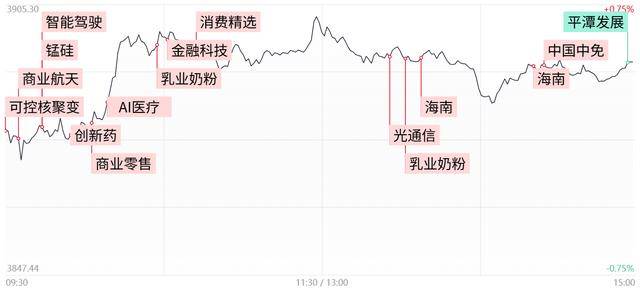
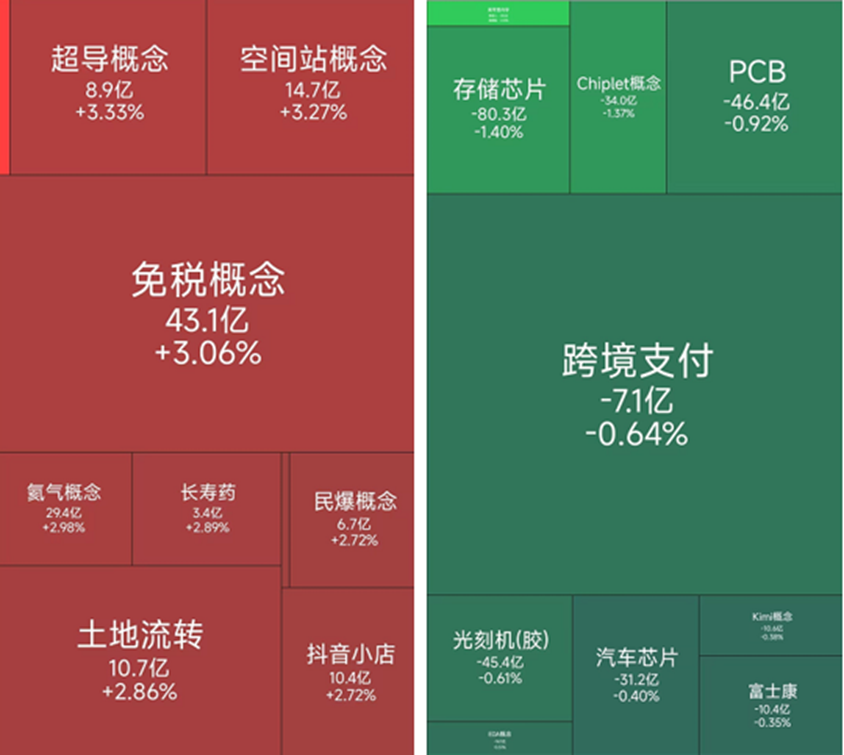
免税概念涨幅居前,19位基金经理发生任职变动
Jin Rong Jie· 2025-12-19 08:24
Market Performance - On December 19, A-shares saw a collective rise in the three major indices, with the Shanghai Composite Index increasing by 0.36% to 3890.45 points, the Shenzhen Component Index rising by 0.66% to 13140.21 points, and the ChiNext Index up by 0.49% to 3122.24 points [1]. Sector Performance - The superconducting concept, duty-free concept, and land transfer sectors performed well, while the storage chip, PCB, and cross-border payment sectors experienced declines [1]. - Specific sector performance included: - Superconducting concept: 8.9 billion with a rise of 3.33% - Duty-free concept: 43.1 billion with a rise of 3.06% - Land transfer: 10.7 billion with a rise of 2.86% - Storage chips: -34.04 billion with a decline of 1.40% - PCB: -80.34 billion with a decline of 1.57% - Cross-border payment: -7.1 billion with a decline of 0.64% [2]. Fund Manager Changes - On December 19, there were 19 fund manager changes, with 10 funds announcing departures involving 6 managers. Reasons for changes included work transitions and product expirations [3][4]. - Notable fund managers included: - Li Xiaoxing from Yinhua Fund, managing assets of 26.145 billion, with a top-performing fund yielding a return of 237.37% over 10 years [4]. - Gao Yuan from Changxin Fund, managing assets of 6.028 billion, with a top-performing fund yielding a return of 207.75% over 7 years [5]. Fund Research Activity - In the past 30 days (November 19 to December 19), 644 fund managers left their positions, with the most active fund company being Bosera Fund, which conducted research on 45 listed companies [6][7]. - The most researched sectors included specialized equipment with 218 instances and consumer electronics with 158 instances [7]. - The most researched stock was Zhongke Shuguang, with 117 fund management companies participating in the research [8]. Recent Research Focus - In the last week (December 12 to December 19), the most researched company was Changan Automobile, with 68 fund institutions conducting research [9].




从“辅助”到“自动”的关键一跃,首批L3级自动驾驶车型获批,车企明确:L2车辆暂无法直接升级
3 6 Ke· 2025-12-19 06:17
12月15日,这份束缚迎来被打破的关键节点——工业和信息化部正式公布我国首批L3级有条件自动驾驶车型准入许可,长安深蓝、北汽极狐各有一款纯 电动轿车入选,分别在重庆、北京的指定区域开启上路试点。 周二早高峰的北京京台高速,阳光刚穿透薄雾,刘磊(化名)的手指已经在方向盘上搭了23分钟。他每天要往返50公里通勤,座驾是2023年购入的搭载 L2级辅助驾驶的轿车——这套能自动跟车、保持车道的系统,曾让他以为"轻松开车"触手可及。但此刻,仪表盘上"请保持注意力"的提示灯第三次亮起, 他不得不挺直腰板,紧盯前方缓行的车流。 上周晚高峰堵在机场北线,L2级辅助驾驶帮忙跟着车,但眼睛得一直盯着,他的手臂僵了一路。刘磊想起手机里刷到的工信部许可两款L3级自动驾驶车 型产品的新闻,屏幕上"特定场景解放双手"的描述让他忍不住多看了两眼。"要是能在拥堵的高速上真正松开方向盘,哪怕只是让我活动下胳膊,都是奢 望成真了。"他心里想。 刘磊的期盼,正是中国数千万L2级辅助驾驶车主的共同心声。按乘联分会近年乘用车销量数据估算,结合中国L2级辅助驾驶超50%的全球第一普及率, 仅近三年累计售出的7000余万辆乘用车中,就有超3500万辆搭载 ...

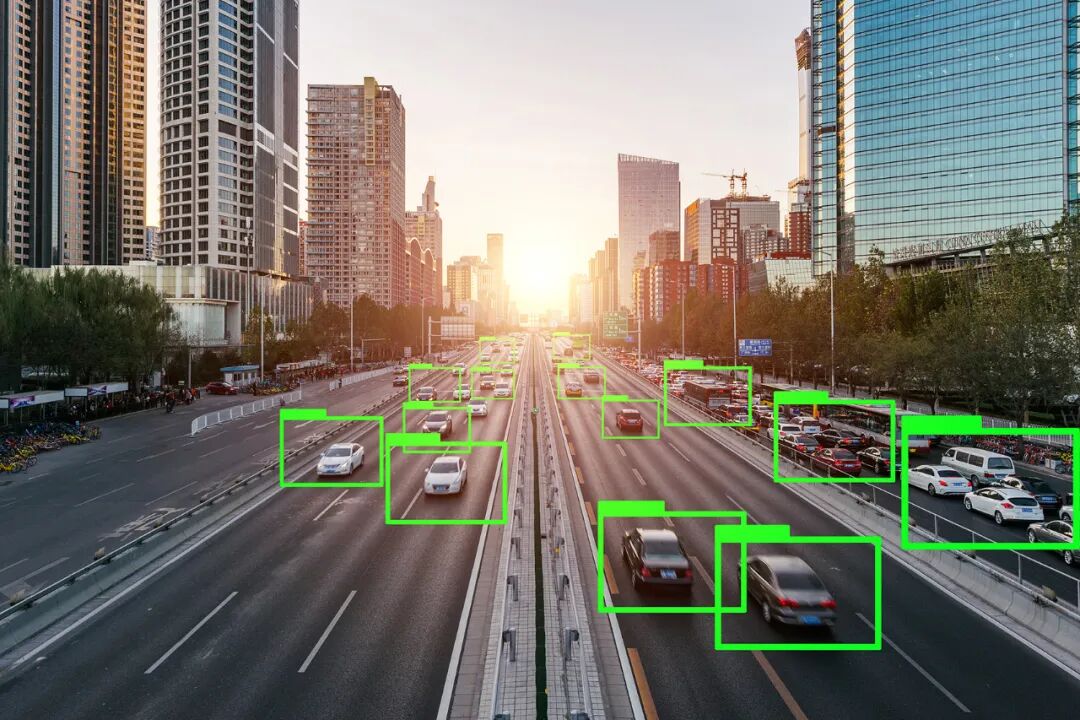
港股智能驾驶概念股集体走强,佑驾创新涨15%
Ge Long Hui· 2025-12-19 02:43
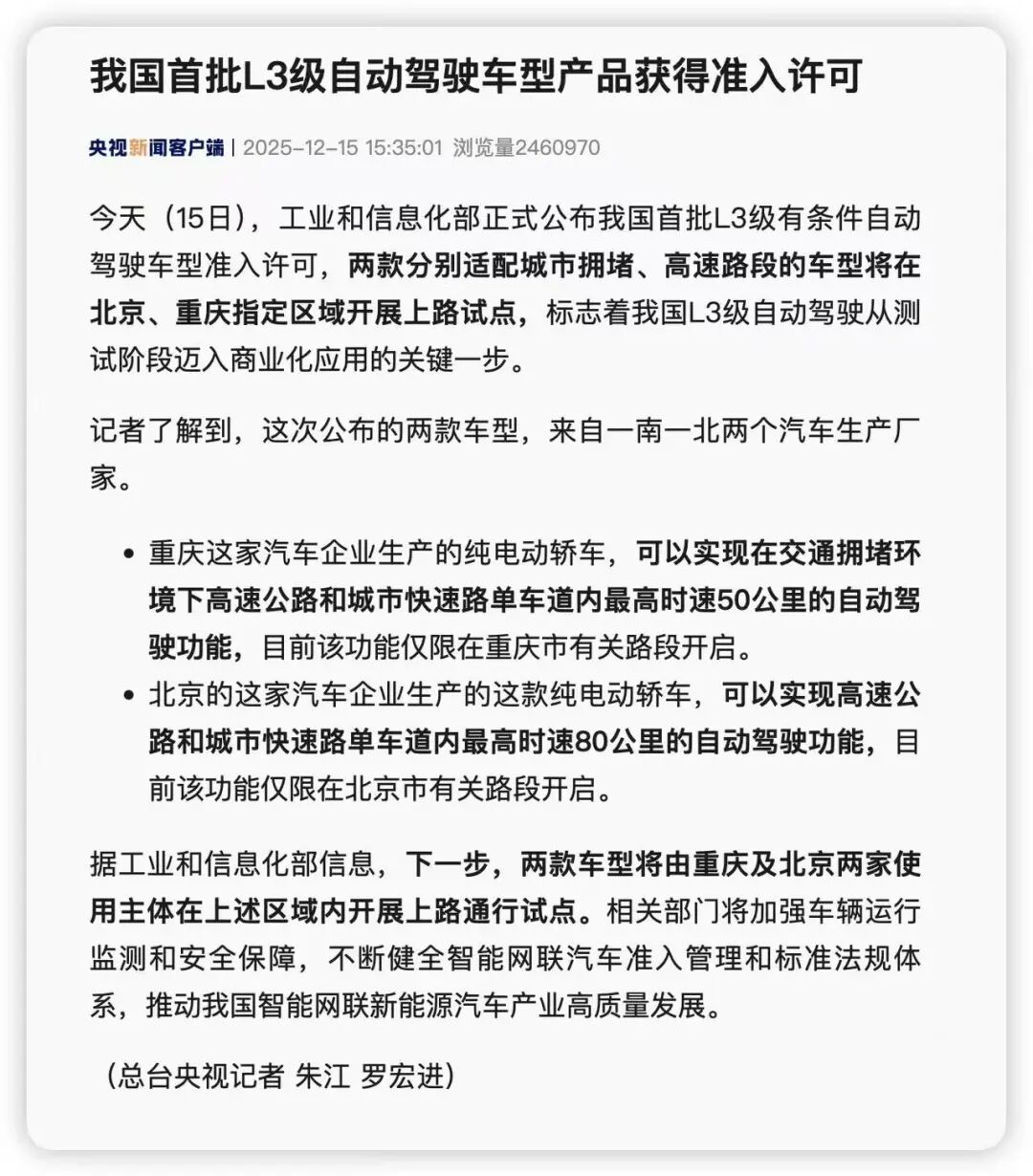
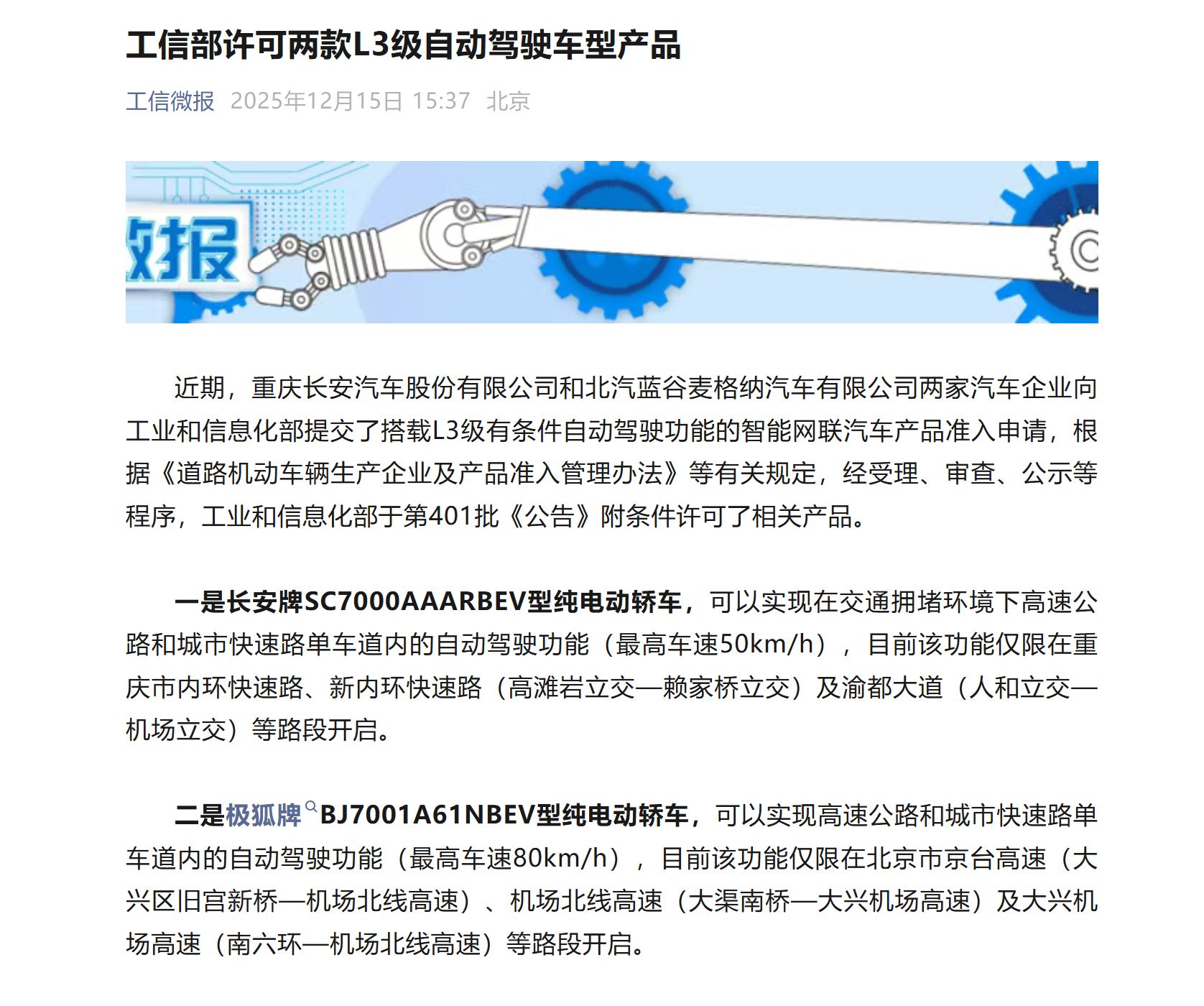
格隆汇12月19日|港股市场智能驾驶概念股集体走强,其中,佑驾创新涨15%,浙江世宝涨近12%,地 平线机器人-W涨7%,小鹏汽车-W、黑芝麻智能涨超4%,速腾聚创、禾赛-W、知行科技涨超3%,小马 智行-W、零跑汽车涨2%。 消息面上,日前,我国首批L3级有条件自动驾驶车型准入许可正式公布,分 别为长安牌SC7000AAARBEV型纯电动轿车和极狐牌BJ7001A61NBEV型纯电动轿车。根据《汽车驾驶 自动化分级》国家标准,L3级自动驾驶属于"有条件自动驾驶",即在特定设计运行条件下,车辆系统可 以完全接管动态驾驶任务,允许驾驶员脱手,但驾驶员仍需保持警觉并随时准备接管。 交银国际指 出,辅助驾驶功能已逐渐成为中国消费者购车决策的重要考量因素,部分车企已具备L3级智驾方案和 L3级车型量产能力。L3级自动驾驶法规的正式落地将成为2026年行业发展的关键催化剂,值得重点跟 踪。 ...
脱手开车不再违法?一次全说清L3落地真相:人人都能开吗?出了事算谁的?...
3 6 Ke· 2025-12-19 02:12
L3自动驾驶终于要来了! 最近,国内汽车圈被一则重磅消息点燃了——工业和信息化部正式公布我国首批L3级有条件自动驾驶车型准入许可。 相信不少人刷新闻也看到了,北汽、长安一南一北俩车企率先拿到"入场券",它们旗下特定的两款车型将在北京、重庆等指定城市区域开展上路试点。 紧接着这两天,问界、小鹏、理想、比亚迪等热门品牌纷纷跟进,自家L3测试车开上马路。 一时间,L3仿佛从遥不可及的技术概念,变成了触手可及的"明日科技",不再是车企在封闭区域里瞎折腾,而是有望大规模上路了! 不过兴奋归兴奋,估计不少人心里也在打鼓:L3到底是啥?开车真能全程脱手不碰方向盘?普通人能开上不?出了事算谁的?那么今天咱就好好捋一 捋,把L3自动驾驶的底细给扒清楚。 政策开闸,北汽长安先上路 而今年12月,就是L3自动驾驶的关键转折点,算是真正迈开了步子。先是传统车企成为第一批吃螃蟹的人,12月15日,长安深蓝与北汽极狐两款L3级有 条件自动驾驶车型上路试点获得批准。 官方公告显示,这两款测试车型对应为极狐阿尔法S(L3版)、长安深蓝SL03。 这次L3的真正到来,算是政策和技术一块儿发力的结果。2023年底的时候,《关于开展智能网联汽车准 ...



11月新能源汽车表现亮眼 | 投研报告
Zhong Guo Neng Yuan Wang· 2025-12-19 02:04
Core Insights - November automotive sales reached 3.429 million units, a year-on-year increase of 3.4%. Cumulative sales from January to November totaled 31.127 million units, reflecting an 11.4% year-on-year growth [1][2] - The comprehensive inventory coefficient for automotive dealers in November was 1.6, up 41.4% year-on-year and 34.2% month-on-month. The inventory warning index stood at 55.6%, an increase of 3.8 percentage points year-on-year and 3 percentage points month-on-month [2] Sales Performance - In November, the sales of new energy vehicles (NEVs) reached 1.823 million units, marking a 20.6% year-on-year increase, with a penetration rate of 53.2%. From January to November, NEV sales totaled 14.78 million units, up 31.2% year-on-year, with a penetration rate of 47.5% [2] Investment Strategy - The automotive sector should focus on undervalued leading companies in vehicle manufacturing and parts due to performance improvements. Key areas of interest include: - Domestic car manufacturers with first-mover advantages in the NEV sector, such as BYD, Changan Automobile, Geely, and Li Auto [3] - Stable performance low-valuation leading parts manufacturers like Huayu Automotive and Fuyao Glass [3] - Core players in the electrification and intelligentization sectors, including Desay SV, Ruikeda, Kobot, and Bertley [3] - Opportunities arising from domestic circulation and local replacements, such as Lingdian Electric Control, Sanhua Intelligent Control, Xingyu Co., and Shangsheng Electronics [3] - Strong vehicle manufacturers driving demand for core components, including Top Group, Wencan Co., and Xusheng Group [3] Market Overview - The automotive sector experienced a weekly change of 0.16%, ranking 9th among 31 sectors. The automotive industry outperformed the CSI 300 index during the week [5] - The weekly performance of major indices was as follows: Shanghai Composite Index -0.34%, CSI 300 -0.08%, Shenzhen Component Index 0.84%, and ChiNext Index 2.74% [5] - In sub-sectors, the weekly performance was: automotive services -5.23%, automotive parts 0.11%, passenger vehicles 0.23%, commercial vehicles 0.25%, and motorcycles and others 1.70% [5] Top Performing Stocks - The top five performing stocks in the automotive sector for the week were: Chaojie Co., Huamao Technology, Yueling Co., Huapei Power, and Zhenghe Industrial [6] Underperforming Stocks - The bottom five performing stocks in the automotive sector for the week were: Xiamen Xinda, Rongtai Co., Longji Machinery, Kailong High-Tech, and Disengli [7]


首批L3级自动驾驶车型获批 车企明确:L2车辆暂无法直接升级
Mei Ri Jing Ji Xin Wen· 2025-12-19 00:50
Core Viewpoint - The approval of the first L3-level conditional autonomous driving models in China marks a significant milestone in the transition from "assisted driving" to "autonomous driving," fundamentally altering the responsibility chain in driving and paving the way for commercial applications in specific scenarios [2][5][9]. Group 1: Market Response - Following the announcement of L3-level model approvals, the capital market reacted swiftly, with several stocks in the intelligent driving sector experiencing significant gains, indicating strong investor interest [4]. - The approval is seen as a leap towards mass production and application of intelligent connected vehicles, reflecting a balance between regulatory oversight and technological advancement [4][17]. Group 2: Technical and Regulatory Developments - The L3-level models approved include Changan's "Deep Blue SL03" and BAIC's "Arcfox Alpha S6 (L3 version)," which will operate in designated areas in Chongqing and Beijing, respectively, under specific speed limits [6][8]. - The transition to L3-level driving involves a shift in responsibility from the driver to the system under certain conditions, a significant change from L2-level systems where the driver retains full responsibility [5][10]. Group 3: Future Projections - Industry experts predict that by 2026, the penetration rate of L3 and above autonomous vehicles could reach 10%, with L3-level vehicles expected to be commercially viable in specific applications such as airport shuttles and campus commuting [5][25]. - The market for Robotaxi services is projected to grow significantly, with estimates suggesting a market size exceeding 2.93 trillion yuan by 2030, driven by advancements in autonomous driving technology [12][24]. Group 4: Technological Innovations - The cost of key components for autonomous driving, such as lidar and AI chips, is decreasing, which is expected to stimulate the entire supply chain and create new business models in the automotive industry [21][24]. - The integration of advanced sensor technologies and AI models is crucial for the development of reliable L3-level autonomous driving systems, with a focus on multi-sensor fusion to handle complex driving environments [26][30]. Group 5: Regulatory Framework - The approval process for L3-level vehicles has been gradual, involving multiple stages of regulatory development and safety assessments, indicating a structured approach to integrating autonomous vehicles into the market [13][15]. - Local regulations, such as those in Beijing and Wuhan, are being established to support the commercialization of L3-level autonomous vehicles, providing a framework for future developments [16][30].
从“辅助”到“自动”的关键一跃!首批L3级自动驾驶车型获批,车企明确:L2车辆暂无法直接升级
Mei Ri Jing Ji Xin Wen· 2025-12-19 00:36
Core Viewpoint - The approval of L3-level conditional autonomous driving vehicles in China marks a significant milestone in the transition from L2-level assistance to true automation, fundamentally altering the responsibility chain in driving and opening new market opportunities for the automotive industry [4][10][19]. Group 1: Market Response and Impact - Following the announcement of L3-level vehicle approvals, the stock market reacted positively, with several companies in the intelligent driving sector experiencing significant stock price increases, indicating strong investor interest [6][19]. - The approval of L3 vehicles is expected to lead to a competitive landscape where companies that can leverage L3 technology will gain a strategic advantage in the automotive market [10][19]. Group 2: Technical Specifications and Regulations - The first two approved L3 vehicles, the Changan Deep Blue SL03 and the BAIC Arcfox Alpha S6, will operate in designated areas with maximum speeds of 50 km/h and 80 km/h respectively, highlighting the initial application of L3 technology in specific scenarios [8][10]. - The L3 technology represents a shift in responsibility from the driver to the system under certain conditions, which is a fundamental change from L2 systems where the driver retains full responsibility [7][10]. Group 3: Future Projections and Industry Trends - Industry experts predict that by 2026, the penetration rate of L3 and above autonomous vehicles could reach 10%, with L2-level vehicles expected to achieve a 70% market penetration [10][27]. - The development of L3 technology is anticipated to create a new market worth trillions, as the industry shifts from selling vehicles to selling mileage, particularly in specific applications like airport shuttles and logistics [26][27]. Group 4: Challenges and Considerations - Despite the advancements, the rollout of L3 vehicles will face challenges, including the need for high-precision infrastructure and regulatory frameworks to ensure safety and operational efficiency [31][32]. - The approval process for L3 vehicles has been gradual, involving extensive testing and regulatory compliance, which underscores the importance of a robust safety and operational framework for the future of autonomous driving [19][28].
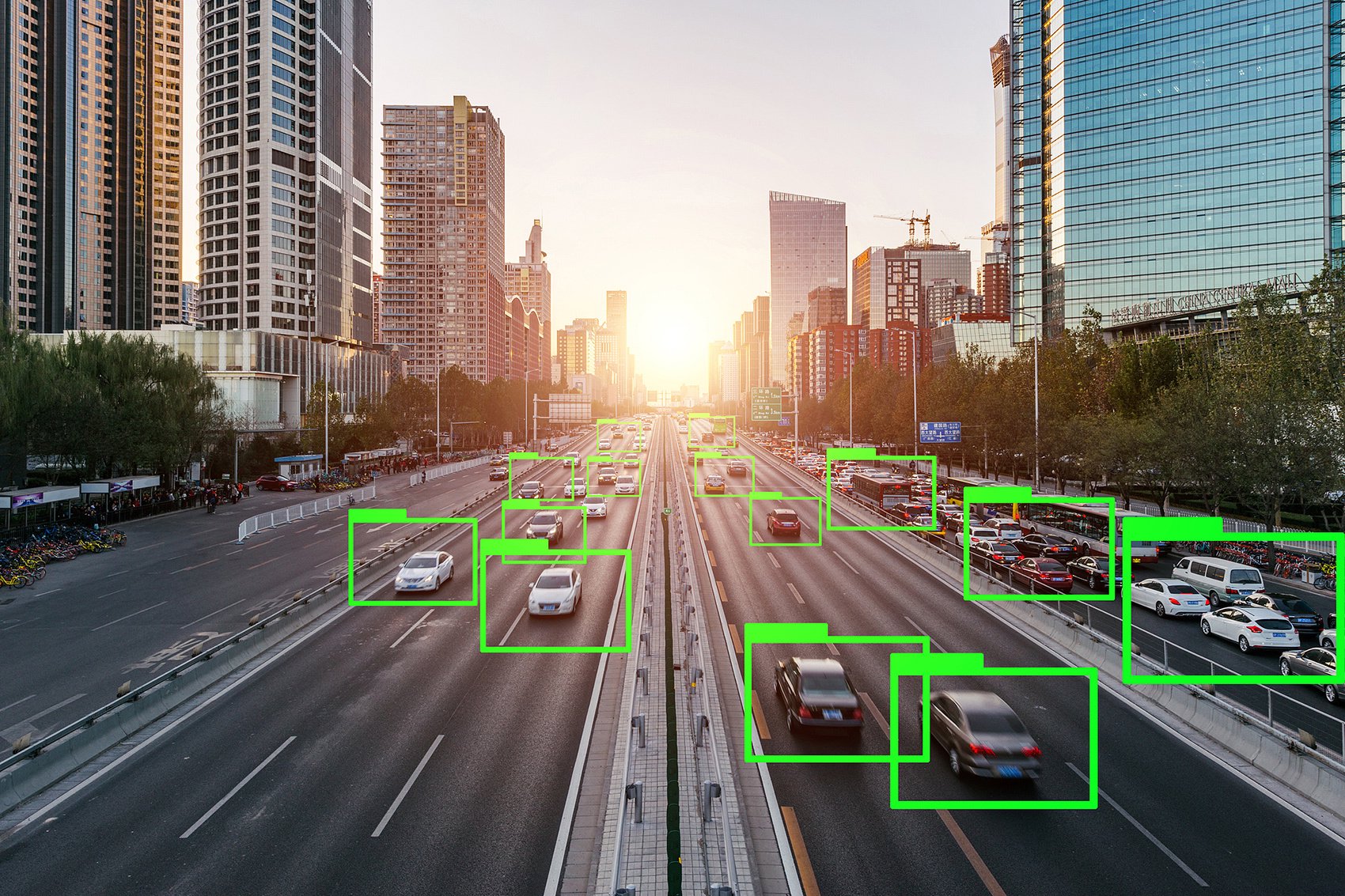
出行观|L3级自动驾驶将进入生活,但行业仍需“谨慎乐观”
Guan Cha Zhe Wang· 2025-12-18 23:49
Core Viewpoint - The approval of L3-level conditional autonomous driving vehicles marks a significant milestone in China's autonomous driving technology, transitioning from testing to mass production [2][3] Group 1: Product Approval - The Ministry of Industry and Information Technology approved two models with L3-level conditional autonomous driving capabilities: Changan Automobile's Deep Blue SL03 and BAIC Group's Arcfox Alpha S6 [2] - The Deep Blue SL03 features Changan's self-developed "Tianshu Intelligent" system, while the Arcfox Alpha S6 is equipped with Huawei's QianKun Intelligent Driving ADS system [2] - This approval indicates that L3-level autonomous driving technology is moving from "test tracks" to "mass production" [2] Group 2: Conditional Nature of L3 - L3 is classified as "conditional autonomous driving," meaning the vehicle can perform all driving tasks under specific conditions, but the driver must be ready to take control when requested [4] - The operational limits for these L3 vehicles include specific urban areas, road types, speed limits, and scenarios, as outlined in the Ministry's announcement [4][5] - For instance, the Deep Blue SL03 can operate in congested traffic on highways and urban expressways at a maximum speed of 50 km/h, while the Arcfox Alpha S6 can do so at up to 80 km/h [4] Group 3: Regulatory and Management Framework - The approval of L3 products necessitates the establishment of a management and regulatory framework to address issues such as traffic responsibility, insurance, and policy integration [6] - The process of validating and refining standards, regulations, and policies will be crucial as L3 vehicles are introduced on the roads [6] - This approval is seen as a "constrained advancement," acknowledging technological progress while setting clear operational boundaries for future advancements in autonomous driving [6] Group 4: Future Outlook - A cautious optimism is suggested regarding the impact of L3 product approval on transportation and industry dynamics, emphasizing the importance of not overestimating its current capabilities [7] - The future of autonomous driving in China will depend on both technological capabilities and the patience to progress step by step [7]
工信部公布首批L3车型准入许可:吹响L3的号角,迎来L4的曙光
GUOTAI HAITONG SECURITIES· 2025-12-18 14:57
Investment Rating - The report indicates a positive outlook for the L3 autonomous driving industry, suggesting a transition towards commercialization and increased market penetration [3][16]. Core Insights - The issuance of conditional permits for the first L3 autonomous vehicles by the Ministry of Industry and Information Technology marks a significant step towards commercial application, with expectations for rapid growth in the smart vehicle penetration rate [3][16]. - The year 2026 is projected to be a pivotal year for autonomous driving, with L4 scenarios beginning to commercialize, indicating a shift in consumer vehicle usage towards robotaxi applications [20][21]. Summary by Sections 1. Approval of L3 Autonomous Vehicle Models - On December 15, the Ministry of Industry and Information Technology granted conditional approval for the first two L3 autonomous vehicle models, specifically Changan and Arcfox brands, with restrictions on driving routes, speeds, and user entities [2][10][15]. 2. L3 Implementation and Industry Benefits - The approval signifies a transition from testing to commercial application, with expectations for increased demand in smart vehicle technologies, including sensors and high-performance driving chips [3][16][19]. - The penetration rate of advanced driver-assistance systems (ADAS) is expected to rise significantly, with projections indicating an increase from approximately 10% to 28.21% by August 2025 [17][19]. 3. Outlook for L4 and Market Expansion - The report anticipates that L4 autonomous driving will begin to see commercial applications in various scenarios by 2026, with significant market opportunities in urban logistics and mining sectors [20][21][26]. - The logistics sector is expected to see a market size of 65.75 billion yuan by 2030, driven by the adoption of logistics unmanned vehicles [21][22]. - The mining sector is projected to exceed 30 billion yuan by 2030, with a compound annual growth rate of 57.4% from 2024 to 2030, highlighting the commercial viability of autonomous solutions in structured environments [26][27].