
ZGXT(000831)

Search documents
稀土大战2.0:中国稀土的3个致命漏洞,这次终于全堵上了
Hu Xiu· 2025-10-21 10:04
Core Viewpoint - The latest rare earth export control policy introduced on October 9 is a significant measure aimed at closing existing loopholes in China's rare earth industry, which have been described as critical and increasingly harmful [1] Group 1 - The article highlights three major illegal gaps in China's rare earth industry that pose serious risks [1] - The new policy is compared to a high-grade concrete that effectively seals these loopholes, indicating a strong regulatory approach [1] - The implications of this policy are said to impact not only the domestic market but also international relations, particularly with the United States [1]

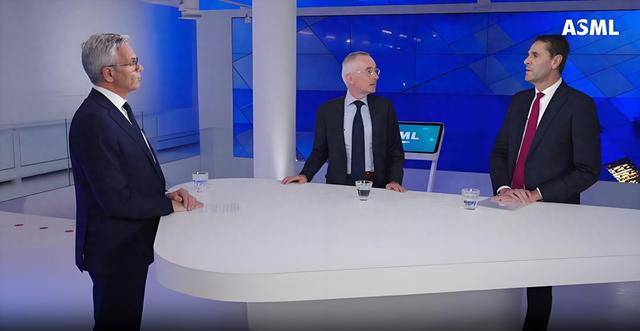
ASML老板突然改口,中国稀土反制击中要害!光刻机战争迎意外转折
Sou Hu Cai Jing· 2025-10-21 08:04
Core Viewpoint - ASML's CEO expressed concerns over China's potential abandonment of its lithography machines and the implementation of rare earth countermeasures, highlighting the intense technological competition between the US and China [1] Group 1: ASML's Concerns - ASML's anxiety stems from recent US regulations that expanded sanctions to subsidiaries controlled by Chinese companies, leading to the freezing of assets of a Chinese semiconductor firm [3] - The Dutch government, feeling supported by the US, took aggressive actions against Chinese investments, underestimating China's ability to retaliate swiftly and effectively [3] Group 2: Impact of Rare Earth Regulations - China announced strict export controls on five types of medium and heavy rare earths, affecting the entire supply chain from mining to manufacturing [3] - ASML's lithography machines require over 10 kilograms of rare earth magnets, with over 90% of these materials sourced from China, leading to a potential production drop of 15-20 machines per month and a loss of up to €3.2 billion annually [5] Group 3: China's Advancements in Lithography Technology - By Q3 2025, China is projected to become ASML's largest customer, with a 42% share of equipment deliveries, despite being blocked from acquiring advanced EUV lithography machines [7] - Chinese companies are making significant strides in developing their own lithography technologies, with local equipment coverage expected to rise from 15% in 2022 to 35% by 2025 [7] Group 4: ASML's Historical Context and Challenges - ASML has been a key player in US-led technology restrictions against China, facing a dilemma between adhering to US regulations and maintaining access to the Chinese market [12] - The company's sales to China peaked at 49% in early 2024 but are expected to drop to 25% by 2025 due to ongoing sanctions, resulting in a projected revenue loss of €2 billion [12] Group 5: Future Dynamics and Industry Implications - The Dutch government has shown signs of softening its stance, seeking negotiations with China, while the automotive industry in Germany expresses significant concern over reliance on Chinese rare earths [14] - The ongoing semiconductor industry struggle reflects a broader battle for control over supply chains, emphasizing the need for cooperation rather than confrontation to ensure sustainable development [15]


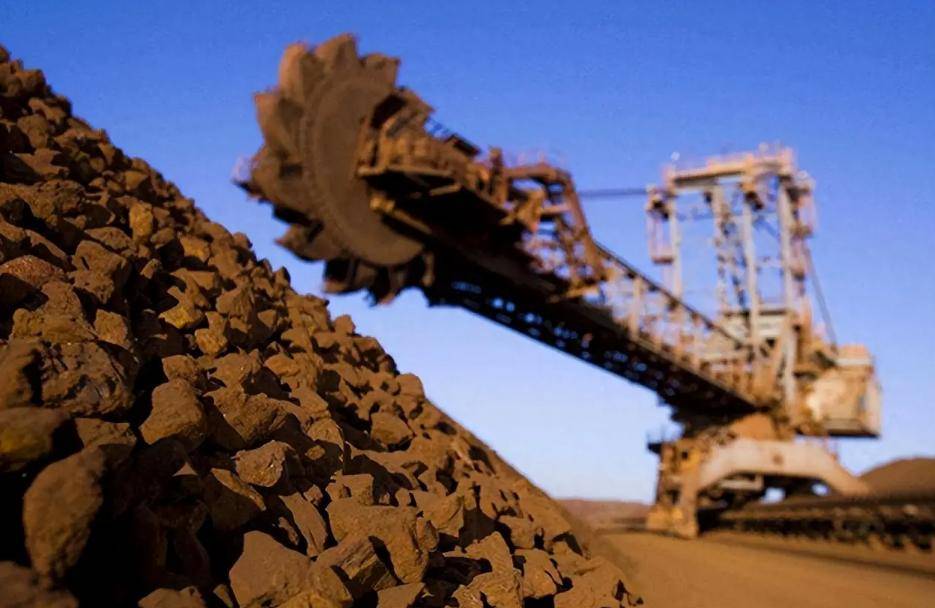
莫迪做出选择,大幅买俄油,还通告全球,绝不将中国稀土卖给美国
Sou Hu Cai Jing· 2025-10-21 07:50
Group 1: Oil Imports and Economic Impact - India's reliance on Russian oil has become more pronounced, with the country increasing its imports despite U.S. pressure, resulting in a nearly 30% reduction in India's trade surplus with the U.S. due to a 50% tariff on Indian goods [5][9] - The average price of oil imported from Russia is $12 per barrel lower than the international market, allowing India to earn an average profit of $89 per ton by refining and reselling it to Western markets, totaling over $6 billion in profits in the first nine months of the year [7][9] - India's private refining companies, such as Reliance Industries, are the primary beneficiaries of this profitable model, which has significantly contributed to the country's energy revenue [7] Group 2: Rare Earth Elements and Strategic Choices - Indian companies have committed to using rare earths sourced from China solely for domestic production, explicitly stating they will not resell to the U.S., indicating a strategic choice amid U.S.-China tensions [3][11] - Approximately 60% of India's rare earth imports come from China, valued at over 3 billion rupees, highlighting India's dependency on Chinese resources for critical manufacturing [11][14] - Despite deepening cooperation with China in rare earths, India is also negotiating with Australia for rare earth mining and plans to invest $2 billion in domestic production capabilities, reflecting a pragmatic approach to balancing relationships [13][14] Group 3: Geopolitical Implications - The U.S. pressure on India to reduce oil imports from Russia has backfired, leading to an increase in Russian oil imports beyond initial plans, demonstrating India's firm stance against external coercion [9][16] - The U.S. military plans have been affected by India's rare earth decisions, with delays in the F-35 upgrade program and a 30% reduction in production at Tesla's Texas factory due to rare earth shortages [11][17] - India's approach of balancing relations with both the U.S. and China, while prioritizing national interests, showcases its traditional strategy of "hedging" in international relations [13][17]
莫迪否认放弃俄油进口,还通告全球,绝不将中国稀土卖给美国
Sou Hu Cai Jing· 2025-10-21 07:16
Core Insights - India's strategic decision to continue importing oil from Russia and halt rare earth exports to the US has garnered global attention, challenging previous commitments made by US President Trump [1][11]. Group 1: Oil Imports from Russia - India has significantly increased its crude oil imports from Russia, defying earlier statements from the US and highlighting its need for energy diversification amid geopolitical tensions in the Middle East [5][6]. - The Indian government is enhancing cooperation with Russia by investing in infrastructure projects, such as modernizing the Murmansk port and expanding the Visakhapatnam port's oil handling capacity, which is expected to increase from 30 million tons to 50 million tons by 2025 [8]. - Plans are underway for joint ventures in natural gas processing, including converting pipeline gas into LNG to meet domestic energy needs [10]. Group 2: Rare Earth Export Policy - India has approximately 36 million tons of identified rare earth reserves, accounting for 6% of the global total, and has shifted its export policy to impose stricter controls on rare earth exports to the US [13][14]. - The new policy includes a suspension of primary rare earth exports to the US and a special licensing system for processed rare earth products, limited to countries with which India has signed technology cooperation agreements [13][14]. - This strategic move aims to enhance India's position in the global value chain and support domestic high-tech industries, with plans to invest $5 billion in five national rare earth processing parks by 2030 [19]. Group 3: International Reactions and Global Impact - The US has expressed strong concerns over India's rare earth export restrictions, indicating potential impacts on its renewable energy and semiconductor supply chains, and has placed India on a "critical rare earth supply chain watch list" [23]. - Russia has welcomed India's increased oil imports, viewing it as a strengthening of bilateral strategic ties, while European nations have expressed worries about the stability of global supply chains [25]. - Southeast Asian countries like Vietnam and Indonesia have shown understanding and support for India's energy cooperation, seeing it as a means to alleviate global market tensions [25]. Group 4: Strategic Considerations - India's export restrictions on rare earths are not merely a response to US demands but are driven by long-term strategic considerations, particularly in light of the growing importance of rare earths in high-tech manufacturing and electric vehicles [17]. - The Indian government aims to leverage these strategic moves to bolster its economic development and energy security while navigating complex international relations [27].
争分夺秒下单稀土!全球车企在中国稀土出口管制之前满世界采购
Zhi Tong Cai Jing· 2025-10-21 07:07
Core Viewpoint - The global automotive industry is facing significant challenges due to China's export controls on rare earth elements, which are critical for various automotive components, particularly in electric vehicles. This situation raises concerns about potential shortages and production halts in the automotive sector [1][6]. Group 1: Supply Chain Concerns - Automotive executives are worried that China's export restrictions could lead to shortages of essential components and factory shutdowns [1]. - China controls approximately 70% of global rare earth mining, 85% of refining capacity, and about 90% of rare earth metal alloys and magnet production [1]. - The new export control list from China includes elements like yttrium, holmium, and europium, which are also used in automotive manufacturing [2]. Group 2: Inventory and Production Challenges - Suppliers are experiencing tight inventory levels, with some reporting that their products are nearly sold out [2]. - Even if new orders are fulfilled before the export controls take effect, shipping delays could exacerbate supply issues, as it takes about 45 days to transport goods to Europe [5]. - The automotive industry is expected to stockpile rare earth materials before the November 8 deadline, but many companies have already depleted their inventories [6]. Group 3: Industry Adaptation and Innovation - Automakers are actively seeking to reduce their dependence on rare earth elements by developing electric motors with low to zero rare earth content [7]. - Companies like General Motors, ZF, and BorgWarner are working on new motor technologies, while BMW and Renault have already produced rare earth-free motors [7]. - Despite these efforts, industry experts indicate that it will take years for these new technologies to be fully implemented, and the plans to develop new rare earth mines and processing facilities outside China face significant challenges [7]. Group 4: Competitive Landscape - The U.S. government is reportedly more focused on the threat posed by China's control over rare earth supplies compared to Europe [7]. - Supply chain experts note that China is likely to continue undercutting competitors on price, making it difficult for automakers to justify the higher costs of rare earth-free components [7]. - The ongoing export controls from China are expected to persist, maintaining the country's dominance in the rare earth market [7].
稀土狂飙,不只是因为“反制”
投中网· 2025-10-21 06:51
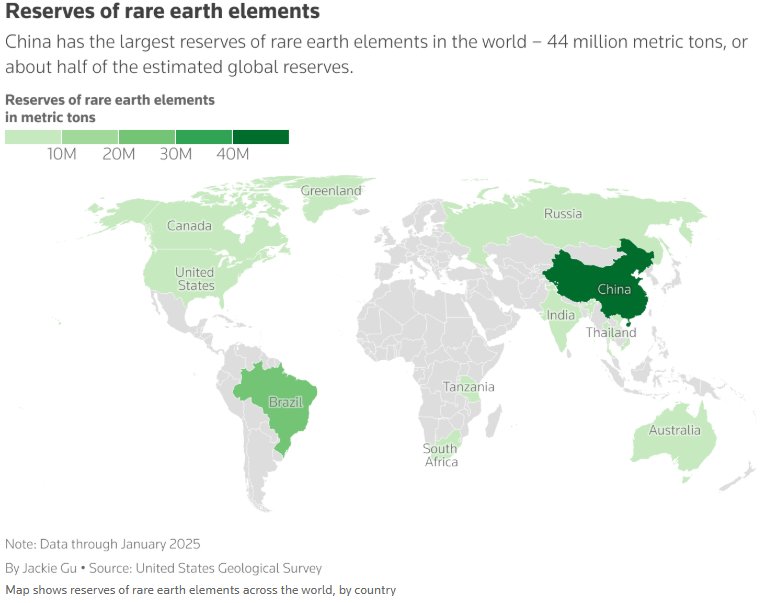
Core Viewpoint - The strategic value of rare earth elements is being highlighted due to China's export controls and policy upgrades, leading to a significant increase in stock prices and overall market performance in the rare earth sector [6][10][12]. Group 1: Market Performance - Shenghe Resources (600392.SH) saw its stock price rise by 5.04% to 26.26 yuan, with a year-to-date increase of 155.45% [6]. - The rare earth index (8841089.WI) has increased by 118.86% year-to-date, with five out of seven stocks in the sector doubling in value [6][10]. - On October 9, the rare earth sector surged by 7.97%, followed by a 9.49% increase on October 13, with several stocks recording over 110% gains [10][11]. Group 2: Supply and Demand Dynamics - China's rare earth reserves account for approximately 48% of the global total, with a production capacity of about 27,000 tons, representing nearly 70% of global output [8][9]. - The recent export controls by China, which include restrictions on key technologies and production lines, have tightened global supply and increased the strategic importance of rare earths [9][13]. - The demand for rare earths is expected to grow significantly, particularly in sectors like electric vehicles and renewable energy, with projections indicating a need for 3-5 kg of rare earth permanent magnets per electric vehicle [14][15]. Group 3: Price Trends - The price index for rare earths has been on an upward trend, with light rare earths like praseodymium and neodymium increasing from approximately 440,000 yuan/ton to 562,000 yuan/ton, a rise of about 27.7% [15]. - Heavy rare earths, such as dysprosium oxide, have seen even more dramatic increases, with prices soaring from around 830,000 yuan/ton to 2.6 million yuan/ton, marking a 212% increase [15]. - Recent announcements from companies like Northern Rare Earth and Baotou Steel have indicated continuous price increases for rare earth concentrates, reflecting ongoing supply constraints [17][19]. Group 4: Company Performance - In 2023, several rare earth companies are showing signs of recovery, with five out of seven companies reporting revenue growth in the first half of the year [21]. - Northern Rare Earth reported a revenue of 188.66 billion yuan in the first half of the year, with a net profit increase of 45.24% [22]. - Shenghe Resources anticipates a net profit of 740 million to 820 million yuan for the first nine months of the year, representing a growth of 696.82% to 782.96% [23]. Group 5: Future Outlook - Industry experts predict that while short-term fluctuations may occur, the mid-term price center for rare earths is likely to rise due to tightening supply and increasing strategic value [26]. - Analysts suggest that the recent export control measures will likely lead to price increases, particularly for light rare earth products, while cautioning about potential overvaluation of stocks in the sector [25][27].



稀土板块催化不断,稀土ETF嘉实(516150)近7天获得连续资金净流入,规模再创新高!
Sou Hu Cai Jing· 2025-10-21 02:38
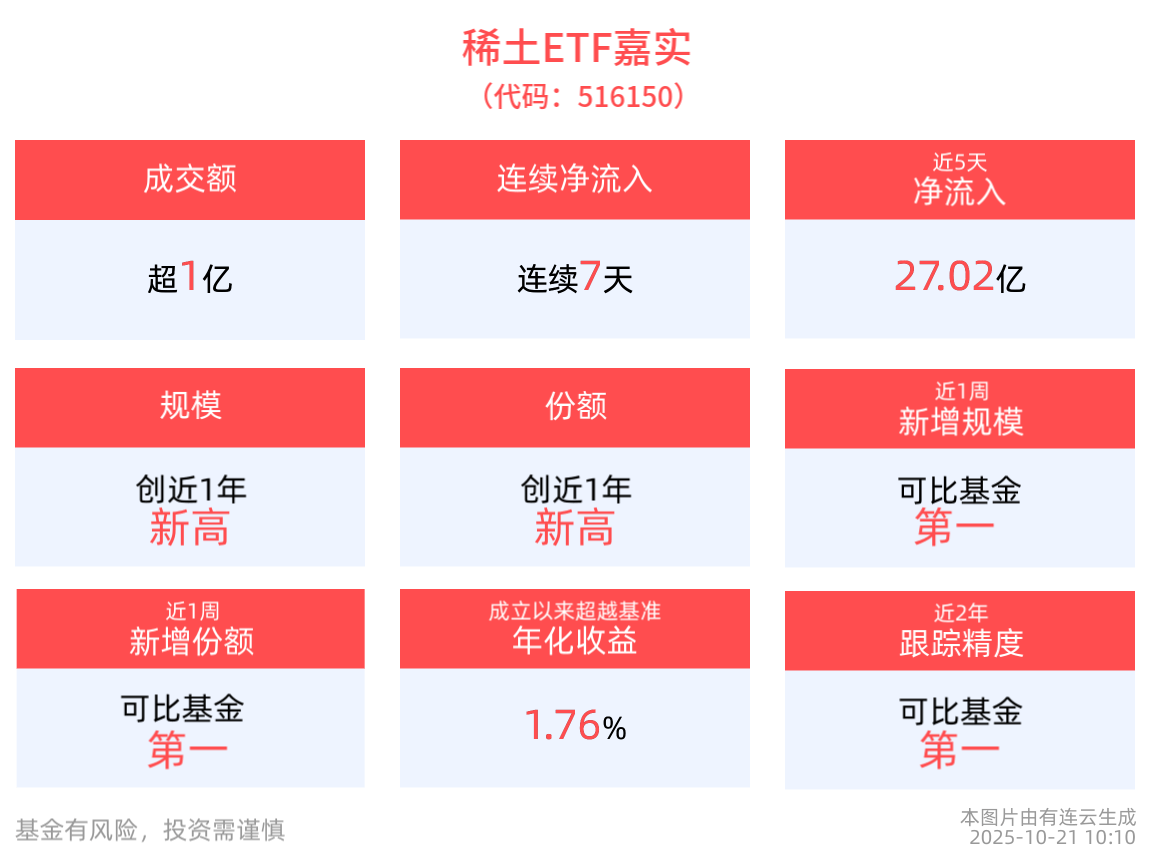
Group 1: Market Performance - The liquidity of the Rare Earth ETF managed by Jiashi has a turnover rate of 1.61%, with a transaction volume of 1.74 billion yuan [2] - The latest scale of the Rare Earth ETF reached 108.04 billion yuan, marking a new high since its establishment and ranking first among comparable funds [2] - The latest share count of the Rare Earth ETF is 6.034 billion shares, also a new high since its inception, and ranks first among comparable funds [2] - Over the past 7 days, the Rare Earth ETF has seen continuous net inflows, with a maximum single-day net inflow of 1.184 billion yuan, totaling 3.405 billion yuan [2] - As of October 20, the net value of the Rare Earth ETF has increased by 88.93% over the past two years, ranking 59th out of 2358 index equity funds, placing it in the top 2.50% [2] - The highest monthly return since the establishment of the Rare Earth ETF is 41.25%, with the longest consecutive monthly increase being 4 months and the longest increase percentage being 83.89% [2] Group 2: Industry Developments - On October 19, Tianhe Magnetic Materials announced plans to invest 850 million yuan in a project for high-performance rare earth permanent magnets and related equipment in Baotou City [3] - Northern Rare Earth and Baotou Steel announced an increase in rare earth prices for the fourth quarter of 2025 [3] - In September, the export of rare earths and related products reached 10,538 tons, a year-on-year increase of 7.6%, with a cumulative export of 95,875 tons from January to September, up 3.1% year-on-year [3] - The Ministry of Commerce of China issued two announcements on October 9 regarding rare earth export controls, indicating that products containing Chinese-origin rare earths valued at 0.1% or more may be subject to export restrictions [3] - The new regulations on rare earths are seen as a necessary response in the context of global supply chain competition, following similar measures for gallium and germanium [3] - It is recommended to focus on investment opportunities along the "resources + growth" dual lines, considering the potential impact of regional politics and export policies from major resource countries [3]



印度签署停售美国证明,中国稀土流向管理升级引发国际资源博弈
Sou Hu Cai Jing· 2025-10-20 18:17
Core Viewpoint - The narrative surrounding China's rare earths is shifting from quantity and export quotas to the management of material flow, emphasizing the destination of resources rather than just the amount sold [2][4]. Group 1: Changes in Resource Management - The focus has transitioned from "how much" to "where it goes," with China asserting its authority not only in production and export but also in tracing the final destination of materials through legally binding end-user certifications [2][4]. - End-user certification is a crucial part of the export compliance system, aimed at defining the actual use of buyers and preventing re-exportation [4][13]. - This new flow management approach is likened to a detailed network, making it difficult for critical resources to be diverted unnoticed [4][14]. Group 2: Importance of Heavy Rare Earths - Heavy rare earths, particularly permanent magnets, are highlighted as key components in high-performance motors and electric vehicle drive systems, making control over their supply critical for the new energy vehicle and high-end manufacturing industries [6][15]. - The engineering parameters of these materials can significantly impact product lines, underscoring their strategic importance [7][15]. Group 3: India's Strategic Dilemma - India faces a contradiction between its desire for strategic autonomy and its reliance on Chinese rare earths, especially in high-performance electric motor and vehicle supply chains [8][9][16]. - The decision by Indian companies to sign end-user certifications reflects a pragmatic approach to ensure continuity in supply chains, acknowledging the risks of production line disruptions [11][16]. Group 4: Challenges in Domestic Production - Despite having rare earth mines, India struggles with establishing a self-sufficient supply chain due to high technical, financial, and environmental barriers [12][18]. - The complexity of the rare earth production process requires significant time and investment, making rapid self-sufficiency unrealistic [12][18]. Group 5: Implications of End-User Certification - The explicit terms of the end-user certification, particularly the prohibition against resale to the U.S., create a structured boundary in the context of U.S.-China competition, effectively acting as a non-tariff barrier [13][19]. - This flow management strategy is more refined than traditional quotas, allowing for precise control over resource distribution [14][19]. Group 6: Future Pathways - Three potential developments are anticipated: India accelerating its domestic rare earth industry, China maintaining its global supply dominance, and industries exploring alternative materials and processes [18]. - India's dependency on Chinese rare earths is expected to persist in the short term, influencing its geopolitical decision-making [18].
高盛:中国稀土优势短期难以撼动,特朗普11月1日加征100%关税概率很低
Zhi Tong Cai Jing· 2025-10-20 14:16
Core Insights - Goldman Sachs released a research report addressing the recent concerns in financial markets regarding rare earths and tariffs, asserting that China's dominance in the rare earth sector is unlikely to be challenged in the short term and predicting a low probability of the 100% tariff being implemented after the APEC meeting [1] Group 1: China's Rare Earth Export Control - The recent expansion of China's rare earth export controls is a response to the U.S. broadening its "entity list/military end-user list" definition, which now includes a "50% ownership rule" that significantly increases the compliance burden on Chinese companies' trade partners [2] - The new U.S. regulations are seen as a major expansion of export control laws, particularly impacting Chinese enterprises, as evidenced by the Dutch government's takeover of a Chinese-controlled semiconductor company [2] Group 2: Impact on Other Asian Economies - The impact of China's export controls on other Asian economies is expected to be precise and not generalized, with China indicating it will issue export licenses for civilian uses of rare earths while rejecting military-related applications [3] - If China limits rare earth supplies specifically for U.S. defense equipment, the economic impact on Asian economies will be minimal, as their defense-related exports to the U.S. account for less than 0.1% of GDP [4] Group 3: China's Dominance in the Rare Earth Market - China maintains a strong dominance in the rare earth market, controlling key stages of the supply chain, including mining, refining, and manufacturing of rare earth permanent magnets [5] - The U.S. government has invested in expanding its rare earth production capabilities, but these facilities are not expected to be operational until after 2028, leaving China with significant bargaining power in the short term [5] Group 4: Potential Impact of U.S. Tariffs - An increase in tariffs by 20% is estimated to reduce China's GDP by approximately 0.7 percentage points, with the impact of tariffs being non-linear [6] - The high dependency of U.S. importers on Chinese rare earth supplies means that even with significant price increases, it would be challenging for them to quickly switch suppliers [7] Group 5: Possible Paths to De-escalation - Three potential paths for de-escalation exist, though their feasibility varies: unilateral concessions from China, U.S. concessions in exchange for a pause in Chinese controls, or both parties escalating measures to gain negotiation leverage [8] Group 6: Key Upcoming Dates - Key dates to watch include the APEC meeting from October 31 to November 1, where a meeting between U.S. and Chinese leaders may occur, and the deadline for the implementation of U.S. tariffs on November 1 [9]
中国稀土:现阶段,公司稀土萃取分离等工艺过程中暂不涉及聚乙二醇的运用
Zheng Quan Ri Bao Wang· 2025-10-20 09:13
Core Viewpoint - China Rare Earth (000831) stated on October 20 that the company currently does not utilize polyethylene glycol in its rare earth extraction and separation processes [1] Group 1 - The company is actively engaging with investors through interactive platforms [1] - The current processes of the company do not involve the application of polyethylene glycol [1]