
WLY(000858)

Search documents
老登们的社交货币全崩了
3 6 Ke· 2025-11-05 10:29
Group 1: Market Overview - The Shanghai Composite Index is challenging the 4000-point mark, but the market remains highly differentiated, particularly in the traditional high-end consumption sector represented by liquor, which has been stagnant for a long time [1][4] - Limited market funds seem to have completely abandoned the shift from technology stocks back to traditional consumer stocks, although some investors are still betting on liquor stocks for a brighter future [1][4] - The liquor sector experienced a significant surge despite the historical negative news from Wuliangye, reflecting an optimistic investment sentiment that the bottom has been established [1][4] Group 2: Liquor Industry Performance - The liquor industry reported its worst third-quarter results in history, with 18 listed companies achieving a total revenue of 317.66 billion yuan, a year-on-year decline of 5.84%, and a net profit of 122.69 billion yuan, down 6.88% [5][4] - The third quarter saw a dramatic revenue drop of 18.42% and a net profit decline of 22.03%, significantly worse than the average decline in the first three quarters [5][4] - Even leading companies like Kweichow Moutai reported a third-quarter revenue growth rate of only 0.56% and a net profit growth rate of 0.48%, marking their lowest growth rates in recent years [8][9] Group 3: Kweichow Moutai's Challenges - Kweichow Moutai is facing severe operational issues, with its flagship product's price dropping below 1700 yuan, a significant decline during peak consumption seasons [9][8] - The traditional distribution model is under pressure as the company shifts towards direct sales and e-commerce platforms, disrupting the traditional dealer system [9][12] - The liquor industry's long-standing "strong factory, weak dealer" situation is being challenged as the market dynamics shift [11][12] Group 4: Tea Industry Developments - In contrast to the liquor sector, the high-end tea industry has seen positive developments, with Baima Tea successfully listing on the Hong Kong Stock Exchange, achieving an 86.7% increase on its first trading day [13][15] - Baima Tea aims to address industry pain points through brand upgrading and digitalization, although its performance has shown signs of slowing growth [15][13] - The high-end tea market is characterized by a complex relationship between product value and social connections, with the actual value often tied to the networking opportunities it provides [16][15] Group 5: Traditional Chinese Medicine - The traditional Chinese medicine sector, represented by Pian Zai Huang, reported its worst performance in history, with a revenue of 7.442 billion yuan, down 11.93%, and a net profit of 2.129 billion yuan, down 20.74% [19][22] - The market price of Pian Zai Huang has significantly dropped, reflecting a broader decline in the perceived value of high-end medicinal products [22][23] - The changing social dynamics and consumer preferences are leading to a reevaluation of the value of traditional high-end products like liquor and medicine [24][25]




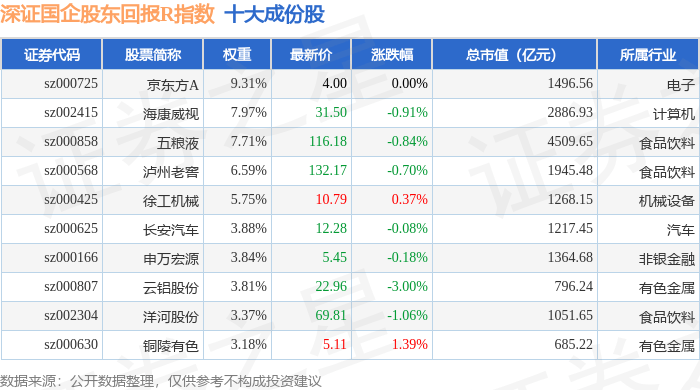
11月5日深证国企股东回报R(470064)指数跌0.32%,成份股云铝股份(000807)领跌
Sou Hu Cai Jing· 2025-11-05 10:15
Core Points - The Shenzhen State-Owned Enterprises Shareholder Return Index (470064) closed at 2257.45 points, down 0.32%, with a trading volume of 24.053 billion yuan and a turnover rate of 0.97% [1] - Among the index constituents, 27 stocks rose while 22 stocks fell, with Beixin Building Materials leading the gainers at 2.45% and Yun Aluminum leading the decliners at 3.0% [1] Index Constituents Summary - The top ten constituents of the Shenzhen State-Owned Enterprises Shareholder Return Index include: - BOE Technology Group (9.31% weight, latest price 4.00 yuan, market cap 149.656 billion yuan) in the electronics sector - Hikvision (7.97% weight, latest price 31.50 yuan, market cap 288.693 billion yuan) in the computer sector - Wuliangye Yibin (7.71% weight, latest price 116.18 yuan, market cap 450.965 billion yuan) in the food and beverage sector - Luzhou Laojiao (6.59% weight, latest price 132.17 yuan, market cap 194.548 billion yuan) in the food and beverage sector - Xugong Machinery (5.75% weight, latest price 10.79 yuan, market cap 126.815 billion yuan) in the machinery equipment sector - Changan Automobile (3.88% weight, latest price 12.28 yuan, market cap 121.745 billion yuan) in the automotive sector - Shenwan Hongyuan (3.84% weight, latest price 5.45 yuan, market cap 136.468 billion yuan) in the non-banking financial sector - Yun Aluminum (3.81% weight, latest price 22.96 yuan, market cap 79.624 billion yuan) in the non-ferrous metals sector - Yanghe Brewery (3.37% weight, latest price 69.81 yuan, market cap 105.165 billion yuan) in the food and beverage sector - Tongling Nonferrous Metals (3.18% weight, latest price 5.11 yuan, market cap 68.522 billion yuan) in the non-ferrous metals sector [1] Capital Flow Summary - The net outflow of main funds from the index constituents totaled 1.125 billion yuan, while speculative funds saw a net inflow of 243 million yuan and retail investors saw a net inflow of 882 million yuan [3] - Detailed capital flow for selected stocks includes: - Tongling Nonferrous Metals: main net inflow of 88.024 million yuan, speculative net outflow of 53.924 million yuan, retail net outflow of 34.100 million yuan - Luzhou Laojiao: main net inflow of 57.790 million yuan, speculative net outflow of 22.566 million yuan, retail net outflow of 35.224 million yuan - Beixin Building Materials: main net inflow of 56.578 million yuan, speculative net outflow of 24.593 million yuan, retail net outflow of 31.985 million yuan [3]




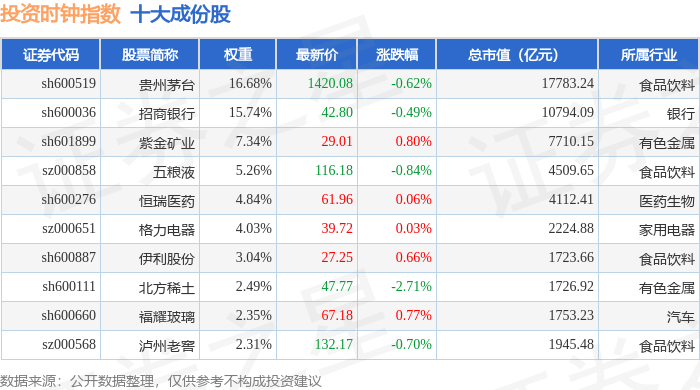
11月5日投资时钟(399391)指数涨0.03%,成份股国城矿业(000688)领涨
Sou Hu Cai Jing· 2025-11-05 09:55
Market Overview - The Investment Clock Index (399391) closed at 3348.13 points, up 0.03%, with a trading volume of 78.792 billion yuan and a turnover rate of 0.81% [1] - Among the index constituents, 71 stocks rose while 28 stocks fell, with Guocheng Mining leading the gainers at a 9.42% increase and Dalian Shengya leading the decliners at a 9.99% decrease [1] Top Constituents - The top ten constituents of the Investment Clock Index are as follows: - Kweichow Moutai (sh600519) holds a weight of 16.68% and closed at 1420.08 yuan, down 0.62% with a market cap of 1778.324 billion yuan [1] - China Merchants Bank (sh600036) has a weight of 15.74%, closing at 42.80 yuan, down 0.49% with a market cap of 1079.409 billion yuan [1] - Yunnan Tin Company (sh601899) has a weight of 7.34%, closing at 29.01 yuan, up 0.80% with a market cap of 771.015 billion yuan [1] - Wuliangye Yibin (sz000858) has a weight of 5.26%, closing at 116.18 yuan, down 0.84% with a market cap of 450.965 billion yuan [1] - Hengrui Medicine (sh600276) has a weight of 4.84%, closing at 61.96 yuan, up 0.06% with a market cap of 411.241 billion yuan [1] - Gree Electric Appliances (sz000651) has a weight of 4.03%, closing at 39.72 yuan, up 0.03% with a market cap of 222.488 billion yuan [1] - Yili Industrial Group (sh600887) has a weight of 3.04%, closing at 27.25 yuan, up 0.66% with a market cap of 172.366 billion yuan [1] - Northern Rare Earth (sh600111) has a weight of 2.49%, closing at 47.77 yuan, down 2.71% with a market cap of 172.692 billion yuan [1] - Fuyao Glass (sh600660) has a weight of 2.35%, closing at 67.18 yuan, up 0.77% with a market cap of 175.323 billion yuan [1] - Jilin Chemical (sz000568) has a weight of 2.31%, closing at 132.17 yuan, down 0.70% with a market cap of 194.548 billion yuan [1] Capital Flow - The net outflow of main funds from the index constituents totaled 677 million yuan, while retail investors saw a net inflow of 708 million yuan [3] - Detailed capital flow for selected stocks includes: - China Zhongjin (601888) saw a main fund net inflow of 36.4 million yuan, while retail funds had a net outflow of 93.414 million yuan [3] - Jiangxi Copper (600362) had a main fund net inflow of 18.2 million yuan, with retail funds experiencing a net outflow of 70.3612 million yuan [3] - Weichai Power (000338) had a main fund net inflow of 13.5 million yuan, while retail funds had a net inflow of 1.60758 million yuan [3] - Giant Network (002558) had a main fund net inflow of 11.8 million yuan, with retail funds experiencing a net outflow of 65.0268 million yuan [3] - China Coal Energy (601898) had a main fund net inflow of 11.7 million yuan, while retail funds had a net outflow of 79.0666 million yuan [3]




五粮液们的雷,彻底爆了!
商业洞察· 2025-11-05 09:23
Core Viewpoint - The article highlights the severe financial downturn of major Chinese liquor companies, particularly Wuliangye, which has experienced unprecedented revenue and profit declines, signaling a significant shift in the industry landscape [5][25]. Financial Performance Summary - Major liquor companies reported disappointing third-quarter results, with Wuliangye's revenue plummeting by 52.66% year-on-year to 81.74 billion yuan, marking its largest quarterly decline since its listing [6][8]. - Wuliangye's net profit fell by 65.62% to 20.19 billion yuan, with a net profit margin dropping from 38.2% to 24.7%, the lowest in nearly a decade [9][12]. - Other companies like Yanghe and Kweichow Moutai also reported significant declines, with Yanghe posting a loss and Kweichow Moutai's profit growth slowing to just 0.48% [5][6]. Internal and External Challenges - The decline in Wuliangye's performance is attributed to a combination of internal mismanagement and external market pressures, creating a "perfect storm" for the company [11][12]. - Wuliangye's strategy of channel inventory pressure led to excessive stock levels, with inventory reaching 5-6 months, forcing distributors to sell at a loss [12][14]. - The company's reliance on a single product line, "Pu Wu," which accounts for over 60% of its revenue, has become a vulnerability in a declining market [16][17]. Market Dynamics and Consumer Behavior - The ongoing "strict ban on alcohol" has severely impacted the consumption of high-end liquor, particularly in government and business settings, which were previously significant revenue drivers [18][22]. - Younger consumers are increasingly turning away from traditional liquor, favoring alternative beverages, which poses a long-term threat to the industry [21][22]. - Economic downturns have led to reduced discretionary spending, further diminishing the market for luxury alcohol products [22][23]. Strategic Implications - The article suggests that the era of relying on channel inventory and government consumption for growth is over, necessitating a reevaluation of business strategies within the industry [25][31]. - Wuliangye's announcement of a significant mid-term dividend aims to stabilize investor confidence, but it may not address the underlying issues of market share and brand reputation [26][27]. - The industry must adapt to changing consumer preferences and economic realities to survive, focusing on rebuilding trust and understanding new consumer demographics [31][32].

五粮液布局储能!
鑫椤锂电· 2025-11-05 07:41
Core Insights - The article discusses the tender announcement for the Wuliangye Industrial Park energy storage station project, which is being managed by Sichuan Zhongxin Green Energy Co., Ltd. [1][3] Project Overview - The project is located adjacent to the Jiusheng 110kV substation and involves the construction of a 10MW/20MWh centralized electrochemical energy storage system [1][3] - The system will utilize two 5.015MWh lithium iron phosphate battery units and two 5000kW 10kV energy storage conversion and boosting units [1][3] - The estimated total investment for the project is 16 million yuan [3] Company Background - Sichuan Zhongxin Green Energy Co., Ltd. was established in August 2023 as a joint venture between Wuliangye Group's subsidiary, Sichuan Wuliangye New Energy Investment Co., Ltd., which holds a 51% stake, and China Petroleum, which holds a 49% stake [1][3]
2025中国白酒酒业市场中期研究报告
Sou Hu Cai Jing· 2025-11-05 05:52
Core Insights - The Chinese liquor industry is undergoing a significant transformation, facing challenges such as declining production and prices, while also experiencing new opportunities driven by consumer trends and digitalization [1][6][14] Group 1: Market Performance (2024-2025) - In 2024, the number of large-scale liquor enterprises decreased to 989, with total production at 4.145 million kiloliters, a year-on-year decline of 1.8%. However, sales revenue reached 796.38 billion yuan, up 5.3%, and total profit increased by 7.8% to 250.87 billion yuan, indicating a shift from extensive to intensive development [2][16] - The top six brands (CR6) accounted for 86% of the industry's total profit in 2024, up from 55% in 2014, highlighting a growing concentration in the market [2][20] - In the first quarter of 2025, the industry faced further pressure with production down 7.2% year-on-year to 1.032 million kiloliters, marking a potential eighth consecutive year of decline [3][26] Group 2: Consumer Trends and Pricing - The first half of 2025 saw a significant shift in consumer behavior, with only 26.9% of distributors reporting increased sales before the Spring Festival, dropping to 11.5% during the May Day holiday [4] - The price range of 100-300 yuan became the most active market segment, while higher price segments faced significant challenges, with the price of premium brands like Moutai dropping over 36% since 2022 [4][6] - Young consumers are increasingly defining value in the liquor market, prompting companies to innovate product designs and marketing strategies to attract this demographic [5][6] Group 3: Industry Challenges - The industry is experiencing a "volume and price decline" scenario, with over 59.7% of liquor companies reporting reduced operating profits due to rising costs and declining sales [3][34] - The average inventory turnover days reached 900, a 10% increase year-on-year, indicating high inventory pressure and a widespread issue of price inversion affecting 60% of companies [23][34] - The overall market is characterized by a cautious consumer sentiment, with many companies resorting to discounts and bundled sales to maintain market share, further squeezing profit margins [3][34] Group 4: Future Outlook - The report suggests that 2025 presents a strategic opportunity for the liquor industry to achieve high-quality development despite short-term challenges, focusing on product innovation, digital transformation, and cultural marketing [6][14] - The industry is expected to transition from "scale growth" to "value growth," with a focus on enhancing product quality and consumer experience [6][14]



史上最长春节假期+免税新政刺激,旅游ETF逆势上涨1%
Ge Long Hui A P P· 2025-11-05 02:13
Core Viewpoint - Global stock markets experienced a decline, while A-shares in the retail and duty-free sectors saw gains, driven by new government policies aimed at boosting consumption and an extended holiday period for the 2026 Spring Festival [1] Group 1: Market Performance - A-shares in the retail and duty-free sectors showed positive performance, with Hainan Airport rising by 6% and China Duty Free Group increasing by 3.71% [1] - The tourism ETF rose by 1%, while the largest food and beverage ETF increased by 0.18% [1] Group 2: Policy Changes - The Ministry of Finance and four other departments issued a notice to enhance duty-free shop policies, increasing the number of duty-free product categories to 47 and expanding domestic product offerings to encourage overseas consumption to return [1] Group 3: Holiday Impact - The official announcement of a nine-day Spring Festival holiday from February 15 to February 23, 2026, led to a doubling in search volume for train and international flight tickets on travel apps within half an hour [1] - The number of pre-booked tickets for the 2026 Spring Festival is projected to increase by 63% year-on-year [1] Group 4: Notable Products - The tourism ETF (562510) rose by 1.59%, with key stocks including China Duty Free, Junting Hotel, Hainan Airport, and Shanghai Airport [1] - The largest food and beverage ETF (515170) increased by 0.18%, with a total scale of 6.164 billion yuan and a year-to-date increase of 5.1 billion shares, primarily consisting of leading liquor stocks like Kweichow Moutai and Wuliangye [1]



五粮液布局储能!
起点锂电· 2025-11-05 02:12
Event Overview - The 2025 Solid-State Battery Industry Annual Conference and the Golden Ding Award Ceremony will be held on November 8, 2025, at the Guangzhou Nansha International Convention Center [3] - The event will focus on new technologies and building a new ecosystem in the solid-state battery industry [3] - The event is expected to attract over 1000 participants and includes concurrent exhibitions for solid-state and sodium batteries [3] Project Announcement - On October 31, a tender announcement was made for the Wuliangye Industrial Park Energy Storage Station project, managed by Sichuan Zhongxin Green Energy Co., Ltd [4] - The project will feature a 10MW/20MWh centralized electrochemical energy storage system using two 5.015MWh lithium iron phosphate battery units [4][5] - The estimated total investment for the project is 16 million yuan [5] Company Background - Sichuan Zhongxin Green Energy Co., Ltd was established in August 2023, with a shareholding structure of 51% from Wuliangye Group's subsidiary and 49% from China Petroleum [6] Technology Development - Cangzhou Zhongfu New Energy Materials Co., Ltd focuses on the research and production of gel polymer electrolyte membranes, with a registered capital of 264 million yuan [7] - The company has developed the "Seraph" gel polymer electrolyte membrane, which enhances battery safety and performance through innovative technology [7][8]

“茅五汾”变“茅汾五”:白酒行业格局会重构吗?
Sou Hu Cai Jing· 2025-11-04 16:40
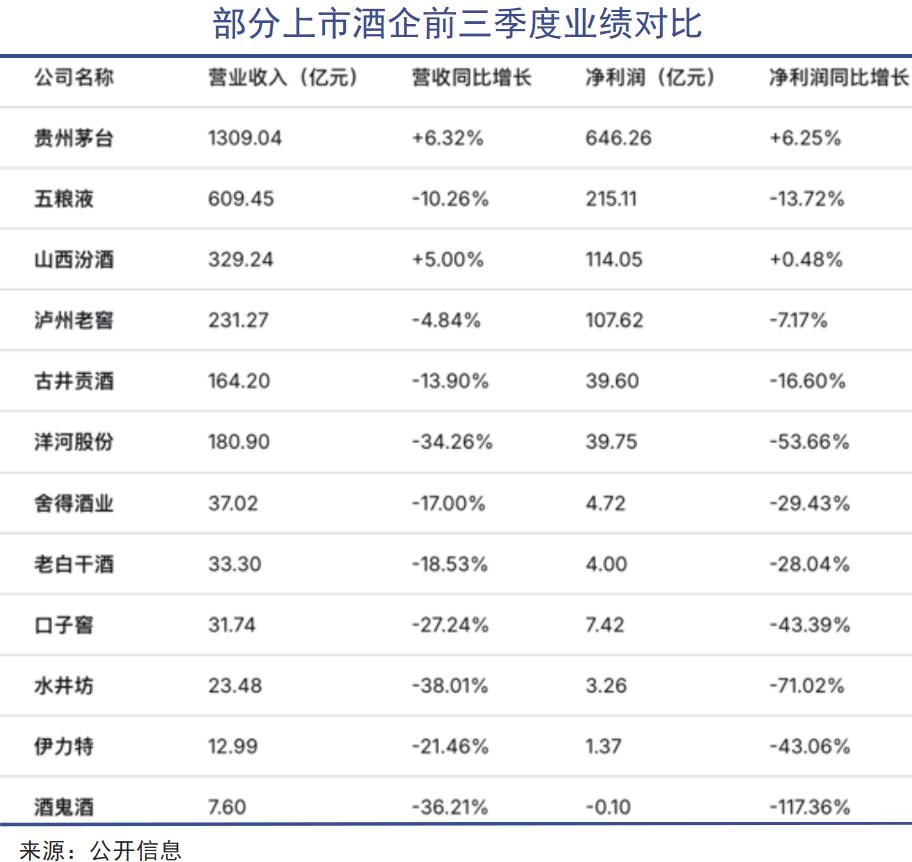
Core Insights - The Chinese liquor industry is experiencing a significant downturn, with a collective revenue of 317.78 billion yuan for 20 listed liquor companies in the first three quarters of 2025, representing a year-on-year decline of 5.90% [2][4] - Shanxi Fenjiu has surpassed Wuliangye to become the second-largest player in the industry, with a revenue of 8.96 billion yuan in Q3 2025, compared to Wuliangye's 8.17 billion yuan [2][7] - The industry is undergoing structural changes, with a general slowdown in revenue growth and profitability across most companies [4][5] Industry Performance - The overall revenue growth rate for the liquor industry has dropped to a five-year low, with only eight companies achieving double-digit profit growth, while many others reported single-digit or negative growth [4] - Moutai remains the leader with a revenue of 128.45 billion yuan in Q3, but its growth rate has slowed to 6.36% [4] - Wuliangye reported a revenue of 60.95 billion yuan with a decline of 10.26%, while Fenjiu's revenue growth of 5% is notable [4][5] Challenges Faced - The industry is facing several challenges, including rising raw material costs, increased promotional expenses, and deteriorating cash flow due to higher inventory levels among distributors [5] - The cumulative production of liquor from January to September 2025 was 2.655 million kiloliters, a year-on-year decrease of 9.9%, indicating weak market demand [5] - Wuliangye's performance has been particularly affected by an imbalanced product structure and intensified competition in the mid-range market [8][9] Competitive Landscape - The competition is shifting from scale expansion to quality differentiation, with Fenjiu's rise posing a potential threat to Wuliangye's long-standing position [10][11] - Fenjiu's growth is attributed to the revival of clear aroma liquor, appealing to younger consumers [11][12] - Wuliangye's traditional distribution model is under pressure, leading to increased inventory and financial strain on distributors [8][9] Future Outlook - The liquor industry is expected to undergo a cleansing process, with a potential recovery starting in 2026 as macroeconomic conditions improve [13][14] - The "Matthew Effect" will continue to intensify, favoring leading companies with strong brand power and national distribution [14][15] - Companies that can blend traditional brewing wisdom with modern consumer insights are likely to emerge as winners post-adjustment [15]

五粮液三季报暴雷!一场白酒巨头的“中年危机”
Sou Hu Cai Jing· 2025-11-04 16:06
Core Viewpoint - Wuliangye, a leading player in the Chinese liquor industry, is experiencing significant declines in revenue and profit, raising concerns about the end of the golden era for Chinese liquor [2][6]. Financial Performance - In Q3 2025, Wuliangye reported revenue of approximately 8.17 billion yuan, a year-on-year decrease of 52.66%, and a net profit of about 2.02 billion yuan, down 65.62% compared to the previous year [2][3]. - For the first three quarters of 2025, total revenue was around 60.95 billion yuan, a decline of 10.26%, with net profit at approximately 21.51 billion yuan, down 13.72% [6]. Market Conditions - The liquor industry is undergoing a deep adjustment period, with weak effective demand impacting sales [4][6]. - The revised regulations limiting alcohol consumption in government settings have reduced the market for high-end liquor, affecting Wuliangye and its competitors [4]. Inventory and Pricing Issues - Wuliangye's inventory remains high, with a book value of 17.54 billion yuan, indicating a pressing need for inventory reduction across the industry [8][9]. - The company faces a pricing issue where the market wholesale price is lower than the factory price, leading to a decline in dealer confidence and cash flow [9][10]. Strategic Response - In response to the inventory crisis, Wuliangye has actively controlled shipment volumes, which directly contributed to the significant drop in revenue for Q3 [10]. - The company aims to stabilize its pricing system and restore dealer confidence through these measures [10]. Brand and Management Challenges - Wuliangye's brand image and product matrix require improvement compared to competitors like Moutai, which have stronger brand loyalty and clearer product positioning [11]. - Recent management changes have raised concerns about strategic continuity and stability within the company [11]. Industry Trends - The overall liquor industry is experiencing a downturn, with many companies reporting declines in both revenue and profit, indicating a broader trend beyond Wuliangye [12][13]. - Analysts predict that the adjustment period for the liquor industry will continue until 2026, with challenges such as inventory digestion and weak demand [16].
