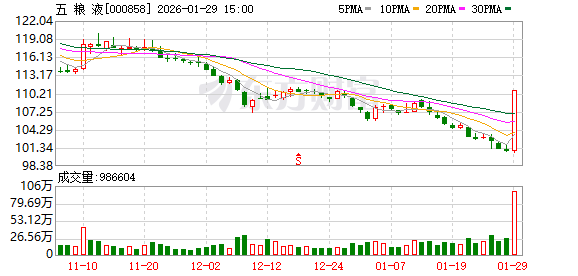
WLY(000858)

Search documents
白酒股今日情绪爆发午后17股涨停,茅台大涨8.6%
Di Yi Cai Jing Zi Xun· 2026-01-29 08:28
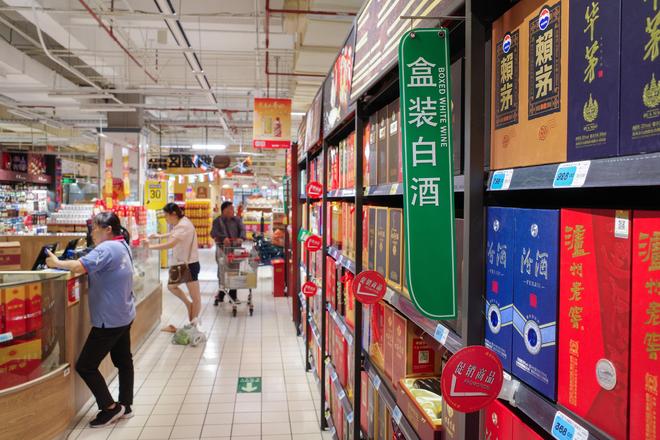
Group 1 - The core point of the news is the significant surge in Chinese liquor stocks, particularly after a period of underperformance, driven by a combination of market sentiment and capital seeking safer investments [1][3] - On January 29, 17 liquor stocks, including Kweichow Moutai, experienced a collective limit-up, with Kweichow Moutai rising by 8.61% [1] - The rise in liquor stocks also positively impacted yellow wine stocks, with Gu Yue Long Shan and Kuaiji Mountain hitting the limit-up, and Jin Feng Jiu Ye increasing by 6.8% [1] Group 2 - Since the third quarter of 2025, liquor stocks have faced challenges, with many companies reporting significant declines in performance growth [1] - Several liquor companies have issued profit warnings, indicating substantial impacts on their annual performance, with Jin Zhong Zi Jiu predicting a net loss of 150 to 190 million yuan for 2025 [1] - The collective rise in liquor stocks is not closely related to individual company fundamentals, but rather reflects a broader market trend where funds are moving from high-risk sectors like technology to safer stocks [3]



贵州茅台、五粮液获大额资金净流入

Xin Lang Cai Jing· 2026-01-29 07:53
Choice数据显示,1月29日,资金净流入额排名前十的个股依次是:贵州茅台、蓝色光标、五粮液、北 方稀土、科大讯飞、航天科技、浙文互联、中国平安、泸州老窖、天孚通信。其中,贵州茅台获净流入 超33亿元,五粮液获净流入超17亿元。 ...
1月29日连板股分析:连板股晋级率50% 连续第四个交易日超3000股下跌
Xin Lang Cai Jing· 2026-01-29 07:51
Core Viewpoint - The market experienced significant volatility with over 3,000 stocks declining for the fourth consecutive trading day, while the advancement rate of stocks with consecutive gains reached 50% [1] Group 1: Market Performance - A total of 83 stocks hit the daily limit up, with 19 stocks classified as consecutive gainers, including 5 stocks with three or more consecutive gains [1] - Over 3,500 stocks declined in the market, indicating a broad sell-off [1] - Large-cap stocks significantly outperformed small-cap stocks, highlighting a divergence in market performance [1] Group 2: Sector Analysis - Among the 19 consecutive gainers, all but one were resource stocks, including gold, non-ferrous metals, oil and gas, and chemicals [1] - Notable performances included silver and non-ferrous metals with 8 consecutive gains, while China Gold and Yuguang Jinlan had 5 consecutive gains [1] - The afternoon session saw a surge in liquor stocks, with major brands like Wuliangye and Shanxi Fenjiu hitting the daily limit up, and Kweichow Moutai rising over 8% [1] Group 3: AI and Technology Sector - The AI application sector experienced a significant rally, with companies like Tiandi Online and Zhejiang Wenhu gaining multiple consecutive limits [1] - The market reacted positively to Meta's revenue outlook, which exceeded expectations, leading to a temporary increase of over 10% in after-hours trading [1] - CEO Mark Zuckerberg emphasized that advertising will be the primary growth driver for the business in the coming years [1]




沪指收涨0.16%!白酒板块掀涨停潮,两市成交额3.23万亿元
Bei Jing Shang Bao· 2026-01-29 07:41
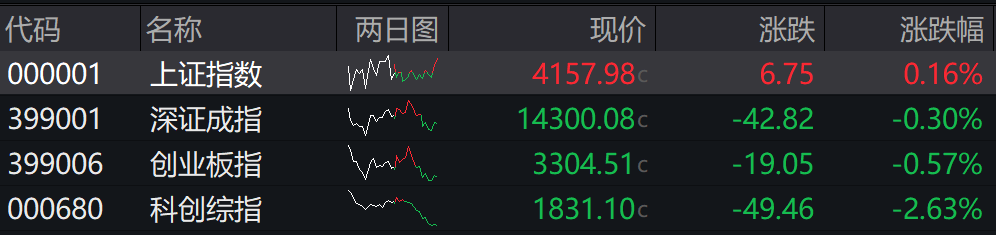
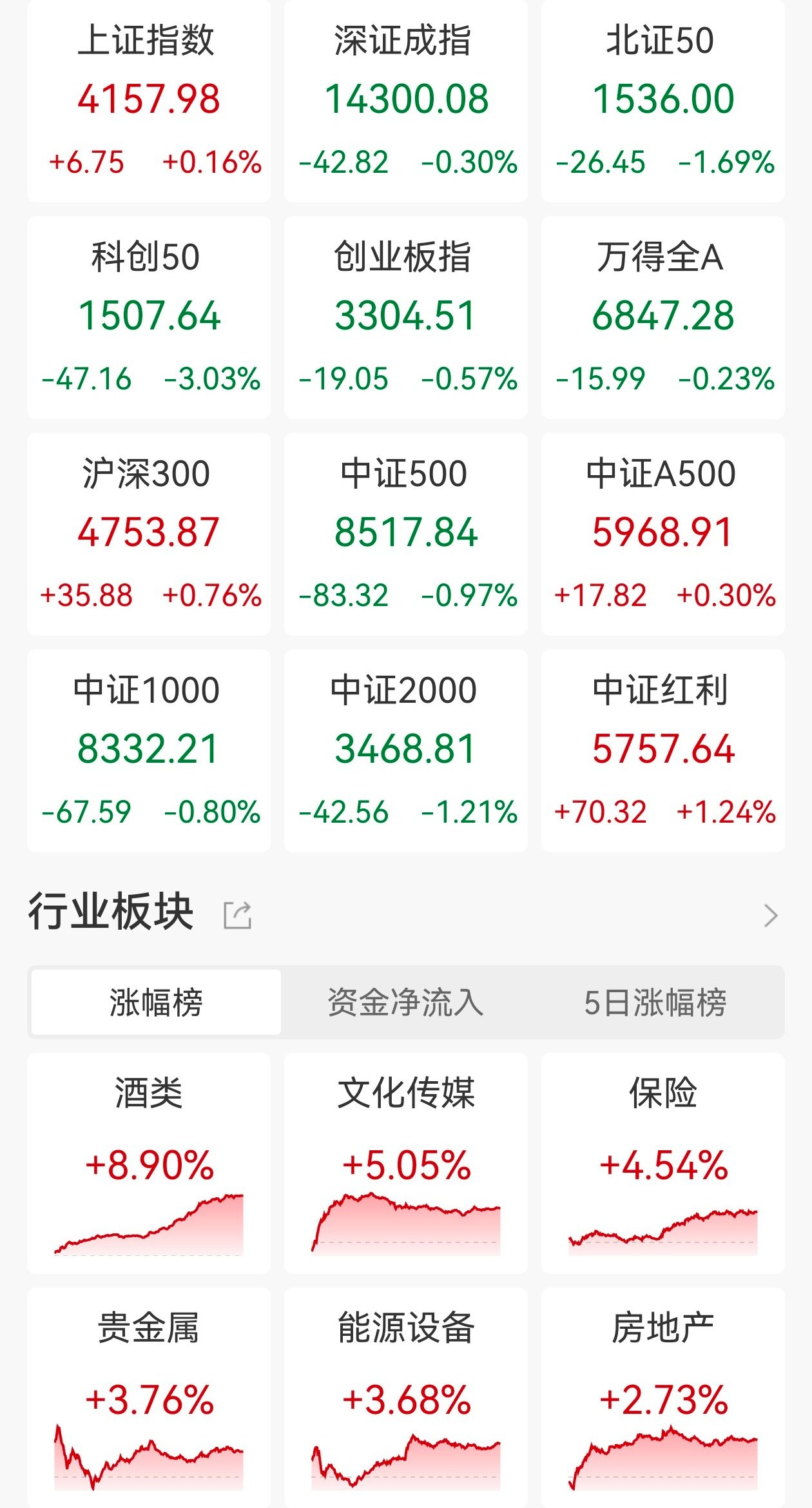
Core Viewpoint - The A-share market exhibited mixed performance on January 29, with the Shanghai Composite Index slightly up by 0.16%, while the Shenzhen Component and ChiNext indices declined by 0.3% and 0.57% respectively [1] Market Performance - The Shanghai Composite Index closed at 4157.98 points, while the Shenzhen Component and ChiNext indices closed at 14300.08 points and 3304.51 points respectively [1] - A total of 1803 stocks in the A-share market gained, with 86 stocks hitting the daily limit up, while 3566 stocks declined, including 35 stocks hitting the daily limit down [1] Sector Performance - The liquor sector saw significant gains in the afternoon, with stocks such as Wuliangye (000858), Jinzhidao (600199), Huangtai Distillery (000995), and Yingjia Gongjiu (603198) reaching their daily limit up [1] - Kweichow Moutai (600519) experienced a substantial price increase, reaching 1400 CNY per share during trading and ultimately closing up by 8.61% at 1437.72 CNY per share [1] - Other sectors that performed well included precious metals and mining, while high-bandwidth memory, MLCC, and SMIC-related sectors faced declines [1] Trading Volume - The total trading volume for the Shanghai Stock Exchange was approximately 14857.95 billion CNY, while the Shenzhen Stock Exchange recorded about 17442.13 billion CNY, leading to a combined trading volume of around 3.23 trillion CNY [1]


超3500只个股下跌
第一财经· 2026-01-29 07:30
Core Viewpoint - The A-share market experienced fluctuations with the Shanghai Composite Index closing up 0.16%, while the Shenzhen Component and ChiNext indices fell by 0.3% and 0.57% respectively, indicating a mixed market sentiment [3][4]. Market Performance - The Shanghai Composite Index closed at 4157.98, gaining 6.75 points or 0.16% [4]. - The Shenzhen Component Index closed at 14300.08, down 42.82 points or 0.3% [4]. - The ChiNext Index closed at 3304.51, decreasing by 19.05 points or 0.57% [4]. - The Sci-Tech Innovation Board Index fell by 49.46 points or 2.63%, closing at 1831.10 [4]. Sector Highlights - The liquor sector saw a significant surge, with stocks like Kweichow Moutai rising over 8%, and nearly 20 liquor stocks hitting the daily limit up [3][5]. - Oil and gas stocks continued their strong performance, with Intercontinental Oil and Gas achieving five consecutive limit-ups [7]. - The AI application sector was active, particularly in short drama and gaming themes, while sectors like semiconductors and commercial aerospace experienced notable pullbacks [3][5]. Capital Flow - There was a net inflow of capital into sectors such as media, food and beverage, and real estate, with Kweichow Moutai, Bluefocus, and Wuliangye receiving net inflows of 3.339 billion, 2.898 billion, and 1.703 billion respectively [9]. - Conversely, significant net outflows were observed in semiconductor and non-ferrous metal sectors, with companies like Industrial Fulian, Sungrow Power, and SMIC facing sell-offs of 6.531 billion, 1.787 billion, and 1.427 billion respectively [9]. Institutional Insights - Citic Securities noted that the index faces pressure above and support below, emphasizing the need to monitor changes in trading volume [11]. - Dexun Securities suggested that the index is likely to maintain narrow fluctuations in the short term [12]. - Dongwu Securities indicated that if trading volume aligns effectively, there is potential for the market to reach new highs in the short term [12].



收盘丨沪指放量上涨0.16%,白酒、资源股全线爆发
Di Yi Cai Jing· 2026-01-29 07:19
Market Overview - The total trading volume in the Shanghai and Shenzhen markets reached 3.23 trillion yuan, an increase of 264.6 billion yuan compared to the previous trading day [1][6] - The A-share market experienced fluctuations, with the Shanghai Composite Index closing up by 0.16%, while the Shenzhen Component Index and the ChiNext Index fell by 0.3% and 0.57%, respectively [1][2] Sector Performance - The liquor sector saw a surge, with Kweichow Moutai rising over 8%, and nearly 20 stocks in the sector hitting the daily limit [2] - Oil and gas stocks continued to perform strongly, with Intercontinental Oil and Gas achieving five consecutive trading limits in seven days [4] - The semiconductor, computing hardware, commercial aerospace, and humanoid robot sectors experienced noticeable pullbacks [2] Individual Stock Highlights - Notable gainers in the liquor sector included: - Jinzhongzi Wine: +10.04% [3] - Liquor stocks such as Luzhou Laojiao and Wuliangye also saw increases of +10% [3] - In the oil and gas sector, Keli Co., Ltd. surged by 29.99%, while Tongyuan Petroleum and Qianeng Hengxin rose by 20.04% and 20.00%, respectively [5] Capital Flow - Main capital inflows were observed in the media, food and beverage, and real estate sectors, while outflows were noted in the semiconductor, non-ferrous metals, and home appliance sectors [9] - Specific stocks with significant net inflows included Kweichow Moutai (3.339 billion yuan), Bluefocus (2.898 billion yuan), and Wuliangye (1.703 billion yuan) [10] - Conversely, Industrial Fulian, Sungrow Power, and SMIC faced net outflows of 6.531 billion yuan, 1.787 billion yuan, and 1.427 billion yuan, respectively [10] Institutional Insights - Citic Securities noted that the index faces pressure above and support below, emphasizing the need to monitor changes in trading volume [11] - Dexun Securities suggested that the index is likely to maintain narrow fluctuations in the short term [11] - Dongwu Securities indicated that if trading volume effectively supports the market, there is potential for the market to reach new highs in the short term [11]

A股收评 | 白酒突然暴涨!茅台冲击涨停 市场迎三大变局信号
智通财经网· 2026-01-29 07:17
Market Overview - The market showed significant divergence today, with traditional blue-chip sectors like liquor and real estate surging, leading to a substantial rise in the Shanghai Stock Exchange 50 Index, while technology sectors such as semiconductors and chips weakened, resulting in notable declines in the STAR Market and ChiNext Index [1] - The total market turnover reached 3.2 trillion yuan, an increase of over 200 billion yuan compared to the previous trading day, with more than 3,500 stocks declining [1] Key Signals - Three major changes in the market were noted: 1. The simultaneous rise of real estate and liquor stocks indicates potential structural volatility as the market rotates towards these rebound assets [1] 2. The recent surge in commodities, including gold, reflects liquidity trends, while cryptocurrencies have remained relatively subdued, suggesting inflation expectations may significantly impact AI and computing power [1] 3. The unexpected performance of government bonds, particularly the strong showing of 30-year treasury futures, indicates a complex narrative in the market, suggesting that the rotation is not strictly binary [1] Sector Performance - Consumer stocks, particularly liquor and retail, saw a significant afternoon rally, with Kweichow Moutai rising by 8% and several stocks hitting the daily limit [1] - Precious metals and oil and gas stocks experienced volatility but ultimately rallied, with China Gold achieving five consecutive limit-ups and Hunan Gold four consecutive limit-ups [1] - AI application concepts surged, with multiple stocks like Sai Group and Tiandi Online hitting the daily limit [1] - The banking sector also saw gains, with Qingdao Bank hitting the daily limit, while semiconductor, military, and automotive sectors faced the largest declines [1] Fund Flow - Major funds focused on sectors such as advertising, software development, and liquor, with significant net inflows into stocks like BlueFocus, Kweichow Moutai, and iFlytek [3] Future Outlook - Short-term market trends indicate a continued oscillation, with the Shanghai Composite Index expected to maintain an upward trajectory, although space for growth before the Spring Festival appears limited [2][8] - The market sentiment is supported by a weakening US dollar and ongoing monetary easing, which may provide a conducive environment for further capital inflow [7] - The upcoming earnings reports from A-share companies and North American tech giants are anticipated to have a more pronounced impact on market structure [6]



A股收评:成交额3.26万亿元!三大指数涨跌不一,白酒股爆发贵州茅台涨近9%
Ge Long Hui A P P· 2026-01-29 07:09
Market Performance - The A-share market showed mixed results with the Shanghai Composite Index rising by 0.16% to close at 4157 points, while the Shenzhen Component Index fell by 0.3% and the ChiNext Index decreased by 0.57% [1] - The total market turnover reached 3.26 trillion yuan, an increase of 267.1 billion yuan compared to the previous trading day, with over 3500 stocks declining [1] Sector Highlights - The liquor sector experienced a surge, with Kweichow Moutai's price rising nearly 9%, and over twenty stocks including Wuliangye and Luzhou Laojiao hitting the daily limit [1] - The precious metals sector continued to rise, with spot gold approaching 5600 USD, leading to multiple stocks like Sichuan Gold and Zhaojin Gold hitting the daily limit [1] - AI application stocks collectively surged, with a significant increase in related stocks [1] - The cultural media sector also saw gains, with stocks like Zhejiang Wenlian hitting the daily limit [1] - Insurance stocks were active, with China Pacific Insurance leading the gains [1] - Real estate, oil and gas services, and banking sectors showed notable increases [1] Declines in Specific Sectors - The high-bandwidth memory and SMIC concepts faced declines, with Jingce Electronics dropping nearly 9% [1] - The electronic chemicals sector experienced widespread declines, with Anji Technology falling over 8% [1] - The electronic components and PCB sectors also saw declines, with Yidong Electronics dropping over 11% [1] - Other sectors such as power grid equipment, superconducting concepts, and optical communication modules faced significant downturns [1]


五粮液尾盘触及涨停
Mei Ri Jing Ji Xin Wen· 2026-01-29 07:06
每经AI快讯,五粮液尾盘触及涨停,成交超100亿元,贵州茅台涨超8%,成交超240亿元。 (文章来源:每日经济新闻) ...