
WLY(000858)

Search documents
“i茅台”成交用户超40万!“茅五泸汾洋”集体上攻,机构喊话白酒配置机会!
Xin Lang Ji Jin· 2026-01-12 02:30
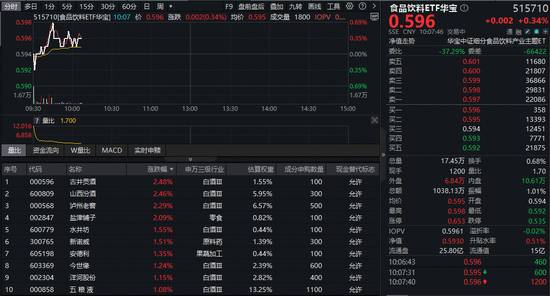
Group 1 - The food and beverage sector is experiencing an upward trend, with the Huabao Food and Beverage ETF (515710) showing a price increase of 0.34% as of the latest update [1] - Major liquor stocks such as Shanxi Fenjiu, Luzhou Laojiao, and Gujing Gongjiu have surged over 2%, while Wuliangye and Yanghe have increased by more than 1% [1] - The recent communication from Kweichow Moutai to its distributors emphasizes a strategy to stabilize the market by ensuring product availability directly to consumers, with over 2.7 million new users on the iMoutai platform [2][4] Group 2 - Guojin Securities notes that the market's expectations for the liquor industry are at an absolute low, and the clear volume and price planning from leading companies will alleviate concerns about price competition [3] - The valuation of the food and beverage sector is at a historical low, making it a favorable time for investment, with the food and beverage ETF's price-to-earnings ratio at 20.16, which is in the bottom 5.88% of the last decade [3] - CITIC Securities suggests that the current adjustments in the liquor industry may signal a turning point, with the upcoming Spring Festival being a critical observation period for market recovery [4] Group 3 - The Huabao Food and Beverage ETF (515710) primarily invests in leading high-end and mid-range liquor stocks, with about 60% of its portfolio allocated to these sectors [5] - The top ten weighted stocks in the ETF include major brands like Moutai, Wuliangye, and Luzhou Laojiao, indicating a strong focus on established players in the market [5]







五粮液集团召开特色消费品板块2025年度经济运行分析会 谋划新周期发展路径
Xin Lang Cai Jing· 2026-01-12 01:18
Core Viewpoint - The meeting held by Wuliangye Group emphasized the achievements of the specialty consumer goods sector in 2025 and outlined strategies for 2026 and the 14th Five-Year Plan, focusing on enhancing core business and overcoming development bottlenecks [1][3]. Group 1: Achievements and Strategies - The specialty consumer goods sector, which includes areas like black tea and clothing, has shown significant progress in 2025, with notable revenue and profit growth driven by companies like Shengshan Group and Chuanhong Group [1][3]. - The emphasis is on returning to core responsibilities, leveraging industry turning points, and moving away from a "small and weak" model through scaling, standardization, and branding [1][3]. Group 2: Four Breakthroughs - Companies are urged to achieve "four breakthroughs": 1. Capability breakthrough through standard leadership, professional certification, and R&D platform development [1][3]. 2. Quality breakthrough by creating differentiated products through technological innovation and single product strategies to enhance brand reputation [1][3]. 3. Market breakthrough by deepening core markets and existing customers while expanding into overseas markets and high-end sectors [1][3]. 4. Mechanism breakthrough by establishing organizational, talent, and incentive mechanisms aligned with strategic goals [1][3]. Group 3: Future Planning - Companies should enhance resource sharing and complementary advantages, deepen collaboration in business, channels, and branding, and create a closed-loop development model [2][4]. - The focus is on setting clear operational goals for 2026, detailing actionable measures, and scientifically planning the 14th Five-Year Plan to build a competitive and distinctive specialty consumer goods industry cluster [2][4].
酒价内参1月12日价格发布 市场分化企稳整体价格小幅回升
Xin Lang Cai Jing· 2026-01-12 01:07
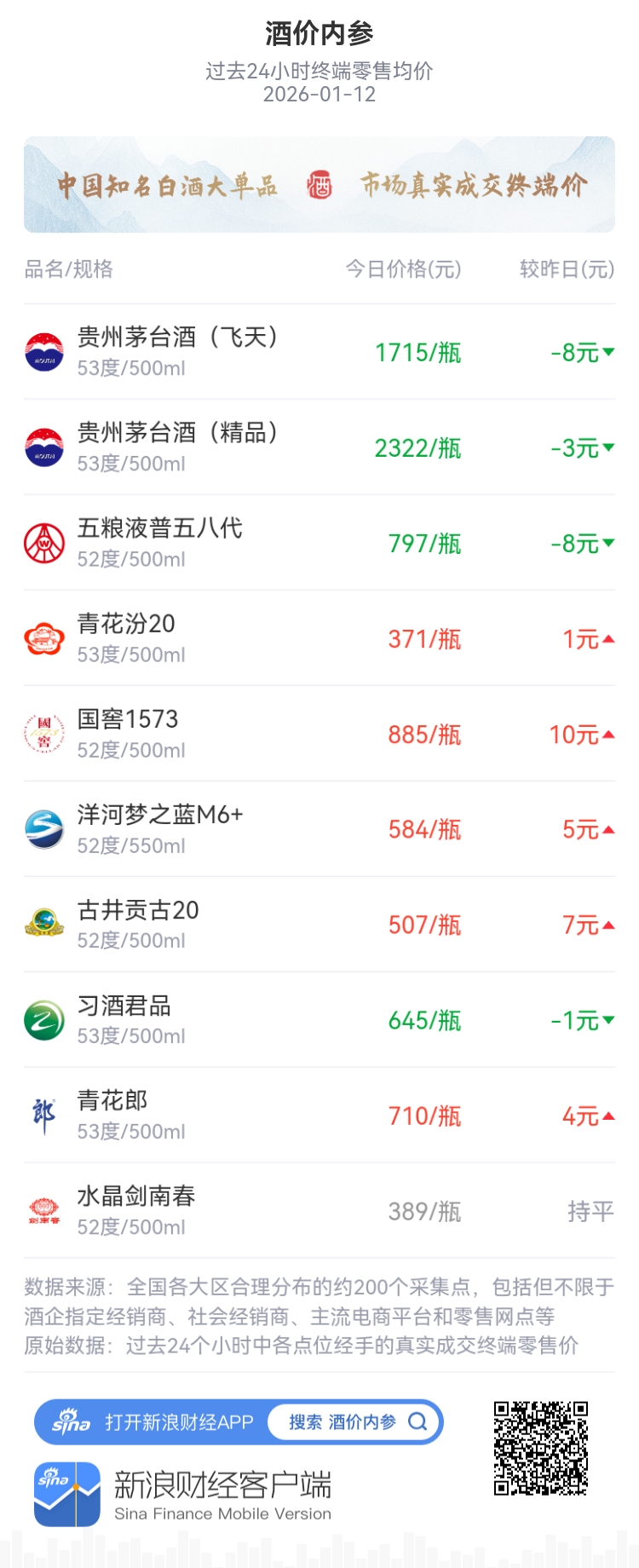
Core Viewpoint - The Chinese liquor market shows signs of stabilization in retail prices for the top ten products as of January 12, with an overall price increase after a period of decline, indicating a potential recovery in the market [1]. Price Trends - The total retail price for a package of the top ten liquor products is 8,925 yuan, reflecting a slight increase of 7 yuan from the previous day, suggesting a slowdown in the downward price trend [1]. - The market exhibits a mixed pattern of price changes, with some products increasing in price while others decrease [1]. Price Increases - Notable price increases include: - Guojiao 1573, up 10 yuan per bottle [1][3]. - Gujinggong 20, up 7 yuan per bottle [1][4]. - Yanghe Dream Blue M6+, up 5 yuan per bottle [1][4]. - Qinghualang, up 4 yuan per bottle [1][4]. - Qinghualang 20, up 1 yuan per bottle [1][3]. - Shujian Jiananspring, stable compared to the previous day [1]. Price Decreases - Significant price declines include: - Feitian Moutai, down 8 yuan per bottle [1][3]. - Wuliangye Pu 58th generation, down 8 yuan per bottle, falling below 800 yuan for the first time in a month [1][3]. - Boutique Moutai, down 3 yuan per bottle [1][3]. - Xijiu Junpin, down 1 yuan per bottle [1][4]. Market Dynamics - The stabilization of prices for most core products is the primary factor driving the overall price recovery in the market [1].

行业周报:肉奶价格有望共振上行,关注零食春节行情催化-20260111
KAIYUAN SECURITIES· 2026-01-11 10:12
Investment Rating - The industry investment rating is "Positive" (maintained) [1] Core Viewpoints - The supply-demand structure of raw milk is improving, and the snack food sector continues to show upward momentum. The food and beverage index increased by 2.1% from January 5 to January 9, ranking 24th among 28 sectors, underperforming the CSI 300 by approximately 0.7 percentage points. Sub-sectors such as processed foods (+6.7%), soft drinks (+5.8%), and snacks (+4.5%) performed relatively well [3][10][12]. Summary by Relevant Sections Weekly Insights - The supply-demand dynamics for raw milk are optimizing, and the snack food sector is experiencing sustained growth. The recent policy by the Ministry of Commerce to implement safeguard measures on imported beef is expected to alleviate the impact on domestic industries, leading to a potential increase in beef prices over the next 2-3 years. The domestic dairy sector is facing challenges, with a continuous reduction in dairy cow inventory, which may lead to a widening supply-demand gap post-Spring Festival [10][11]. Market Performance - The food and beverage index rose by 2.1% from January 5 to January 9, ranking 24th out of 28 sectors, and underperformed the CSI 300 by about 0.7 percentage points. Leading individual stocks included Qianwei Yangchun, Anji Food, and Yangyuan Beverage, while stocks like Jiabi You, *ST Chuntian, and Xianle Health saw declines [12][13]. Upstream Data - As of January 6, the GDT auction price for whole milk powder was $3,407 per ton, reflecting a 10.4% year-on-year decrease. The domestic fresh milk price was 3.03 yuan per kilogram, down 2.9% year-on-year. The domestic milk price is expected to remain under pressure in the short to medium term [19][21]. Recommended Stocks - The report recommends focusing on companies that are likely to benefit from the improving raw milk supply-demand balance and the growth in the snack food sector. Notable mentions include: - Yuran Agriculture: Expected to benefit from the recovery in raw milk prices. - Modern Dairy: Anticipated to gain from the overall industry improvement. - Yili Group and Mengniu Dairy: Expected to see positive impacts from the anticipated recovery in milk prices [10][11]. Snack Food Sector - The snack food sector is projected to continue its upward trend, particularly during the Spring Festival season. Companies such as Weilang Delicious, Ganyuan Food, and Yanjin Food are highlighted for their potential growth due to seasonal demand and strategic initiatives [11][12].


食品饮料行业周报 20260105-20260109:茅台改革全面向 C 伊利估值吸引力提升-20260111
Shenwan Hongyuan Securities· 2026-01-11 05:50
Investment Rating - The report maintains a positive outlook on the liquor sector, with expectations for a recovery in sales and valuation improvements in 2026 [2][6]. Core Insights - The liquor market is undergoing a restructuring with a focus on balancing volume and price, and a potential turning point is anticipated in Q3 2026 [2][6]. - The report highlights the importance of consumer price index (CPI) as a key indicator for the consumer goods sector, predicting gradual improvements in food CPI throughout 2026 [2][6]. - The report recommends several high-quality liquor companies for long-term investment, including Kweichow Moutai, Luzhou Laojiao, and Shanxi Fenjiu, while also suggesting attention to Wuliangye and other brands [2][6]. Summary by Sections 1. Weekly Overview of Food and Beverage Sector - The food and beverage sector saw a 2.12% increase last week, with liquor stocks rising by 2.46%, although it underperformed the broader market by 1.70 percentage points [5]. - Notable stock performances included Ziyuan Food (+33.97%), Qianwei Central Kitchen (+22.52%), and Anji Food (+18.34%) [5]. 2. Market Performance of Food and Beverage Sub-sectors - The food and beverage industry lagged behind the Shenwan A index by 3.06 percentage points, with various sub-sectors underperforming, particularly beverages and dairy [33][34]. 3. Liquor Pricing Trends - As of January 10, 2026, the price of Moutai was reported at 1540 RMB for loose bottles, reflecting a week-on-week increase of 50 RMB, while the price for a case rose by 40 RMB to 1545 RMB [7][19]. - The report indicates that Moutai's pricing has found a bottom, reducing downward risks and suggesting a potential for price stability moving forward [7][19]. 4. Consumer Goods Sector Insights - The report emphasizes the shift in competitive strategies from price-based to quality-based approaches among consumer goods companies, with expectations for improved margins as raw material costs stabilize [2][6]. - Recommendations for consumer goods include Anjijia Food, Yili Group, and Tianwei Food, with a focus on the supply chain related to condiments and frozen foods [8]. 5. Dairy Industry Outlook - The dairy sector is expected to see an improved supply-demand balance in 2026, with growth potential in deep-processed products and low-temperature milk [8][9]. - Yili Group's projected net profits for 2025-2027 are 11.3 billion, 12.2 billion, and 12.9 billion RMB, respectively, indicating a growth trajectory [9].
白酒,彻底走下神坛
Ge Long Hui A P P· 2026-01-10 08:57
Core Viewpoint - The white liquor industry is facing significant challenges, with major companies like Kweichow Moutai implementing drastic changes to adapt to market conditions, including a shift to direct sales and the introduction of new products through the "i Moutai" platform [1][5][35]. Group 1: Industry Performance - The overall white liquor sector saw a nearly 15% decline in 2024, with Kweichow Moutai's net profit expected to drop by 50% to 60% in 2025, from 16.55 billion yuan to an estimated 6.62 billion to 8.28 billion yuan [1][21]. - In the first three quarters of 2025, 20 A-share listed liquor companies reported a combined revenue of 317.78 billion yuan, a year-on-year decrease of 5.90%, and a net profit drop of 6.93% to 122.57 billion yuan [21][23]. - The average inventory turnover days for the industry reached 1,424 days by the end of Q3 2025, a significant increase of 65% compared to the same period in 2024 [25]. Group 2: Kweichow Moutai's Strategy - Kweichow Moutai has announced a major reform to eliminate its distribution model, transitioning to a direct sales approach, which is expected to stabilize pricing and improve profit margins [5][12][35]. - The launch of the "i Moutai" platform has seen over 100,000 purchases within three days of offering the 500ml flying Moutai, indicating strong consumer demand despite the broader market challenges [4][10]. - The company aims to combat counterfeit products and enhance its brand image as a state-owned enterprise through these reforms, although it may face short-term resistance from distributors [13][15][19]. Group 3: Market Dynamics - The white liquor industry is experiencing a widespread phenomenon of price inversion, with 58.1% of liquor companies reporting increased inventory pressure and over 40% of retailers facing cash flow issues [20]. - The market is witnessing a shift in consumer behavior, with a growing demand for high-quality, cost-effective products in the 100-300 yuan price range, projected to exceed 200 billion yuan in market size [37]. - The industry's future growth will depend on companies' ability to adapt to changing consumer preferences and market conditions, with a focus on innovation and flexible sales strategies [36][39].

白酒,彻底走下神坛
格隆汇APP· 2026-01-10 08:53
Core Viewpoint - The white liquor industry is facing significant challenges, with major companies like Kweichow Moutai undergoing drastic changes to adapt to market conditions, while overall industry performance is declining sharply [3][4][6][41]. Group 1: Industry Performance - The white liquor sector saw a nearly 15% decline in overall performance last year, with Kweichow Moutai's major reform efforts indicating a critical turning point for the industry [6][8]. - Kweichow Moutai's projected net profit for 2025 is expected to drop by 50% to 60%, from 16.55 billion yuan in 2024 to between 6.62 billion and 8.28 billion yuan [5][41]. - In the first three quarters of 2025, the combined revenue of 20 A-share listed liquor companies was 317.78 billion yuan, a year-on-year decrease of 5.90%, with net profit down 6.93% to 122.57 billion yuan [41]. Group 2: Kweichow Moutai's Strategy - Kweichow Moutai has launched a direct sales initiative through its "i Moutai" platform, marking a significant shift away from traditional distribution methods [7][11][25]. - The introduction of a stable pricing strategy at 1,499 yuan for new products aims to combat price volatility and improve market control [24][27]. - The direct sales model is expected to enhance profit margins in the long run, despite potential short-term profit impacts due to price control [26][27]. Group 3: Market Dynamics - The white liquor industry is experiencing widespread inventory pressure, with 58.1% of liquor companies reporting increased channel inventory stress [40]. - The average inventory turnover days for the industry reached 1,424 days by the end of Q3 2025, a 65% increase from the previous year [47]. - The market is witnessing a phenomenon of price inversion, where retail prices are falling below wholesale prices, leading to potential inventory devaluation for distributors [30][33]. Group 4: Future Outlook - The white liquor industry's recovery is closely tied to macroeconomic factors, including consumer demand and national development strategies [51][66]. - The market for mid-range liquor priced between 100-300 yuan is projected to exceed 200 billion yuan, representing a new growth opportunity for the industry [62]. - Companies that fail to adapt to changing market conditions and consumer preferences may face significant challenges in the upcoming industry reshuffle [63][69].

泸州老窖 拟分红约20亿元
Zheng Quan Shi Bao· 2026-01-09 15:50
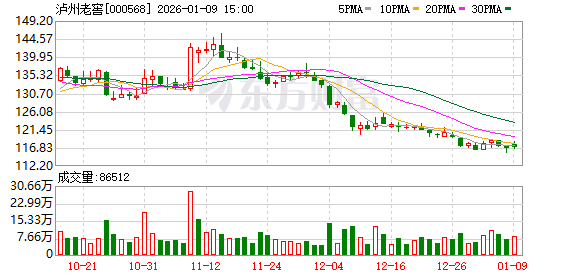
Group 1 - Luzhou Laojiao announced a mid-term profit distribution plan for 2025, proposing a cash dividend of 13.58 yuan per 10 shares, totaling approximately 2 billion yuan [2] - Kweichow Moutai's mid-term profit distribution plan for 2025 was approved, with a cash dividend of 23.957 yuan per share, amounting to a total of 30 billion yuan [5] - Wuliangye's board approved a mid-term profit distribution plan for 2025, proposing a cash dividend of 25.78 yuan per 10 shares, totaling approximately 10 billion yuan [8] Group 2 - The record date for Kweichow Moutai's dividend is December 18, 2025, with the ex-dividend date and payment date on December 19, 2025 [5][6] - Wuliangye's record date is December 17, 2025, with the ex-dividend date on December 18, 2025 [8]
泸州老窖,拟分红约20亿元
证券时报· 2026-01-09 15:39
Group 1 - Luzhou Laojiao announced a mid-term profit distribution plan for 2025, proposing a cash dividend of 13.58 yuan (including tax) for every 10 shares, totaling approximately 2 billion yuan (including tax) [1] - Kweichow Moutai's mid-term profit distribution plan for 2025 was approved, with a cash dividend of 23.957 yuan (including tax) per share, amounting to a total distribution of 30 billion yuan (including tax) [4] - Wuliangye announced a mid-term profit distribution plan for 2025, agreeing to distribute a cash dividend of 25.78 yuan (including tax) for every 10 shares, totaling approximately 10 billion yuan (including tax) [5]

五粮液:截至2025年12月31日股东户数为60余万户
Zheng Quan Ri Bao Wang· 2026-01-09 11:44
Group 1 - The core point of the article is that Wuliangye (000858) has stated on its interactive platform that the number of shareholders is expected to exceed 600,000 by December 31, 2025 [1]