
WLY(000858)

Search documents
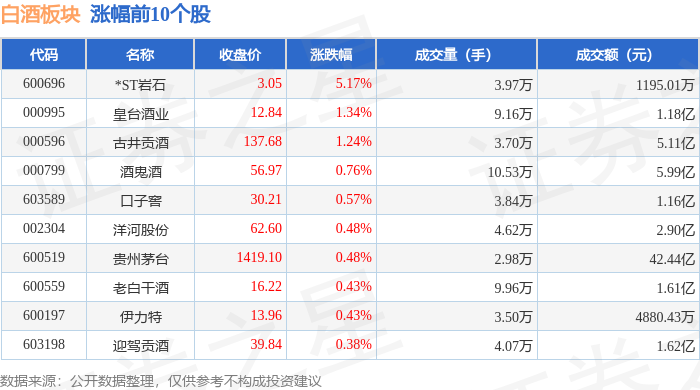
白酒板块1月9日涨0.4%,*ST岩石领涨,主力资金净流出8893.72万元
Zheng Xing Xing Ye Ri Bao· 2026-01-09 08:54
Group 1 - The liquor sector experienced a 0.4% increase on January 9, with *ST Yanshi leading the gains [1] - The Shanghai Composite Index closed at 4120.43, up 0.92%, while the Shenzhen Component Index closed at 14120.15, up 1.15% [1] - Key stocks in the liquor sector showed varied performance, with *ST Yanshi rising by 5.17% to a closing price of 3.05 [1] Group 2 - The main capital flow in the liquor sector showed a net outflow of 88.94 million yuan from institutional investors, while retail investors had a net inflow of 89.93 million yuan [2] - Individual stock capital flows indicated that Kweichow Moutai had a net inflow of 98.51 million yuan from institutional investors, despite a net outflow from retail investors [3] - Gujing Gongjiu saw a significant net inflow of 67.90 million yuan from institutional investors, while also experiencing outflows from retail investors [3]




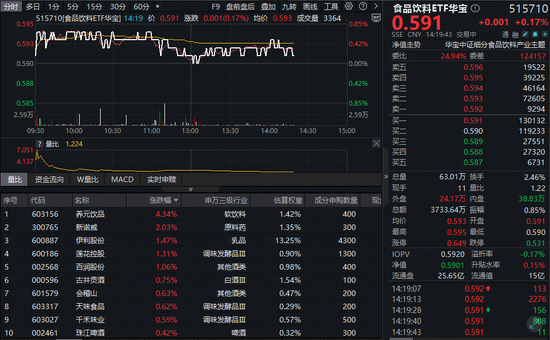
吃喝板块午后回落,食品饮料ETF华宝(515710)红盘震荡!机构:白酒五底共振
Xin Lang Cai Jing· 2026-01-09 06:31
Core Viewpoint - The food and beverage sector is experiencing a slight recovery, with the Huabao Food and Beverage ETF (515710) showing a price increase of 0.17% as of the latest update, indicating a positive trend in the market [1][8]. Group 1: Market Performance - The food and beverage ETF Huabao (515710) has seen a price increase of 0.17%, reflecting overall sector performance [1][8]. - Key stocks in the sector include Yangyuan Beverage, which surged over 4%, and other major players like Yili and Lianhua Holdings, which rose over 1% [1][8]. - Leading liquor brands such as Kweichow Moutai, Wuliangye, and Yanghe also showed slight gains, contributing to the positive sentiment in the market [1][8]. Group 2: Industry Outlook - Open-source securities indicate that after experiencing policy shocks and rapid price declines, leading liquor companies like Moutai and Wuliangye have implemented market-oriented adjustment plans, suggesting that the liquor industry is nearing a bottom [10]. - Pacific Securities highlights that recent important meetings have prioritized boosting domestic demand, with expectations for further policies to stimulate demand recovery [10]. - The valuation of the food and beverage sector is currently at historical lows, with the food index's price-to-earnings ratio at 20.16, placing it in the 5.88% percentile of the last decade, indicating a favorable long-term investment opportunity [10]. Group 3: Investment Strategy - CITIC Construction points out that the current phase of the liquor industry, characterized by low prices and low expectations, may present a cyclical bottom for capital market investments [11]. - The Huabao Food and Beverage ETF (515710) tracks a specialized index with approximately 60% of its portfolio in leading high-end and mid-range liquor stocks, and nearly 40% in beverage, dairy, seasoning, and beer stocks [11]. - Investors can also consider the Huabao Food and Beverage ETF linked funds (Class A 012548/Class C 012549) for exposure to core assets in the food and beverage sector [11].



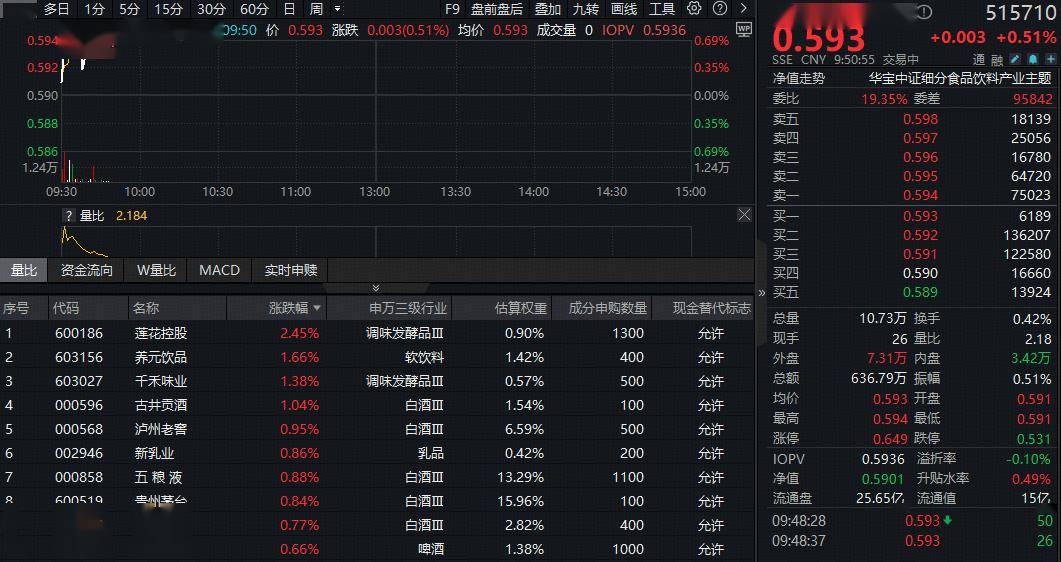
ETF盘中资讯|茅台又“秒空”!“茅五泸汾洋”齐涨,食品饮料ETF华宝(515710)红盘震荡!机构:白酒板块或迎底部配置机会
Sou Hu Cai Jing· 2026-01-09 02:26
Group 1 - The food and beverage sector showed a positive trend today, with the ETF Huabao (515710) rising by 0.51% as of the report time [1] - Key stocks in the sector, including liquor and consumer goods, performed well, with Lianhua Holdings up over 2% and Guizhou Moutai, Wuliangye, and others showing slight gains [1] - The recent launch of premium Moutai products has seen strong demand, with products selling out quickly [1][3] Group 2 - Guizhou Moutai is the largest holding in the Huabao ETF, accounting for 14.89% of the portfolio as of Q3 2025 [3] - The valuation of the food and beverage sector is at a historical low, with the ETF's underlying index PE ratio at 20.16, indicating a potential opportunity for investment [3] - Historical analysis suggests that the current phase of the high-end liquor market may present a bottoming opportunity for capital market investments, especially with the upcoming Spring Festival [3] Group 3 - The Huabao ETF primarily invests in leading high-end and mid-range liquor stocks, with significant allocations to beverage, dairy, and seasoning sectors [4] - Investors can also access the core assets of the food and beverage sector through the Huabao ETF linked funds [4] - The redemption fee structure for the Huabao ETF linked funds is outlined, with varying rates based on the investment amount and holding period [5]
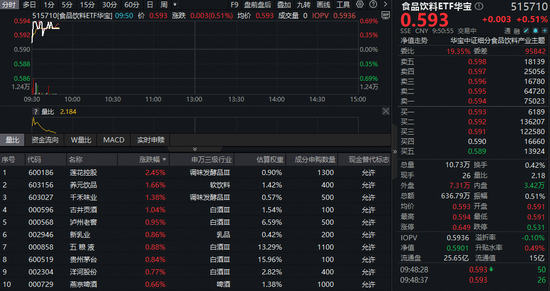
茅台又“秒空”!“茅五泸汾洋”齐涨,食品饮料ETF华宝(515710)红盘震荡!机构:白酒板块或迎底部配置机会
Xin Lang Cai Jing· 2026-01-09 02:06
Group 1 - The food and beverage sector showed an upward trend on January 9, with the food and beverage ETF Huabao (515710) increasing by 0.51% [1][10] - Key stocks in the sector, including liquor and consumer goods, performed well, with Lianhua Holdings rising over 2%, and Gujing Gongjiu and Yangyuan Beverage increasing over 1% [1][10] - Notable stocks such as Kweichow Moutai, Wuliangye, Luzhou Laojiao, and Yanghe also saw slight gains [1][10] Group 2 - Kweichow Moutai is the largest holding in the food and beverage ETF Huabao, accounting for 14.89% of the fund's assets as of Q3 2025 [3][12] - The fund's top holdings also include Wuliangye and Yili, with respective asset values of approximately 188.37 million and 160.59 million yuan [4][13] Group 3 - The valuation of the food and beverage sector is currently at a historical low, with the food and beverage ETF Huabao's index PE ratio at 20.16, placing it in the 5.88% percentile over the past decade, indicating a favorable long-term investment opportunity [4][12] - Analysts suggest that the current market conditions may present a good entry point for investments in the sector [4][14] Group 4 - Recent market strategies from Kweichow Moutai, Wuliangye, and Luzhou Laojiao are expected to coincide with the upcoming Spring Festival, potentially marking a turning point for the liquor industry [5][14] - The food and beverage ETF Huabao tracks the CSI segmented food and beverage industry index, with approximately 60% of its portfolio in high-end and mid-range liquor stocks [6][14]
酒价内参1月9日价格发布 精品茅台价格下跌6元/瓶
Xin Lang Cai Jing· 2026-01-09 01:37
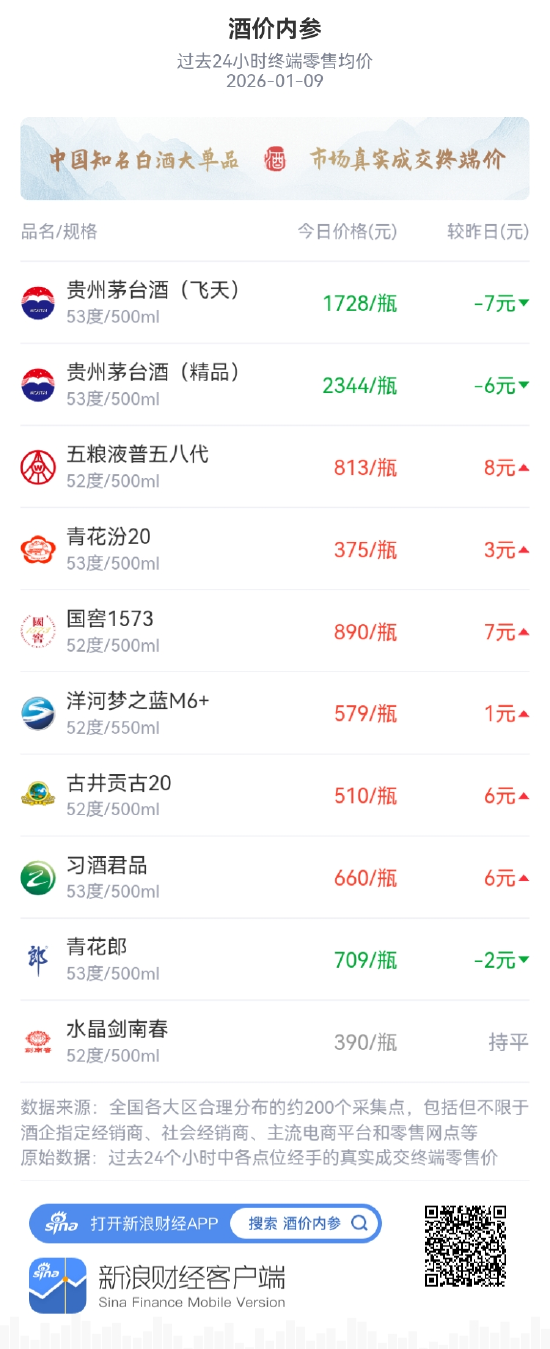
Core Viewpoint - The Chinese liquor market is experiencing a rebound in retail prices for major products after a period of decline, indicating a stabilization in market sentiment [1]. Price Trends - The average retail price of the top ten Chinese liquor products increased to 8998 yuan, up by 16 yuan from the previous day [1]. - Major products showing price increases include: - Wuliangye Pu Wuyi 8th generation: up 8 yuan per bottle - Guojiao 1573: up 7 yuan per bottle - Gujing Gong 20 and Xijiu Junpin: up 6 yuan per bottle each - Qinghua Fen 20: up 3 yuan per bottle - Yanghe Dream Blue M6+: up 1 yuan per bottle, marking five consecutive days of increases - Shuijing Jiananshun: price remained stable [1][5]. Price Declines - Products experiencing price declines include: - Feitian Moutai: down 7 yuan per bottle - Boutique Moutai: down 6 yuan per bottle - Qinghua Lang: down 2 yuan per bottle [1][4]. Market Dynamics - The market is showing signs of recovery with most brands experiencing price increases and moderate volume growth, leading to a more positive market sentiment compared to previous days [1]. - The introduction of new sales channels for Moutai products, including the iMoutai platform, is expected to influence retail prices positively [2][3].
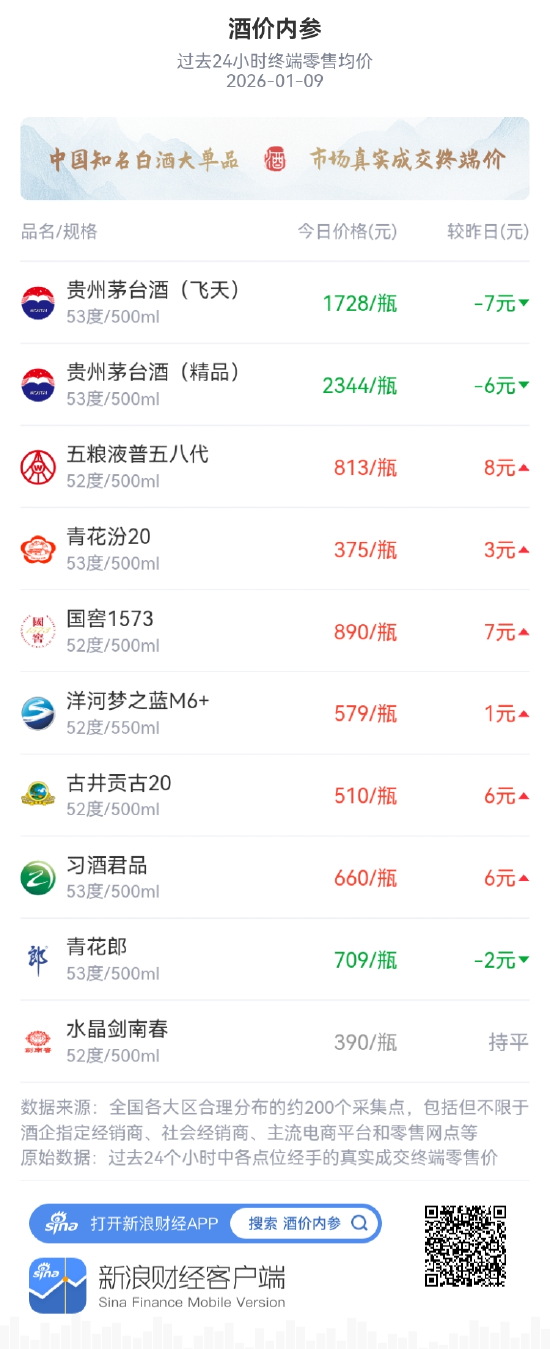
酒价内参1月9日价格发布 古井贡古20价格上涨6元/瓶
Xin Lang Cai Jing· 2026-01-09 01:33
Core Viewpoint - The Chinese liquor market is experiencing a rebound in retail prices for major products after a period of decline, indicating a stabilization in market sentiment [1]. Price Trends - The average retail price of the top ten liquor products increased to 8998 yuan, up by 16 yuan from the previous day [1]. - Major products showing price increases include: - Wuliangye Pu Wuyi 8th generation: up 8 yuan per bottle - Guojiao 1573: up 7 yuan per bottle - Guqingong 20 and Xijiu Junpin: up 6 yuan per bottle each - Qinghua Fen 20: up 3 yuan per bottle - Yanghe Dream Blue M6+: up 1 yuan per bottle, marking five consecutive days of increases - Shuijing Jiananshun: price remained stable [1][5]. Price Declines - Products experiencing price declines include: - Feitian Moutai: down 7 yuan per bottle - Boutique Moutai: down 6 yuan per bottle - Qinghua Lang: down 2 yuan per bottle [1][4]. Market Data Collection - The data is sourced from approximately 200 collection points across various regions, including designated distributors, social distributors, e-commerce platforms, and retail outlets, ensuring a comprehensive and objective representation of the market [2]. New Sales Channels - The launch of new sales channels for Moutai products, including the iMoutai platform selling Feitian Moutai at 1499 yuan per bottle and Boutique Moutai at 2299 yuan per bottle, is expected to influence market prices significantly [2][3].

价格失守、库存高企 白酒如何翻盘
Sou Hu Cai Jing· 2026-01-09 01:21
Core Insights - The Chinese liquor industry is facing significant challenges, including oversupply, high inventory levels, and price declines, leading to a shift from "volume and price increase" to "price stabilization" strategies for survival [2][4][12] Group 1: Market Conditions - The white liquor market in 2025 is characterized by dual pressures of "price stabilization" and "inventory reduction," making it difficult for companies to navigate [2][3] - Major brands like Moutai and Wuliangye have seen significant price drops, with Moutai's price falling from over 2500 yuan to below 2000 yuan per bottle [4] - Inventory levels among 20 listed liquor companies reached 168.39 billion yuan, an increase of 19.29 billion yuan year-on-year, indicating a persistent upward trend in stock levels [4] Group 2: Industry Strategies - Companies are moving away from traditional inventory pressure tactics and are instead focusing on inventory reduction while balancing market prices [5][6] - A "price protection" strategy has emerged, with companies like Wuliangye reducing contract volumes by 0%-50% to stabilize prices [6] - The industry is implementing strict measures against counterfeit products and pricing chaos, with Wuliangye reporting 268 counterfeit bottles identified in a consumer service initiative [6][7] Group 3: Future Outlook - The focus for 2026 will be on channel profitability, with companies emphasizing the need for distributors to earn profits rather than relying solely on price margins [8][9] - Companies are exploring new markets through youth-oriented products and innovative retail strategies, aiming to adapt to changing consumer preferences [10][11] - The industry is expected to see gradual improvements in supply and demand dynamics, with analysts predicting a recovery in sales and pricing in the medium term [11][12]

酒价内参1月9日价格发布 习酒君品价格上涨6元/瓶
Xin Lang Cai Jing· 2026-01-09 01:15
Core Insights - The Chinese liquor market has seen a rebound in retail prices for the top ten products as of January 9, following a period of decline, with an overall increase of 16 yuan in total price for a packaged set of these products, now totaling 8998 yuan [1][6][7] Price Trends - The market is experiencing a general upward trend, with notable price increases for several products: - Wuliangye Pu Wubai Dai increased by 8 yuan per bottle - Guojiao 1573 rose by 7 yuan per bottle - Gu Qing Gong Gu 20 and Xijiu Junpin both increased by 6 yuan per bottle - Qinghua Fen 20 saw a rise of 3 yuan per bottle - Yanghe Dream Blue M6+ increased by 1 yuan per bottle, marking five consecutive days of price increases - Meanwhile, prices for Feitian Moutai and Premium Moutai decreased by 7 yuan and 6 yuan per bottle respectively [1][7][10] Data Collection Methodology - The "Liquor Price Reference" collects data from approximately 200 sampling points across various regions, including designated distributors, social distributors, e-commerce platforms, and retail outlets, aiming to provide an objective and traceable representation of the market prices for well-known liquors [2][8] Market Influences - The launch of new sales channels for Feitian Moutai at 1499 yuan per bottle and Premium Moutai at 2299 yuan per bottle on the iMoutai platform is expected to have a significant impact on the market prices for these products [2][8] Product Launches - iMoutai announced adjustments to the release schedule for Premium Moutai and other products, with specific purchase limits set for consumers starting January 9, 2023, and additional products being introduced on January 10, 2023 [3][8]
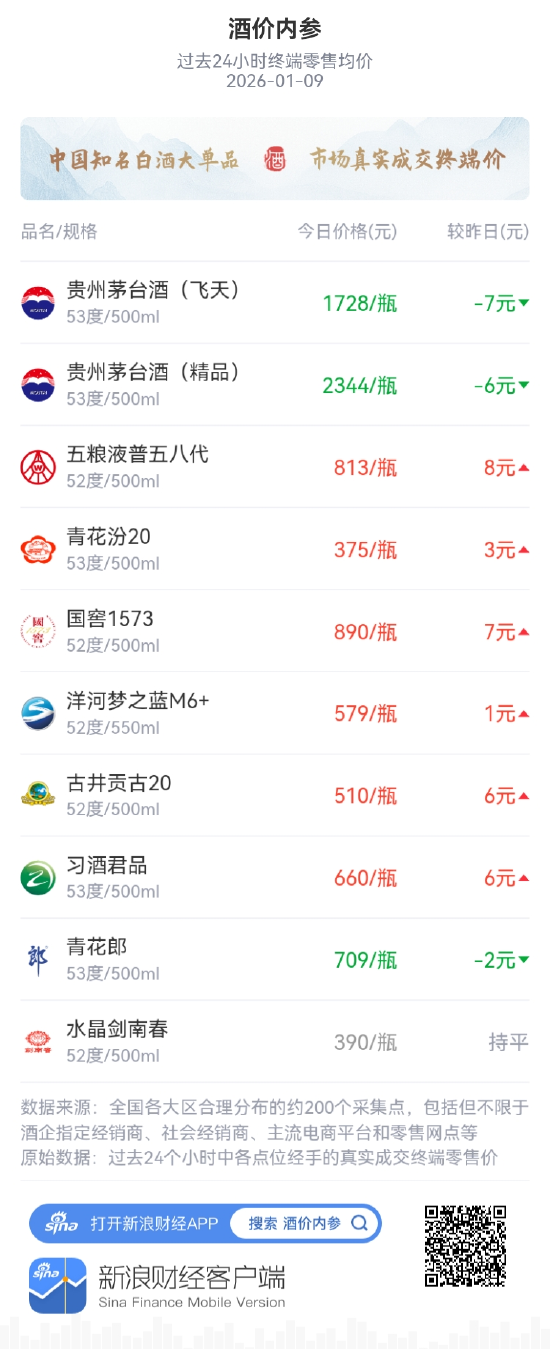
酒价内参1月9日价格发布 国窖1573价格上涨7元/瓶
Xin Lang Cai Jing· 2026-01-09 01:15
Core Insights - The Chinese liquor market has seen a rebound in retail prices for the top ten products as of January 9, following a period of decline, with an overall increase of 16 yuan, bringing the total price for a package of these products to 8998 yuan [1][6]. Price Trends - The market is experiencing a general upward trend, with notable price increases for several products: - Wuliangye Pu Wubai Dai increased by 8 yuan per bottle - Guojiao 1573 rose by 7 yuan per bottle - Gu Qing Gong Gu 20 and Xijiu Junpin both increased by 6 yuan per bottle - Qinghua Fen 20 saw a rise of 3 yuan per bottle - Yanghe Dream Blue M6+ increased by 1 yuan per bottle, marking five consecutive days of price increases - Meanwhile, prices for Feitian Moutai and Premium Moutai decreased by 7 yuan and 6 yuan per bottle, respectively [1][7][10]. Data Collection Methodology - The "Liquor Price Reference" collects data from approximately 200 sampling points across various regions, including designated distributors, social distributors, e-commerce platforms, and retail outlets, aiming to provide objective and traceable pricing data for well-known liquor products [2][8]. Market Impact of New Sales Channels - The launch of new sales channels for Feitian Moutai at 1499 yuan per bottle and Premium Moutai at 2299 yuan per bottle is expected to influence the market prices significantly, with the potential for a magnetic effect on retail prices [2][8]. Product Launches and Adjustments - iMoutai announced adjustments to the release schedule for Premium Moutai and other products, with specific purchase limits and scheduled release dates throughout the year, including key periods such as the Spring Festival and Mid-Autumn Festival [3][8].
酒价内参1月9日价格发布 五粮液普五八代环比上涨8元/瓶
Xin Lang Cai Jing· 2026-01-09 01:15
Core Insights - The article highlights a significant rebound in the retail prices of major Chinese liquor brands, particularly in the white liquor market, after a period of decline, indicating a stabilization in market sentiment [1][6]. Price Trends - The average retail price of the top ten white liquor products increased to 8998 yuan, up by 16 yuan from the previous day [1][6]. - Major brands such as Wuliangye and Guojiao 1573 saw price increases of 8 yuan and 7 yuan per bottle, respectively, while Moutai products experienced a decline of 7 yuan for the Flying Moutai and 6 yuan for the Premium Moutai [7][10]. Market Data Collection - The "Wine Price Reference" collects data from approximately 200 points across various regions, including designated distributors and retail outlets, to provide an objective and traceable overview of market prices [2][8]. - The introduction of new sales channels for Moutai products, such as the iMoutai platform, is expected to influence the market prices of Flying Moutai and Premium Moutai [2][8]. Product Launches and Adjustments - iMoutai announced the launch of new Moutai products with specific purchase limits starting January 9, including the Premium Moutai and Flying Moutai, which will be available in different sizes [3][8]. - The company plans to optimize the release schedule for Moutai products over the coming years, with key sales periods identified throughout the year [3][8].