
DEHUA TB(002043)

Search documents
2政策+资金双重暴击!建材行业震荡走高掀全民狂欢,龙头股集体暴走引领顺周期反攻新浪潮!
Sou Hu Cai Jing· 2026-01-22 11:25
Core Viewpoint - The A-share building materials sector is experiencing a strong upward trend, with multiple stocks showing active performance, driven by market expectations for a cyclical recovery in the sector [1] Group 1: Policy and Economic Support - The Ministry of Housing and Urban-Rural Development has released an opinion on improving housing quality, aiming for significant enhancements in housing standards, design, materials, construction, and operation by 2030, which directly benefits the consumption of building materials, waterproofing, and glass sectors [1] - The central bank has lowered various structural monetary policy tool rates by 0.25 percentage points, with the one-year re-lending rate reduced from 1.5% to 1.25%, aimed at promoting stable economic growth and providing liquidity support for the recovery of real estate and infrastructure sectors, indirectly boosting demand in the building materials industry [1] Group 2: Infrastructure and Supply Chain Developments - The issuance of special bonds by local governments has accelerated, with a total issuance scale of 0.18 trillion yuan, an increase of 0.10 trillion yuan year-on-year, easing government fiscal pressure and supporting demand for cement and pipe materials through accelerated municipal engineering and pipeline construction projects [2] - The building materials industry has seen improvements in supply-demand dynamics after five years of capacity clearance, with the waterproofing sector's concentration rapidly increasing, and a significant reduction in floating glass daily melting capacity by 27,200 tons compared to the 2021 peak, alongside a 160 million ton capacity exit in the cement industry, alleviating supply pressures and laying the foundation for profit recovery [2] Group 3: Sector-Specific Benefits - The waterproofing industry is expected to benefit from housing quality improvement policies, the release of renovation demand, and supply-side clearance, with leading companies projected to experience revenue declines significantly lower than the industry average from 2021 to 2024, and further price increases anticipated in 2025 [3] - The glass processing industry is poised to gain from accelerated cold repairs in floating glass production capacity and a balanced supply-demand structure, alongside increased demand for high-end glass driven by housing quality improvements [3] - The pipe and pipeline industry is supported by the rapid implementation of infrastructure projects and municipal pipeline renovation policies, with municipal engineering projects accelerating, directly benefiting related pipe material companies from the recovery in infrastructure demand [3]


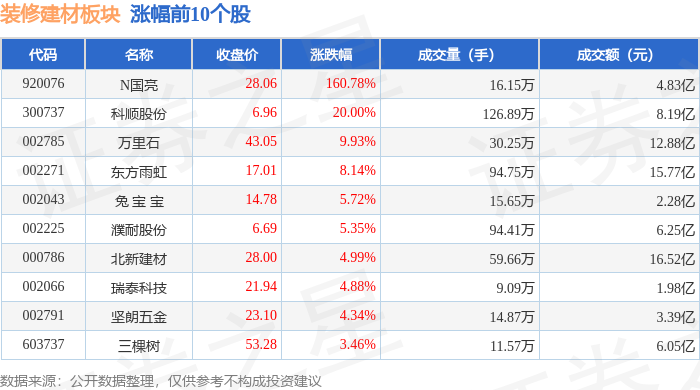
装修建材板块1月22日涨4.03%,N国亮领涨,主力资金净流入6805.53万元
Zheng Xing Xing Ye Ri Bao· 2026-01-22 09:02
Market Performance - The renovation and building materials sector increased by 4.03% compared to the previous trading day, with N国亮 leading the gains [1] - The Shanghai Composite Index closed at 4122.58, up 0.14%, while the Shenzhen Component Index closed at 14327.05, up 0.5% [1] Stock Highlights - N国亮 (code: 920076) saw a significant rise of 160.78%, closing at 28.06 with a trading volume of 161,500 shares and a transaction value of 483 million [1] - 科顺股份 (code: 300737) increased by 20.00%, closing at 6.96 with a trading volume of 1,268,900 shares and a transaction value of 819 million [1] - 万里石 (code: 002785) rose by 9.93%, closing at 43.05 with a trading volume of less than 302,500 shares and a transaction value of 1.288 billion [1] - 东方雨虹 (code: 002271) increased by 8.14%, closing at 17.01 with a trading volume of 947,500 shares and a transaction value of 1.577 billion [1] Capital Flow - The renovation and building materials sector experienced a net inflow of 68.06 million from institutional investors, while retail investors contributed a net inflow of 64.30 million [2] - The sector saw a net outflow of 132 million from speculative funds [2] Individual Stock Capital Flow - 科顺股份 had a net outflow of 50.83 million from institutional investors, while retail investors had a net inflow of 1.72 million [3] - 东方雨虹 experienced a net inflow of 34.78 million from institutional investors, but a net outflow of 51.34 million from retail investors [3] - N国亮 had a net inflow of 11.20 million from institutional investors, with a net outflow of 12.43 million from retail investors [3]



建材板块震荡走高,金隅集团涨超10%


Xin Lang Cai Jing· 2026-01-22 05:53
Group 1 - The building materials sector experienced a significant upward trend, with Jinju Group rising over 10% [1] - Dongfang Yuhong saw an increase of more than 7% [1] - Other companies such as China Jushi, Tubao, Beixin Building Materials, and Yaopi Glass also followed the upward trend [1]
建材行业点评:量变累积,建材行业复苏可期
Shenwan Hongyuan Securities· 2026-01-21 10:41
Investment Rating - The report maintains a positive outlook on the building materials industry, indicating a "Look Forward" investment rating [3][4]. Core Insights - The real estate sector has experienced a downturn for five consecutive years, but there are emerging positive signals that warrant attention. The building materials industry has faced pressures such as declining demand, credit risk expansion, cost disturbances, and intensified competition [4][5]. - Over the past five years, the industry has undergone significant capacity clearance, with a cumulative decline of 38% in waterproof materials production from 2021 to 2024. In contrast, the top three companies in this sector have seen a revenue decline of only 20.9%, indicating a rapid increase in industry concentration [4][5]. - Strategic transformations have been completed by several leading building materials companies, enhancing their competitive positions and adapting to market changes. Companies like Dongfang Yuhong and Keshun have successfully restructured their channels and expanded into new markets [6]. - There is an anticipated surge in renovation demand due to the aging housing stock, with a significant portion of homes being over 20 years old. The report predicts that by 2025, second-hand housing transactions will account for 70% of the market, which will likely stimulate renovation activities [7][9]. - Policy adjustments have been noted, with government signals indicating support for the real estate sector, including tax incentives for housing transactions. This is expected to positively influence market sentiment and investment in the building materials sector [9]. Summary by Sections Industry Overview - The building materials industry has faced five years of challenges, but recent developments suggest a potential recovery. The report emphasizes the importance of viewing the industry from a long-term perspective [4][5]. Capacity and Production - The report highlights a significant reduction in production capacity across various segments, including a 38% decline in waterproof materials and a 1.6 billion ton reduction in cement capacity, which has alleviated supply pressures [4][5]. Strategic Transformations - Notable companies have successfully navigated strategic transformations, with improvements in asset quality and revenue growth. For instance, Dongfang Yuhong has seen a substantial increase in retail business revenue [6]. Demand Dynamics - The report anticipates a shift in demand dynamics, particularly in the renovation market, driven by an aging housing stock and changing consumer preferences. This is expected to lead to increased demand for building materials [7]. Policy Environment - Recent policy changes are viewed as supportive of the real estate market, with indications of government backing for housing transactions and urban renewal initiatives [9]. Investment Recommendations - The report suggests focusing on core consumer building materials stocks, particularly those positioned to benefit from anticipated increases in construction activity and renovation demand [9].




地产链这些年都经历了什么
2026-01-21 02:57
Summary of the Conference Call on the Real Estate Supply Chain Industry Overview - The real estate supply chain, particularly in the consumer building materials sector, has undergone significant changes over the past four years, with a turning point expected in Q3 2025 when leading companies will see revenue and profit growth year-on-year in Q4 2025, indicating independent growth through strategies like stock renovation, channel expansion, and internationalization despite ongoing industry pressures [1][2] Key Points and Arguments - **Supply Side Changes**: - Companies are enhancing profits through asset impairment, while many peers are exiting or transforming their businesses. The consumer building materials sector is currently undervalued, with most leading companies emerging from difficulties, and a growth trend expected to continue into 2026 [3] - The competition among leading companies is slowing, with strategies such as channel expansion and product diversification being employed to seek new growth points. Price increases in coatings and waterproof materials are anticipated in 2025, with gypsum board also expected to see price hikes in 2026, reflecting a trend of compromise and coexistence among leading firms [4] - **Impact of Urban Renewal Policies**: - Urban renewal policies are significantly boosting the building materials industry, with measures aimed at accelerating the transformation of the stock market to address challenges posed by a declining new housing market. By the end of 2024, there will be approximately 420 million housing units and over 50 billion square meters of total construction area in urban and rural areas, providing substantial demand support for the building materials sector [5] - **Performance in Specific Segments**: - The coatings sector has seen multiple price increases since 2021, with another expected in Q1 2025. Waterproof materials are also set for price hikes in mid-2025, while gypsum board has already undergone several price adjustments. These price changes indicate a shift in demand from the supply side, with these segments stabilizing prices and gradually restoring profitability during a demand downturn [6] - **Revenue Structure Adjustment and Cost Reduction**: - Building materials companies are shifting from reliance on large B clients (real estate bulk purchases) to small B and C end customers (retail market), improving gross margins through channel adjustments and product upgrades. Cost reduction and efficiency measures are expected to show results post-2025, with a notable decrease in expense ratios and improved financial conditions [7] Additional Important Insights - **Current Valuation of the Consumer Building Materials Sector**: - The sector is currently undervalued, showing signs of recovery after several years of adjustment. Leading companies are expected to continue this growth trend into 2026, with ongoing cost reduction measures and diminishing historical issues impacting financial reports, making it a favorable investment opportunity [8] - **Market Expectations and Demand Characteristics**: - Market expectations for the consumer building materials sector are low, with overall demand recovery anticipated to take time. However, there are signs of stabilization and differentiation, such as leading coatings companies exploring the second-hand housing market and non-housing demand growth in sectors like pipes and waterproof materials [9][10] - **Price Elasticity and Supply Structure Expectations**: - Current profit forecasts and valuations for companies have not fully reflected price elasticity. The supply structure has undergone deep adjustments, with small capacities exiting the market, leading to a concentration of market share among companies with brand, channel, and resource advantages, enhancing their pricing power and management capabilities [11] - **Investment Recommendations**: - Investors are advised to focus on companies such as Three Trees, Oriental Yuhong, Henkel Group, and Rabbit Baby, as well as Beixin Building Materials, Weixing New Materials, China Liansu, and ASEAN Holdings, which are decoupling from real estate and transitioning towards C-end and small B clients, with many beginning to expand internationally [12] - **Future Industry Outlook**: - Companies in the industry are making significant efforts to adapt to the current environment, including international expansion, product category diversification, and exploring structural opportunities in the second-hand housing market. While high expectations for rapid demand recovery are tempered, there is confidence that more companies will find recovery opportunities over time, with more sub-sectors expected to stabilize in 2026 [13]


未知机构:华福建筑建材地产及地产链大涨点评上层态度变化政策渴望以及板块高低切的共振-20260121
未知机构· 2026-01-21 02:15
Summary of Conference Call Notes Industry Overview - The real estate and building materials sector experienced a significant increase, primarily driven by market rumors regarding policy relaxation in Shanghai and expectations of more substantial policy measures to follow [1][2] Core Insights and Arguments - A reassessment of the real estate and related sectors is deemed necessary at this juncture [2] - Key points highlighted in the commentary from "Qiushi" include: 1. Recognition of real estate as a significant financial asset, central to household wealth [3] 2. The need for comprehensive policy measures rather than incremental adjustments, indicating potential for new expectations regarding policy strength and breadth [3] - Statistical data from the National Bureau of Statistics indicates a decline in real estate investment by 17% year-on-year, new construction down by 20%, completions down by 18%, sales area down by 9%, and sales revenue down by 13% [3] - Despite the overall decline in data, the marginal negative impact on the building materials industry has noticeably weakened [3] - The fundamental investment logic in the building materials sector is centered on "supply-side improvement" preceding "demand-side recovery" [3] - Under the "anti-involution" policy direction, price coordination in industries like cement is beginning to show results, with profit levels continuing to recover [3] - The consumer building materials sector, including waterproofing and coatings, is entering the final phase of clearing out excess, with an improved competitive landscape and positive changes in gross margins and expense ratios for leading companies in specific segments [3] Recommendations - Recommended to focus on high-credit, high-quality real estate developers benefiting from policy rumors, such as China Merchants Shekou and Binjiang Group [4] - Suggested to pay attention to leading companies in the real estate supply chain that are expected to benefit from anticipated demand recovery, including Oriental Yuhong, Beixin Building Materials, Sankeshu, and Tubao [4]


兔宝宝股价涨5.04%,摩根基金旗下1只基金重仓,持有50.29万股浮盈赚取34.2万元
Xin Lang Cai Jing· 2026-01-20 03:28
Group 1 - The stock of Rabbit Baby (兔宝宝) increased by 5.04%, reaching a price of 14.17 yuan per share, with a trading volume of 98.29 million yuan and a turnover rate of 0.96%, resulting in a total market capitalization of 11.758 billion yuan [1] - Rabbit Baby, officially known as 德华兔宝宝装饰新材股份有限公司, was established on December 27, 2001, and went public on May 10, 2005. The company specializes in the production and sales of decorative materials, including decorative panels, paints, wall coatings, adhesives, and various furniture products [1] - The main revenue composition of Rabbit Baby includes decorative materials at 77.04%, cabinet products at 12.15%, brand usage fees at 5.54%, flooring at 3.90%, other products at 0.79%, and wooden doors at 0.58% [1] Group 2 - Morgan Fund has a significant holding in Rabbit Baby, with the Morgan Large Cap Blue Chip Stock A Fund (376510) holding 502,900 shares, accounting for 3.39% of the fund's net value, making it the eighth largest holding [2] - The Morgan Large Cap Blue Chip Stock A Fund has a total size of 158 million yuan and has achieved a year-to-date return of 0.78%, ranking 4954 out of 5542 in its category, while its one-year return is 14.87%, ranking 3635 out of 4235 [2] - The fund manager of Morgan Large Cap Blue Chip Stock A is Li Heng, who has been in the position for 8 years and 362 days, with the fund's best return during his tenure being 215.79% and the worst being -31.9% [3]
年末需求进入淡季,关注供给改善品种 | 投研报告
Sou Hu Cai Jing· 2026-01-20 01:51
Group 1: Cement Industry - The national market is gradually entering the off-season, with overall demand showing a downward trend, particularly in the housing construction market, while infrastructure demand is regionally differentiated under policy influence, and the civil market shows relatively rigid demand [1] - In the medium term, the cement industry's capacity is expected to continue declining under policies limiting overproduction, leading to a significant increase in capacity utilization and profit elasticity [1] - Key companies to watch include Conch Cement and Huaxin Cement [1] Group 2: Glass Industry - The demand side is experiencing a continuous decline in 2025 due to the impact of real estate, with short-term demand during the traditional peak season showing limited improvement and high inventory levels among intermediaries [1] - The supply side faces ongoing supply-demand contradictions, and despite recent cold repairs of multiple production lines, prices are expected to remain low and fluctuate in the short term [1] - Key company to watch is Qibin Group [1] Group 3: Glass Fiber Industry - As the year-end approaches, many pool kiln factories focus on cash collection, resulting in weak performance in middle and downstream deliveries [2] - The supply side sees the completion of cold repairs at China Jushi's production line, with a resurgence in production; the electronic yarn segment is thriving due to demand from the AI industry, leading to a rise in both volume and price for low dielectric products [2] - Key companies to watch include China Jushi and China National Building Material [2] Group 4: Consumer Building Materials - The industry has reached a profitability bottom, with prices having no downward space after years of competition; there is a strong demand for price increases and profit improvement driven by anti-involution policies [2] - In 2025, multiple categories such as waterproofing, coatings, and gypsum boards are expected to issue price increase notices, with anticipated profit improvements for leading companies in 2026 [2] - Key companies to watch include Oriental Yuhong, Sankeshu, Beixin Building Materials, and Rabbit Baby [2] Group 5: Market Overview - In the past week (January 12–18), the main index performance was as follows: the Shenwan Building Materials Industry Index decreased by 0.67%, the Shanghai Composite Index decreased by 0.45%, the Shenzhen Component Index increased by 1.14%, the ChiNext Index increased by 1.00%, and the CSI 300 Index decreased by 0.57% [2] - Among the 31 first-level sub-industry indices in Shenwan, the building materials sector ranked 18th in terms of performance [2]

政策组合拳助力“开门红”,看好玻纤景气度向上
East Money Securities· 2026-01-18 13:27
Investment Rating - The report maintains a "Strong Buy" rating for the fiberglass sector, indicating a positive outlook for investment opportunities in this industry [2]. Core Insights - The report highlights a favorable policy environment that is expected to support the fiberglass sector's growth, particularly in 2026, with anticipated price increases for electronic fabrics due to supply constraints and high demand for mid-to-high-end products [7][11]. - The report emphasizes the importance of leading companies in the construction materials sector, which are expected to show resilience and profitability as the real estate market stabilizes [7][11]. Summary by Sections Cement - The cement market is entering a seasonal slowdown, with prices expected to decline as demand weakens ahead of the Chinese New Year. The average price is around 353 RMB/ton, with a decrease of 4.7 RMB/ton week-on-week [25][27]. - Southern regions are experiencing a temporary uptick in demand due to project completions before the holiday, while northern regions face declining demand due to cold weather [32][34]. Glass - Float glass prices have seen a slight increase, with an average price of 1,138 RMB/ton, while inventory levels have decreased by 4% week-on-week [35]. - The report anticipates a stable price environment for glass in the short term, with supply reductions expected to support price stabilization as the industry faces ongoing profitability challenges [44]. Fiberglass - The report notes that electronic fabric prices have increased, with the G75 electronic yarn priced between 9,300-9,700 RMB/ton, and the 7628 electronic fabric priced at 4.4-4.85 RMB/meter, reflecting a stable demand and supply situation [49]. - The fiberglass sector is expected to benefit from structural adjustments in product offerings, leading to a favorable supply-demand balance and potential price increases in 2026 [11][45]. Carbon Fiber - Carbon fiber prices are expected to remain stable in the short term, with the report highlighting the potential for increased demand driven by advancements in commercial aerospace [11][13].

建材行业双周报(2026/01/02-2026/01/15):“稳地产”信号持续释放,建材供给侧“优化”进一步推进-20260116
Dongguan Securities· 2026-01-16 08:32
Investment Rating - The industry investment rating is "Market Weight" [51] Core Insights - The construction materials industry is experiencing a continuous release of "stabilizing real estate" signals, with further optimization of supply-side measures [2][42] - Cement production is strictly regulated according to approved capacity, with over 280 clinker production lines replaced by the end of 2025, resulting in an annual capacity reduction of 150 million tons [3][42] - The glass fiber industry is undergoing a structural recovery driven by "anti-involution" policies, with demand shifting from traditional construction materials to high-growth emerging fields [44] Summary by Sections Industry Overview - The construction materials sector has shown a 3.37% increase over the past two weeks, outperforming the CSI 300 index by 0.75 percentage points [11] - The cement market is facing a decline in production and prices due to reduced demand from real estate and infrastructure [3][21] Cement - The average price of cement is currently 316 RMB/ton, down 2 RMB from the previous week, with regional variations in demand affecting prices [21] - The cement industry is expected to see demand supported by major infrastructure projects and urban renewal in 2026, despite ongoing price fluctuations [3][43] Glass and Glass Fiber - The average price of float glass in December 2025 was 1121.29 RMB/ton, reflecting a month-on-month decrease of 8.14% and a year-on-year decrease of 18.0% [44] - The glass fiber sector is benefiting from high demand in advanced applications such as AI servers and 5G communications, with a focus on upgrading production technologies [44] Consumer Building Materials - The Ministry of Commerce and other departments have issued a notice promoting green consumption, which is expected to drive growth in the renovation and urban renewal sectors [45] - Leading companies are enhancing their market share through brand advantages and service improvements, focusing on retail and overseas expansion [45] Recommended Stocks - The report suggests focusing on companies with strong fundamentals and high dividend yields, including Shangfeng Cement (000672), Tapai Group (002233), and Huaxin Cement (600801) [43][46]