Yanghe(002304)

Search documents
吃喝板块突遇“闪崩”,洋河股份暴跌近9%!食品饮料ETF华宝(515710)跌超1%,估值低位布局正当时?
Xin Lang Ji Jin· 2026-01-26 02:29
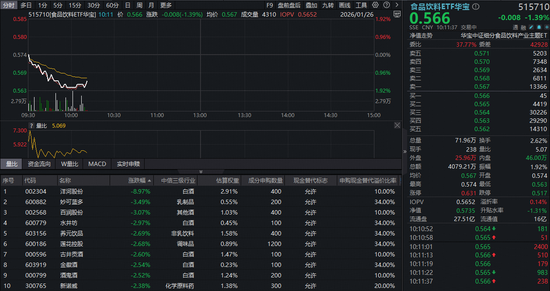
Group 1 - The food and beverage sector continues to experience a downturn, with the Huabao Food and Beverage ETF (515710) showing a decline of 1.39% as of the latest report [1][2] - Major stocks in the sector, particularly in the liquor category, have seen significant drops, with Yanghe Co. falling nearly 9% and other brands like Gujing Gongjiu and Shui Jing Fang dropping over 2% [1][3] - The recent addition of new shipping warehouses in Nanjing and Beijing by "iMoutai" aims to enhance logistics efficiency in response to increased order volumes and winter weather challenges [3][4] Group 2 - Analysts suggest that the food and beverage sector is currently at a historical low in terms of valuation, making it a potentially good time for left-side positioning in the market [3][4] - The price-to-earnings ratio for the food and beverage ETF is reported at 19.39, which is at the 1.76% percentile of the last decade, indicating a favorable long-term investment opportunity [3][4] - Market trends indicate a preference for sectors like snacks and dairy, which are expected to perform well due to policy support and improving monthly data, while the liquor sector is in a phase of consolidation and preparation for upcoming demand [4][5]


酒价内参1月26日价格发布 十大单品涨跌互现青花郎领涨
Xin Lang Cai Jing· 2026-01-26 01:17
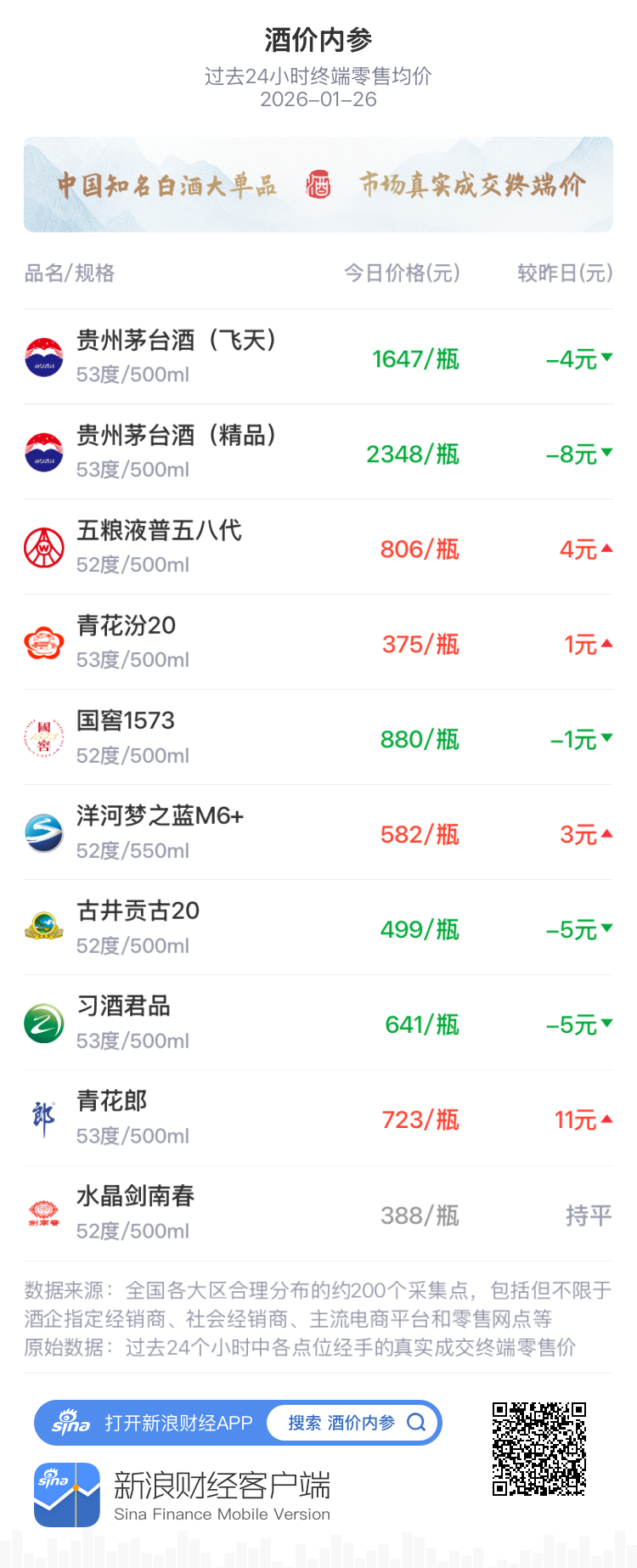
Core Viewpoint - The Chinese liquor market is experiencing a weak price differentiation among the top ten products, with a slight overall decline in retail prices, indicating a phase of market rebalancing [1]. Price Trends - The total retail price for a package of the top ten liquor products is 8,889 yuan, down by 4 yuan from the previous day [1]. - The market shows four products increasing in price, five decreasing, and one remaining stable [1]. Price Increases - Qinghua Lang leads the price increase with an 11 yuan rise per bottle, marking four consecutive days of price growth [1]. - Wuliangye and Mengzhilan M6+ saw increases of 4 yuan and 3 yuan per bottle, respectively, providing support in the mid-range segment [1]. - Qinghua Fen 20 experienced a slight increase of 1 yuan per bottle [1]. Price Decreases - Premium Moutai saw a price drop of 8 yuan per bottle [1]. - Xijiu Junpin and Gujing Gonggu 20 both decreased by 5 yuan per bottle [1]. - Feitian Moutai fell by 4 yuan per bottle due to normalized supply from the iMoutai platform [1]. - Guojiao 1573 experienced a minor decline of 1 yuan per bottle [1]. - Shujin Jianan Spring's price remained unchanged from the previous day [1]. Specific Product Prices - Feitian Moutai: 1,647 yuan per bottle, down 4 yuan [3]. - Premium Moutai: 2,348 yuan per bottle, down 8 yuan [3]. - Wuliangye: 806 yuan per bottle, up 4 yuan [3]. - Qinghua Fen 20: 375 yuan per bottle, unchanged [3]. - Guojiao 1573: 880 yuan per bottle, down 1 yuan [3]. - Mengzhilan M6+: 582 yuan per bottle, up 3 yuan [4]. - Gujing Gonggu 20: 499 yuan per bottle, down 57 yuan [4]. - Xijiu Junpin: 641 yuan per bottle, down 57 yuan [4]. - Qinghua Lang: 723 yuan per bottle, up 11 yuan [4]. - Shujin Jianan Spring: 388 yuan per bottle, unchanged [4].




食品饮料行业周报:茅台批价坚挺旺季氛围渐起,鸣鸣很忙上市催化零食板块-20260125
Shenwan Hongyuan Securities· 2026-01-25 13:08
Investment Rating - The report maintains a positive outlook on the liquor sector, particularly on premium brands like Guizhou Moutai, Luzhou Laojiao, and Shanxi Fenjiu, while also highlighting the potential of other brands such as Wuliangye and Jinjing Wine [2][7]. Core Insights - The liquor market is undergoing a restructuring phase, with expectations of a double-digit decline in sales year-on-year for Q1 2026, but a potential stabilization in Q2 and a turning point in Q3 [2][7]. - The report anticipates a recovery in the liquor sector by the end of 2026 and into 2027, driven by improved fundamentals and valuation [2][7]. - The consumer goods sector is showing structural improvements, with competition shifting from price to quality, leading to a gradual balance in supply and demand [2][9]. Summary by Sections 1. Weekly Insights on Food and Beverage - The food and beverage sector saw a decline of 1.41% last week, with liquor down 2.80%, underperforming the Shanghai Composite Index by 2.25 percentage points [6]. - Notable stock performances included a 19.59% increase for Haoxiangni and a 14.32% rise for Wancheng Group [6]. 2. Market Performance of Food and Beverage Sectors - The report highlights the price stability of Moutai, with a current price of 1560 RMB per bottle, up 20 RMB from the previous week, indicating a positive trend in pricing [8][27]. - The report notes that Moutai's pricing has found a bottom, reducing downward risks significantly, and anticipates a potential increase in sales volume as the Spring Festival approaches [8]. 3. Industry Events and Updates - The report mentions the upcoming IPO of Mingming Hen Mang, a leading snack retail chain, which is expected to catalyze the snack sector [10]. - The report emphasizes the importance of supply chain management and digitalization in enhancing competitive advantages for companies like Mingming Hen Mang [10]. 4. Valuation Table - The food and beverage sector's dynamic PE is currently at 19.27x, with a premium rate of 10%, while the liquor sector's dynamic PE stands at 17.50x, indicating a zero premium [27].
洋河70万吨优质原酒:天赋与坚守筑就的行业“护城河”
Zhong Jin Zai Xian· 2026-01-25 09:01
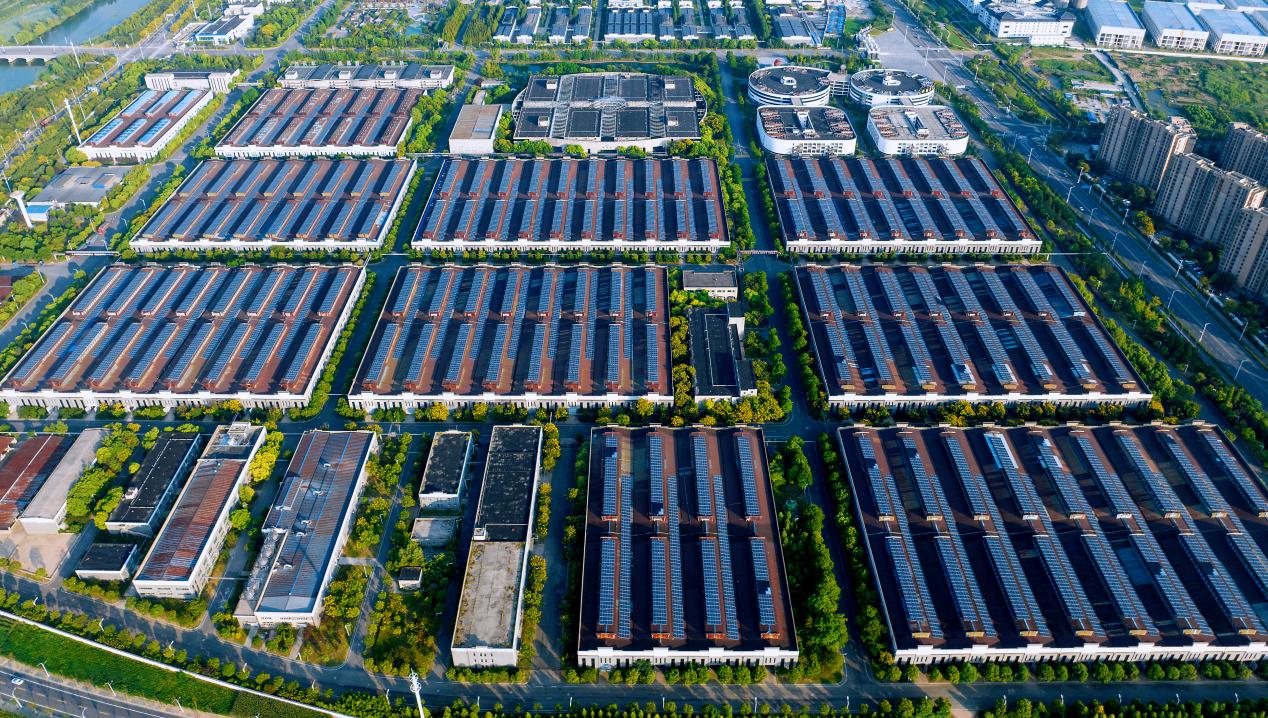
Core Insights - The Chinese liquor industry is undergoing a significant adjustment phase characterized by weak sales, declining profits, and high inventory levels, with a reported production decrease of 11.5% year-on-year from January to October 2025 [1] - Yanghe Co. has leveraged its substantial reserve of 700,000 tons of original liquor to establish a differentiated competitive barrier, positioning itself favorably for future growth despite the industry's challenges [1][4] Industry Overview - The current liquor market is experiencing intensified competition, leading to a rapid industry reshuffle where the strategic value of original liquor reserves has become paramount [2][4] - Many smaller liquor companies are reducing production and compromising on quality due to insufficient original liquor, while leading companies are focusing on volume control and price stability [4] Company Strengths - Yanghe's original liquor reserve is a result of its unique geographical advantages and long-term strategic commitment, with its production site located in a renowned liquor-producing region [4] - The company has consistently adhered to a strategic reserve policy, ensuring a portion of high-quality base liquor is set aside for long-term storage, contributing to its competitive edge [4] Product Strategy - Yanghe has introduced the concept of "real aging" in the light bottle liquor segment, emphasizing a "100% three-year aged" product to align with consumer trends favoring quality over packaging [5][6] - The seventh generation of "Hai Zhi Lan" has undergone a quality upgrade, enhancing its market position through improved taste and sufficient original liquor supply [6] Market Positioning - In the premium segment, the "Meng Zhi Lan M6+" has maintained stable pricing and strengthened its brand value, allowing Yanghe to avoid the pitfalls of price wars [8] - The company is focusing on strategic markets such as the Yangtze River Delta and major cities to reinforce its market presence and address high inventory levels through targeted policies and activities [8][9] Future Outlook - Yanghe's comprehensive strategies, including its original liquor reserves and channel reforms, are expected to create a synergistic effect, potentially leading to a gradual recovery in the market [9] - While challenges remain, such as inventory digestion and regional competition, Yanghe's solid foundation and pragmatic reforms may facilitate a gradual upward trend in performance [9]
酒行业周度市场观察-20260125
Ai Rui Zi Xun· 2026-01-25 03:02
Investment Rating - The report does not explicitly provide an investment rating for the industry Core Insights - The Australian wine market is reshaping the Chinese imported wine market after a year and a half of absence, with a significant initial increase in imports followed by a decline in sales due to inventory issues and economic pressures [2] - The low-alcohol beverage category is rapidly growing, appealing to younger consumers, but faces challenges such as brand homogenization and declining repurchase rates [2] - The white liquor industry is experiencing a shift in market dynamics, with top brands competing fiercely and some companies facing their first quarterly negative growth in nearly a decade [4] - New beverage products are emerging, with brands like Xiaojin Wine and Guoli Fang successfully capturing market share through innovative approaches [5] - The industry is expected to return to rationality in 2026, focusing on consumer needs and product quality, while smaller companies may face elimination [6] Industry Environment - The Australian wine market is seeing a resurgence in China due to the removal of anti-dumping taxes, but initial sales have not met expectations, leading to inventory issues and price reductions [2] - The low-alcohol market is projected to grow from 20 billion yuan in 2020 to 57 billion yuan by 2024, but faces challenges in brand differentiation and consumer loyalty [2] - The white liquor market is undergoing structural changes, with companies like Shanxi Fenjiu surpassing others in revenue, indicating a competitive landscape [4] - The introduction of innovative products is crucial for the industry's transformation, with a focus on low-alcohol and health-oriented offerings [5] - The industry is moving towards a more rational approach, emphasizing product quality and consumer experience, as it transitions from a bubble phase to a healthier growth period [6] Top Brand Dynamics - Guizhou Zhenjiu is upgrading its "Dazhen" product to enhance quality and market positioning, aiming to compete with top brands like Moutai [8] - Wuliangchun is celebrating its 30th anniversary with a marketing campaign that deepens emotional connections with consumers [9] - Xifengjiu is focusing on quality and cultural empowerment to drive its revival in the competitive white liquor market [10] - Moutai is launching a new product structure to meet diverse consumer needs and stabilize its market presence [14] - Niulanshan is evolving its product strategy to maintain its position in the mass market while enhancing emotional connections with consumers [18]
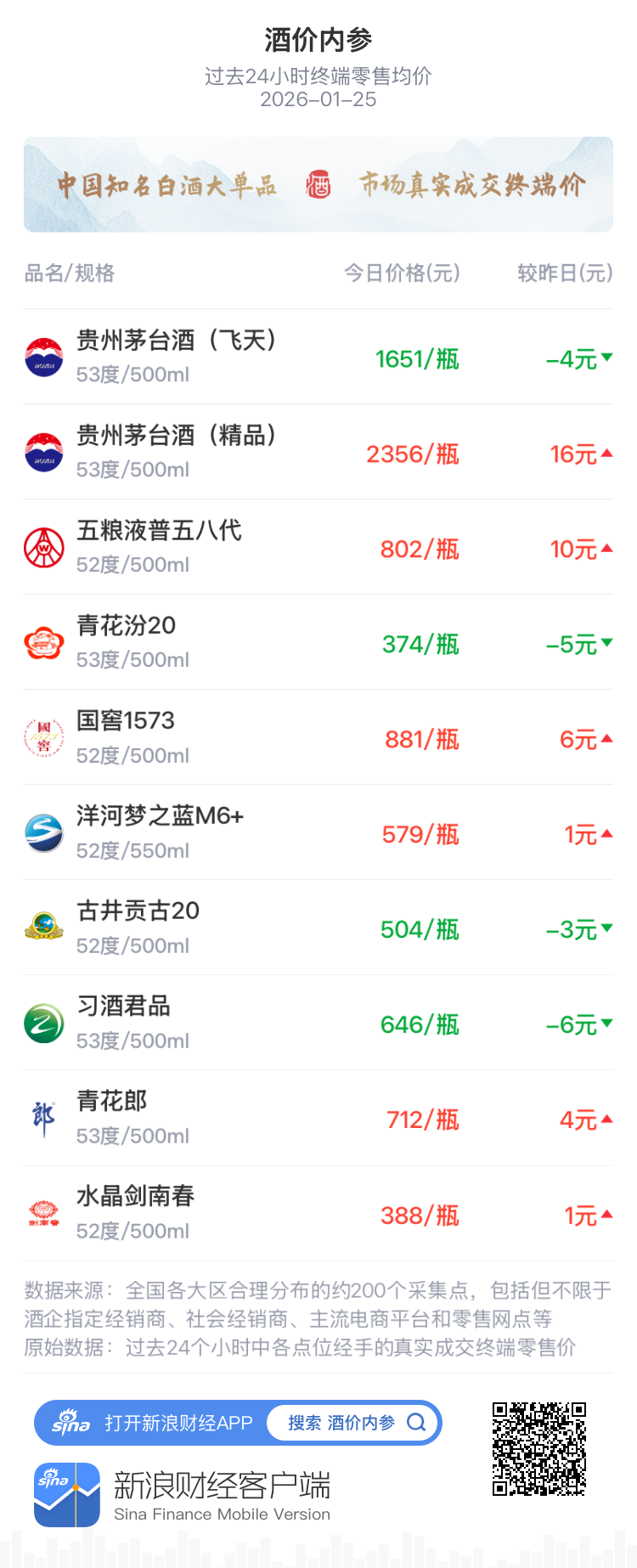
酒价内参1月25日价格发布 十大单品结构性回升精品茅台领涨
Xin Lang Cai Jing· 2026-01-25 01:12
Core Insights - The Chinese white liquor market has experienced a structural rebound in retail prices for the top ten products as of January 25, with an overall average price of 8,893 yuan, an increase of 20 yuan from the previous day, marking a five-day high [1] - The market shows a mixed performance with six products increasing in price and four decreasing, indicating ongoing structural adjustments within the industry [1] Price Movements - The premium Moutai (Jingpin) saw the largest increase, rising by 16 yuan to 2,356 yuan per bottle [3] - Wuliangye (Pu Wu 58) increased by 10 yuan to 802 yuan per bottle, contributing significantly to the average price rise [3] - Other notable increases include Guojiao 1573 (+6 yuan), Qinghua Lang (+4 yuan), and slight increases for Yanghe Dream Blue M6+ and Shuijing Jian Nan Chun (+1 yuan each) [1][4] Declines in Prices - The price of Xijiu Junpin decreased by 6 yuan to 646 yuan per bottle [4] - Qinghua Fen 20 dropped by 5 yuan, while Feitian Moutai faced a slight decline of 4 yuan due to consistent supply from the iMoutai platform [1][4] - Other declines include Gujing Gong Gu 20, which fell by 3 yuan [4]
白酒巨头:未来三年现金分红率不低于100%!
Zhong Guo Ji Jin Bao· 2026-01-24 07:09
【导读】洋河股份公布现金分红回报规划(2025年度-2027年度) 中国基金报记者郑俊婷 1月23日晚间,洋河股份(证券代码:002304)连发3条重要公告,分别指向2025年业绩预告、现金分红回报规划、高管人事调整。 其中,现金分红回报规划尤为引人注目。洋河股份表示,在满足《公司章程》利润分配政策的前提下,2025年度-2027年度,公司每年度现金分红总额不 低于当年实现归母净利润的100%。 2025年第四季度减亏 根据业绩预告,洋河股份预计2025年实现归母净利润21.16亿元-25.24亿元,同比下降62.18%-68.30%。 | 项目 | 本报告期 | 上年同期 | | --- | --- | --- | | 归属于上市公司 股东的净利润 | 盈利: 211,578 万元-252,356 万元 | 盈利:667,338.86 万元 | | | 比上年同期下降:62.18%-68.30% | | | 扣除非经常性损 益后的净利润 | 盈利: 185,318 万元-226,096 万元 | 盈利:683,523.56 万元 | | | 比上年同期下降:66.92%-72.89% | | | 基本每股收 ...
白酒巨头:未来三年现金分红率不低于100%!
中国基金报· 2026-01-24 07:07
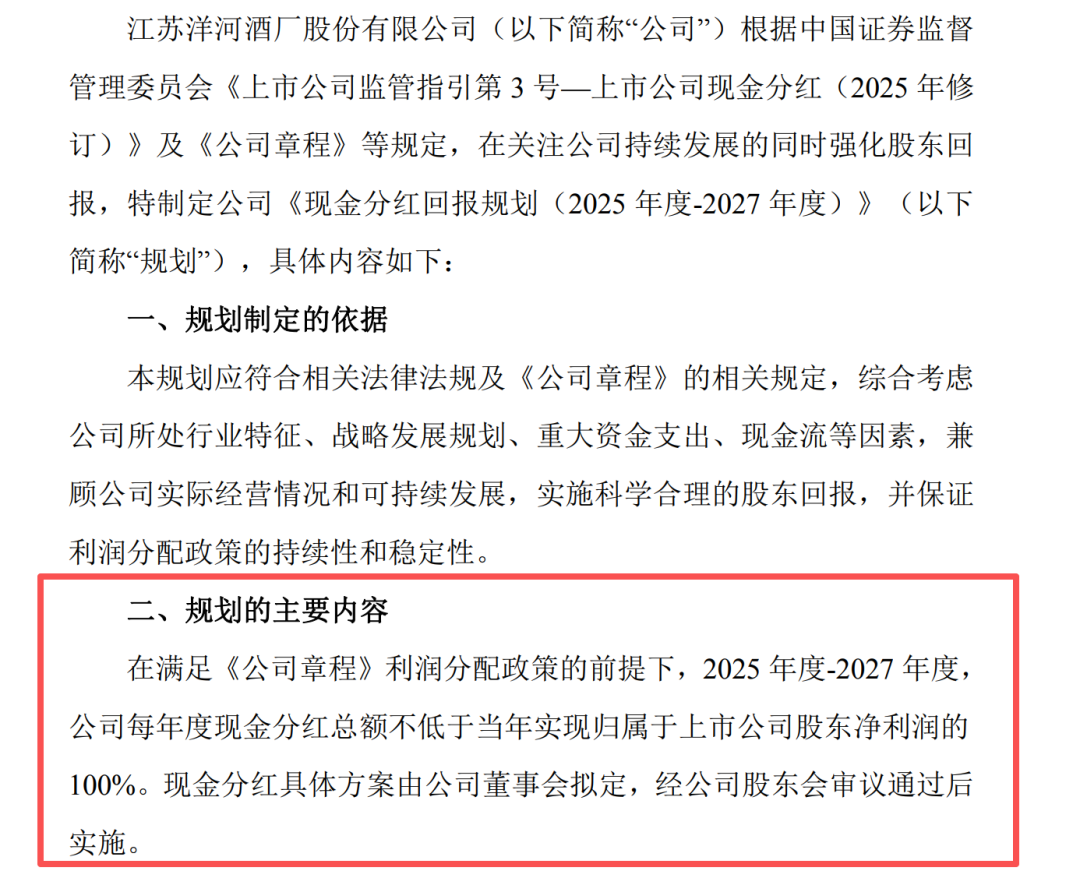
Core Viewpoint - Yanghe Co., Ltd. announced a cash dividend return plan for the years 2025 to 2027, committing to a total cash dividend amount of no less than 100% of the annual net profit attributable to shareholders [2][10]. Financial Performance - For the year 2025, Yanghe Co., Ltd. expects a net profit attributable to shareholders of 2.116 billion to 2.524 billion yuan, representing a year-on-year decline of 62.18% to 68.30% [6][7]. - The net profit after deducting non-recurring gains and losses is projected to be between 1.853 billion and 2.261 billion yuan, reflecting a decrease of 66.92% to 72.89% compared to the previous year [7]. - Basic earnings per share are estimated to be between 1.4045 yuan and 1.6752 yuan, down from 4.4299 yuan in the same period last year [7]. Market Challenges - The white liquor industry is undergoing a deep adjustment period, with intensified competition and challenges such as reduced market demand, weakened brand momentum, increased channel inventory, and declining channel profits [7]. - The company plans to focus on inventory reduction, price stabilization, and enhancing brand momentum in its marketing efforts for 2025, which will significantly impact current profitability [7]. Cash Dividend Plan - The cash dividend return plan for 2025 to 2027 differs significantly from the previous plan for 2024 to 2026, which stipulated a minimum cash dividend of 70% of the annual net profit and at least 7 billion yuan [11]. - The adjustment in the cash dividend plan is likely due to the anticipated performance challenges in 2025, which would make adhering to the previous plan burdensome for the company [11]. Management Changes - Yanghe Co., Ltd. announced the resignation of its Vice Chairman and President, Zhong Yu, due to retirement, after over 10 years in the role [14]. - Gu Yu has been appointed as both Chairman and President, which is expected to facilitate smoother execution of the company's strategy amid declining performance over the past two years [15]. Stock Information - As of January 23, the stock price of Yanghe Co., Ltd. was 62.55 yuan per share, with a total market capitalization of 94.2 billion yuan [16].
洋河的2025:筑底蓄力,洋河的2026:静水流深,蓄力风起时
Xin Lang Cai Jing· 2026-01-24 05:12
Core Insights - The Chinese liquor industry is entering a deep adjustment phase in 2025, characterized by multiple pressures including policy constraints, weak consumption, high inventory, and price inversion [1] - Yanghe Co. is proactively addressing these challenges with a comprehensive adjustment strategy focused on stabilizing prices, reducing inventory, and promoting sales, with expected results to be seen in 2026 [1] Group 1: Strategic Adjustments - In 2025, Yanghe has adopted a dual-track strategy of "deepening the home market and nationwide expansion," shifting resources towards its core market in Jiangsu to counteract declining market share [2] - The company has implemented a "regional network penetration" model to strengthen coverage in county and township markets, achieving recognition as the "most favored wedding wine" by the Jiangsu Wedding Industry Association [2] - This strategic focus has led to a significant reduction in inventory turnover in Jiangsu, decreasing from 3 months to 2.5 months, and a 12% quarter-on-quarter increase in contract liabilities, restoring channel confidence [2] Group 2: Inventory and Channel Management - Yanghe's core strategy for 2025 centers on "inventory reduction and profit stabilization," reforming its channel system to eliminate previous inventory pressure and establish a win-win profit structure [3] - The company has shifted to a consumer-driven approach for inventory management, utilizing digital marketing strategies to stimulate sales and reduce channel stockpiling [3] - Yanghe's product strategy for 2025 includes a comprehensive product matrix across all price ranges, with high-end products like Dream Blue M6+ implementing a "controlled quantity and stable price" strategy to alleviate inventory pressure [3][4] Group 3: Product Development and Market Positioning - Yanghe's diverse product offerings, including high-end and mid-range products, are designed to mitigate risks from market fluctuations while maintaining a long-term focus on premiumization [4] - The introduction of high-line bottled liquor has achieved impressive sales, demonstrating the effectiveness of a full-price range strategy in maintaining competitiveness in various consumption scenarios [4] - The company's strong production capabilities, including 70,000 premium fermentation pits and 1 million tons of storage capacity, ensure product quality and support innovation, even amidst industry-wide investment reductions [4] Group 4: Future Outlook - The liquor industry is expected to enter the final phase of adjustment in 2026, with positive signals from policy and a recovery in consumption, setting the stage for overall industry revival [5] - Yanghe's adjustments in 2025 are anticipated to translate into growth momentum in 2026, with a stabilized core market and improved product structure contributing to revenue recovery [5][6] - The revitalization of channel dynamics, driven by reduced inventory pressure and improved profitability expectations, is expected to enhance sales activity in 2026 [6][7]
洋河新跑法:以稳破局
Zhong Guo Ji Jin Bao· 2026-01-24 03:01
Core Viewpoint - The Chinese liquor industry, particularly the baijiu sector, is entering a phase of stock competition with a notable decline in production, prompting companies like Yanghe to adopt a "slow and steady" development philosophy to navigate challenges [1]. Group 1: Industry Trends - The production of baijiu from large-scale enterprises decreased by 11.3% year-on-year, totaling 3.215 million liters from January to November 2025, indicating a significant contraction in the industry [1]. - The industry is experiencing a shift towards stock competition, with many brands reducing their operations to weather the downturn [3]. Group 2: Yanghe's Brand Strategy - Yanghe has adjusted its brand investment structure, reducing sales expenses by 17.75% and advertising promotion costs by 21.03%, while increasing regional advertising expenditure to 37.38%, reflecting a strategic shift from broad coverage to targeted engagement [3]. - The brand has established emotional connections with consumers, exemplified by the "Dream Blue M6+" being featured in the CCTV Spring Festival Gala for seven consecutive years, embedding the brand in national collective memory [3]. Group 3: Local Market Engagement - Yanghe has demonstrated flexibility in regional markets by sponsoring local sports teams and integrating brand stories into local culture, transitioning from a "sponsor" to a "partner" [5]. - Collaborations with national entities like China Rocket and China Aviation to launch co-branded products have resonated with younger consumers, enhancing the brand's appeal [5]. Group 4: Market Dynamics and Sales Strategy - Yanghe is focused on converting online traffic into offline consumption, utilizing strategies like QR code red envelopes and tasting events to drive product usage and repeat purchases [6]. - The company has implemented a strategy of "de-stocking, enhancing momentum, and stabilizing prices," which, while reflecting short-term revenue declines, lays a solid foundation for long-term health [7]. Group 5: Financial Performance and Pricing Stability - Yanghe's main products have maintained stable prices, with market inventory reducing by double digits, supported by strict measures against low-price dumping [7]. - The wholesale price of "Dream Blue M6+" has only slightly adjusted from 550 yuan to 540 yuan, with retail prices remaining stable between 600-700 yuan, acting as a stabilizer in the mid-range price segment [7]. Group 6: Long-term Strategy and Investment - Yanghe's strategic choices reflect a commitment to long-termism, with significant investments in R&D increasing by 77.92% year-on-year, aimed at enhancing product quality and innovation [10]. - The company possesses substantial resources, including 70,000 premium cellars and an annual production capacity of over 160,000 tons, providing a buffer against market fluctuations [10]. Group 7: Market Perception and Future Outlook - Despite short-term performance pressures, analysts recognize Yanghe's adjustments in market health, product structure optimization, and long-term operational rhythm as positive developments [11]. - The company's approach is likened to a marathon strategy, focusing on steady progress rather than immediate gains, positioning it for future success as market conditions improve [12].