HAID GROUP(002311)

Search documents
东方证券农林牧渔行业周报(20251208-20251214):11月猪企出栏延续放量去库-20251213
Orient Securities· 2025-12-13 09:14
Investment Rating - The report maintains a "Positive" investment rating for the agriculture industry [5] Core Insights - The report highlights the ongoing capacity reduction in the pig farming sector, driven by recent policies and market conditions, which is expected to enhance long-term performance in the sector [3][9] - The report identifies several investment opportunities across different segments of the agriculture industry, including pig farming, feed, planting, and pet food sectors [3][43] Summary by Sections Pig Farming Sector - The pig farming industry is experiencing accelerated capacity reduction, with current pig prices and expectations both weak, leading to a significant decline in profitability [9] - In November, 14 listed pig companies collectively slaughtered 16.82 million pigs, a decrease of 2.21% month-on-month but an increase of 22.48% year-on-year [13] - The average selling price of pigs showed a slight recovery, with prices ranging from 11.1 to 12.53 yuan/kg, although still down approximately 30% year-on-year [15] Feed Sector - The report notes that raw material prices for feed are stabilizing at the bottom, with corn prices slightly down and soybean meal prices up [28] - As of December 12, corn prices averaged 2,356.67 yuan/ton, down 0.08%, while soybean meal prices rose by 1.54% to 3,159.43 yuan/ton [28] Planting Sector - The report indicates a confirmed upward trend in grain prices, suggesting favorable fundamentals for planting and seed industries, with significant investment opportunities [3][43] Pet Food Sector - The pet food industry is in a growth phase, with increasing domestic brand recognition and continuous growth among leading companies [3][43]


美国农业部(USDA)月度供需报告数据分析专题:美国牛肉 2026 年进口预估大增,全球玉米期末库存环比调减-20251213
Guoxin Securities· 2025-12-13 07:07
Investment Rating - The report maintains an "Outperform" rating for the agricultural sector, particularly focusing on livestock and feed companies [7]. Core Insights - The USDA's December supply and demand report indicates a tightening supply-demand balance for corn, with prices expected to maintain a moderate upward trend [15][18]. - For soybeans, the report suggests a recovery in U.S. imports, which is likely to support price recovery [33][35]. - The beef market is projected to see a price increase in 2026, driven by reduced production and strong domestic demand [3][6]. - The dairy sector is expected to experience a price reversal due to a combination of reduced supply and increased demand for both meat and milk [4][6]. - The pork market is anticipated to face a decline in prices in the latter half of 2026, despite a positive outlook for the first half [6][7]. Summary by Sections Corn - The USDA report predicts a reduction in global corn production by 3.27 million tons, leading to a decrease in global ending stocks and a tightening supply-demand ratio [15][16]. - Domestic corn prices are currently at a historical low, with expectations for a gradual recovery supported by low trader inventories [18][19]. Soybeans - The global soybean ending stocks are expected to increase slightly, with a projected rise in U.S. imports and a positive outlook for domestic soybean meal prices [33][35]. - The report highlights the importance of monitoring U.S.-China trade relations and South American weather conditions for future price movements [38]. Wheat - The global wheat supply remains ample, with an increase in production forecasts from major exporting countries, leading to a slight rise in the global ending stocks ratio [2][45]. - Domestic wheat prices are expected to stabilize, influenced by the overall supply situation and potential government storage interventions [48][52]. Beef - The USDA forecasts a decrease in U.S. beef production, with prices expected to rise due to strong domestic demand and reduced imports [3][6]. - The report anticipates a turning point in the domestic beef cycle by 2025, with prices likely to trend upwards [3][6]. Dairy - The report indicates a potential reversal in the dairy market, driven by reduced cow inventories and a tightening supply-demand balance [4][6]. - Domestic raw milk prices are expected to rise as a result of these factors [4][6]. Pork - The U.S. pork market is projected to see a decline in prices in the latter half of 2026, despite a positive outlook for the first half of the year [6][7]. - Domestic breeding sow inventories are stabilizing, which may help support industry profitability [6][7]. Poultry - The U.S. poultry market is expected to recover, with increased production and consumption anticipated as avian influenza impacts diminish [6][7]. - Domestic chicken supply is projected to stabilize, with a focus on internal demand recovery [6][7].



农林牧渔行业双周报(2025、11、28-2025、12、11):生猪价格有所回升-20251212
Dongguan Securities· 2025-12-12 08:40
Investment Rating - The report maintains an "Overweight" rating for the agriculture, forestry, animal husbandry, and fishery industry [1][51]. Core Insights - Recent recovery in pig prices is noted, with expectations for continued price increases as the seasonal consumption peak approaches. The inventory of breeding sows remains relatively high, indicating significant potential for capacity reduction [51]. - The report highlights investment opportunities in leading pig farming companies due to expected capacity reduction and improving profitability margins in chicken farming [51]. - The report emphasizes the importance of strong R&D capabilities in animal health companies and the long-term growth potential of domestic pet food leaders [51]. Industry Performance Overview - The SW agriculture, forestry, animal husbandry, and fishery industry underperformed the CSI 300 index, declining by 0.92% from November 28 to December 11, 2025, lagging behind the index by approximately 1.73 percentage points [12]. - Among the sub-sectors, only animal health and planting recorded positive returns, increasing by 1.96% and 1.18%, respectively, while other sectors such as agricultural product processing, feed, breeding, and fishery experienced declines of 1.01%, 1.5%, 3.03%, and 3.76% [15][18]. - Approximately 68% of stocks in the industry recorded negative returns during the same period, with over 60% of stocks showing losses [16][18]. Valuation Metrics - As of December 11, 2025, the overall price-to-book (PB) ratio for the SW agriculture, forestry, animal husbandry, and fishery industry is approximately 2.75 times, reflecting a recent decline in valuation. This level is around 61.8% of the historical median since 2006, indicating a relatively low historical valuation [19]. Key Industry Data - **Pig Farming**: The average price of external three yuan pigs rose from 11.28 CNY/kg to 11.45 CNY/kg during the reporting period. However, self-breeding pig farming continues to incur losses, with profits at -163.34 CNY per head, while purchased pig farming shows a loss of -240.69 CNY per head [23][28]. - **Poultry Farming**: The average price of broiler chicks increased slightly to 3.54 CNY per chick, while the average price of white feather broilers rose to 7.33 CNY/kg, with losses of -0.71 CNY per bird [30][33]. Company Highlights - The report suggests focusing on key companies such as Muyuan Foods (002714), Wens Foodstuff Group (300498), and Shengnong Development (002299) due to their market leadership and potential for recovery [51][52].


重磅!2025年广东农业企业品牌价值50强榜单发布
Nan Fang Nong Cun Bao· 2025-12-12 04:05
Core Insights - The 2025 Guangdong Agricultural Enterprises Brand Value Top 50 list was officially released, showcasing a total brand value of 259.195 billion yuan, reflecting a steady growth from 257.224 billion yuan in 2024 [9][10]. Group 1: Top Performers - Leading companies include Foshan Haitian (57.192 billion yuan), Wen's Food (49.158 billion yuan), and Guangdong Haida (38.765 billion yuan), maintaining their positions in the top three for two consecutive years [11][12]. - Other notable companies in the top ten are Shenzhen Baiguoyuan (20.304 billion yuan), Guangzhou Qian Dama (18.335 billion yuan), and Guangdong Hengxing Group (9.415 billion yuan) [12][13]. Group 2: Emerging Brands - Young brands such as Guangdong Kuaishu Group, Rontong Agriculture, and Jun Chuang Group have rapidly increased their brand values, surpassing 100 million yuan, leveraging social media and digital technologies to connect with consumers [17][18][19]. Group 3: Evaluation and Impact - This is the second year of the Guangdong Agricultural Enterprises Brand Value Top 50 evaluation, which has gained significant attention and media coverage, becoming a key reference for observing the development of the agricultural sector in Guangdong [20][24]. - The evaluation committee, composed of branding experts and industry leaders, has positioned the list as an authoritative certification in the AI digital era [25]. Group 4: Key Trends - The list highlights three significant trends: 1. Technological innovation is crucial for reshaping agricultural brand value, with many companies enhancing product quality and production efficiency [30]. 2. Sustainable development principles are increasingly integrated into core business strategies, reflecting active exploration in this area [31]. 3. Brand narratives are evolving from functional descriptions to deeper emotional connections with consumers, enhancing brand affinity and influence [32]. Group 5: Event Significance - The release of the list coincided with the Greater Bay Area Agricultural Products Trade Fair, providing a platform for brand showcasing and industry collaboration, thus promoting high-quality development in Guangdong's agricultural sector [34][36].



畜牧ETF(159867)涨近1%,中央储备冻猪肉轮换收储即将开始
Sou Hu Cai Jing· 2025-12-12 02:09
Group 1 - The China Livestock Breeding Index (930707) increased by 0.44% as of December 12, 2025, with notable gains in constituent stocks such as Luo Niu Shan (000735) up 6.21%, and BioShares (600201) up 2.99% [1] - The Central Reserve Frozen Pork Rotation Storage Auction will take place on December 18, 2025, with 3,100 tons available for bidding, as announced by the China Storage Network [1] - Recent analysis indicates that traditional peak season for pork consumption is leading to a steady recovery in demand, driven by colder weather and increased demand for cured meats in southern regions, although supply remains high due to previous production capacity [1] Group 2 - As of November 28, 2025, the top ten weighted stocks in the China Livestock Breeding Index account for 65.6% of the index, including Muyuan Foods (002714) and Wens Foodstuff Group (300498) [2] - The index reflects the overall performance of listed companies involved in livestock feed, veterinary drugs, and livestock farming [1]



饲料板块12月11日跌0.49%,天马科技领跌,主力资金净流出2.75亿元
Zheng Xing Xing Ye Ri Bao· 2025-12-11 09:01
证券之星消息,12月11日饲料板块较上一交易日下跌0.49%,天马科技领跌。当日上证指数报收于 3873.32,下跌0.7%。深证成指报收于13147.39,下跌1.27%。饲料板块个股涨跌见下表: | 代码 | 名称 | 收盘价 | 涨跌幅 | 成交量(手) | 成交额(元) | | --- | --- | --- | --- | --- | --- | | 603668 | 天马科技 | 17.24 | -10.02% | 46.73万 | 8.34亿 | | 001313 | 材料塑塑 | 8.36 | -4.89% | 12.26万 | 1.04亿 | | 002548 | 金新农 | 5.53 | -4.66% | 40.90万 | 2.29亿 | | 001366 | 播恩集团 | 12.98 | -4.42% | ¥ 4.57万 | 6038.56万 | | 002696 | 百洋股份 | 6.70 | -4.01% | 11.27万 | 7628.33万 | | 000702 | 正虹科技 | 6.60 | -2.80% | 7.02万 | 4660.65万 | | 002567 | 唐人神 ...


11月CPI同比上涨0.7%,某地产龙头冲击涨停!消费ETF(159928)、港股通消费50ETF(159268)双双收红!茅台回归指导价,段永平仍看多
Xin Lang Cai Jing· 2025-12-10 09:06
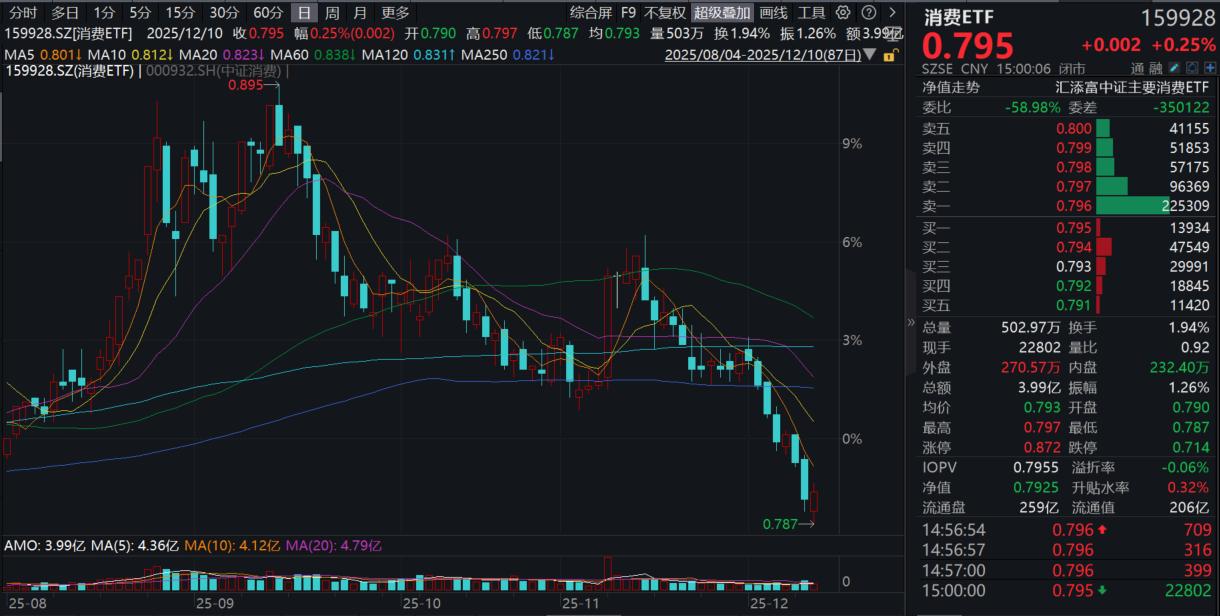
Group 1: Market Performance - On December 10, A-shares rebounded with slight gains in the consumer sector, as the Consumer ETF (159928) rose by 0.25% with a total trading volume of 399 million yuan [1] - The Consumer ETF (159928) saw a net inflow of over 170 million yuan in the past 10 days, and as of December 9, its latest scale exceeded 20.5 billion yuan, leading its peers significantly [1] Group 2: Economic Indicators - The National Bureau of Statistics reported that consumer spending continues to recover, with the Consumer Price Index (CPI) slightly decreasing by 0.1% month-on-month and increasing by 0.7% year-on-year. The core CPI, excluding food and energy prices, rose by 1.2% year-on-year [3] Group 3: Real Estate and Alcohol Industry - Real estate stocks showed unusual upward movement in the afternoon, with a leading real estate company nearing a trading limit, influenced by recent mortgage-related news [6] - In the alcohol sector, the price of 25-year Flying Moutai bottles dropped to 1,500 yuan, a decrease of 15 yuan from the previous day. The wholesale reference price for the original box remained unchanged at 1,520 yuan [6] Group 4: Valuation and Investment Opportunities - The valuation of the Consumer ETF (159928) remains attractive, with a TTM price-to-earnings ratio of 19.32, which is at the 2.84% percentile over the past decade, indicating it is cheaper than 97% of the historical time [8] - The white liquor sector is facing price pressure, with high inventory and weak demand challenges. However, the current adjustment in stock prices has reflected pessimistic expectations, suggesting long-term investment value [10] Group 5: Consumer Trends - There is a growing emphasis on expanding service consumption, which is expected to accelerate as China's GDP per capita exceeds 13,000 USD. This shift indicates significant growth potential in sectors like culture, leisure, and health [11] - Recent data shows positive trends in consumer spending, with notable increases in luxury goods sales and hotel industry performance, indicating a recovery in consumer sentiment [12]




芯路径,芯力量——广东种业振兴“五年见成效”创新实践
Nan Fang Nong Cun Bao· 2025-12-10 07:04
Core Viewpoint - Guangdong's seed industry has made significant progress over the past five years, focusing on innovation and achieving key milestones in seed quality and agricultural productivity [2][6][8]. Group 1: Achievements and Innovations - Guangdong has implemented the "Yueqiang Seed Core" project, achieving notable results in seed resource protection, innovation, and market purification [4][5][28]. - The province has developed 36 varieties of super rice, accounting for 28% of the national total, and has received multiple awards for quality rice varieties [22][23]. - Guangdong's agricultural sector has seen the emergence of high-quality varieties, such as the "Hua Hang Xiang Yin Zhen" super rice, which is expected to yield 1,200 pounds per acre [20][21]. Group 2: Strategic Goals and Future Plans - The province aims to achieve significant breakthroughs in the seed industry by 2035, focusing on innovation and industry leadership [12][15]. - Guangdong plans to enhance its seed resource management, strengthen breeding technology, and promote the integration of enterprises and research institutions [108][110]. Group 3: Economic Impact and Industry Growth - The seed industry in Guangdong has contributed to substantial economic growth, with individual seed varieties generating significant revenue, such as a single seed variety contributing 240 million yuan [82]. - The province's agricultural enterprises, such as Wens Food Group and Haida Group, are leading the industry with innovative breeding systems and substantial market shares [70][68]. Group 4: Regulatory and Support Framework - Guangdong has strengthened intellectual property protection for seed varieties, ensuring the safety and integrity of agricultural production [101][103]. - The province has established a seed development fund of 476.1 million yuan to support industry growth and attract social capital [65].

政策+估值双驱动,全市场唯一农牧渔ETF(159275)逆市飘红!机构高呼长期投资价值凸显
Xin Lang Cai Jing· 2025-12-10 03:14
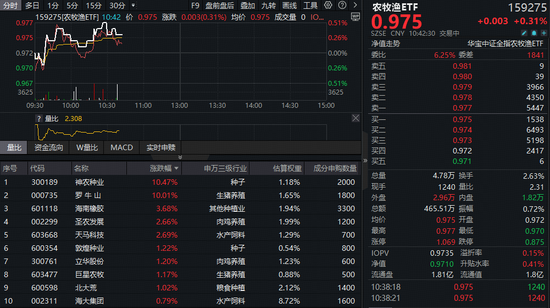
Core Viewpoint - The agricultural, animal husbandry, and fishery sector experienced a market rally on December 10, with the only agricultural ETF (159275) showing a price increase of 0.31% after a peak of 0.51% during trading [1][9]. Market Performance - The agricultural ETF (159275) opened strong, with significant gains in individual stocks such as Luoniushan reaching the daily limit, Shennong Seed rising over 10%, Hainan Rubber increasing by over 3%, and both Shengnong Development and Tianma Technology gaining over 2% [1][9]. - The current market sentiment is characterized by cautious observation, which may present a favorable allocation window for investors [12]. Valuation Insights - The agricultural sector's valuation remains relatively low, with the market's agricultural ETF (159275) showing a price-to-book ratio of 2.48, placing it at the 21.48 percentile of the past decade, indicating a compelling mid-to-long-term investment opportunity [3][10]. Industry Outlook - Analysts from Huaxi Securities suggest that the active reduction of production capacity in the pig farming industry has begun, with expectations for a long-term increase in domestic pig prices [11]. - The industry is currently facing pressures from declining market prices, rising epidemic risks, and policy guidance, which are expected to enhance the motivation for capacity reduction [11]. - The majority of listed pig farming companies are currently valued at historical lows, suggesting significant potential for future appreciation [11]. Investment Strategy - The agricultural ETF (159275) tracks the CSI Agricultural Index, which includes leading stocks in pig farming and covers various segments of the agricultural supply chain [11]. - Investors can also consider connecting funds (Class A 013471/Class C 013472) to gain exposure to the agricultural sector [11].

——农林牧渔行业周报:去产能迎来加速阶段,布局生猪底部-20251208
Guohai Securities· 2025-12-08 14:31
Investment Rating - The report maintains a "Recommended" rating for the agriculture, forestry, animal husbandry, and fishery industry [1] Core Viewpoints - The swine industry is entering an accelerated phase of capacity reduction, presenting opportunities for investment at the bottom of the market [3][4] - The poultry sector's fundamentals are expected to improve, with a focus on marginal changes in the cycle [4][5] - The animal health sector is closely monitoring the progress of African swine fever vaccine clinical trials, which could enhance the industry's competitive landscape [6][7] - The pet economy is thriving, with domestic brands rapidly emerging and improving profitability [9][10] Summary by Sections Swine Industry - The average price of live pigs in November was 11.69 yuan/kg, with a month-on-month change of 0 yuan/kg [15] - The number of breeding sows as of the end of October was 39.9 million, a decrease of 1.1% month-on-month and 2.1% year-on-year [15][16] - Investment suggestions include leading companies such as Muyuan Foods and Wens Foodstuffs, with a focus on low-cost performance and dividend increases [16] Poultry Industry - The price of white feather broiler parent stock chicks was 41 yuan/set, down 6 yuan from the previous week [31] - The poultry sector is seeing a gradual recovery, with a recommendation for companies like Shennong Development and Lihua Stock [32] Animal Health - The profitability of self-breeding pigs has been negative for over two months, impacting the animal health sector [40] - Companies like Bio-Pharmaceuticals and Keqian Bio are recommended due to their strong business layouts and customer resources [6][40] Planting Industry - The price of corn was 2229 yuan/ton, with a month-on-month increase of 0.5% and a year-on-year increase of 8% [45] - Companies with early reserves in genetically modified seeds are recommended, including Suqian Agricultural Development and Longping High-Tech [50] Feed Industry - The price of feed for fattening pigs was 3.32 yuan/kg, with a month-on-month decrease of 20 yuan/ton [51] - The feed industry is expected to see increased concentration, with recommendations for Haida Group and He Feng Stock [52] Pet Industry - The pet consumption market in urban China is projected to reach 300.2 billion yuan in 2024, with a year-on-year growth of 7.5% [58] - Recommended companies in the pet food sector include Guibao Pet and Zhongchong Stock, with a focus on the pet medical sector as well [59]