TLC(002466)

Search documents
锂王破卷 是抢跑者也是逆行者
Si Chuan Ri Bao· 2025-10-10 21:56
Core Viewpoint - The lithium battery industry is currently facing a challenging period characterized by overcapacity and intense competition, but Tianqi Lithium is strategically positioning itself for future growth by investing in next-generation solid-state battery technology and securing early partnerships for its lithium sulfide products [1][2][3]. Group 1: Industry Overview - The lithium carbonate futures price has dropped to between 70,000 and 75,000 yuan per ton, a decline of over 80% from the historical high of 600,000 yuan per ton in 2022, indicating a significant downturn in the industry [1]. - The solid-state battery, regarded as the ultimate form of next-generation batteries, offers energy density more than twice that of traditional lithium batteries, enhancing electric vehicle range and safety [2]. - The industry anticipates that solid-state batteries will achieve mass production by 2027, with several companies, including CATL and EVE Energy, making significant advancements in this area [3]. Group 2: Company Strategy - Tianqi Lithium has proactively developed lithium sulfide, a key precursor for solid-state electrolytes, and has begun construction on a pilot production line with a planned capacity of 50 tons [1][3]. - The company has established partnerships with multiple downstream enterprises, indicating strong demand for its lithium sulfide products, which are expected to have no inventory upon reaching production capacity [1]. - Tianqi Lithium is transitioning from being a lithium resource supplier to a provider of new material solutions, aiming to solidify its leading position in the new energy materials sector [5]. Group 3: Production and Cost Management - Despite the overall industry downturn, Tianqi Lithium's Anju factory has maintained full production, leveraging its vertical integration and stable supply of high-quality lithium ore from the Greenbushes mine [6]. - The company has implemented advanced automation and process optimization to reduce production costs and improve efficiency, allowing it to navigate the volatile pricing environment effectively [6][7]. - Tianqi Lithium employs a strategy of long-term agreements and futures hedging to stabilize price expectations and mitigate the impact of price wars in the market [7]. Group 4: Market Challenges and Innovations - The lithium battery industry is experiencing severe competition and price wars due to structural overcapacity, with many new entrants and existing companies expanding production without adequate investment in quality and compliance [8]. - Experts suggest that the industry must focus on enhancing comprehensive competitiveness through innovation in research and development, process improvement, and cost control to avoid low-end competition [9]. - There remains significant potential for technological innovation across various segments of the lithium battery supply chain, including solid-state batteries, which are seen as a definitive trend despite existing production bottlenecks [9].

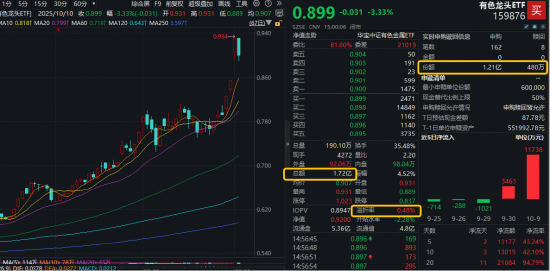
“铜博士”依然坚挺,白银有色逆市涨停!资金逢跌抢筹,有色龙头ETF(159876)获资金净申购1.16亿份!
Xin Lang Ji Jin· 2025-10-10 11:47
Core Viewpoint - The market is experiencing a consolidation phase, with the non-ferrous metal sector ETF (159876) seeing a price drop of 3.33% while achieving a record trading volume of 1.72 billion yuan, indicating strong investor interest despite the downturn [1] Fund Flows and Performance - The non-ferrous metal ETF (159876) saw a net subscription of 116 million units, with a total inflow of 117 million yuan on the previous day and a cumulative inflow of 210 million yuan over the past 20 days [1][3] - As of October 9, the latest scale of the non-ferrous metal ETF reached 493 million yuan, marking a new historical high [1] Sector Analysis - The "Copper Doctor" remains strong, with Jiangxi Copper rising over 7% and Yunnan Copper increasing by more than 1%. Silver stocks also performed well, with a limit-up increase [1] - Conversely, companies like Hanrui Cobalt and Western Gold fell over 9%, dragging down the index performance [1] Market Drivers - Gold prices have fluctuated due to a ceasefire agreement between Israel and Hamas, with Bank of America indicating a potential bull market for gold lasting until 2026, following a nearly 50% increase this year [3] - Copper prices surged due to supply constraints from the Grasberg copper mine incident, igniting investor enthusiasm [3] - The recent export control regulations on rare earths by the Ministry of Commerce are expected to maintain strong pricing in the rare earth sector [3][4] Industry Outlook - The non-ferrous metal industry maintains a high level of prosperity, with precious metals benefiting from Federal Reserve rate cuts and geopolitical tensions, leading to gold prices surpassing the 4000 USD mark [4] - Industrial metals like copper and aluminum are experiencing price increases due to supply constraints and a weak dollar environment [4] - The rare earth sector is expected to see continued valuation and performance growth due to tightening export controls [4] Investment Strategy - The non-ferrous metal ETF (159876) and its linked funds provide a diversified exposure to various metals, including copper (27.6%), gold (14.5%), aluminum (13.1%), rare earths (10.4%), and lithium (8.4%), making it suitable for risk diversification in investment portfolios [6]



153.87亿元主力资金今日撤离有色金属板块
Zheng Quan Shi Bao Wang· 2025-10-10 09:58
Market Overview - The Shanghai Composite Index fell by 0.94% on October 10, with 18 out of the 28 sectors rising, led by construction materials and coal, which increased by 1.92% and 1.37% respectively [1] - The electronic and electrical equipment sectors experienced the largest declines, down by 4.71% and 4.46% respectively [1] - The non-ferrous metals sector dropped by 2.93% [1] Capital Flow - The net outflow of capital from the two markets reached 125.784 billion yuan, with 8 sectors seeing net inflows [1] - The construction materials sector had the highest net inflow of 418 million yuan, followed by the agriculture, forestry, animal husbandry, and fishery sector with a net inflow of 379 million yuan [1] - The electronic sector faced the largest net outflow of 38.319 billion yuan, followed by the electrical equipment sector with a net outflow of 25.535 billion yuan [1] Non-Ferrous Metals Sector - The non-ferrous metals sector saw a net outflow of 15.387 billion yuan, with 137 stocks in the sector, of which 30 rose and 104 fell [2] - The top three stocks with the highest net inflow were Antai Technology (22.3 million yuan), Silver Industry (19.5 million yuan), and Pengxin Resources (19.1 million yuan) [2] - The stocks with the largest net outflow included Northern Rare Earth (2.519 billion yuan), Huayou Cobalt (1.011 billion yuan), and Luoyang Molybdenum (920 million yuan) [2] Non-Ferrous Metals Capital Inflow - The top stocks in terms of capital inflow included: - Antai Technology: +9.99%, turnover rate 10.79%, net inflow 223.06 million yuan - Silver Industry: +9.96%, turnover rate 3.52%, net inflow 194.94 million yuan - Pengxin Resources: +10.06%, turnover rate 10.60%, net inflow 190.96 million yuan [2][4] Non-Ferrous Metals Capital Outflow - The stocks with the largest capital outflow included: - Northern Rare Earth: -1.22%, turnover rate 8.90%, net outflow 2.518 billion yuan - Huayou Cobalt: -7.74%, turnover rate 7.85%, net outflow 1.011 billion yuan - Luoyang Molybdenum: -3.18%, turnover rate 2.59%, net outflow 919.66 million yuan [4]




突发回调!半导体板块重挫!发生了什么?
Zheng Quan Shi Bao· 2025-10-10 09:24
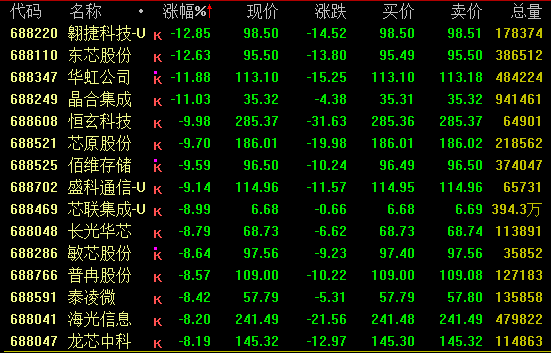
Market Overview - The Chinese asset market experienced a collective pullback, with the A-share market declining significantly after a strong opening on the first trading day post-holiday. The Shanghai Composite Index fell approximately 1% to below 3900 points, while the ChiNext Index dropped over 5% before slightly narrowing its losses at the close [1] - The total trading volume in the Shanghai and Shenzhen markets decreased by 137.8 billion yuan compared to the previous day, totaling 253.45 billion yuan [1] Sector Performance - The semiconductor sector saw a substantial decline, with companies like Aojie Technology and Dongxin Co. dropping over 10%, and SMIC falling nearly 8% [2][3] - Conversely, resource sectors such as gas, coal, steel, and oil experienced gains, with companies like Dazhong Public Utilities and Hongtong Gas hitting the daily limit up [2][7] - The coal sector is expected to see improved performance in Q3 due to rising coal prices, with potential further increases in Q4 as winter demand rises [8] Semiconductor Sector Insights - Analysts suggest that the recent adjustment in the semiconductor sector is a short-term fluctuation driven by profit-taking, rather than a fundamental shift in the industry's long-term growth prospects. The trend of domestic substitution remains a key focus [3][5] - Domestic wafer fabs are progressively establishing high levels of localization, particularly in advanced storage, with expectations for stable expansion needs through 2025 and rapid growth anticipated by 2026 [5] Brokerage Sector Dynamics - The brokerage sector showed strong performance, with stocks like Guosen Securities reaching their daily limit. The sector's growth is supported by favorable policies, improved market confidence, and a shift towards high-value-added services [9][10] - The current environment is seen as enhancing the brokerage sector's profitability outlook, making it an attractive investment opportunity [10]




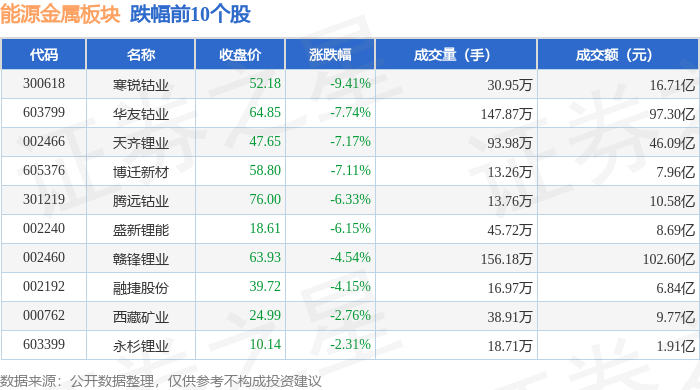
能源金属板块10月10日跌5.03%,寒锐钴业领跌,主力资金净流出40.92亿元
Zheng Xing Xing Ye Ri Bao· 2025-10-10 08:45
证券之星消息,10月10日能源金属板块较上一交易日下跌5.03%,寒锐钴业领跌。当日上证指数报收于 3897.03,下跌0.94%。深证成指报收于13355.42,下跌2.7%。能源金属板块个股涨跌见下表: 从资金流向上来看,当日能源金属板块主力资金净流出40.92亿元,游资资金净流入10.87亿元,散户资金 净流入30.05亿元。能源金属板块个股资金流向见下表: | 代码 | 名称 | 主力净流出 (元) | 主力净占比 游资净流入 (元) | | 游资净占比 散户净流入(元) | | 散户净占比 | | --- | --- | --- | --- | --- | --- | --- | --- | | 603799 | 华友钻业 | -11.03亿 | -11.33% | 4.14亿 | 4.25% | 6.89 Z | 7.08% | | 002460 | 赣锋锂√ | -10.05 Z | -9.80% | 1.89亿 | 1.84% | 8.16/Z | 7.95% | | 002466 | 天齐锂业 | -7.47 Z | -16.21% | 2.15/Z | 4.67% | 5.32 Z | 1 ...


锂业股集体走低 年内锂盐供给增速仍然高于需求增长 碳酸锂价格走势或将继续承压
Zhi Tong Cai Jing· 2025-10-10 03:41
Core Viewpoint - Lithium stocks have collectively declined, with significant drops observed in major companies such as Ganfeng Lithium, Tianqi Lithium, and CATL, amid intense supply-demand dynamics in the lithium market [1] Industry Summary - Recent market conditions indicate a fierce competition between lithium supply and demand, with a notable increase in lithium carbonate production, surpassing 20,000 tons per week, reaching historical highs [1] - The production of spodumene lithium has approached 13,000 tons, compensating for previous production losses from Qinghai salt lakes and other sources [1] - Compared to 2024, the current weekly production has increased by 7,796 tons, representing a 61.29% rise from last year's average [1] Company Summary - Major lithium companies such as Ganfeng Lithium (down 7.7% to HKD 47.12), Tianqi Lithium (down 6.83% to HKD 45.28), and CATL (down 6.24% to HKD 548.5) have experienced significant stock price declines [1] - The structural change in inventory, with upstream destocking and downstream proactive restocking, reflects a positive growth in actual demand [1] - The upcoming resumption of production at the Jiangxia mine is expected to increase supply pressure, with supply growth anticipated to outpace demand growth in the fourth quarter, leading to continued downward pressure on lithium carbonate prices, projected to fluctuate around RMB 70,000 to 75,000 per ton [1]

特朗普政府入股关键金属公司!有色龙头ETF(159876)下挫...
Xin Lang Cai Jing· 2025-10-10 03:31
Core Viewpoint - The performance of the non-ferrous metals sector remains mixed, with significant movements in stock prices and ongoing policy changes affecting supply dynamics in the industry [1][2]. Group 1: Market Performance - The non-ferrous metals ETF showed weak performance, with a decline of 3.1% and a trading volume of 1.21 billion yuan, while the fund's latest scale is 4.83 billion yuan [1]. - Silver stocks performed exceptionally well, with a notable increase, while companies like Western Gold, Huaxi Nonferrous, and Huayou Cobalt experienced declines of 8.27%, 6.98%, and 6.66% respectively [1]. Group 2: Policy and Supply Dynamics - The Trump administration is discussing investments in critical metals companies, particularly concerning Greenland's largest rare earth project [1]. - The Ministry of Commerce has implemented export controls on rare earth-related technologies, tightening supply policies and maintaining strong price trends in the rare earth sector [2]. - Western Securities predicts that the supply of secondary resource recycling will reach 27% by 2025, indicating a fully controlled supply side with limited potential for sudden increases [1]. Group 3: Industry Outlook - The non-ferrous metals industry maintains a high level of prosperity, with supply constraints from major copper producers due to safety incidents in Indonesia, contributing to rising prices for copper and aluminum [2]. - The top ten weighted stocks in the non-ferrous metals index include major players such as Zijin Mining, Northern Rare Earth, and Luoyang Molybdenum [2].

资金持续抢筹!机器人ETF、有色金属ETF基金五连“吸金”
Ge Long Hui A P P· 2025-10-10 03:29
Group 1 - Precious metals, semiconductors, and new energy battery sectors are leading the decline, with Yiwei Lithium falling nearly 9% and CATL dropping over 6% [1] - The market is showing strong structural characteristics, with increased volatility this week, potentially influenced by the upcoming review of the "14th Five-Year Plan" proposals [1] - Institutional strategies for October focus on technology, anti-involution, and promoting domestic demand, highlighting sectors benefiting from improved profit expectations such as innovative pharmaceuticals and new energy [1] Group 2 - The largest robot-themed ETF, Robot ETF (562500), has seen a net inflow of 1.757 billion yuan over five days, with key stocks including Huichuan Technology, Greentech Harmonic, and Stone Technology [2] - The non-ferrous metal ETF (516650) has attracted a net inflow of 300 million yuan over five days, with major holdings including Zijin Mining, Luoyang Molybdenum, Northern Rare Earth, Huayou Cobalt, and China Aluminum [2] - The largest new energy vehicle ETF (515030) has received a total net inflow of 7.104 million yuan over four days, with key stocks including Huayou Cobalt, Tianqi Lithium, Ganfeng Lithium, CATL, Huichuan Technology, Guoxuan High-Tech, and leading vehicle manufacturers like BYD and Changan Automobile [2]



黄金、有色金属板块,集体下挫
Di Yi Cai Jing Zi Xun· 2025-10-10 02:07
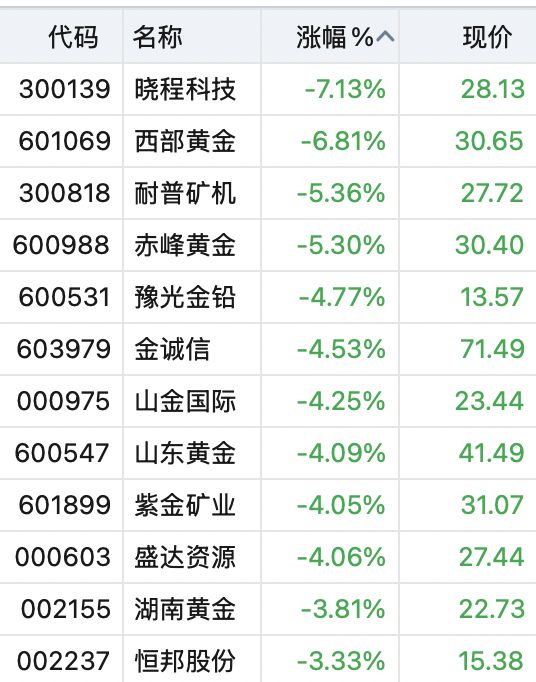
Core Viewpoint - The gold and non-ferrous metal sectors experienced a significant decline at the beginning of trading on October 10, with multiple companies in these sectors reporting substantial drops in their stock prices [1]. Group 1: Gold Sector - Xiaocheng Technology saw a decline of over 7%, trading at 28.13 [2] - Western Gold fell by over 6%, with a current price of 30.65 [2] - Other notable declines include Chifeng Gold down by 5.30% at 30.40, Shandong Gold down by 4.09% at 41.49, and Hunan Gold down by 3.81% at 22.73 [2][3]. Group 2: Non-Ferrous Metal Sector - Companies such as Huayou Cobalt, Tengyuan Cobalt, and Hanrui Cobalt all experienced declines, indicating a broader downturn in the non-ferrous metal market [1]. - Specific declines include Huayou Cobalt down by 5.68% at 66.30, Tengyuan Cobalt down by 5.37% at 76.78, and Tianqi Lithium down by 2.79% at 49.90 [3].




黄金、有色金属板块,集体下挫
第一财经· 2025-10-10 01:53
Group 1 - The gold and non-ferrous metal sectors experienced a significant decline on October 10, with many companies in these sectors reporting losses [1] - Notable declines in the gold sector included Xiaocheng Technology down 7.13% to 28.13, Western Gold down 6.81% to 30.65, and Chifeng Gold down 5.30% to 30.40 [2] - In the non-ferrous metal sector, companies such as Huayou Cobalt, Tengyuan Cobalt, and Tianqi Lithium also saw collective declines [3] Group 2 - The overall market sentiment for gold and related companies appears negative, as multiple firms reported losses exceeding 4% [2][3] - The decline in stock prices indicates potential challenges within the gold and non-ferrous metal industries, reflecting broader market trends [1][2]