
BYD(002594)

Search documents
电动化上半场完美收官:比亚迪(01211)发布第二代刀片电池及闪充技术
智通财经网· 2026-03-09 10:49
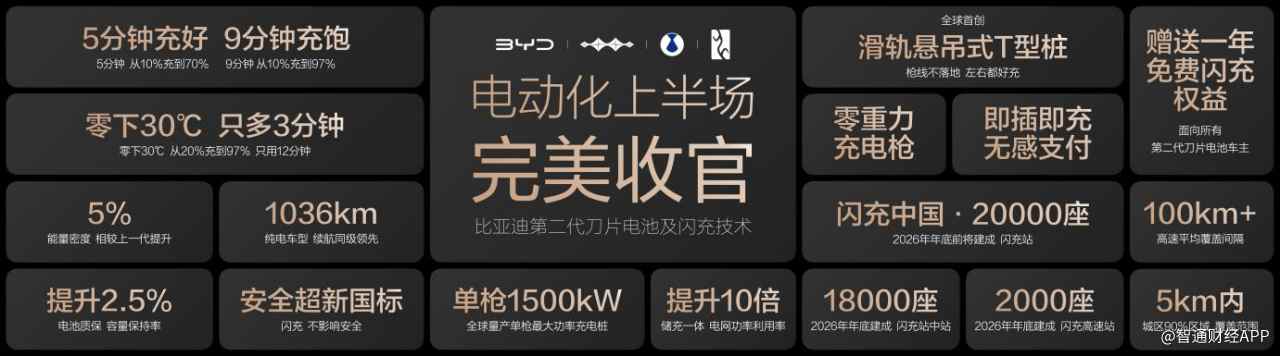
Core Viewpoint - BYD has officially launched its second-generation blade battery and flash charging technology, achieving the fastest charging speed in the world, addressing the issues of slow charging and low-temperature charging difficulties in electric vehicles [1][24]. Group 1: Second-Generation Blade Battery - The second-generation blade battery allows charging from 10% to 70% in just 5 minutes and from 10% to 97% in 9 minutes, even at -30 degrees Celsius, only taking 3 additional minutes compared to normal temperatures [1][6]. - The battery features a "lithium-ion high-speed channel" and an "all-temperature intelligent thermal management system," resulting in lower heat generation and efficient heat dissipation, ensuring that flash charging has minimal impact on battery life [8]. - Compared to the first generation, the energy density of the second-generation blade battery has increased by over 5%, while also achieving a range of 1,036 kilometers for the Tengshi Z9GT vehicle [9]. Group 2: Flash Charging Technology - BYD has developed a new flash charging pile with a single-gun charging power of 1,500 kW, the highest in the world for mass-produced charging piles, which does not harm the power grid [14]. - The flash charging stations will be built across China, with a target of 20,000 stations by the end of the year, ensuring that users can access flash charging services within 5 kilometers in urban areas [18][20]. Group 3: User Benefits and Policies - All owners of vehicles equipped with the second-generation blade battery will enjoy one year of free flash charging at the stations, with no additional charges after the free period [3]. - The warranty policy for the second-generation blade battery has been enhanced, with a 2.5% increase in capacity retention rates compared to the first generation, and a lifetime warranty on the battery cells [11]. Group 4: Strategic Vision - The launch of the "Flash Charging China" strategy aims to make flash charging experiences widely accessible, addressing user pain points associated with traditional charging stations [16]. - BYD's long-term vision includes expanding flash charging stations globally, with plans to establish them overseas by the end of 2026, contributing to the global electric vehicle development [25].


车市上演“三国杀”:谁将登上2026年“一哥”宝座?
经济观察报· 2026-03-09 10:30
Core Viewpoint - The competition among leading Chinese automakers has entered a new phase, with BYD defending its position while SAIC and Geely are aggressively pursuing market share, creating a suspenseful race for the title of the top seller in the domestic market [2][14]. Group 1: Market Dynamics - In early 2026, both SAIC and Geely surpassed BYD in monthly sales for January and February, breaking the previous two-year trend where BYD led the market [2]. - SAIC's sales in 2025 reached 4.387 million units, narrowly losing to BYD's 4.602 million units, indicating a strong competitive resurgence [2]. - Geely's sales in January and February 2026 were 27,000 and 20,600 units respectively, outpacing BYD's 21,000 and 19,000 units, showing a significant recovery in its market position [4]. Group 2: Geely's Performance - Geely's growth is attributed to its strong performance in the new energy vehicle (NEV) sector, with a 19% year-on-year increase in February sales, reaching 117,000 units [4]. - The company's NEV penetration rate exceeded 50% in the first two months of 2026, marking a transition to a "NEV-led" phase [4]. - Geely's overseas exports also surged, with a 138% increase in February, highlighting its strategic expansion in international markets [5]. Group 3: SAIC's Recovery - After a significant decline in 2024, SAIC implemented comprehensive reforms, including restructuring and launching new models, which led to a recovery in sales [8][9]. - In January and February 2026, SAIC sold 32,700 and 26,900 units respectively, achieving a total of 59,700 units, a 6.8% increase year-on-year [9]. - The company aims to regain its position as the market leader through a combination of domestic and international growth strategies [9]. Group 4: BYD's Challenges - BYD, which transitioned to an all-electric model in 2022, has seen its growth rate slow, with a 7.7% increase in 2025 compared to previous years [11]. - In early 2026, BYD faced declining sales, prompting the need for strategic adjustments to maintain its market position [11][12]. - The introduction of new technologies, such as the second-generation blade battery and fast-charging technology, is part of BYD's strategy to counteract competitive pressures [12]. Group 5: Competitive Landscape - The competition among BYD, SAIC, and Geely is characterized by aggressive product launches and international expansion plans, with each company setting ambitious overseas sales targets for 2026 [14]. - BYD aims for 1.3 million units in overseas sales with a growth rate of 24.3%, while SAIC targets 1.5 million units with a 40% growth rate [14]. - Despite their strengths, each company faces challenges, such as BYD's reliance on low-end models and Geely's high-end market struggles, which could impact their competitive positions [15].



汽车与汽车零部件行业周报、月报:地缘政治突发,关注新能源全球化机会
Guoyuan Securities· 2026-03-09 10:30
Investment Rating - Maintain recommendation for the automotive and automotive parts industry [5] Core Insights - Geopolitical events create significant opportunities for industries, particularly in the automotive sector, where external factors can lead to rapid growth [1] - China's new energy vehicles (NEVs) have achieved over 50% penetration domestically and are poised for global expansion, despite current challenges in overseas markets [2] - The rise in global oil prices is expected to renew interest in energy-saving and new energy products, driving demand for NEVs [2] Summary by Sections Weekly Market Review (2026.02.28-03.06) - The automotive sector index fell by 2.76%, underperforming the Shanghai and Shenzhen 300 index by 1.69 percentage points [11] - Key stocks included BYD with a 4.8% increase, while others like Seres and Haima saw declines of 6.6% and 5.1% respectively [11][14] Data Tracking (2026.02.28-03.06) - February 2026 sales figures for major automakers showed a mixed performance, with BYD's sales down 41% year-on-year [18][19] Industry News (2026.02.28-03.06) - Geely's advanced driver assistance system is set to launch internationally, marking a significant technological milestone for Chinese automotive exports [20] - Huawei's ADS system reported over 3.7 billion kilometers driven during the Spring Festival, indicating strong user engagement [21] - The Chinese automotive industry is implementing a new guideline to standardize pricing behaviors, aiming to enhance market compliance [24][36] Key Company Announcements - BYD's global sales have surpassed Tesla in 22 countries, with a notable increase in overseas sales [29][30] - The company is expanding its production capabilities to meet growing international demand, including new factories in Thailand and Brazil [30] - The launch of BYD's second-generation blade battery and fast-charging technology is expected to significantly enhance its competitive edge in the market [37][38]

电厂 | 比亚迪正在让闪充站“长出来”
Xin Lang Cai Jing· 2026-03-09 10:28
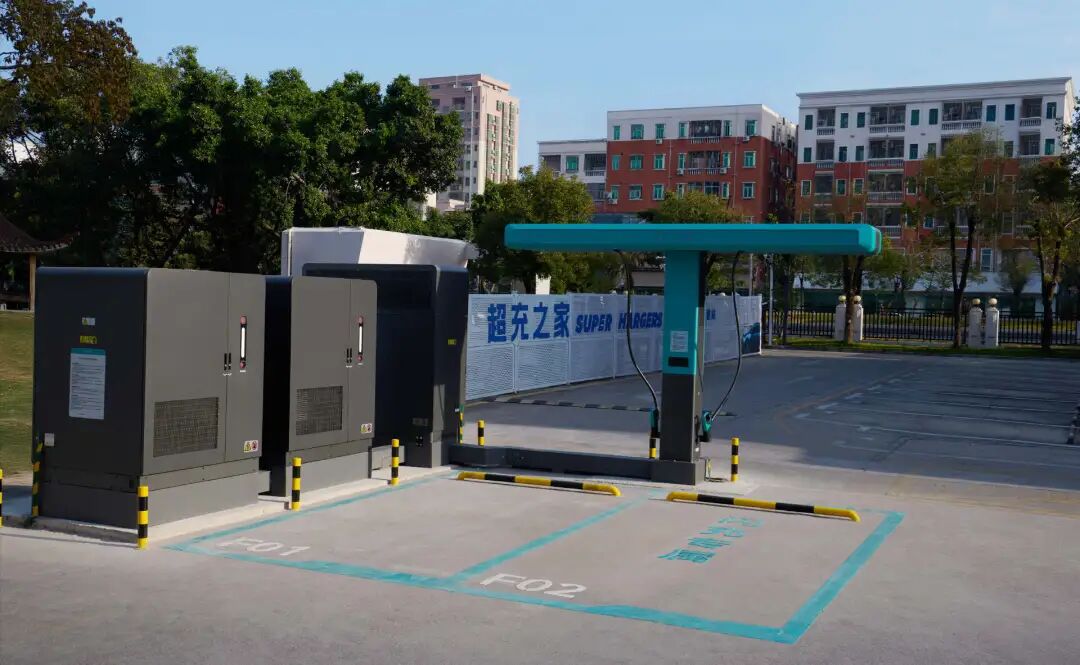
Core Viewpoint - BYD has made significant advancements in electric vehicle charging technology, launching its second-generation blade battery and new flash charging technology, which addresses key challenges in electric mobility and sets a new global record for charging speed [3][10]. Group 1: Technological Advancements - The new flash charging technology allows charging from 10% to 70% in just 5 minutes and from 10% to 97% in 9 minutes, even in extreme cold conditions [3][10]. - BYD's flash charging station has a single-gun charging power of 1500kW, making it the highest power charging station in mass production globally [3][10]. Group 2: Infrastructure Development - BYD announced the "Flash Charging China" strategy, aiming to build 20,000 flash charging stations across the country by the end of the year [7]. - This ambitious plan is significantly larger than competitors, with Li Auto having around 3,900 supercharging stations and Tesla over 2,400 [8]. Group 3: Implementation Strategy - The key to achieving the 20,000 station goal lies in BYD's "station within a station" strategy, collaborating with public charging operators to deploy its flash charging stations at existing sites [10]. - This approach reduces construction costs and time, allowing stations to be set up in about a week, similar to installing an air conditioner [10]. Group 4: Market Positioning - BYD's flash charging stations are designed to be compatible with all electric vehicles, enhancing their attractiveness to a broader customer base [13]. - The company plans to build 2,000 "flash charging highway stations" this year, covering nearly one-third of highway service areas [13]. Group 5: Customer Engagement - BYD will offer one year of free flash charging for owners of vehicles equipped with the second-generation blade battery, with pricing remaining competitive after the free period [13][14].
汽车周观点:乘用车景气有望回升,配置聚焦新兴赛道
GOLDEN SUN SECURITIES· 2026-03-09 10:24
Investment Rating - The industry investment rating is maintained as "Increase" [4] Core Insights - The passenger car market is expected to recover starting in March, following a dip in sales due to the Spring Festival holiday and other factors. The adjustment of the new energy vehicle purchase tax and subsidy policies in 2026 is anticipated to guide the industry towards high-quality development [9][10] - The automotive sector experienced a decline of 2.76% in the week from March 2 to March 8, ranking 16th out of 31 sectors. The Shanghai Composite Index fell by 0.93%, while the Shenzhen Component Index and CSI 300 Index decreased by 2.22% and 1.07%, respectively [14][15] - BYD has launched its second-generation blade battery and fast-charging technology, which is expected to enhance the sales growth of new energy vehicles due to improved charging efficiency [10][11] Summary by Sections Weekly Dynamics - Sales were impacted by the Spring Festival holiday, but a recovery is expected in March. The new energy vehicle purchase tax will shift from a capped exemption to a 50% reduction, and subsidy policies will be refined to encourage high-quality development [9] - The sales data for January and February showed a significant year-on-year decline, with the industry at a low point for the year. However, as car manufacturers resume normal sales activities, a recovery in market conditions is anticipated [9][10] Weekly Market Performance - The automotive sector's performance was down 2.76%, with the commercial vehicle segment declining by 3.76% and the passenger vehicle segment increasing by 0.85%. The overall market sentiment remains cautious [14][15] Investment Recommendations - Recommended stocks include: - Passenger Vehicles: Jianghuai Automobile, Geely Automobile, BYD, Xpeng Motors, Tesla - Commercial Vehicles: Weichai Power, China National Heavy Duty Truck Group, Yutong Bus, King Long Automobile - Liquid Cooling: Yinlun, Feilong, Ruikeda - Robotics: Zhejiang Rongtai, Siling, Delta Electronics, Top Group, Sanhua Intelligent Controls, Xinquan, Shuanghuan Transmission, Hengshuai - Autonomous Driving: Horizon Robotics, Hesai Technology, Suton, Pony.ai, Nexperia, Coboda, Jingwei Hirun, Bertley - Commercial Aviation: Chaojie, Haoneng, Jingwei Hirun [3]
周观点:乘用车景气有望回升,配置聚焦新兴赛道-20260309
GOLDEN SUN SECURITIES· 2026-03-09 09:51
Investment Rating - The report maintains an "Accumulate" rating for the automotive industry [4] Core Insights - The passenger car market is expected to recover starting in March, following a dip in sales due to the Spring Festival holiday and other factors. The adjustment of the new energy vehicle purchase tax and subsidy policies in 2026 is anticipated to guide the industry towards high-quality development [9][10] - The automotive sector experienced a decline of 2.76% in the week of March 2-8, ranking 16th out of 31 sectors, while the overall market indices also showed negative performance [14] - BYD has announced advancements in battery technology, including the second-generation blade battery and fast-charging technology, which are expected to enhance the sales growth of new energy vehicles [10][11] Summary by Sections Weekly Dynamics - Sales were impacted by the Spring Festival holiday, but a recovery is expected in March as various automakers schedule product launches. The government has also emphasized support for consumption through long-term special bonds [9] Weekly Market Performance - The automotive sector's performance was -2.76% for the week, with the passenger car segment showing a slight increase of 0.85%, while commercial vehicles declined by 3.76% [14] Investment Recommendations - Recommended stocks include: - Passenger Vehicles: Jianghuai Automobile, Geely Automobile, BYD, Xpeng Motors, Tesla - Commercial Vehicles: Weichai Power, China National Heavy Duty Truck Group, Yutong Bus, King Long Automobile - Liquid Cooling: Yilun Co., Feilong Co., Ruikeda - Robotics: Zhejiang Rongtai, Siling Co., Dechang Electric Holdings, Top Group, Sanhua Intelligent Controls, Xinquan Co., Shuanghuan Transmission, Hengshuai Co. - Autonomous Driving: Horizon Robotics, Hesai Technology, Suteng Zhuochuang, Xiaoma Zhixing, Naisite, Kobot, Jingwei Hengrun, Bertley - Commercial Aviation: Chaojie Co., Haoneng Co., Jingwei Hengrun [3]
招商证券:比亚迪股份二代刀片电池实现5分钟快充 维持“增持”评级
Zhi Tong Cai Jing· 2026-03-09 09:47
Core Viewpoint - BYD has launched its second-generation blade battery and fast-charging technology, significantly enhancing charging speed and efficiency, which is expected to strengthen its competitive advantage in the electric vehicle market [1][2] Group 1: Battery Technology - The new battery allows charging from 10% to 70% in 5 minutes and from 10% to 97% in 9 minutes, setting a new record for mass-produced vehicles [1] - The battery will be featured in 10 models, including the BYD Dynasty and Ocean series, with the Tengshi Z9GT achieving a range of 1,036 kilometers [1] - Performance improvements include enhanced charging in low temperatures, with charging from 20% to 97% taking about 12 minutes at -20 degrees Celsius [1] Group 2: Safety and Infrastructure - The new battery passed rigorous safety tests, including a 10-fold impact test without catching fire or exploding, and successfully completed 500 fast-charging cycles [1] - The company plans to implement the "Fast Charge China" strategy, aiming to build approximately 20,000 fast-charging stations by the end of 2026, with 4,239 already established [1] Group 3: Competitive Advantage - The significant technological advancements are expected to enhance BYD's competitive edge by improving charging efficiency and reducing the gap with fuel vehicles [2] - The vertical integration in battery technology, vehicle platforms, and charging networks is likely to strengthen BYD's technological moat and accelerate the launch of high-end models [2] - The new battery technology and product cycle are anticipated to improve market expectations and help BYD regain a differentiated competitive advantage amid temporary sales pressures [2]

汽车与汽车零部件行业周报、月报:地缘政治突发,关注新能源全球化机会-20260309
Guoyuan Securities· 2026-03-09 09:45
Investment Rating - The report maintains a "Buy" recommendation for the automotive and automotive parts industry [5] Core Insights - The report emphasizes that significant geopolitical events create substantial industry opportunities, aligning with Michael Porter's theory of national competitive advantage, which highlights the importance of external opportunities in industry growth [1] - The report notes that China's automotive industry has rapidly grown due to various external events, including the COVID-19 pandemic and the global chip shortage, leading to increased exports since 2019 [1] - The report identifies a potential turning point for Chinese electric vehicles (EVs) as they have established a leading position in technology and industry chain, with over 50% domestic penetration, but face challenges in overseas market demand [2][3] Summary by Sections Weekly Market Review (2026.02.28-03.06) - The automotive sector experienced a decline of 2.76% during the week, with most related sub-sectors also falling [11] - The Shanghai Composite Index decreased by 1.07%, while the automotive industry index fell by 2.76%, indicating a weaker performance compared to the broader market [11] Weekly Data Tracking (2026.02.28-03.06) - Notable sales figures for February 2026 show a decline in sales for major automakers compared to February 2025, with BYD experiencing a 41% drop [18] Industry News Highlights (2026.02.28-03.06) - Key developments include the announcement of the launch of advanced driver assistance systems by Geely, and the significant sales performance of BYD, which surpassed Tesla in 22 countries [20][29] - The report also highlights the implementation of a nationwide vehicle trade-in policy, which aims to stimulate new car sales [35][36] Investment Suggestions - The report suggests focusing on leading companies in the electric vehicle export layout, indicating a potential for significant growth in this area [3]
比亚迪李云飞:第一代刀片电池不会停产 新一代技术有望推动市场回暖
Xin Lang Cai Jing· 2026-03-09 09:39
Core Insights - BYD has officially launched its second-generation blade battery and fast-charging technology, achieving record charging speeds that allow for a 5-minute charge to 70% and a 9-minute charge to 97% in normal conditions [1] - The new technology addresses global challenges in electric vehicle charging, particularly slow charging and difficulties in low-temperature environments [1] - The first-generation blade battery will continue to be produced alongside the new version, providing customers with more options [1] Charging Infrastructure - BYD plans to build 20,000 fast-charging stations by the end of the year, with a focus on a "fast-charging station within a station" model in collaboration with national charging network operators [2] - The fast-charging stations will cover nearly one-third of highway service areas, with 2,000 stations expected to be completed by year-end [2] - An innovative solution for urban public charging stations has been introduced, requiring only three parking spaces to set up a system that includes a storage host and charging piles [2] Market Outlook - The release of the second-generation blade battery and fast-charging technology is expected to have a profound impact on the industry, with a potential market rebound anticipated in the second quarter as new technologies and charging infrastructure are deployed [3] - Despite a decline in overall sales due to subsidy reductions and policy adjustments, there is confidence in the future performance of the market [2]
比亚迪的关键时刻:6年两代刀片电池,牌桌却变了
Di Yi Cai Jing· 2026-03-09 09:11
Core Viewpoint - BYD has launched its second-generation blade battery, which boasts the fastest charging speed for mass-produced batteries globally, amidst a slowing sales growth in the competitive Chinese electric vehicle market [1][2][4]. Group 1: Battery Technology Advancements - The second-generation blade battery has over a 5% increase in energy density compared to the first generation, with charging times significantly reduced [3]. - Charging from 10% to 70% takes only 5 minutes, and from 10% to 97% takes 9 minutes, while in extreme cold conditions, charging from 20% to 97% takes 12 minutes [3]. - The peak charging power of the new fast-charging stations has increased from 1000 kW to 1500 kW, with plans to build 20,000 fast-charging stations across China [3]. Group 2: Market Dynamics and Sales Performance - BYD's sales growth has slowed, with a mere 7.7% increase in 2025 compared to previous years of 61.9% and 41.3% [2][8]. - In early 2023, sales dropped over 30% year-on-year, indicating a challenging market environment [2][8]. - The company aims to launch new models equipped with the second-generation blade battery in March-April 2026, which will be crucial for validating the return on investment in new technology [4]. Group 3: Competitive Landscape - The Chinese electric vehicle market has matured, leading to intensified competition, with companies adopting strategies like model iterations and international expansion [8]. - BYD's high-end brand Yangwang has launched models priced over 1 million yuan, aiming to capture a differentiated market segment [8]. - The company has set a target of selling 1.3 million vehicles overseas in 2026, following a significant increase in overseas sales in 2023 [9]. Group 4: Cost and Profitability Challenges - The rising prices of precious metals for battery production may increase the cost of the second-generation blade battery by over 1500 yuan per unit [3]. - The investment required for building fast-charging stations is substantial, with estimates exceeding 5 billion yuan for the planned 20,000 stations [3]. - The balance between new technology costs and profitability will be critical for BYD's stock performance and market position [4].