
EVE(300014)

Search documents
深度丨“不卷价格卷价值”!锂电行业加速优化产能结构
证券时报· 2025-07-09 08:04
Core Viewpoint - The lithium battery industry is currently facing a "price competition" crisis, transitioning from previous "capacity expansion" issues, leading to a consensus on the need for "anti-involution" strategies to improve profitability and sustainability [3][5][7]. Group 1: Industry Challenges - The lithium battery sector is experiencing severe price competition, with many companies struggling to maintain profitability as prices approach cost levels [5][7]. - A significant number of listed companies in the lithium battery sector reported declining net profits, with 65 out of 104 companies experiencing profit drops last year [5]. - The rapid expansion of production capacity in previous years has resulted in an oversupply, while market growth has slowed, leading to a shift from "capacity competition" to "price competition" [7][10]. Group 2: Calls for Action - Industry associations have recently issued initiatives urging companies to focus on quality and innovation rather than price competition [9][10]. - The Chinese Battery Industry Association and the China Plastics Processing Industry Association have called for enhanced collaboration within the industry to promote healthy development [9]. - There is a push for supply-side reforms to accelerate the exit of outdated production capacity, with suggestions for a structured mechanism to phase out inefficient companies [10][12]. Group 3: Technological Innovation - Technological innovation is seen as a key strategy for the industry to shift from "price competition" to "value competition," emphasizing the importance of quality and safety [13][20]. - Industry leaders have highlighted the necessity of improving technology and quality standards to combat the current challenges [14][15][16]. - The introduction of new safety standards in 2025 is expected to raise industry entry barriers and further accelerate the exit of outdated capacity [19][21]. Group 4: Market Adjustments - Companies are beginning to reassess their expansion plans in light of current market conditions, with some halting or terminating previously planned projects [11][12]. - The market is witnessing a cautious approach to capacity expansion, with firms conducting thorough market assessments before investing [12]. - The focus is shifting towards creating competitive advantages through innovative products and technologies, as seen with leading companies launching new battery products [18][19].






电力设备新能源行业观察:亿纬锂能加速海外布局;光伏“反内卷”进入政策执行期
Sou Hu Cai Jing· 2025-07-09 04:49
Group 1: Industry Overview - The "anti-involution" signal from policy levels is driving structural adjustments in the power equipment and new energy sectors, indicating a shift from disorderly competition to high-quality development [1] - The photovoltaic industry is experiencing accelerated elimination of backward production capacity under policy guidance, with signs of price stabilization in silicon materials and glass [1] Group 2: EVE Energy's Global Expansion - EVE Energy has submitted an IPO application to the Hong Kong Stock Exchange, aiming to raise funds for a 30GWh power battery factory in Hungary and a 38GWh energy storage battery project in Malaysia, marking a critical phase in its global layout [1] - The Hungary project targets local demand from European automakers, focusing on the production of 46 series cylindrical batteries, while the Malaysia project aims at the Southeast Asian energy storage market [1] Group 3: Competitive Landscape and Financial Challenges - The shift in industry competition logic is evident as domestic lithium battery capacity faces significant overcapacity pressure, while policies in Europe and the U.S. favor localized supply, creating new opportunities [2] - EVE Energy's "China manufacturing + overseas base" model helps avoid trade barriers and shortens the distance to core customers, but the projected 2027 production timeline for the Hungary project coincides with competitors like CATL and Sunwoda, indicating potential market competition intensity [2] - As of March 2025, EVE Energy has cash reserves of 13.435 billion yuan, but the total investment demand for overseas projects far exceeds current reserves, with a debt-to-asset ratio rising to 62% [2] - The energy storage business's strategy of "exchanging price for volume" has led to a continuous decline in gross margins, with the average price of energy storage batteries expected to drop by 33% year-on-year in 2024 [2] Group 4: Photovoltaic Industry Dynamics - The photovoltaic industry's "anti-involution" actions are transitioning from initiatives to tangible implementations, with major domestic photovoltaic glass companies collectively announcing a 30% production cut, expected to reduce July output to 45GW, which has led to a rebound in glass prices [3] - The central financial committee has mandated the rectification of low-price disorderly competition, indicating that supply-side reforms in the photovoltaic sector have entered an execution phase [3] - The silicon material segment is becoming a focal point for capacity consolidation, with recent rumors of "silicon material storage" leading to price recovery, as the average transaction price for multi-crystalline silicon N-type materials has risen to 34,700 yuan/ton, a 0.87% increase [3] - The new photovoltaic manufacturing industry standards raise the threshold for new capacity, further curbing inefficient expansion [3] - The competitive focus is shifting from price to technological differentiation, with advancements in large-size N-type cells and perovskite tandem technologies accelerating, allowing leading firms to achieve cost reductions and efficiency improvements [3] - The primary contradiction in the photovoltaic sector has shifted from insufficient demand to oversupply, with the potential for marginal improvements as policies and corporate actions drive capacity elimination [3]
广东制造的“新”密码藏于何处
Jin Rong Shi Bao· 2025-07-09 03:23
Group 1: Transformation of Guangdong Manufacturing - Guangdong has transformed from a "world factory" to a "smart manufacturing highland," showcasing technological advancements in various sectors such as autonomous driving, drones, and smart equipment [1] - The province has maintained its position as the leading region in GDP for 36 consecutive years, with high-tech manufacturing value added increasing by 10.2% in 2024, accounting for 32.0% of the total industrial value added [1] Group 2: Growth of the Drone Industry - Guangdong's drone industry is rapidly advancing, with over 15,000 companies in the low-altitude economy, generating a market size exceeding 100 billion yuan [2] - Shenzhen's low-altitude aerospace industry achieved double-digit growth in 2024, while Zhongshan's drone sector generated over 5.7 billion yuan in sales [2] Group 3: Robotics and Automation - Guangdong has become China's largest intelligent robot industry cluster, with revenues exceeding 90 billion yuan in 2024 [6] - The Guangdong Intelligent Robot Research Institute and Shenzhen AI and Robotics Research Institute are fostering innovation and application in the robotics sector [7] Group 4: Financial Support for Innovation - Since 2022, Guangdong has signed strategic cooperation agreements with 23 national financial institutions, resulting in 233 specific cooperation projects worth 1.31 trillion yuan [16] - The province's technology credit balance grew by 23% in 2024, with private equity and venture capital management numbers leading the nation [17] Group 5: Talent Development and Education - Guangdong is implementing the "Million Talents Gather in South Guangdong" initiative to attract graduates and various talents, with over 1.2 million job openings identified [19] - The province has established 28 city-level industry-education joint bodies and 216 open regional industry-education integration practice centers [21]

“高质量”标的有望成为推动指数突破的关键力量,创业板50ETF嘉实(159373)盘中涨近1%
Xin Lang Cai Jing· 2025-07-09 03:15
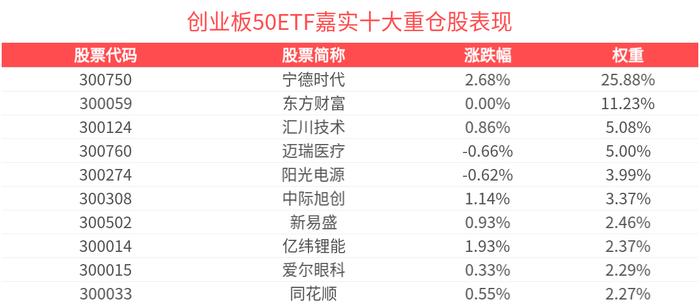
Group 1 - The ChiNext 50 Index has increased by 0.75% as of July 9, 2025, with notable gains from stocks such as AVIC Chengfei (+3.89%), JinkoSolar (+3.40%), and CATL (+2.68%) [1] - The ChiNext 50 ETF (159373) has seen a trading volume of 9.57 million yuan with a turnover rate of 3.11% [1] - Since its inception, the ChiNext 50 ETF has recorded a highest monthly return of 9.54% and an average monthly return of 5.11% during rising months [1] Group 2 - The top ten weighted stocks in the ChiNext 50 Index account for 64.62% of the index, with CATL holding the largest weight at 25.88% [3] - The sectors leading the gains include steel, new energy, building materials, media, communication, and electronics, driven by the "anti-involution" trend and AI industry growth [3][4] - The "anti-involution" trend is expected to improve corporate profitability and attract more long-term capital into the market, with high-quality stocks likely to drive index breakthroughs [3] Group 3 - The AI sector is identified as a key driver of the current technological revolution, creating investment opportunities across multiple industries in the A-share market [4] - Investors can access investment opportunities through the corresponding ChiNext 50 ETF linked fund (023429) [5]





亿纬锂能谋求港股上市,超百亿元豪赌两大海外工厂
Hua Xia Shi Bao· 2025-07-09 02:55
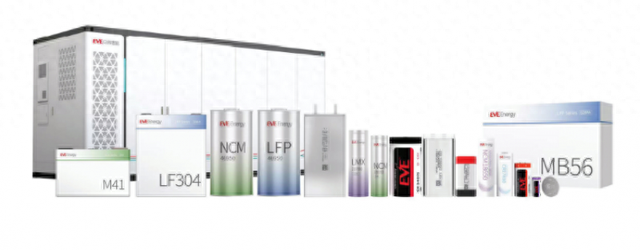
Core Viewpoint - EVE Energy has submitted its IPO application to the Hong Kong Stock Exchange, aiming to raise funds primarily for its 30GWh battery factory in Hungary and a 38GWh energy storage project in Malaysia, to accelerate its global capacity expansion [2][3]. Group 1: Overseas Expansion - EVE Energy is pursuing a dual overseas strategy, focusing on a 30GWh battery project in Hungary and a 38GWh energy storage base in Malaysia, with production expected to start in 2027 and 2025-2026 respectively [3]. - The investment in Malaysia amounts to 8.654 billion yuan, positioning it as a multi-scenario lithium battery production base to meet energy storage needs and support electric two-wheelers and tool batteries [3]. - The Hungarian base targets local battery supply for European automakers like BMW and Mercedes, aligning with the company's recent capacity expansion strategy [3]. Group 2: Market Dynamics - Despite domestic overcapacity, the overseas market presents significant opportunities, with Chinese lithium battery companies planning to build 58 factories abroad, totaling a designed capacity of 787.5GWh and an investment exceeding 363 billion yuan [4]. - EVE Energy's international capacity expansion is part of a broader trend among leading battery manufacturers, with major players like CATL and Sunwoda also establishing factories in Hungary [4]. Group 3: Financial Performance - EVE Energy's revenue from energy storage batteries reached 19.027 billion yuan in 2024, a year-on-year increase of 16.44%, with the segment's revenue share rising from 33.5% to 39.1% [6]. - The average selling price of energy storage batteries decreased from 0.6 yuan/Wh to 0.4 yuan/Wh in 2024, leading to a decline in gross margin from 17% to 14.7% [6]. - The company's cash flow has improved, with a net cash flow from operating activities of 0.892 billion yuan in Q1 2025, a significant turnaround from -1.751 billion yuan in the previous year [8]. Group 4: Capital Structure and Debt - EVE Energy's cash reserves increased by 48.21% to 13.435 billion yuan as of March 2025, although this still falls short of the total investment needs for its overseas projects [8]. - The company's debt ratio has risen to 62%, with interest-bearing liabilities reaching 32.819 billion yuan, reflecting a 34.97% year-on-year increase [8]. - Financial expenses surged by 131% to 0.181 billion yuan in Q1 2025, primarily due to interest payments [8].
2025年中国废电池回收行业发展现状、竞争格局及发展趋势研判:行业已形成“电池企业+材料企业+第三方专业回收企业”三足鼎立格局[图]
Chan Ye Xin Xi Wang· 2025-07-09 01:39
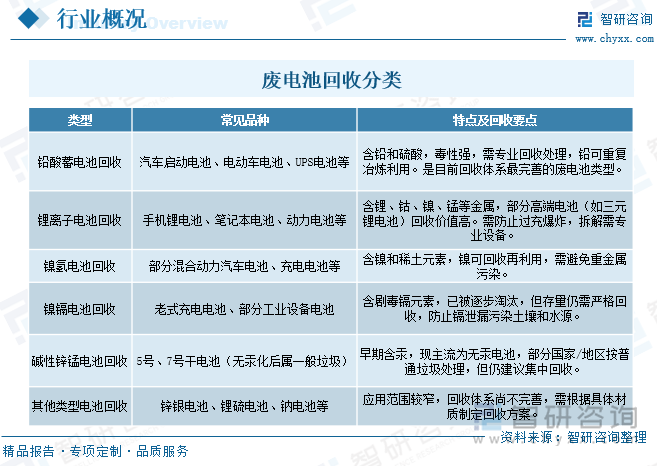
Overview - The recycling of waste batteries is essential for reducing environmental pollution and achieving resource sustainability, with a focus on recovering valuable metals like lithium, cobalt, and nickel [1][11] - In 2024, China's waste battery (excluding lead-acid) recycling volume is projected to reach 750,000 tons, a year-on-year increase of 22.95%, with a recycling value of 17.25 billion yuan, up 17.83% [1][11] Market Policies - A series of policies have been implemented in China to support the development of the waste battery recycling industry, including guidelines for enhancing recycling systems and promoting green manufacturing [4][6] - Key policies include the "2030 Carbon Peak Action Plan" and various initiatives aimed at improving recycling networks and encouraging the integration of advanced technologies in recycling processes [4][6] Industry Chain - The waste battery recycling industry consists of three main segments: upstream (battery sources and collection channels), midstream (recycling and dismantling), and downstream (production of recycled products) [7] - The increasing number of retired batteries from electric vehicles and energy storage systems is a significant source of waste batteries, providing ample raw materials for the recycling industry [7] Current Development - The rapid growth of the electric vehicle and consumer electronics markets has led to an increase in waste battery generation, highlighting the economic and environmental benefits of recycling [11] - The waste lithium-ion battery sector is particularly significant, with the production of lithium-ion batteries in China expected to reach 29.46 billion units in 2024, a 20.1% increase year-on-year [9] Competitive Landscape - The waste battery recycling industry in China is characterized by a tripartite structure involving battery manufacturers, material companies, and third-party recycling firms [13][15] - Leading companies like BYD and CATL have established closed-loop systems for battery production and recycling, while material companies like Huayou Cobalt and Ganfeng Lithium focus on material recovery and processing [13][15] Future Trends - The industry is expected to see stricter regulations and enhanced collaboration between automakers and recycling companies, driven by carbon neutrality goals and ESG considerations [19] - The adoption of intelligent recycling systems utilizing blockchain and AI technologies is anticipated to improve efficiency and reduce costs in the recycling process [19]




反内卷信号明确,市场有望加速出清 | 投研报告
Zhong Guo Neng Yuan Wang· 2025-07-09 01:06
Group 1 - The core viewpoint of the news highlights that the photovoltaic industry is undergoing a "de-involution" movement that has reached the highest strategic level of the country, focusing on capacity integration in the silicon material segment and strengthening price regulation across the industry chain [1][4] - The current state of the photovoltaic industry is at the bottom of the cycle, with future policy strength being a key variable affecting industry trends [1][4] - In the medium to long term, the photovoltaic industry is expected to enter a phase of high-quality development, where technological upgrades and market structure optimization will become core competitive factors for companies [1][4] Group 2 - Weekly market review indicates that from June 29 to July 4, the Shanghai Composite Index rose by 1.40%, the Shenzhen Component Index by 1.25%, and the ChiNext Index by 1.50%, with the Shenwan Electric Equipment Index increasing by 1.99%, outperforming the CSI 300 by 0.45 percentage points [2] - In the sub-sectors, the Shenwan photovoltaic equipment increased by 5.76%, while wind power equipment decreased by 0.86%, battery by 1.63%, and grid equipment by 0.82% [2] Group 3 - The report tracks key sectors, noting that EVE Energy has submitted an IPO application to the Hong Kong Stock Exchange, with funds primarily allocated for projects in Hungary and Malaysia, as well as working capital and general corporate purposes [3] - The Hungarian project is already under construction and is expected to be operational by 2027, with a planned capacity of 30GWh, focusing on producing power batteries, particularly the 46 series cylindrical batteries [3] Group 4 - Investment suggestions for the photovoltaic sector emphasize the importance of focusing on silicon materials, glass, and battery segments that have undergone sufficient corrections, as well as new technologies and leading manufacturers [4][5] - For the wind power sector, the domestic industry chain has a localization rate exceeding 90%, with strong global competitiveness in upstream materials and core components [4] - The report suggests focusing on companies like Goldwind Technology, Dongfang Cable, and others in the wind power sector, while in the new energy vehicle sector, it recommends companies benefiting from low upstream material prices and stable profitability [5]
锂电行业加速优化产能结构“不卷价格卷价值”成为共识
Zheng Quan Shi Bao· 2025-07-08 18:26
Core Viewpoint - The lithium battery industry is currently facing significant challenges due to intense price competition, a consequence of previous aggressive capacity expansion, leading to a consensus on the need for "anti-involution" strategies to stabilize the market and improve profitability [1][2][3] Industry Challenges - The lithium battery supply chain is experiencing continuous price declines, approaching cost lines, resulting in widespread survival difficulties for companies [1][2] - A significant number of listed companies in the lithium battery sector reported profit declines, with 65 out of 104 companies experiencing net profit drops last year, and over 60 companies seeing year-on-year gross margin reductions [1][2] Causes of Involution - The current "involution" in the lithium battery industry is primarily driven by low-price competition, stemming from the overcapacity created by previous years' aggressive expansion [2] - Local governments' incentives for lithium battery projects have led to an oversupply situation, with many companies now facing a market where demand does not meet the inflated production capacity [2] Proposed Solutions - Industry associations have called for a shift in focus from price competition to quality and innovation, advocating for a coordinated approach to enhance the industry's health [3] - Accelerating supply-side reforms and promoting the exit of outdated capacities are seen as immediate solutions to address the supply-demand mismatch [3][4] Market Adjustments - Some companies are beginning to reassess their expansion plans, with notable cancellations of previously planned projects, indicating a more cautious approach to capacity growth [4] - The government is encouraged to play a regulatory role to prevent blind investments and manage capacity effectively from the outset [5] Shift to Value Competition - There is a growing consensus that the industry should transition from "price competition" to "value competition," emphasizing technological innovation as a key driver for future success [6][7] - Leading companies are focusing on developing advanced battery technologies to enhance product competitiveness and profitability [7][8] Technological Innovations - The industry is witnessing rapid advancements in battery materials and technologies, with companies like Ningde Times and EVE Energy launching innovative products that improve performance and safety [8][9] - The introduction of stringent safety standards is expected to further elevate industry entry barriers and accelerate the exit of underperforming capacities [9]
SPIR:预计32140大圆柱2025全年出货量将达1.88亿只
起点锂电· 2025-07-08 10:36
Core Viewpoint - The article highlights the upcoming 2025 Fifth Electric Two-Wheeler Battery Swap Conference and the growth potential of the 32140 cylindrical lithium battery market, driven by increasing demand in outdoor activities, instant delivery services, and advancements in battery technology [2][6]. Group 1: Event Details - The event theme is "Swap City, Smart Two-Wheelers" and will take place on July 11, 2025, at the Shenzhen Baoan DENGXILU International Hotel [2]. - The event is organized by Qidian Lithium Battery, Qidian Sodium Battery, Qidian Two-Wheelers, and Battery Swap [2]. - Numerous sponsors and partners are involved, including major companies like Yadi Technology Group, New Day Co., and others [2]. Group 2: Market Statistics - In 2024, the shipment volume of 32140 cylindrical lithium batteries is expected to reach approximately 150 million units (7.19 GWh), representing a year-on-year growth of 15.7% [2]. - In Q1 2025, the shipment volume is projected to be 42 million units, with an anticipated total shipment of 188 million units (9.0 GWh) for the entire year [2]. - By 2030, the shipment volume of 32140 cylindrical lithium batteries in China is expected to reach 363 million units (17.4 GWh), indicating a promising future for the market [2]. Group 3: Growth Drivers - The growth of the 32140 cylindrical lithium battery market is attributed to the increasing popularity of outdoor activities and the rising demand for portable energy storage solutions [2]. - The expansion of the instant delivery market is expected to enhance the penetration rate of battery swapping for two and three-wheelers, which require high-capacity batteries [2]. - Technological advancements and decreasing prices of lithium batteries are likely to lead to a gradual replacement of lead-acid batteries, providing a larger market space for 32140 batteries [2]. Group 4: Industry Structure - The 32140 cylindrical lithium battery industry is relatively mature with a high market concentration [6]. - The first tier of companies includes EVE Energy, Guoxuan High-Tech, and CATL, which together account for 55.0% of the market share in Q1 2025 [6]. - The second tier consists of companies like Chuangming New Energy, Baoli New Energy, and others [6].
中证新能源汽车指数上涨1.42%,前十大权重包含赣锋锂业等
Jin Rong Jie· 2025-07-08 10:07
Core Viewpoint - The China Securities New Energy Vehicle Index (CS New Energy Vehicle, 399976) has shown positive performance, with a recent increase of 1.42% and significant gains over various time frames, indicating a strong market for new energy vehicles in China [1][2]. Group 1: Index Performance - The CS New Energy Vehicle Index has increased by 2.20% over the past month, 11.53% over the past three months, and 3.42% year-to-date [2]. - The index reflects the overall performance of listed companies involved in lithium batteries, charging stations, and new energy vehicles, with a base date of December 31, 2011, set at 1000.0 points [2]. Group 2: Index Composition - The top ten weighted companies in the CS New Energy Vehicle Index are: CATL (10.33%), Huichuan Technology (9.45%), BYD (9.05%), Changan Automobile (5.02%), Sanhua Intelligent Control (4.53%), Yiwei Lithium Energy (4.34%), Huayou Cobalt (4.21%), Ganfeng Lithium (3.14%), Tianqi Lithium (2.75%), and Guoxuan High-Tech (2.61%) [2]. - The index's holdings are primarily listed on the Shenzhen Stock Exchange (84.08%), followed by the Shanghai Stock Exchange (15.30%) and the Beijing Stock Exchange (0.62%) [2]. - In terms of industry composition, the index is comprised of 59.42% industrial sector, 23.09% consumer discretionary, 16.27% materials, and 1.23% information technology [2]. Group 3: Index Adjustment Mechanism - The index samples are adjusted biannually, with adjustments implemented on the next trading day following the second Friday of June and December [3]. - Weight factors are generally fixed until the next scheduled adjustment, with special circumstances allowing for temporary adjustments [3]. - Companies that are delisted or undergo mergers, acquisitions, or splits are handled according to specific calculation and maintenance guidelines [3].