CATL(300750)

Search documents
2025年12月国内电池产量和装车量同比高增,六氟磷酸锂价格下降
Zhong Guo Neng Yuan Wang· 2026-01-22 01:21
Core Viewpoint - The lithium battery industry is expected to see significant growth in production and demand in 2025, with domestic battery and lithium iron phosphate (LFP) cathode material output notably higher than in 2024 [1][2] Production - In December 2025, domestic battery production is projected to reach 201.7 GWh, representing a year-on-year increase of approximately 62% and a month-on-month increase of about 14% [1][2] - The output of domestic lithium iron phosphate cathode materials in December 2025 is expected to be 26.93 million tons, showing a year-on-year growth of 32.48% and a month-on-month increase of 0.16%, with a capacity utilization rate of 59.85% [1][2] Pricing - As of January 16, 2026, the price of industrial-grade lithium carbonate has risen to 153,000 yuan per ton, with a weekly increase of 10.87% [3] - The price of lithium iron phosphate (power type) was reported at 47,100 yuan per ton on January 9, 2026, up 4.43% from January 4 [3] - The average price of square lithium iron phosphate energy storage cells remained stable, with specific capacities showing slight increases in price [3] Demand - In December 2025, the monthly loading volume of lithium iron phosphate batteries reached 79.8 GWh, a year-on-year increase of 30.82% and a month-on-month increase of 5.98%, marking a new high for the year [4] - The monthly loading volume of ternary power batteries was 18.2 GWh, remaining stable compared to November and showing a year-on-year increase of 27.27% [4] - In November 2025, global sales of new energy vehicles reached 2 million units, reflecting a year-on-year growth of 8.53% and a month-on-month increase of 4.63% [4] Investment Recommendations - The report suggests focusing on companies involved in the production of lithium batteries and related materials, particularly those with strong positions in both domestic and overseas markets [5] - Recommended companies include CATL (300750.SZ), EVE Energy (300014.SZ), Xinwangda (300207.SZ), Hunan Youneng (301358.SZ), Tianci Materials (002709.SZ), and Dofluorid (002407.SZ) [5]






研判2026!中国太阳能路灯行业发展历程、产销量、市场规模、重点企业及未来展望:社会绿色转型推动行业发展提速,太阳能路灯市场规模达4.07亿元[图]
Chan Ye Xin Xi Wang· 2026-01-22 01:01
Core Insights - The solar street light market in China is experiencing significant growth potential, transitioning from initial application to market promotion and scaling up towards intelligent upgrades, driven by technological advancements and increasing demand [1][11] Market Overview - The market size of China's solar street light industry is projected to grow from 291 million yuan in 2019 to 385 million yuan in 2024, with a compound annual growth rate (CAGR) of 5.76% [1][12] - By 2025, the market size is expected to reach 407 million yuan [1] Industry Development - The solar street light industry has evolved from the 1970s, initially limited by low efficiency and storage capacity, to widespread application in urban and rural areas since the 21st century [7][11] - The production volume of solar street lights is forecasted to increase from 543,500 units in 2019 to 642,600 units in 2024, with a CAGR of 3.41% [11][12] - Sales volume is expected to rise from 458,200 units in 2019 to 571,000 units in 2024, with a CAGR of 4.5% [11][12] Technological Advancements - Continuous improvements in photovoltaic and storage technologies are leading to enhanced efficiency and cost optimization, facilitating the transition towards intelligent solar street lights [1][11] - The efficiency of single crystal PERC cells has surpassed 23%, and new battery technologies are emerging, significantly reducing initial investment costs and extending the lifespan of solar street lights [11] Industry Chain - The solar street light industry chain includes upstream raw material supply (solar panels, lithium batteries, LED lights), midstream manufacturing and assembly, and downstream applications in parks, squares, and urban roads [8][11] Key Players - Major companies in the solar street light industry include Qunshang Co., Ltd., Zhouming Technology, and Jiawei New Energy, among others [2][13] - The competitive landscape is characterized by a mix of national brands and numerous regional manufacturers, with a shift towards comprehensive solutions that integrate smart control systems [13] Future Trends - The integration of smart management platforms and IoT technologies is expected to transform solar street lights into critical nodes for urban data collection and management [15] - Innovations in materials and storage technologies will drive performance improvements, with a focus on higher efficiency solar cells and advanced battery solutions [17] - Aesthetic design and scene-specific customization are becoming focal points for competition, moving beyond basic functionality to enhance visual appeal and environmental integration [18]


新能源车报废将实行“车电一体”制
Mei Ri Shang Bao· 2026-01-22 00:25
Core Viewpoint - The new regulations for the recycling and comprehensive utilization of used power batteries from new energy vehicles (NEVs) will take effect on April 1, 2026, addressing the urgent need for standardized recycling processes as the first batch of NEVs approaches retirement [1]. Group 1: Regulations on Non-Swap Battery Vehicles - For non-swap battery vehicles, the core requirement is that the power battery must be handed over together with the vehicle to a qualified recycling and dismantling organization upon retirement [2]. - By 2025, the total amount of retired power batteries in China is expected to reach 820,000 tons, and it is projected to exceed 1 million tons by 2030 [2]. - The new regulations include a "digital ID" for each battery, allowing for full lifecycle tracking from production to recycling, which aims to prevent illegal sales and ensure consumer protection [2]. Group 2: Clarifications for Battery Replacement and Recycling Channels - Vehicle owners are advised to keep records of battery replacements and recycling receipts to avoid complications during the vehicle retirement process [3]. - The regulations require battery manufacturers to establish recycling points in each province, while NEV manufacturers must cover recycling points down to the prefecture level, simplifying the recycling process for vehicle owners [3]. - Strict penalties are established for those who illegally repurpose used batteries for other applications, with fines ranging from 10,000 to 100,000 yuan for serious violations [3]. Group 3: Exemptions for Swap Battery Vehicles - Swap battery vehicles are exempt from the "vehicle-battery integration" requirement, recognizing the unique nature of the battery swap model [4]. - The decision to exempt swap vehicles is based on the growing prevalence of battery swap networks, such as those operated by NIO and CATL, which have established extensive infrastructure [4]. - The regulations will allow for different ownership models of batteries, whether purchased outright or rented, without requiring the battery to be returned with the vehicle upon retirement [4]. Group 4: Recycling Technology and Market Regulation - The recycling technology for used power batteries in China has matured, with some companies achieving recovery rates of 99.6% for nickel-cobalt-manganese and 96.5% for lithium [5]. - The implementation of the new regulations is expected to further reduce illegal recycling activities, leading to a more regulated and orderly recycling market [5]. - The overall lifecycle management system for NEVs will become more robust, enhancing environmental protection and public safety while improving the user experience for vehicle owners [6].
兴证全球基金谢治宇:重点配置海外算力、半导体设备等领域
Sou Hu Cai Jing· 2026-01-22 00:21
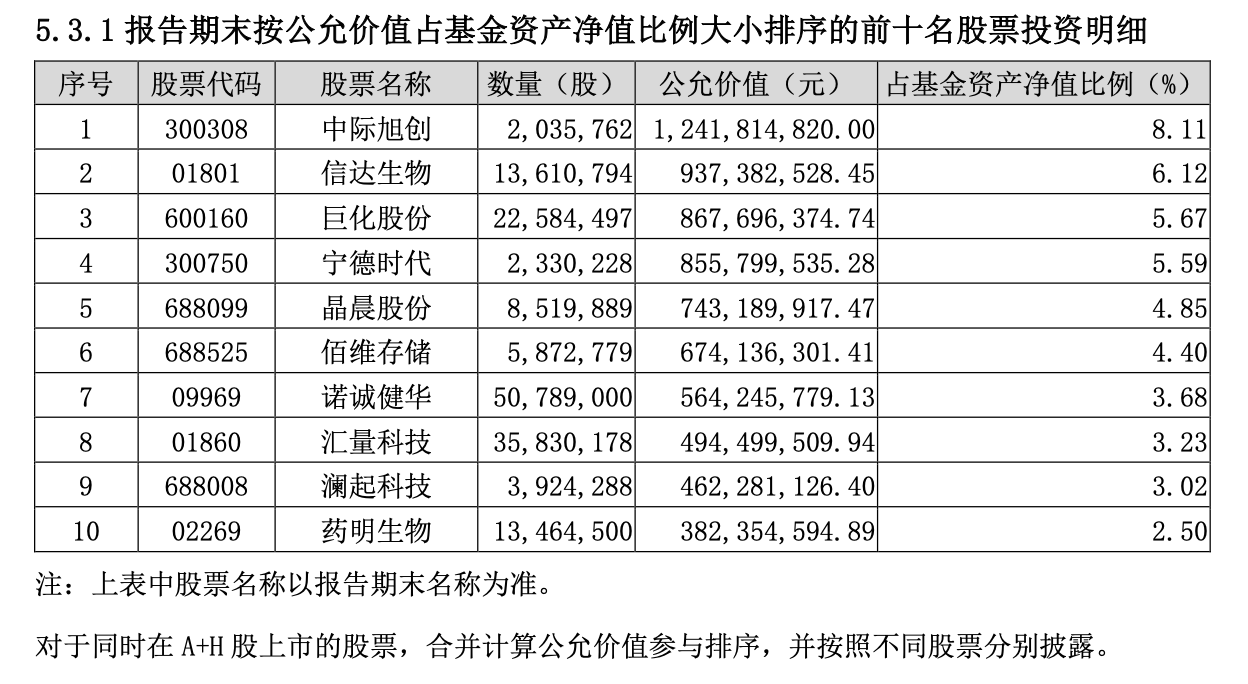
Core Insights - The report highlights significant investments made by fund manager Xie Zhiyu in various technology sectors, particularly in overseas computing power and semiconductor equipment, indicating a strategic focus on high-growth areas for 2026 [1][2] Investment Strategy - The funds managed by Xie Zhiyu, namely Xingquan He Yi and Xingquan He Run, have newly increased their positions in companies such as Baiwei Storage, Huiliang Technology, and WuXi Biologics, while also increasing their holdings in CATL [1] - The report emphasizes the importance of tracking core competitive trends in companies over a longer cycle to identify investment opportunities arising from technological transformations and sectoral rebounds [2] Sector Performance - The overseas computing power sector, particularly in optical modules, is experiencing record highs due to increased orders from major clients and advancements in new technologies [1] - Domestic supply chain leaders are gaining more influence on the international stage, especially in the optical module and PCB sectors, while also achieving breakthroughs in liquid cooling and power supply [1] - The AI-driven capital expenditure surge is creating challenges such as power shortages and storage deficits overseas, leading to heightened demand in domestic energy storage, gas turbines, and related industries [1] Company Holdings - The report lists significant stock holdings, including: - Zhongji Xuchuang: 2,035,762 shares valued at approximately 1.24 billion yuan - CATL: 2,330,228 shares valued at approximately 855.8 million yuan - Baiwei Storage: 5,872,779 shares valued at approximately 674.1 million yuan - Huiliang Technology: 35,830,178 shares valued at approximately 494.5 million yuan - WuXi Biologics: 13,464,500 shares valued at approximately 382.4 million yuan [3]


宁德时代获摩根大通增持约31.47万股 每股作价约491.2港元
Xin Lang Cai Jing· 2026-01-21 23:56
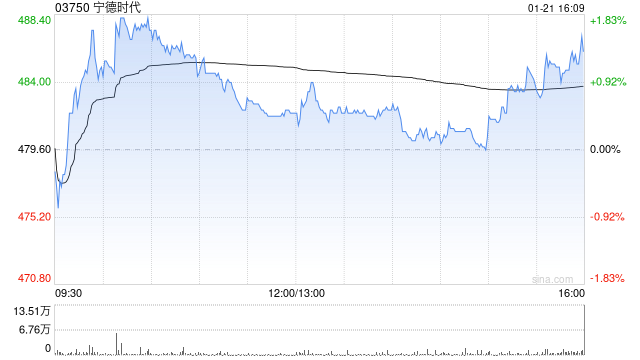
Group 1 - Morgan Stanley increased its stake in Contemporary Amperex Technology Co., Limited (CATL) by 314,727 shares at a price of HKD 491.1985 per share, totaling approximately HKD 155 million [1] - After the increase, Morgan Stanley's total shareholding in CATL reached approximately 11,043,800 shares, representing a stake of 7.08% [1]
宁德时代竟锁定的产能,是全球产量三倍!容百科技,只是个马前卒!
Ge Long Hui· 2026-01-21 20:05
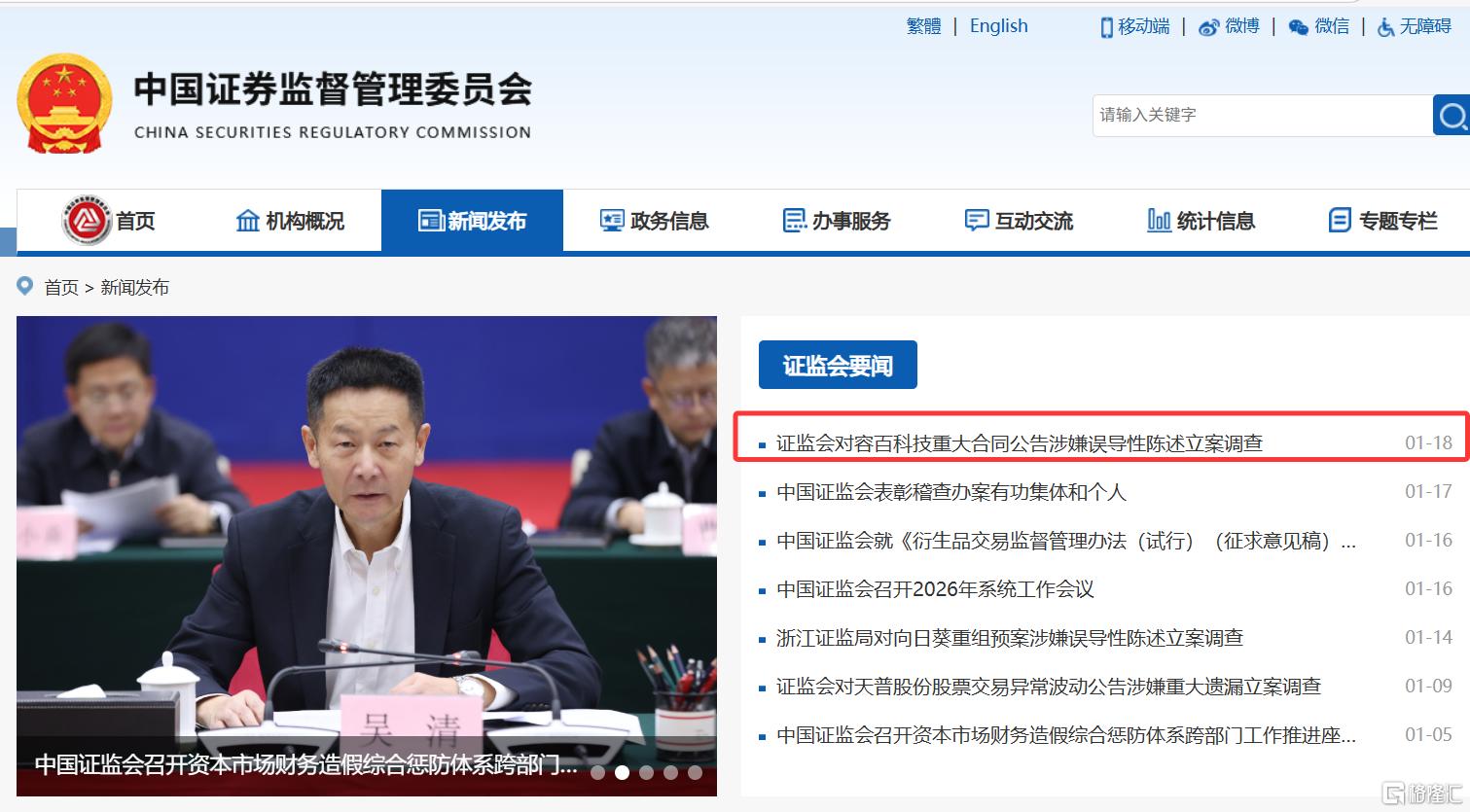
Core Viewpoint - The China Securities Regulatory Commission (CSRC) has initiated an investigation into Rongbai Technology for allegedly misleading statements in a major contract announcement, raising concerns about corporate governance and compliance within the company [1][3][4]. Group 1: Investigation and Corporate Response - On January 18, 2026, CSRC announced the investigation into Rongbai Technology following a contract announcement that was deemed misleading [1]. - Rongbai Technology's announcement of a 120 billion yuan contract was based on estimates, with actual sales dependent on future orders, leading to questions about the accuracy of the disclosure [3][4]. - The company stated that the announcement was prepared by the secretary of the board without the chairman's approval, implying a lack of oversight in the approval process [3][5]. Group 2: Governance Issues - The company's governance structure is under scrutiny, as the chairman is ultimately responsible for information disclosure, regardless of whether they directly approved the announcement [4][5]. - The failure to follow proper approval processes for significant announcements raises concerns about the effectiveness of internal controls and corporate governance at Rongbai Technology [5][6]. Group 3: Market Impact and Competitor Analysis - Following the investigation announcement, Rongbai Technology's stock fell by 11.16% after a trading halt, reflecting investor concerns about the company's ability to fulfill its contract obligations [8]. - Concurrently, CATL (Contemporary Amperex Technology Co., Limited) secured significant contracts with other suppliers, indicating a competitive landscape where Rongbai Technology's missteps could impact its market position [8][10]. - CATL has locked in substantial lithium iron phosphate (LFP) supply agreements, totaling approximately 737.31 million tons, which positions it strongly in the market [10][14]. Group 4: Future Market Dynamics - The ongoing investigation and governance issues at Rongbai Technology may lead to broader implications for the lithium battery supply chain, particularly as CATL continues to expand its market share and secure supply contracts [20][22]. - The industry is witnessing a "lock-in" trend for orders, with companies aggressively securing future supply, raising questions about potential overcapacity and market stability [22][23].

巴斯夫、科思创、世索科,固态电池陆续签约!
DT新材料· 2026-01-21 16:05
Core Viewpoint - The article discusses the advancements and collaborations in the solid-state battery industry, highlighting key players and their strategic partnerships aimed at enhancing battery technology and materials for electric vehicles and other applications [1][2][3][4][5]. Group 1: Industry Developments - Solid-state batteries are recognized for their high safety and energy density, marking a significant development direction for electric vehicle power batteries [1]. - The Ministry of Industry and Information Technology of China has emphasized accelerating breakthroughs in solid-state battery technologies, indicating a shift from pure R&D to engineering validation [1]. - Major chemical companies are actively engaging in the solid-state battery sector, with BASF and Sanyou Technology announcing milestone collaborations to enhance their strategic partnership [2]. Group 2: Key Collaborations - BASF has partnered with Sanyou Technology to deliver high-quality samples for heavy-duty vehicle projects and to collaborate on new product cell validation in the 3C safety certification field [2]. - Covestro is working with Fujian Blue Ocean Black Stone New Materials Technology to develop polyurethane binders for silicon-carbon anodes, addressing volume expansion issues during charge and discharge cycles [3]. - SES Holdings has formed a new company, Argylium, with Axens Group to focus on the commercialization of advanced materials for solid-state batteries, particularly targeting the next generation of sulfide solid electrolytes [4]. Group 3: Material Innovations - Companies like Dow Chemical and LG Chem are developing low-cost sulfide electrolytes and uniform control technologies for solid-state electrolytes, respectively, with LG Chem planning to launch a vehicle solid-state battery with an energy density exceeding 500 Wh/kg by 2027 [5]. - Other firms, such as Tianqi Materials and Huizhou Enjie, are also advancing their production capabilities for lithium sulfide and solid-state electrolytes, with significant production lines already established [5]. - The article notes that various materials, including polymer electrolytes and silicon-based anode materials, present promising opportunities for chemical companies in the solid-state battery landscape [6].




突发!锂电材料龙头拟赴港上市!
Zheng Quan Ri Bao Zhi Sheng· 2026-01-21 13:12
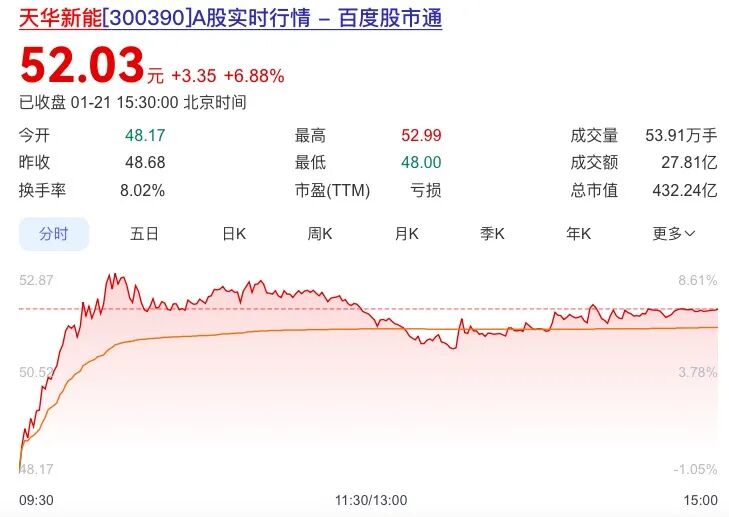
Core Viewpoint - Tianhua New Energy's announcement of its plan to issue H-shares and list on the Hong Kong Stock Exchange is seen as a strategic move to broaden financing channels and enhance its global business layout and technological development [1][5]. Group 1: Company Strategy and Goals - The core objective of the H-share issuance is to accelerate the implementation of the internationalization strategy, leveraging the advantages of international capital markets to create a diversified capital platform and enhance overseas financing capabilities [5]. - The company is currently in discussions with relevant intermediaries regarding the specific details of the H-share issuance, which has not yet been finalized [5]. - The issuance will not lead to a change in the controlling shareholder or actual controller, but there remains significant uncertainty regarding the approval and implementation processes [5]. Group 2: Market Position and Financial Performance - As of January 21, Tianhua New Energy's stock price was 52.03 yuan per share, with a daily increase of 6.88%, resulting in a total market capitalization of 43.224 billion yuan [2]. - The company has established a global resource layout, holding lithium mining rights in Nigeria and the Democratic Republic of Congo, with significant lithium resources identified [7]. - Tianhua New Energy has formed a collaborative development structure with three major business segments, focusing on lithium battery materials, anti-static ultra-clean technology products, and medical devices [7]. Group 3: Industry Context and Competitive Advantage - The lithium battery materials industry is experiencing increased concentration, with leading companies expanding capacity and iterating technology to solidify their advantages [6]. - Tianhua New Energy's global resource layout and capacity expansion create dual barriers in the competitive landscape, allowing the company to mitigate risks associated with lithium price fluctuations [8]. - The company has made technological advancements in solid-state battery materials, positioning itself to capture higher value in the supply chain and reduce dependence on lithium price volatility [8].

突发!锂电材料龙头天华新能拟赴港上市!
Xin Lang Cai Jing· 2026-01-21 13:10
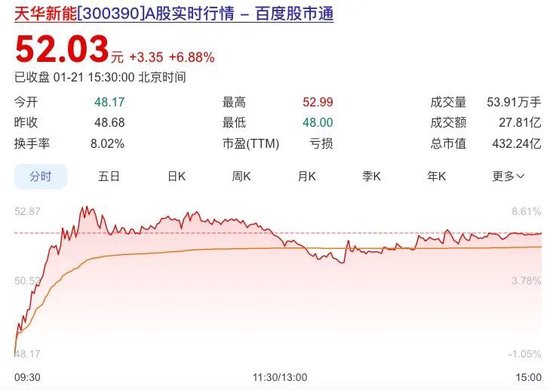
Core Viewpoint - Suzhou Tianhua New Energy Technology Co., Ltd. (Tianhua New Energy) has announced its plan to issue H-shares and list on the Hong Kong Stock Exchange, which is seen as a key move to broaden financing channels and support global business expansion and technological upgrades [1][3]. Group 1: H-Share Issuance and Strategic Goals - The core objective of the H-share issuance is to accelerate the implementation of the internationalization strategy, leveraging the advantages of international capital markets to create a diversified capital platform and enhance overseas financing capabilities [3][9]. - The issuance will not lead to changes in the controlling shareholder or actual controller, but there are uncertainties regarding the approval and implementation processes [3][9]. Group 2: Market Position and Financial Performance - As of January 21, Tianhua New Energy's stock price was 52.03 yuan per share, with a daily increase of 6.88%, resulting in a total market capitalization of 43.224 billion yuan [1][7]. - The company has established a global resource system, holding multiple lithium mining rights in Nigeria and Congo, with a reported lithium resource of 25 million tons at an average grade of 1.36% [5][11]. Group 3: Business Structure and Product Offerings - Tianhua New Energy has formed a collaborative development structure with three main business segments: new energy lithium battery materials, anti-static ultra-clean technology products, and medical device operations [4][10]. - The core products include battery-grade lithium hydroxide and battery-grade lithium carbonate, which are essential raw materials for lithium-ion battery cathodes, widely used in power and energy storage batteries [4][10]. Group 4: Competitive Advantages and Future Outlook - The company's global resource layout and capacity expansion create dual barriers in the lithium battery materials industry, allowing it to mitigate risks associated with lithium price fluctuations [6][12]. - Tianhua New Energy's advancements in solid-state battery materials and low-cost advantages position it favorably for sustainable growth, with expectations of increased profitability as lithium prices rise [6][12].
一个被英伟达掩盖的、中美AI最残酷的物理真相
Xin Lang Cai Jing· 2026-01-21 12:37
Core Insights - The article discusses the contrasting energy challenges faced by the US and China in the context of AI development, highlighting that while the US is experiencing a severe electricity shortage, China has a significant surplus of power capacity [3][34]. - It emphasizes that the real bottleneck in AI development is shifting from GPU availability to the availability of gigawatt-level electricity and data centers [3][34]. Energy Supply and Demand - By 2030, the incremental electricity demand for AI development in China will only account for 1% to 5% of its new power generation capacity over the past five years, while in the US, it will account for 50% to 70% [35][4]. - In 2023, the US added approximately 51 GW of new power generation capacity, whereas China added an impressive 429 GW, showcasing an 8-fold difference in capacity expansion [37][6]. Efficiency and Cost Challenges - Despite having cheaper electricity, the energy cost for AI computation in China could be 40% higher than in the US due to efficiency issues in converting electricity into computational power [35][40]. - Chinese AI chips are limited to older manufacturing processes (7nm or older), while top US chips utilize advanced 4nm and 3nm technologies, leading to significant performance and efficiency gaps [42][41]. System-Level Solutions - The article suggests that while the US is attempting to innovate through decentralized energy solutions like small modular reactors (SMRs), China is leveraging its advanced ultra-high voltage (UHV) transmission technology to efficiently transport surplus renewable energy to AI centers [50][52]. - Chinese companies are integrating AI into energy systems, with examples like CATL embedding batteries in data centers for energy management, indicating a comprehensive approach to energy and AI infrastructure [52][51]. Global Competitive Landscape - The article posits that as global demand for AI increases, countries will face a choice between the US model, which requires significant investment in expensive chips and infrastructure, and the Chinese model, which offers a turnkey solution that includes both AI servers and the necessary energy infrastructure [53][56]. - The competition is framed not just in terms of chip technology but also in the ability to provide comprehensive energy solutions that support AI development [56][57].