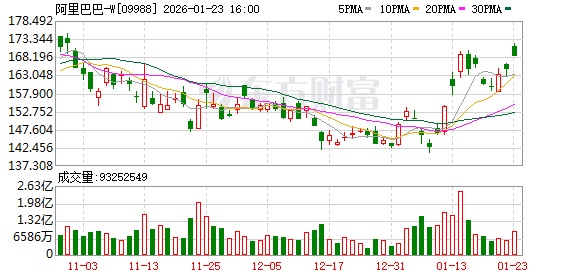
BABA(BABA)

Search documents
AI引领云服务行业新变革:从卖算力到拼应用
Shang Hai Zheng Quan Bao· 2026-01-25 18:52
Core Insights - The cloud service industry is entering a new development phase driven by AI applications and intelligent agents, moving beyond the resource-driven "first half" of public cloud services, which has reached saturation and maturity [1][2] - Major cloud providers are experiencing a significant recovery in performance, with Alibaba Cloud reporting a quarterly revenue of 39.824 billion yuan in Q3 2025, a year-on-year increase of 34%, marking a new high in growth rate [1] - The focus of cloud services is shifting from selling resources to selling applications, with an expected emphasis on application-level solutions post-2026 [2][3] Industry Trends - Tencent Cloud's SaaS business has been growing, with revenue growth rates for SaaS significantly outpacing IaaS [2] - The demand for AI and intelligent agents is driving IT budgets of enterprise customers, with AI application innovation expected to be the largest market driver in 2026 [2] - The structure of cloud service customers is changing, with the internet and e-commerce still being the largest sources (31%), followed by government (22%) and finance (10%), while manufacturing's share is only 8% [3] Market Dynamics - The introduction of DeepSeek and other significant events in 2025 has revitalized the market, shifting the focus from survival to seizing new opportunities [4] - Many Independent Software Vendors (ISVs) are beginning to explore AI agent development, indicating a resurgence of activity in the ISV market [4] Token Consumption Insights - The daily token consumption for enterprise-level large models in China reached 10.2 trillion in the first half of 2025, a 363% increase from the second half of 2024 [5] - The focus on token consumption as a metric is being questioned, with a call for a more sustainable AI business model that prioritizes application scenarios and business value over mere volume [5][6] - The competitive landscape among cloud providers is still heavily influenced by foundational model capabilities, with Alibaba and ByteDance showing strong performance in various segments [5][6] Long-term Perspective - The AI landscape is viewed as a long-term race, with a focus on developing hybrid models and embracing advanced open-source models [6] - The process of AI application across industries is expected to evolve from quantitative to qualitative changes, requiring time and endurance [6]

全球媒体聚焦 | 英媒:中国开源AI模型正受到美国企业青睐
Sou Hu Cai Jing· 2026-01-25 16:39
Core Insights - The article discusses how Chinese open-source AI models are gaining popularity among American companies, suggesting that China may be quietly winning the AI race [1] Group 1: Adoption of Chinese AI Models - Pinterest is utilizing Chinese AI models, specifically the DeepSeek R-1 model, to enhance its recommendation engine, indicating a growing trend among U.S. companies to adopt these technologies [2] - The CEO of Pinterest, Bill Ready, noted that the open-source nature of DeepSeek has sparked a wave of interest in open-source AI models [2] - Other Chinese open-source models mentioned include Alibaba's Qwen and Moonshot's Kimi, with ByteDance also developing similar technologies [2] Group 2: Advantages of Chinese AI Models - The CTO of Pinterest, Matt Madridigal, stated that the ability to download and customize these models provides a significant advantage over models from companies like OpenAI, which are not freely available [2] - The accuracy of models trained using open-source technology is reported to be 30% higher than that of off-the-shelf models, with lower optimization costs [2] Group 3: Broader Industry Impact - Chinese AI models are recognized by numerous Fortune 500 companies, with Airbnb's CEO Brian Chesky highlighting the benefits of Alibaba's Qwen for their AI customer service agents, citing quality, speed, and cost-effectiveness [4] - The Hugging Face platform shows that Chinese models occupy multiple spots in the top ten most popular models, with Alibaba's Qwen surpassing Meta's Llama as the most downloaded large language model [4] Group 4: Competitive Landscape - A report from Stanford University indicates that Chinese AI models have either caught up to or surpassed global counterparts in terms of capability and user base [6] - The success of China's open-source model development is partially attributed to government support [6]



涨幅不大但趋势向好,大消费/科技等涨幅居前
Ge Long Hui· 2026-01-25 13:19
Group 1 - The Hang Seng Index closed up 0.45% after fluctuating within a narrow range above the midline, with significant gains in the consumer sector [1] - The consumer sector opened strongly and maintained high levels throughout the day, closing up 1.05%, with notable increases from Lao Pu Gold (up 6.78%), Pop Mart (up 6.6%), and Kangfang Biologics (up 3.65%) [3] - The Hang Seng Technology Index experienced a slight pullback after opening but closed up 0.66%, with Xiaomi Group rising 2.84%, Kuaishou up 2.72%, and Alibaba increasing by 2.25% [3] Group 2 - Bank stocks continued to show weakness, opening high but closing down 0.07%, with Industrial and Commercial Bank of China and Chongqing Bank experiencing slight declines [3] - Some banks, including Zhengzhou Bank, Dah Sing Financial, and Zheshang Bank, managed to post small gains despite the overall sector's downturn [3]

颠覆想象!阿里通义千问绝不仅是AI,它把整个生活都管了
Sou Hu Cai Jing· 2026-01-25 11:41
通义千问这套由阿里巴巴推出的AI大模型系列,已然成了全球领先的开源模型,它可不是单纯的聊天 工具,而是集成了好些能力的智能助手,能够处理针对文本、图像、代码等一系列任务,还深度融入了 阿里生态,能给用户提供从日常咨询一直到复杂问题都能解决的一站式服务 。 通义千问有哪些核心功能亮点 通义千问的核心功能覆盖众多场景,从对话直至专业开发都有涉及,用户能够于官网首页开启对话,此 举措降低了使用门槛 ,它整合了多种模式,像深入研究、图像生成、网页开发以及深度思考等,例 如,其"图片生成"功能可依据文字描述创作出高质量图片,"网页开发"模式能助力前端工程师迅速构建 代码,另外,它设有独立的桌面客户端,支持跨应用调用以及自动化任务执行,提高了工作效率。 通义千问如何融入阿里生态闭环 正在成为连接阿里各大业务智能中枢的是通义千问。最新版千问APP已经全面接入淘宝,亦接入支付 宝,还接入飞猪以及高德等阿里生态应用,实现了在全球首次用AI直接用于点外卖功能,用于购物功 能,用于订机票等一系列"办事"功能。这意味着用户能够通过自然语言指令,借由AI助手完成以往需要 于多个APP间进行跳转的操作。这种深度集成不但简化了用户操作,还 ...

互联网传媒行业AI周度跟踪:快手可灵MAU已超1200万,泡泡玛特启动回购-20260125
GF SECURITIES· 2026-01-25 11:08
Core Insights - The report emphasizes the positive outlook for the internet media sector, particularly driven by AI advancements and strong performance in gaming and e-commerce segments [2][9][12] - It highlights the significant growth of Kuaishou's AI product, Keling, which has surpassed 12 million MAU and is expected to generate $140 million in revenue for 2025, exceeding initial targets [10][12] - The report suggests a focus on companies with strong product pipelines and innovative capabilities, particularly in gaming and AI applications [16][19] Group 1: Internet Sector - E-commerce: Continuous attention is recommended on AI narratives influencing stock prices, with Alibaba's recent developments expected to catalyze further stock performance [12][13] - Social Entertainment Media: Bilibili and Tencent are noted for their strong advertising momentum, with Tencent's gaming fundamentals improving and new game releases expected to enhance performance [13][16] - Internet Healthcare: JD Health and Alibaba Health are leveraging their platform advantages to deepen collaborations with upstream pharmaceutical manufacturers, leading to robust revenue and profit growth [13][19] Group 2: Gaming Sector - The gaming sector is expected to maintain a favorable outlook, with recommendations for leading companies like Tencent and NetEase, as well as promising titles from Century Huatong and Giant Network [16][18] - The report highlights the success of Giant Network's game "Supernatural Action Group," which has seen a rise in rankings and is expected to perform well during the upcoming Spring Festival [10][16] Group 3: AI Developments - Recent advancements in AI models and applications are noted, with significant releases from major players like Baidu and Tencent, indicating a competitive landscape in AI technology [11][19] - The report suggests monitoring AI applications in various sectors, including e-commerce, gaming, and healthcare, with specific companies recommended for investment based on their innovative capabilities [19][20] Group 4: Media and Advertising - The report discusses the impact of asset impairment on Focus Media, predicting a reduction in net profit for Q4 2025 but an increase in Q1 2026, indicating a one-time effect on performance [18] - It also highlights the potential for growth in the advertising sector, driven by increased investment from internet advertisers and upcoming major events that may boost advertising spending [18][19] Group 5: Long Video and Music Streaming - The long video sector is showing signs of recovery, with an increase in drama approvals and the release of quality content expected to enhance performance for platforms like iQIYI and Mango TV [15][16] - In music streaming, Tencent Music and NetEase Music are noted for their stable performance, despite concerns over competition, with a focus on the importance of quality content in driving subscriptions [15][16]



TikTok Shop推出“地平线项目”:拉动美区千万美元年销额品牌入驻;iPhone Air三个月跌近3000元丨Going Global
创业邦· 2026-01-25 10:33
Group 1 - TikTok Shop launched the "Horizon Project" to attract brands with annual sales of at least $10 million to join its platform, aiming for a total sales target of $50 million by the end of 2026 [4] - Temu's market share is projected to equal Amazon's by 2025, with both platforms capturing nearly half of the global cross-border e-commerce market [5][7] - Alibaba's chip company T-Head is planning to restructure for independent listing, which is seen as a significant step in building its AI capabilities [9] Group 2 - The snack retail giant "Mingming Hen Mang" has initiated its IPO process, aiming to raise up to approximately HKD 3.34 billion, with a network of nearly 20,000 stores across China [10][11] - Heytea has expanded internationally, opening over 100 stores in 32 cities, with a focus on local product development for overseas markets [13] - Global memory giant SK Hynix announced record bonuses for employees, reflecting strong financial performance with a 39% year-on-year increase in sales [23]


中美,新消息!商业航天,利好来袭!芯片巨头,直线大跳水!周末影响一周市场的十大消息
Zheng Quan Shi Bao Wang· 2026-01-25 09:38
Group 1: US-China Relations - US President Trump is expected to visit China in April, with Chinese leaders planning to visit the US by the end of the year, highlighting the importance of high-level diplomacy in stabilizing US-China relations [2][3] Group 2: Commercial Space Industry - SpaceX aims to achieve fully reusable rocket technology with its Starship, potentially reducing space access costs by 99% to below $100 per pound [2] - Beijing's measures to promote the development and utilization of commercial satellite remote sensing data from 2026 to 2030 include optimizing financial support and encouraging investment in quality projects [3] - The commercial space economy is projected to reach $1.8 trillion by 2035, driven by new infrastructure and applications in the space sector [4] Group 3: Stock Market and IPOs - Recent rumors about tightening regulations for companies seeking to list in Hong Kong have been denied, confirming that current overseas listing policies remain unchanged [3] - The China Securities Regulatory Commission (CSRC) has approved IPO registrations for three companies, indicating ongoing market activity [11] - A total of 28 companies are set to unlock 796 million shares this week, with a total market value of approximately 40.97 billion yuan [12][13]




一场8年谋局,让阿里市值涨了1000亿
虎嗅APP· 2026-01-25 09:33
Core Viewpoint - The article discusses the strategic importance of Alibaba's chip subsidiary, Pingtouge, in the context of its AI ambitions and the competitive landscape of the chip industry in China [4][7]. Group 1: Pingtouge's Role and Strategy - Pingtouge is positioned as a "tactical base" within Alibaba's AI ecosystem, which includes Alibaba Cloud, Pingtouge, and the Qianwen model [4][5]. - Since its establishment in 2018, Pingtouge has been heavily invested in, focusing on developing a full-stack capability across various chip types, including CPU, GPU, and storage chips [5][6]. - Pingtouge's diverse product offerings, such as the AI inference chip Lingguang 800 and the server CPU chip Yitian 710, differentiate it from other domestic chip manufacturers that typically focus on a single segment [6][7]. Group 2: Competitive Landscape - The article highlights the differences in chip strategies among major Chinese internet companies, with Pingtouge adopting a full-stack approach while competitors like Tencent and ByteDance focus on specialized chips [8]. - Pingtouge's strategy is seen as a response to the competitive pressures from companies like Huawei, Xiaomi, and Baidu, which are also heavily investing in chip technology [10]. Group 3: Future Prospects and Challenges - If Pingtouge successfully goes public, it could alleviate Alibaba's financial pressure and allow for more resources to be allocated towards foundational models and consumer AI products [10][11]. - The chip market is characterized as a "slow engineering" field, indicating that long-term investment and sustained effort will be necessary for success [11].

计算机行业研究:动态漫Agent,景气的极致
SINOLINK SECURITIES· 2026-01-25 07:50
Investment Rating - The report indicates a positive investment outlook for the industry, highlighting a "golden window period" for the short drama sector, with expectations for significant growth in the coming years [2][11]. Core Insights - The short drama industry has reached a scale of nearly 1 trillion yuan, surpassing both the film and long video sectors, with a projected compound annual growth rate (CAGR) of over 50% from 2023 to 2026 [11]. - The market for animated dramas is expected to exceed 22 billion yuan by 2026, contributing 50% of the incremental growth in the short drama industry [11]. - ByteDance is positioned as the absolute leader in the animated drama sector, leveraging its "traffic + IP + AI" integrated strategy to dominate the market [2][17]. - The application of AI technology is transforming the production paradigm of animated dramas, reducing production cycles from over 50 days to under 30 days and significantly lowering costs [3][21]. Summary by Sections Section 1: The Golden Window for Short Dramas - The short drama market has surpassed 1 trillion yuan, with user engagement increasing, and the average daily viewing time expected to exceed 100 minutes by 2025 [11]. - The market has entered a phase of rapid growth and commercialization, with significant increases in both supply and demand for animated dramas [11][12]. Section 2: AI Reshaping Production Paradigms - AI technologies are enabling a shift from manual production to industrialized generation, with production costs dropping to the thousand-yuan level [3][21]. - The integration of AI in production processes is expected to streamline workflows, reducing the number of steps from 11 to 5 and cutting costs by 60% [3][24]. Section 3: Trends in AI Applications - The report anticipates a significant uptick in AI applications by 2026, driven by the need for software to leverage substantial computational investments [4][31]. - Companies are increasingly integrating AI into their business models, with some reporting that AI-related revenues account for over 10% of total income [4][31]. Section 4: Related Investment Targets - Key investment targets include companies such as DeCai Co., Zhaochi Co., and Wanxing Technology, among others, which are positioned to benefit from the growth in the animated drama and AI sectors [5][40].


“平头哥”新动作!深度拆解阿里八年“造芯”路
Mei Ri Jing Ji Xin Wen· 2026-01-25 05:59
Core Viewpoint - Alibaba Group is preparing to push its semiconductor company, Pingtouge, towards an independent IPO after internal restructuring, highlighting the growing importance of AI chip manufacturing in China [2][14][17]. Group 1: Company Overview - Pingtouge, established nearly eight years ago, has remained relatively low-profile until recent news of its potential IPO [2][4]. - The company is located in the Zhangjiang Artificial Intelligence Industrial Park in Shanghai, surrounded by major tech firms like IBM and COMAC [2]. - Pingtouge's name, derived from the honey badger, symbolizes resilience and determination in overcoming technological barriers [3]. Group 2: Product Development - Pingtouge has developed several key products, including the "Hanguang 800" AI chip, which boasts a peak performance of 78,563 IPS and energy efficiency of 500 IPS/W, equating to the power of ten GPUs [4]. - The latest product, the "Zhenyue 510" enterprise SSD controller chip, has been deployed at scale in Alibaba Cloud's EBS and is used in various AI applications [4][5]. - The company is also expanding its "Yuzhen" series chips into logistics and supply chain management, enhancing operational efficiency [5][6]. Group 3: Market Position and Strategy - Pingtouge is transitioning from being an internal supplier for Alibaba to an independent market player, indicating a shift in its business strategy [6][12]. - The company is positioned to capitalize on the growing domestic AI chip market, especially as U.S. restrictions on companies like NVIDIA create opportunities for local manufacturers [3][14]. - Pingtouge's recent developments suggest it is ready to compete with international players, with reports indicating its new AI chip surpasses some NVIDIA models in key performance metrics [7][14]. Group 4: Industry Context - The AI chip market in China is entering a phase of concentrated IPO activity, with several companies, including Pingtouge, looking to capitalize on this trend [3][14]. - The push for domestic AI chip production is seen as a long-term necessity, with current market conditions viewed as optimal for growth [14][15]. - Major tech companies, including Baidu and Tencent, are also accelerating their AI chip initiatives, indicating a competitive landscape among Chinese tech giants [15][16].