BABA(BABA)

Search documents
淘宝闪购的红包怎么暴涨?这份攻略让你省钱事半功倍
Sou Hu Cai Jing· 2026-01-23 16:46
关注微信公众号:满满神卷 每日更新外卖券:美团、京东、饿了么、淘宝闪购等无门槛领取 对于许多淘宝用户而言,闪购活动总是充满诱惑力,但看着别人晒出的大额红包,自己却只能领到几毛钱的小额优惠,这种落差感确实令人沮丧。淘宝闪购 的红包并非随机分配,而是有一套潜在的规则和技巧。只要掌握正确的方法,普通用户也能实现红包金额的快速增长。 淘宝闪购红包的暴涨并非偶然,而是多种策略综合作用的结果。这需要用户对平台规则有深入理解,并采取系统性的方法。红包金额的提升可以从多个维度 入手,包括领取渠道的多样性、任务完成的策略性以及使用技巧的巧妙性。 许多用户可能不知道,淘宝闪购频道本身就是红包领取的主战场。当用户打开淘宝应用,首页顶部的导航栏中清晰的"闪购"入口是获取红包的第一通道。点 击进入后,系统通常会自动弹出当日可领取的红包浮层,这是最直接的领取方式。如果未能看到弹窗,可以主动寻找页面右上角的"红包"按钮,手动点击进 入红包中心。这里的红包面额可能随着用户活跃度的提升而逐步增加,坚持每日领取是暴涨的基础。 任务中心是许多用户忽略的宝藏之地。在闪购频道页面内,通常设有任务入口,完成指定任务可以获得额外红包奖励。这些任务设计得相 ...



Alibaba Reportedly Planning T-Head Spinoff — Eyeing High China Chip Valuations?
Benzinga· 2026-01-23 14:58
Core Viewpoint - Alibaba Group is reportedly considering a spinoff and separate listing for its chip-making unit, T-Head, in response to high valuations in the Chinese AI chip market, following a similar move by Baidu [4][21]. Group 1: Spinoff Plans - The potential spinoff of T-Head would occur nearly three years after Alibaba's initial plan to split into six divisions was scrapped [5]. - T-Head is closely linked to Alibaba's Cloud Intelligence Unit, which had previously abandoned its own spinoff due to U.S. restrictions on advanced AI chips [6]. - Alibaba aims to restructure T-Head as a business partly owned by its employees before exploring an IPO, potentially within the next three to four months [12]. Group 2: Market Context - Chinese chip startups, including T-Head, are developing their own AI chips to fill the gap left by U.S. restrictions, with companies like Moore Threads and Biren seeing significant stock price increases [7][8]. - The high valuations of these Chinese companies are driven by expectations of state support as China seeks to reduce reliance on Western technology [9]. - Alibaba's stock rose 5% following the spinoff news, with its market cap reaching $423 billion, narrowing the gap with Tencent [15]. Group 3: Financial Performance - Alibaba's revenue rose 5% to 248 billion yuan ($35.6 billion) in the quarter through September, with a notable 34% growth in its cloud unit [18][19]. - The instant commerce segment, which includes the merger of Ele.me and Taobao Instant Commerce, reported a 60% year-on-year growth [19]. - The spinoff plan is seen as opportunistic, capitalizing on the inflated valuations of AI chip makers and the strong growth in Alibaba's cloud and instant commerce sectors [20].
全球科技(计算机)行业周报:GEO概念催化AI应用,千问APP全面接入阿里生态
Huaan Securities· 2026-01-23 13:30
Investment Rating - Industry rating: Overweight [1] Core Insights - The report highlights the emergence of Generative Engine Optimization (GEO) as a significant evolution in AI applications, reshaping the advertising and marketing industry. It emphasizes the importance of AI-driven recommendation systems, particularly in the context of the X platform's new algorithm, which aims to enhance user engagement through AI [5][12]. - The Qianwen APP has launched over 400 AI service functions, integrating various Alibaba ecosystem services to streamline user experiences from decision-making to transaction execution [4][13]. - GEO is identified as a crucial direction for the commercialization of AI applications, with major internet companies accelerating their efforts to capture AI application entry points, thereby promoting faster implementation of AI solutions [5][12]. Summary by Sections 1. Computer Industry Insights - GEO represents a fundamental shift from traditional SEO to AI-driven content optimization, focusing on increasing brand visibility in AI-generated responses [12]. - The X platform's commitment to open-sourcing its recommendation algorithm aligns with GEO's objectives, enhancing the synergy between AI technologies and marketing strategies [12]. 2. Market Performance Review - The computer industry index increased by 3.82% this week, outperforming major indices such as the Shanghai Composite Index and the CSI 300 [15][18]. - Year-to-date, the computer industry index has risen by 12.64%, ranking first among 31 industry indices [15][18]. 3. Technology Software Industry News - The report discusses various technological advancements, including the integration of AI in applications, the development of low-altitude economies, and the growth of intelligent driving technologies [23][24][26]. - It also highlights the increasing importance of data elements in emergency management and the role of AI in enhancing operational efficiency across various sectors [29][30]. 4. Company Dynamics - Several companies, including Guokai Electronics and Jin Hai Tong, are projected to see significant profit increases in 2025, with expected net profits rising by over 100% compared to the previous year [32][34]. - The report notes ongoing stock option incentive plans and performance forecasts for various companies, indicating a positive outlook for the technology sector [32][34].
英伟达重返中国市场关键一步!阿里拟购H200芯片 联想为其服务器最大供应商成直接受益方
Ge Long Hui· 2026-01-23 13:11
23日,据媒体公开消息称,中国已要求阿里巴巴等顶尖科技公司准备订购H200人工智能芯片,这也是 英伟达重返中国市场计划的关键一步。 如若消息属实,这将对服务器等硬件设备的需求呈现井喷式增长,联想集团作为全球服务器市场的重要 参与者,也是阿里服务器的最大供应商,将有望斩获更多的服务器订单,成为最直接的受益方之一。 联想与阿里巴巴的合作由来已久且不断深入。早在2017年,联想就已经与阿里云展开合作,并一直是阿 里云重要的服务器供应商。2025年4月联想集团董事长兼 CEO 杨元庆透露,联想服务器赢得阿里巴巴、 字节跳动等大客户的青睐。 从硬件供应来看,联想能够为阿里巴巴提供定制化、高性能的服务器产品,满足阿里在云计算、大数据 处理、AI 模型训练等复杂业务场景下的多样化需求。此外,在AI PC和面向行业和企业的智能体解决方 案方面,联想与阿里巴巴有着广泛和广阔的合作。 ...


2026年,淘宝天猫优化营商环境“放大招”!商家的增长红利来了!
Xin Lang Cai Jing· 2026-01-23 13:10
Core Insights - Taobao Tmall is enhancing its business environment in 2026 with new initiatives aimed at supporting merchants and driving growth [2][4][24] Group 1: Business Environment Optimization - In 2026, Taobao Tmall will implement ten new measures to optimize the business environment, including an AI fake image recognition model and a return mismatch mutual trust mechanism [4][35] - The AI fake image governance will help detect fraudulent return requests using AI-generated images, protecting merchants from losses [4][35] - The return mismatch mutual trust mechanism aims to address common malicious refund behaviors, expanding the number of merchants involved and providing them with exclusive rights [7][37] Group 2: Service as a Growth Driver - The focus of competition in the e-commerce sector is shifting from mere traffic and price wars to deeper competition based on product quality and service [40][41] - Taobao Tmall is promoting a "service equals growth" strategy, providing merchants with a clear path to achieve sustainable growth through improved service offerings [39][40] - The platform will enhance the real experience score system, rewarding merchants for good service across various dimensions such as product quality and logistics speed [45][46] Group 3: Merchant Support and Recognition - High-scoring merchants (above 4.8) will be invited to participate in a "good service" list, increasing their visibility and potential customer engagement [47] - A new customer service certification system will be introduced, allowing specialized customer service representatives to gain recognition and improve customer satisfaction [49] - Increased investment in AI services will enable merchants to better understand customer needs and enhance operational efficiency [21][50] Group 4: Performance Metrics - In 2025, merchants with high service levels saw user repurchase rates and net GMV double compared to those with lower service levels [52] - The introduction of the real experience score has significantly accelerated growth for high-scoring merchants, with sales growth rates for those scoring above 4.8 being 2.2 times higher than average [52][53]
中国AI靠百元平扫CT筛出早期胰腺癌,“发现即晚期”难题有望破局
Mei Ri Jing Ji Xin Wen· 2026-01-23 12:39
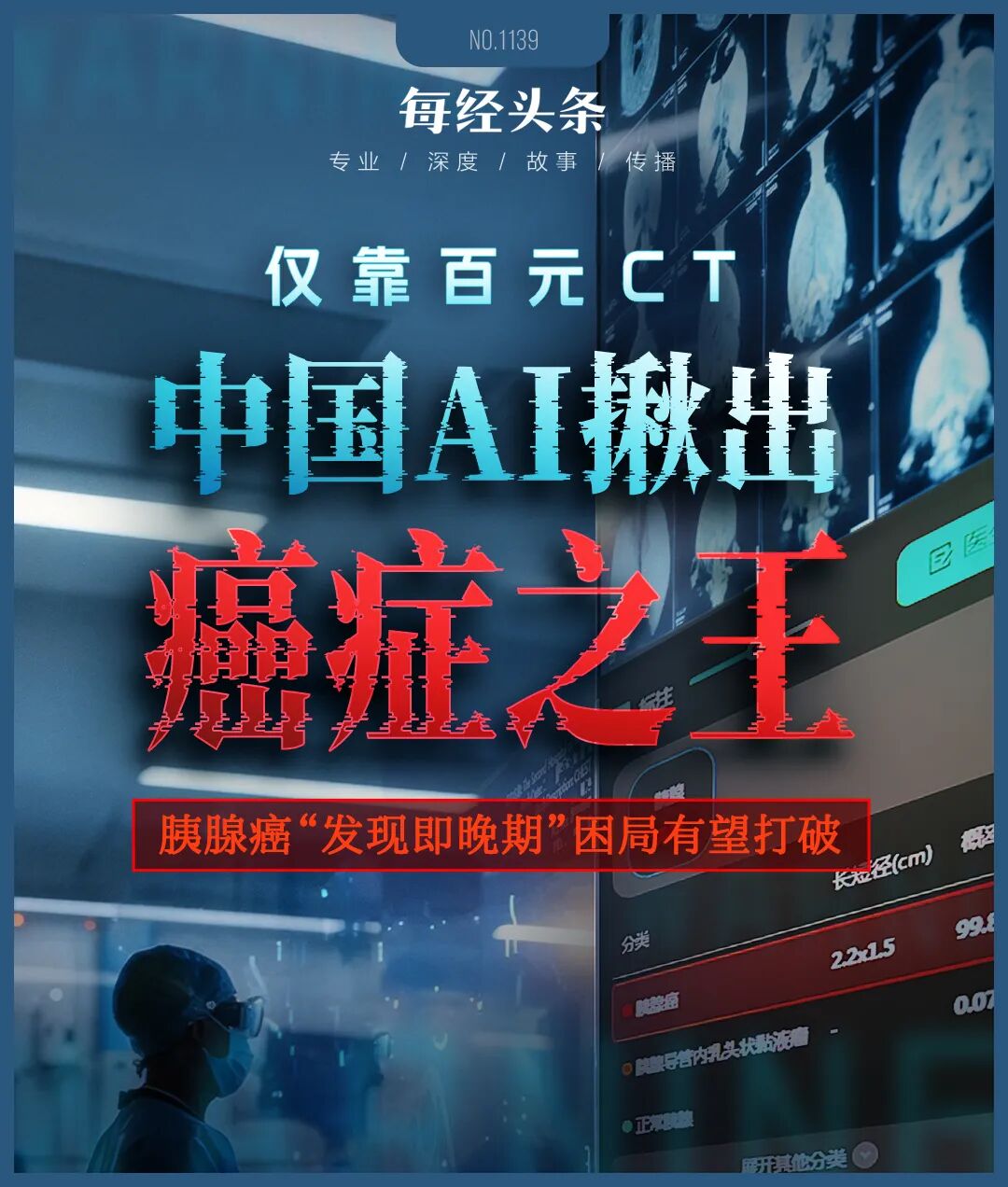
(文章来源:每日经济新闻) 每经讯,被医学界称为"癌症之王"的胰腺癌,正因一项中国AI技术迎来早筛转机 。近日,《每日经济 新闻》记者深入浙江宁波、嘉兴的医院调查发现,由阿里巴巴达摩院研发的"PANDA"胰腺癌AI早筛模 型,已在临床实测中成功从平扫CT中筛查出多例早期病患。得益于这一预警,其中一名患者确诊早期 胰腺癌,术后9天出院,经医保报销,个人自付仅约1.2万至1.4万元。 ...
检查糖尿病却查出胰腺癌!仅凭百元CT揪出“癌症之王”,医生没看出来的病,AI是怎么发现的?
Mei Ri Jing Ji Xin Wen· 2026-01-23 12:28
每经记者|郑雨航 每经编辑|兰素英 胰腺癌,因其极低的早期诊断率,长久以来被冠以"癌症之王"的称号。 临床数据显示,超过80%的胰腺癌患者在确诊时已步入中晚期,错失了手术的黄金窗口。全球胰腺癌患者五年生存率仅约10%。 如今,胰腺癌"发现即晚期"的困局,正被我国的一项AI筛查技术改变。 1月2日,《纽约时报》发布2026年首篇中国报道,题为《在中国,AI正在发现医生可能漏掉的致命肿瘤》。整版讲述了一个普通退休泥瓦匠的就医经 历,他仅花费了约25美元(约人民币174元)做了一项普通的平扫CT,就被AI查出了早期胰腺癌。该报道评论区里的美国网友吐槽:在美国,平扫CT价 格高达数百美元,25美元只够付停车费。 医生都看不出来的病,AI怎么发现的?近日,《每日经济新闻》记者(以下简称每经记者)在宁波和嘉兴,对报道主角邱先生和相关医生进行了采访。 图片来源:《纽约时报》截 "你和乔布斯得了一样的病,但你比他幸运" 浙江宁波57岁的邱先生对每经记者回忆称,2025年8月,自己因患糖尿病,在宁波大学附属人民医院做了一次常规检查,并拍摄了腹部平扫CT。 午饭时,他接到医院打来的电话:"你的胰腺可能有点问题,需要进一步检查。" ...
张坤在管基金披露2025年四季报:减持白酒股 加仓阿里巴巴(09988)
Zhi Tong Cai Jing· 2026-01-23 12:24
Core Viewpoint - E Fund's Zhang Kun reported a decline in total assets under management to 48.383 billion yuan as of December 2025, with three A-share focused funds underperforming their benchmarks, while the E Fund Asia Select fund achieved positive returns, significantly exceeding its benchmark [1][2]. Group 1: Fund Performance - As of December 2025, the largest fund, E Fund Blue Chip Select, had a net asset value of 1.8623 yuan, with a report period net asset value growth rate of -8.93%, compared to a benchmark return of -2.63% [1]. - Three main A-share focused funds reported negative quarterly returns and failed to outperform their performance benchmarks [1]. Group 2: Portfolio Adjustments - Zhang Kun reduced holdings in major stocks such as Kweichow Moutai, Wuliangye, Luzhou Laojiao, and Shanxi Fenjiu, while also significantly reducing positions in Focus Media and China Merchants Bank [1]. - The top ten holdings of E Fund Blue Chip Select remained unchanged, including Tencent, Kweichow Moutai, and Alibaba, with notable reductions in Focus Media and increases in Alibaba [2]. Group 3: Market Outlook - Zhang Kun expressed a long-term optimistic view on the macro economy and market, predicting significant improvements in living standards and social security in China over the next decade [2]. - He emphasized the importance of a strong domestic demand market in promoting technological innovation, suggesting that improved consumer environments could enhance subscription revenues and model capabilities [3]. Group 4: Confidence in Business Models - Zhang Kun maintained confidence in the business models, competitive barriers, and cash flow generation capabilities of the companies in the portfolio, asserting that the market's perception of quality companies presents good opportunities for long-term investors [3].




雷鸟、Rokid、阿里集体出击:中国AI眼镜天团决战放量前夜
3 6 Ke· 2026-01-23 11:12
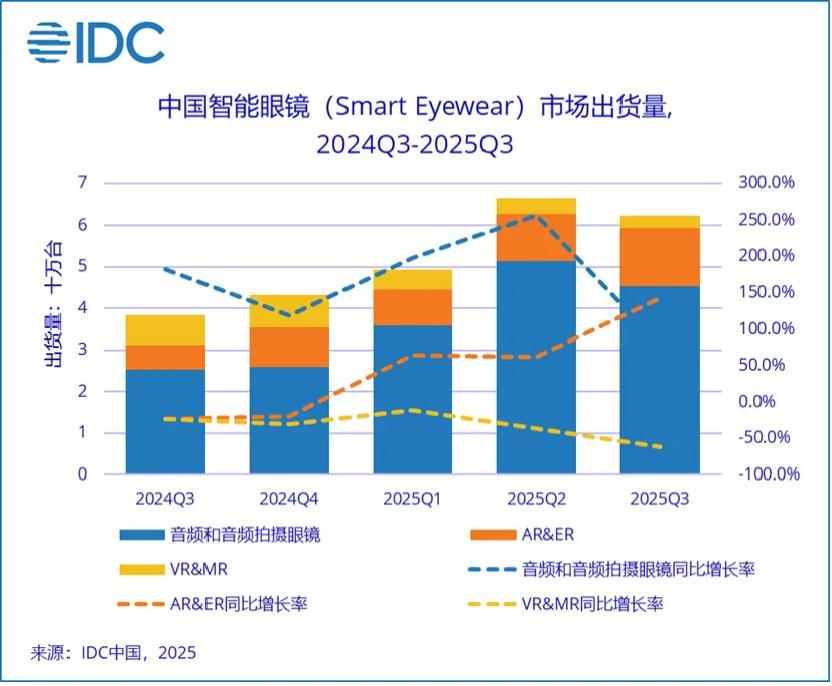
Core Insights - The AI glasses market is experiencing a significant transformation, similar to the early days of smartphones, with various Chinese manufacturers aiming to make AI glasses mainstream through diverse pricing and branding strategies [2][4][15]. Market Trends - According to IDC, global shipments of smart glasses are projected to reach 4.065 million units in the first half of 2025, marking a year-on-year growth of 64.2%, with China expected to surpass 1 million units, capturing 26.6% of the global market share [2][19]. - The AR smart glasses market is also growing, with China holding a 57.3% market share in the first half of 2025 [7]. Competitive Landscape - Meta currently dominates the smart glasses market with a 75.7% share, but Chinese companies like Xiaomi, RayBird, Xreal, and Viture are emerging as key players [5][19]. - The CES showcased numerous AI glasses from Chinese manufacturers, highlighting their technological advancements and market ambitions [9][12]. Technological Innovations - New AI glasses are focusing on lightweight designs and multi-modal AI interactions, with products like Rokid Style weighing only 38.5 grams and offering advanced features [9][10]. - Companies are developing products that integrate AR displays with AI assistants, aiming for a seamless user experience [14][15]. Industry Dynamics - The AI glasses sector is becoming a strategic battleground for various tech companies, with significant investments being made to capture market share [15][28]. - The supply chain for smart glasses is heavily concentrated in China, which produces about 80% of the necessary components, making it a critical hub for the industry [19][29]. Future Projections - The global smart glasses market is expected to see a compound annual growth rate (CAGR) of 55.6% in China, with projections of over 40 million units shipped by 2029 [31]. - By 2030, the AI glasses market could potentially reach 80 million units, representing a significant opportunity within the $150 billion traditional eyewear market [32][33].
加速构建AI芯片生态闭环?阿里旗下芯片公司平头哥被传将独立上市
Jin Rong Jie· 2026-01-23 10:01
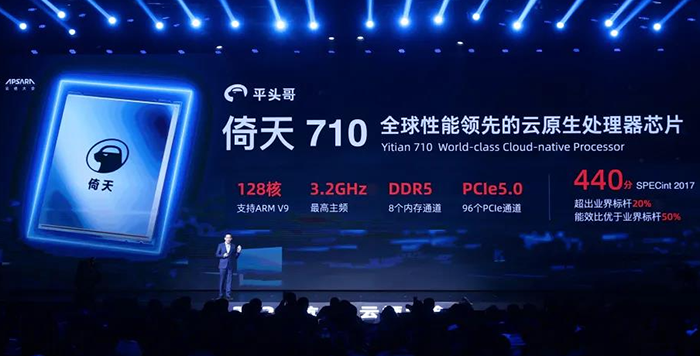
Group 1 - Alibaba is planning to restructure its semiconductor company T-Head and support its future independent listing, which led to a more than 5% increase in Alibaba's stock price in pre-market trading [1] - T-Head Semiconductor was established in September 2018, integrating the previously acquired Zhongtian Micro Systems and Alibaba's internal chip team, offering a full-stack product system covering both cloud and terminal applications [1] - T-Head has launched several chips, including the Yitian 710 server chip and the Hanguang 800 AI inference chip, achieving a comprehensive layout from design to application [1] Group 2 - The split plan for T-Head is seen as a significant step in Alibaba's acceleration of its AI self-research system, with Alibaba's CEO announcing an investment of over 380 billion yuan in cloud and AI hardware infrastructure over the next three years [3] - T-Head, as Alibaba's AI chip developer, is expected to become a key support for Alibaba's long-term competitiveness in the AI era, with the spin-off providing greater flexibility in incentive mechanisms, financing capabilities, and external collaborations [3]