Goldman Sachs(GS)

Search documents
[Earnings]Financials Dominate Upcoming Earnings Calendar, Netflix Looms
Stock Market News· 2026-01-13 14:12
Financial Reporting Schedule - Major financial institutions are set to report earnings starting with JPMorgan Chase & Co. on Tuesday morning, followed by Bank of America Corporation, Wells Fargo & Company, and Citigroup Inc. on Wednesday [1] - The reporting continues with Morgan Stanley, Goldman Sachs Group Inc., and BlackRock Inc. on Thursday, maintaining the focus on financials [1] - The following Tuesday will see a significant number of reports, with 20 companies reporting, including Netflix Inc. after market close and various financial institutions throughout the day [1]



Jim Cramer Says “Goldman’s Takeover Business Should Be Tremendous”
Yahoo Finance· 2026-01-13 12:23
Group 1 - The Goldman Sachs Group, Inc. is expected to report excellent financial results, with strong activity in financial markets and a significant performance in its takeover business [1] - Goldman Sachs is considered undervalued, trading at 17 times earnings, which is lower than the average S&P 500 stock, despite being a major player in mergers and acquisitions and IPO issuances [2] - Following positive market sentiment, Goldman Sachs stock rallied nearly 4%, indicating strong investor interest and potential for further growth [2] Group 2 - The company is positioned to benefit from an anticipated increase in mergers and acquisitions and large equity offerings in the current year [2] - While Goldman Sachs shows potential as an investment, there are AI stocks that may offer greater upside potential with less downside risk [2]
【环球财经】12月美国CPI环比或大幅走高 美联储降息前景不明
Zhong Guo Jin Rong Xin Xi Wang· 2026-01-13 11:02
Group 1 - The core viewpoint of the articles indicates that the upcoming December CPI data is expected to show a significant rebound due to previous distortions caused by the U.S. government shutdown, with analysts predicting a month-on-month increase of 0.3% and a year-on-year increase of 2.7% [1][3][5] - Analysts from various investment banks, including Goldman Sachs and Morgan Stanley, suggest that the December CPI data may reflect a technical upward bias due to the previous month's artificially low price base, which was influenced by the government shutdown [3][4][5] - The Federal Reserve's interest rate cut expectations have decreased, with the probability of a rate cut in January nearly zero and a significant drop in the probabilities for April and June meetings [2][6] Group 2 - The December CPI data is seen as a critical indicator for assessing the impact of tariffs on inflation, with expectations that housing inflation may rebound, although the core CPI may still be underestimated due to statistical methods [4][6] - The market sentiment is leaning towards a bullish outlook, with the potential for a significant market reaction if the December CPI data deviates from expectations, particularly if it comes in lower than anticipated [7][8] - The analysis suggests that the Federal Reserve's easing cycle may experience phases of acceleration and deceleration, influenced by inflation trends and political pressures, with recommendations for asset allocation adjustments in response to these dynamics [8]
Goldman Sachs Predicts 11% Global Equity Returns in 2026: What Does It Mean for Crypto?
Yahoo Finance· 2026-01-13 10:25
Goldman Sachs has forecasted that global equities will continue to rise in 2026, projecting an 11% return, including dividends, over the next 12 months. The rally will be supported by earnings growth and broad economic expansion. As traditional markets continue to climb, a critical question comes into focus: will digital assets move in step with equities, or will they follow a distinct trajectory of their own? Goldman Sachs Shares 2026 Forecast for Global Equities Goldman Sachs’ 2026 global equity outlo ...
高盛瑞银看涨A股:盈利增长与政策红利双驱动
Xin Lang Cai Jing· 2026-01-13 10:11
Group 1 - The core viewpoint is that foreign institutions like Goldman Sachs and UBS are optimistic about the Chinese market, focusing on corporate profit growth as the main driver, replacing valuation recovery, with technology innovation and policy benefits seen as dual engines [1] Group 2 - Strong expectations for profit growth in 2026, with Goldman Sachs predicting a 20% increase in the MSCI China Index and a 12% increase in the CSI 300 Index, with a cumulative rise of 38% from 2026 to 2027, where corporate profits contribute 24% [2] - UBS forecasts a profit growth of over 14% for the MSCI China Index, with overall A-share profit growth rising from 6% in 2025 to 8%, driven by the technology sector, which accounts for 50% of the index [2] - Supporting factors include an increase in nominal GDP growth, a narrowing decline in PPI driving revenue growth, and policies optimizing supply-demand structures in industries like photovoltaics and chemicals [2] Group 3 - The MSCI China Index has a forward P/E ratio of only 12 times, significantly lower than the S&P 500 Index (22 times) and the Indian market (21 times), indicating a historical low [3] - Foreign ownership of A-shares is only 3.68%, much lower than the average of 40% in countries like Japan and South Korea, suggesting substantial room for increased allocation [3] - In the first ten months of 2025, foreign capital inflow into A-shares reached $50.6 billion, more than tripling year-on-year [3] Group 4 - Foreign investment is focusing on technology and structural opportunities, particularly in AI and its supply chain, with key areas including computing infrastructure and application scenarios in fintech and healthcare [4] Group 5 - Beneficiary sectors from policy dividends include new energy companies and high-end manufacturing leaders, with companies like CATL and Ganfeng Lithium receiving upgrades from Morgan Stanley [5] - Companies with high overseas revenue ratios in sectors like new energy vehicles and smart hardware are also targeted [5] - Structural opportunities in consumer services, particularly in dining and prepared foods, may see a rebound in the second half of the year due to PPI recovery [5] Group 6 - In the fourth quarter of 2025, northbound capital is expected to increase holdings in resource stocks while also adding to technology and financial sectors [6]

华尔街财报季今日拉开帷幕
Ge Long Hui A P P· 2026-01-13 09:49
Group 1 - The core focus of the article is on the upcoming earnings reports from major banks and their potential impact on the stock market, alongside the significance of the December CPI report [1] - Major banks including JPMorgan Chase and BNY Mellon are set to release their earnings today, with JPMorgan's CEO Jamie Dimon expected to share insights on the market and the U.S. economy [1] - Other banks such as Bank of America, Citigroup, and Wells Fargo will report their earnings tomorrow, while Morgan Stanley, Goldman Sachs, and BlackRock will follow on Thursday [1] Group 2 - Delta Air Lines is also scheduled to announce its earnings today, indicating a broader interest in the performance of the airline sector [1] - Taiwan Semiconductor Manufacturing Company (TSMC) will disclose its fourth-quarter earnings on Thursday, which is particularly noteworthy given its role as a bellwether for the semiconductor industry amid prevailing AI valuation risks [1]

布米普特拉北京投资基金管理有限公司:美联储降息前景不确定性上升
Sou Hu Cai Jing· 2026-01-13 09:44
Group 1 - The recent U.S. employment data has prompted a reassessment of monetary policy direction, leading major Wall Street financial institutions to adjust their predictions regarding Federal Reserve interest rate actions [1][4] - Notably, JPMorgan has retracted its previous forecast of a potential rate cut in January, now predicting that the Fed's next action will be an interest rate hike, likely in the third quarter of next year, by 25 basis points [4] - Other institutions such as Barclays, Goldman Sachs, and Morgan Stanley have also postponed their expectations for the first rate cut, with Goldman and Barclays moving their forecasts from the first half of this year to September and December, respectively [4][6] Group 2 - Market trading data reflects this shift, with traders significantly increasing the probability of the Fed maintaining interest rates at its January meeting [6] - JPMorgan's analysis indicates that if the labor market weakens again or inflation declines significantly, policy may still shift towards easing, but the base prediction is for the labor market to tighten in the second quarter with a slow decline in inflation [6] - External factors have also been noted to complicate the monetary policy path, with concerns about the Fed's independence arising from certain events, although mainstream views still hold that rate decisions will primarily depend on statutory responsibilities and economic data [8]

邦达亚洲:美联储独立性受挫 黄金受益大幅攀升
Xin Lang Cai Jing· 2026-01-13 08:17
Group 1: Precious Metals Outlook - Citigroup has significantly raised its short-term outlook for precious metals due to increased geopolitical risks, physical shortages, and uncertainty regarding the independence of the Federal Reserve. The gold price target for the next 0-3 months has been increased from $4,200 to $5,000 per ounce, while the silver target has been raised from $62 to $100 per ounce [1][6] - The investment momentum remains strong, and several favorable factors are expected to persist in the first quarter. Analysts noted that the ongoing physical shortages of silver and platinum group metals may worsen in the short term due to potential delays in the U.S. Section 232 tariff decisions, which could further drive up prices [1][6] Group 2: Federal Reserve Interest Rate Predictions - Goldman Sachs has postponed its forecast for Federal Reserve interest rate cuts, now expecting a 25 basis point cut in June and September 2026, instead of March and June 2026 as previously anticipated. This adjustment follows weak non-farm employment data, indicating a gradually weakening labor market, while GDP growth remains stronger than expected [2][7] - The chief U.S. economist at Goldman Sachs stated that the Fed is likely to wait until mid-year to cut rates, anticipating inflation to return to target levels and the labor market to stabilize. The firm has reduced its probability of a recession within the next 12 months from 30% to 20% [2][7] Group 3: Currency Market Movements - The gold price surged to a historical high, breaking the $4,600 mark, supported by rising geopolitical tensions and a weakening U.S. dollar due to concerns over the Federal Reserve's independence. The current trading price is around $4,600, with resistance at $4,650 and support at $4,550 [3][8] - The USD/JPY pair experienced slight gains, supported by expectations of the Fed maintaining its current stance and a cooling of expectations for rate hikes from the Bank of Japan. The current trading price is around 158.80, with resistance at 159.50 and support at 158.00 [4][9] - The USD/CAD pair saw a slight decline, trading around 1.3870, influenced by profit-taking and a weakening dollar index. The current price is under pressure from rising oil prices, with resistance at 1.3950 and support at 1.3800 [5][10]
高盛年度机构调查:美股失宠、Mag7跑输,地缘政治成最大“灰犀牛”,金价上看6000美元
Hua Er Jie Jian Wen· 2026-01-13 08:02
Core Insights - The 34th Annual Global Strategy Conference hosted by Goldman Sachs revealed a stark contrast between macro optimism and micro caution among investors, with a strong GDP outlook but a rush towards safe-haven assets like gold and non-US markets due to geopolitical concerns [1] Group 1: Macroeconomic Outlook - Investors are highly optimistic about the US economy, with over 80% expecting GDP growth to exceed 2% by 2026, a figure more optimistic than Bloomberg's consensus of 2.1% [2] - The fear of a US recession has dropped to nearly zero, with 0% of respondents anticipating a recession [2] Group 2: Geopolitical Risks - Geopolitical risk has emerged as the largest threat to the global economy and markets, with 65% of investors identifying it as a major concern for 2026, up from 30% the previous year [2] - Inflation risk has decreased to 12%, and trade risk has plummeted from 41% to just 4% [2] Group 3: Central Bank Policies - Despite strong economic data, investors are still eager for monetary easing, with expectations for the Federal Reserve to cut rates by 70 basis points by 2026, more aggressive than the current market pricing of 50 basis points [3] - 35% of investors expect the European Central Bank to lower rates, while expectations for the Bank of England are even higher at a 60 basis point cut [3] Group 4: Equity Strategies - The strategy of "buying US stocks blindly" is losing favor, with only 23% of respondents believing the US will be the best-performing region, down from 58% [4] - Emerging markets are gaining traction, with Asia (excluding Japan) being the most favored region at 38% [4] - The perception of China as a long-term investment opportunity has rebounded to 25%, up from 9% in the past two years [4] Group 5: Sector Preferences - Technology stocks remain the top choice for 31% of investors, but the advantage is narrowing [5] - 60% of investors believe the S&P 493 will outperform the "seven giants," indicating a potential shift away from crowded AI trades towards undervalued sectors [5] Group 6: Commodity Market Trends - There is a significant divide in the commodities market, reflecting investor distrust in fiat currencies and supply-demand judgments [6] - 45% of investors believe copper will be the best-performing commodity by 2026, driven by demand from AI data centers and electrification [6] - 42% of respondents expect gold prices to rise to between $5,000 and $6,000 per ounce, with 10% predicting prices above $6,000 [6] - Conversely, 54% expect Brent crude oil prices to fall below $60 per barrel, a stark increase from 5% the previous year [6]
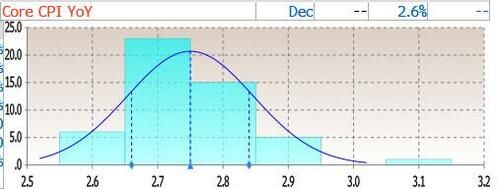
今晚美国CPI:政府停摆扰动消退,核心通胀或回到2.7%,回升才刚开始?
Hua Er Jie Jian Wen· 2026-01-13 07:30
Core Insights - The inflation trend in the U.S. is expected to show resilience by the end of 2025, marking a potential end to the previous slowdown in price growth [1] - The upcoming core CPI data is anticipated to reflect underlying price pressures, with both overall and core CPI expected to rise to 2.7% year-over-year [1][2] Inflation Data and Market Expectations - The sticky nature of inflation supports the Federal Reserve's decision to maintain interest rates in the short term, with market expectations indicating a low probability of rate cuts in the near future [2] - Analysts suggest that the unexpected decline in November's inflation data was largely influenced by technical factors, and December's data will reveal the true inflation levels as these distortions fade [2][7] Monthly Data Recovery - The key focus for December's CPI data is the recovery in month-over-month growth rates, with consensus estimates predicting a rise to 0.3% for both overall and core inflation indices [3] - Morgan Stanley forecasts a significant rebound in December's core CPI, projecting a month-over-month increase of 0.36%, well above the average of 0.08% seen in October and November [5] Statistical Distortions - The potential strength in inflation data is attributed to the reversal of the "shutdown effect," which previously hindered data collection and led to artificially low November figures [7] - The December CPI data is expected to correct for statistical biases caused by the government shutdown, which affected housing data and resulted in an underestimation of inflation [7][12] Sector-Specific Price Movements - Economists predict noticeable rebounds in prices for hotels, airfare, and clothing, with expectations of accelerated inflation in food, core goods, and core services [8] - However, some analysts anticipate only moderate increases in owners' equivalent rent (OER), which could help control December's inflation data [8] Future Inflation Pressures - Inflationary pressures are shifting from service-related costs to tariff-related impacts, with companies increasingly looking to pass on rising input costs to consumers [8][9] - Concerns have been raised about a potential wave of price increases related to tariffs in early 2026, as businesses signal intentions to transfer higher costs to consumers [9] Federal Reserve Policy Outlook - The Federal Reserve faces a complex situation as inflation remains above the 2% target, with overall CPI readings fluctuating between 2.3% and 3.0% [10] - Market predictions suggest that the Fed may remain inactive in terms of rate cuts unless there is a significant drop in inflation in the first quarter [10] Market Reaction Predictions - Morgan Stanley has developed a predictive matrix for the core CPI month-over-month rate and its potential impact on the S&P 500 index, indicating various scenarios based on CPI outcomes [11][13] - The forex market is closely monitoring the upcoming CPI data, particularly the USD/JPY exchange rate, which typically reacts strongly to U.S. economic data [11][16]