JD(JD)

Search documents
家电|26年以旧换新政策解读
2025-12-31 16:02
家电|26 年以旧换新政策解读 20251231 摘要 2026 年"以旧换新"政策总金额预计达 2,500 亿元,其中家电补贴约 800 亿元,补贴额度降至 15%,单台上限 1,500 元,仅限一级能效产 品,旨在提高资金效率并优化产品结构,稳定市场并促进高端品牌发展。 政策平稳接续保障 2026 年 Q1 零售市场,补贴聚焦大品类和一级能效 产品,提升资金效率,利好高端品牌和大企业,同时支持线下实体店和 农村市场,激发下沉市场需求,避免 2025 年补贴消耗过快问题。 以旧换新政策减轻零售商价格战压力,提升利润率,促进高端产品销售, 增强消费者信心,推动更新换代需求,尤其在农村及下沉市场,有利于 行业健康发展和供给侧改革。 2025 年家电和汽车为重点补贴品类,资金总量未缩减,核心品类企业 受益明显,全年资金分配更均衡,避免 2025 年 Q3 后牺牲 GMV 和毛利 自补资金的情况。 政策倾向线下渠道,带动整体经济,集合门店如天猫优选、京东家电等 取代专卖店体系,弥补渠道下沉不足,京东在政策获取和资金垫付上具 有显著优势。 Q&A 2026 年家电以旧换新政策的主要变化是什么? 2026 年的家电以旧 ...

生态融合新样本:京东渠道+宇树技术,共拓机器人产业未来
Xin Lang Cai Jing· 2025-12-31 16:00
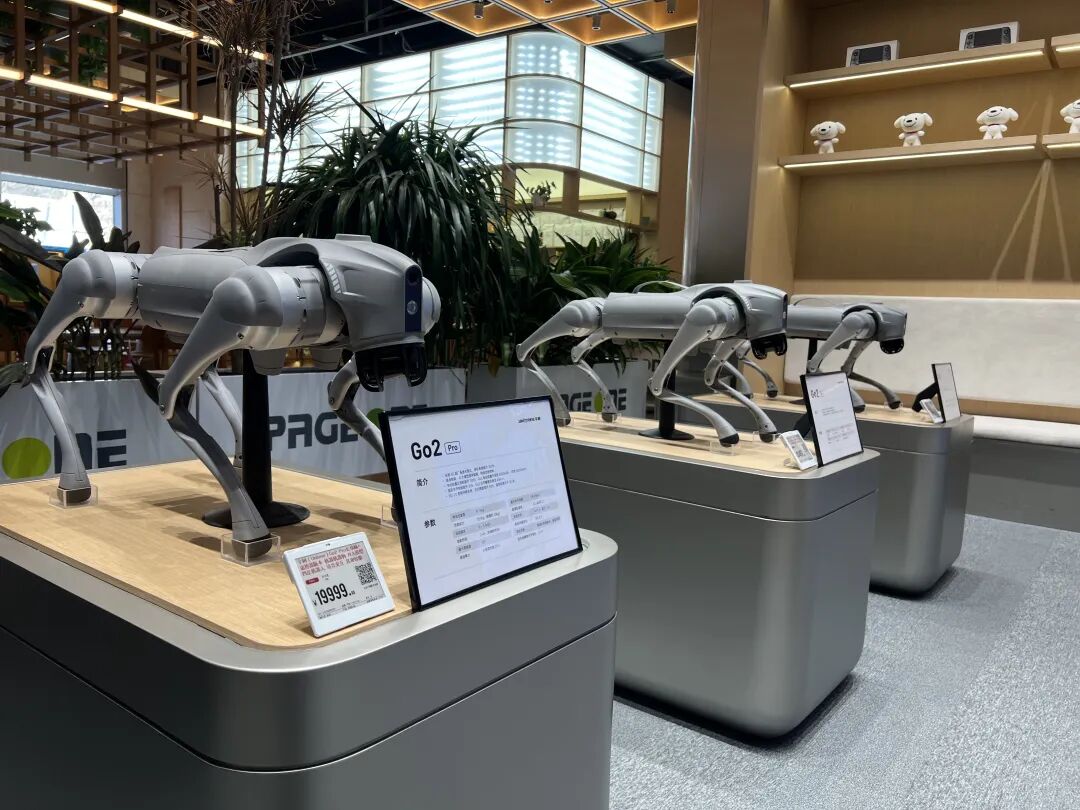
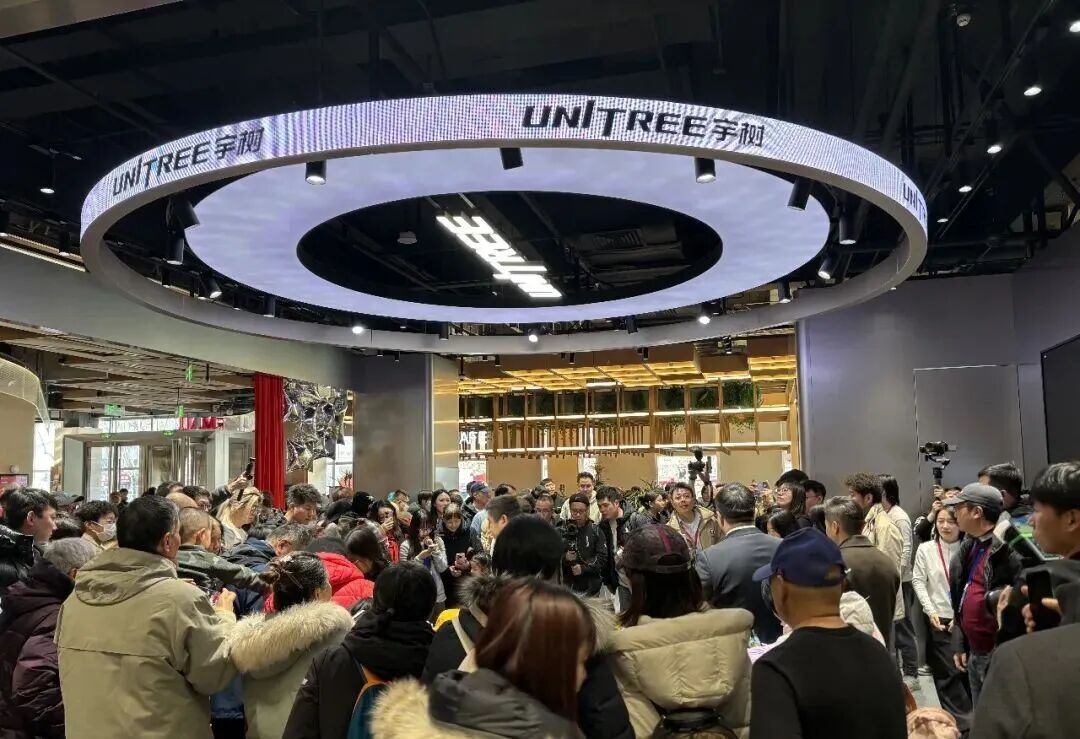
导读 2025年12月31日,京东与宇树科技的全球首店于北京开业。此次合作是宇树向"平台+生态"转型的关键 一步,也是京东百亿投入构建机器人产业生态的重要落子,共同推动人形机器人商业化进程加速。 京东蓝图,百亿投入构建机器人生态 京东在智能机器人领域的布局已形成完整体系。今年世界机器人大会期间,京东发布 "智能机器人产业 加速计划" ,宣布将在该领域投入超百亿资源。 具体目标是在三年内助力100个智能机器人品牌成交额破10亿元,推动智能机器人走进超百万个终端场 景。 为实现这一目标,京东正通过多种方式深度介入产业:今年3月,京东成立具身智能相关业务部门;7 月,发布自研品牌JoyInside,为机器人提供自然对话能力。同时,京东积极投资智能机器人产业链,今 年已陆续投资智元、众擎机器人、千寻智能、逐际动力等多家具身智能企业。 2025年12月31日上午,京东与宇树科技联合打造的全球首店在京东MALL北京双井店正式开业。宇树科 技G1人形机器人及Go2机器狗等明星产品在首店悉数亮相,展示出机器人的无限潜力。 京东与宇树科技的合作,代表着机器人产业生态融合的新趋势。对宇树科技而言,与京东合作不仅是销 售渠道的拓展 ...

2026年“两新”政策公布 挖掘农村消费潜力
Zhong Guo Jing Ying Bao· 2025-12-31 15:45
Group 1 - The core policy for 2026 focuses on large-scale equipment updates and consumer goods replacement, with specific support areas and subsidy standards outlined in the notification [2] - The 2026 policy introduces new subsidy categories, including updates for old residential elevators, equipment for elderly care institutions, and safety equipment [3] - The policy aims to enhance rural consumer access by increasing offline business entities and guiding online channels towards rural areas [3][4] Group 2 - The subsidy mechanism for 2026 has been optimized, with differentiated subsidies based on the number of elevator floors and prioritizing electric vehicle updates for old operational trucks [5] - In the consumer goods replacement sector, the subsidy for cars remains unchanged, while home appliance subsidies are adjusted to support only energy-efficient products, with a cap of 1,500 yuan per item [6] - The policy emphasizes the importance of service consumption and aims to expand domestic demand through the implementation of the "Two New" policies [6][7]


2026年国家补贴来了,只需三步,一图读懂国补领取攻略!
Sou Hu Cai Jing· 2025-12-31 14:50
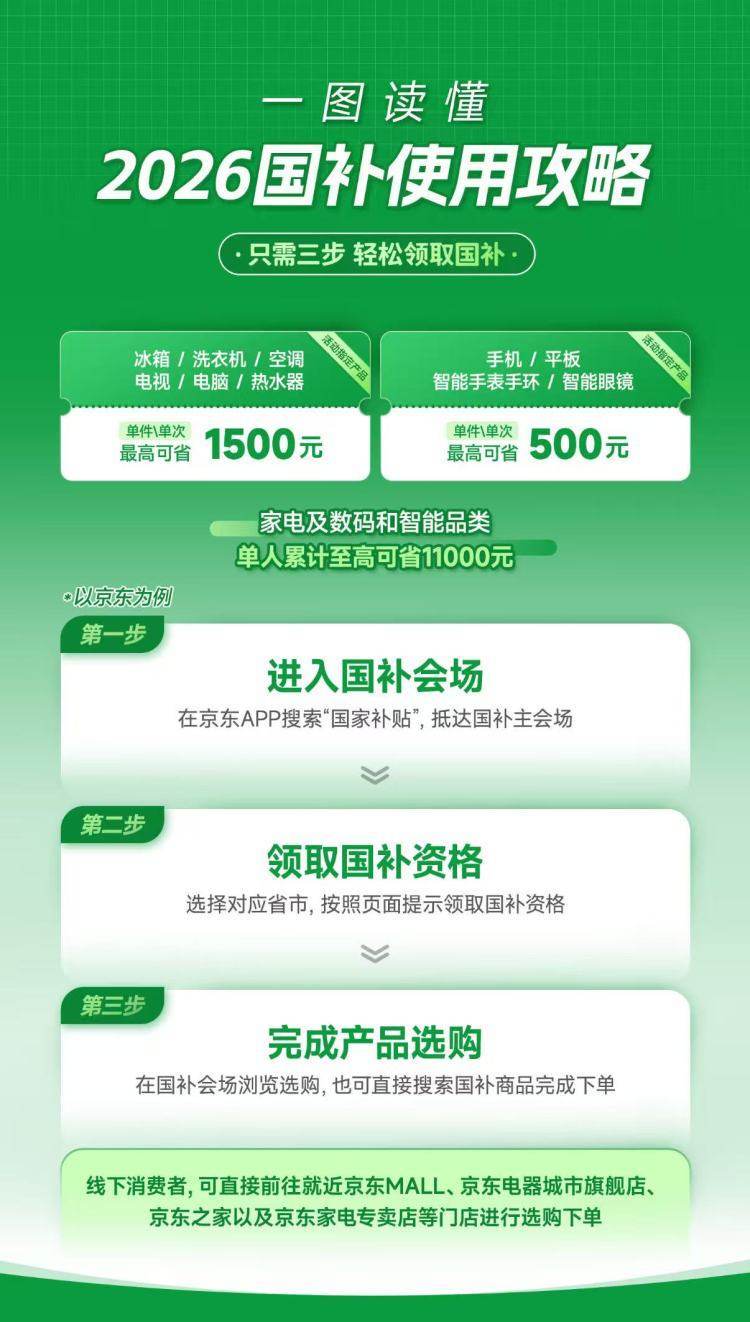
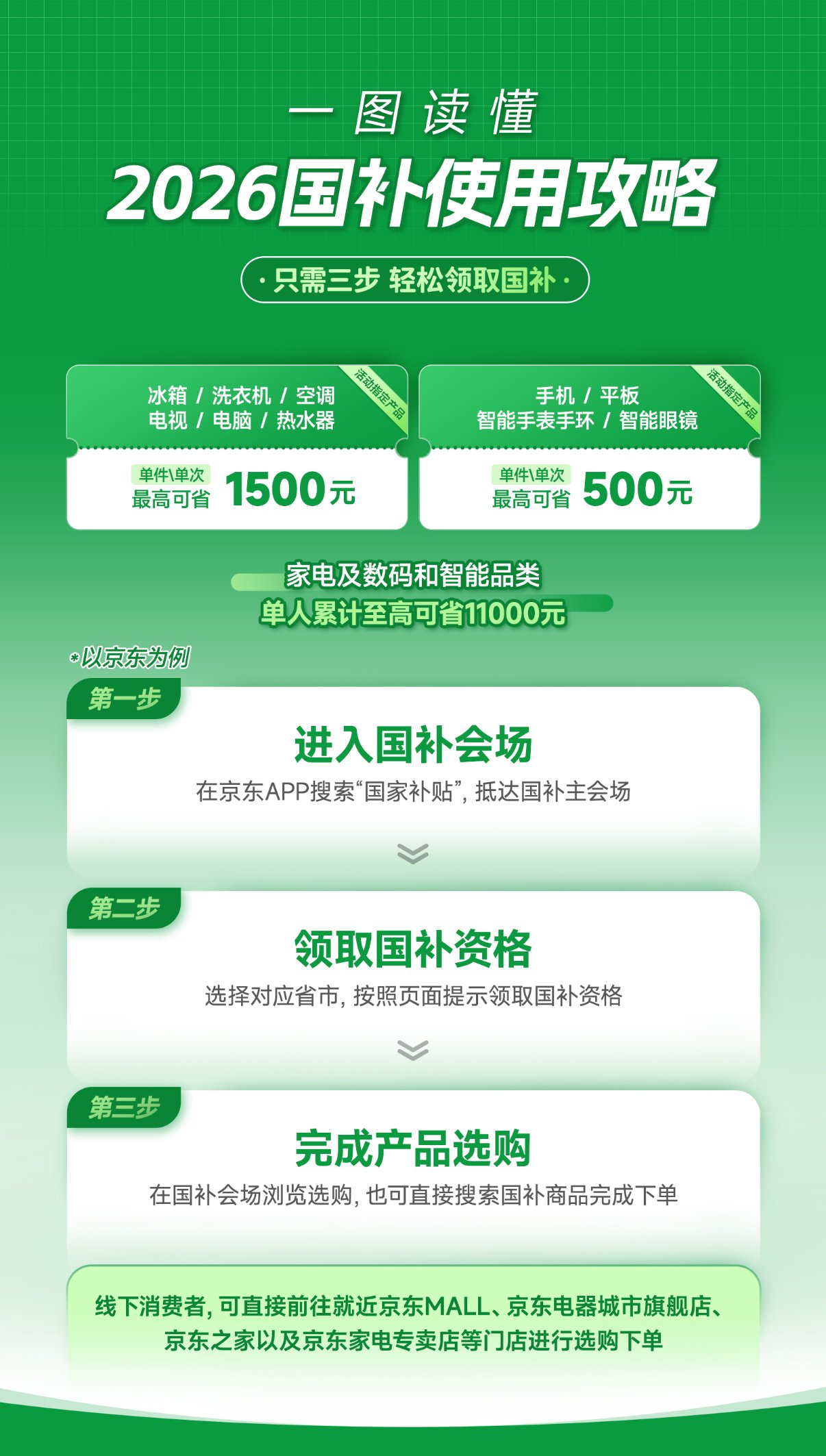
图 读懂 2026国补使用攻略 · 只需三步 轻松领取国补 · 冰箱 / 洗衣机 / 空调 手机 / 平板 智能手表手环 / 智能眼镜 电视 / 电脑 / 热水器 #1单次 500元 #142 1500元 家电及数码和智能品类 单人累计至高可省11000元 ○以京东为例 第一法 进入国补会场 在京东APP搜索"国家补贴",抵达国补主会场 第二步 领域国补资格 选择对应省市,按照页面提示领取国补资格 27 第三步 完成产品达购 在国外会场训培训班 中国语培训室国外文学习与中 此外,京东MALL、京东电器城市旗舰店、京东之家、京东家电专卖店等线下渠道也同步展开国补承接。1 月1日起,消费者可直接前往就近京东门店,咨询国补导购进行国补核销与下单。 在提升国补体验方面,京东可额外为消费者提供家电品类的旧机回收补贴,"送、装、拆、收"一体化服 务,以及"三免四不限"服务(即旧机免费上门、免费拆卸、免费搬运;不限旧机购买渠道、不限品牌、不 限年限、不限品相)。此外,京东可为3C数码品类送货上门的同时,完成现场签收、现场激活,让消费者 足不出户换新机。 为更好支持国补战略进乡村,京东2025年已投入近300亿元支持国补进乡 ...
“可以看到、摸到”,实探宇树科技线下首店
Zhong Guo Zheng Quan Bao· 2025-12-31 14:40
Core Insights - The opening of the first offline experience store by Yushu Technology in Beijing marks a significant step in enhancing consumer interaction with their robotic products [1][3] - The store features consumer-grade products such as the quadruped robot Go2 and humanoid robots G1 and R1, targeting tech enthusiasts, parents, and researchers [3][4] - The pricing strategy includes competitive pricing with promotional subsidies during sales events, aligning offline and online prices [4][6] Group 1: Store Launch and Product Offering - Yushu Technology's offline experience store officially opened on December 31, showcasing products like the quadruped robot Go2 priced at 10,497 yuan and humanoid robots G1 at 85,000 yuan and R1 starting at 29,900 yuan [1][4] - The store aims to facilitate direct communication between the company and consumers, enhancing brand exposure and user experience [6] Group 2: Market Trends and Future Prospects - The consumer robotics market has seen rapid growth this year, with increased availability of products and competitive pricing on platforms like JD.com [7] - Factors influencing the market include product pricing and functionality, with a noted consumer willingness to purchase when robot prices are comparable to smartphones [8] - The collaboration between Yushu Technology and JD.com aims to integrate AI capabilities into robots, enhancing their role in retail environments as service providers [6][8]
互联网电商 25Q3 业绩总结及展望:即时零售转向 UE 修复,加速打造 AI 生态闭环
Shenwan Hongyuan Securities· 2025-12-31 13:46
Investment Rating - The report recommends investment in Alibaba, Meituan, Pinduoduo, and JD.com, indicating a positive outlook for these companies in the e-commerce sector [4]. Core Insights - Online consumption continues to grow steadily, with a total retail sales of 45.6 trillion yuan in the first 11 months of 2025, reflecting a year-on-year increase of 4.0%. The online retail sales reached 14.5 trillion yuan, up 9.1% year-on-year, with physical goods online retail sales growing by 5.7% to 11.8 trillion yuan, resulting in a penetration rate increase of 0.42 percentage points to 25.9% [1][12]. - The impact of the "old-for-new" policy from the previous year is starting to show, leading to a high base effect that is affecting growth rates. The express delivery business volume reached 180.74 billion pieces, a year-on-year increase of 14.9%, but this growth is slowing compared to the previous half of the year [1][12]. - The competition in the instant retail sector has peaked, with platforms shifting their strategies towards differentiation to improve user experience (UE). The report notes that the industry is entering a new phase of competition, focusing on quality and efficiency rather than just price competition [3][47]. Summary by Sections 1. Online Consumption and Retail Performance - Online consumption remains robust, with significant growth in penetration rates. The high base effect from last year's policies is now impacting growth rates, leading to a slowdown in the growth of express delivery and online retail sales [1][12]. - Major platforms are adjusting their strategies in response to the high base effect, with JD.com experiencing a notable decrease in GMV growth rates in Q3 [1][17]. 2. AI Investment and Development - The AI sector is witnessing intensified competition, with major internet companies launching numerous updates and iterations of AI models. The focus is shifting from broad capabilities to specialized strengths, enhancing user experience and application in consumer-facing products [3][34]. - Alibaba's cloud business is accelerating, with AI-related product revenues achieving triple-digit year-on-year growth for nine consecutive quarters, indicating a successful transition from technology investment to value realization [3][34]. 3. Instant Retail Sector Dynamics - The instant retail sector has seen a peak in competition, with platforms initially investing heavily to capture market share. However, as the market stabilizes, strategies are shifting towards differentiation and quality improvement [3][47]. - The report highlights that platforms like Meituan and Taobao are focusing on enhancing user experience and profitability, moving away from aggressive subsidy strategies [3][47]. 4. Performance of Major E-commerce Platforms - Alibaba's core business revenue growth remains strong, while Meituan's local business is under pressure. JD.com and Pinduoduo are expected to see profit recovery in the upcoming quarters, driven by strategic investments and operational efficiencies [3][4]. - The report notes that the profitability of platforms is becoming increasingly differentiated, with expectations for Alibaba and Meituan to see profit recovery soon [4].



廖跃翀:京东IP文娱业务生态
Xin Lang Cai Jing· 2025-12-31 13:20
Core Insights - The 2025 Global Cultural IP Industry Development Conference will be held in Shanghai on December 26-27, 2025, focusing on the theme "IP Without Boundaries: Intelligent Creation of the Future - Global Exploration of Cultural IP and Technology Integration" [3][8] - JD's IP Entertainment business is centered around content industry, forming a B2B2C closed-loop model that addresses typical pain points such as diverse categories, dispersed users, and difficulty in fan retention [3][8] - JD aims to enhance the efficiency of value conversion for IP in e-commerce and supply chain scenarios through a three-party collaborative marketing mechanism involving the platform, copyright holders, and brand merchants [4][5][9] Company Overview - JD's IP Entertainment is responsible for the daily operations and sales of IP products, IP stores, and IP merchants on the JD platform, integrating IP licensing, brand collaborations, and the development and sales of IP derivatives [4][9] - The company connects copyright holders and content providers on one end, and brand merchants and manufacturing supply chains on the other, ultimately presenting compliant and high-quality IP-related products and experiences to end consumers [5][9] Operational Capabilities - JD provides multi-dimensional support, including supply chain and fulfillment capabilities to ensure efficiency and stability from design and development to delivery [5][10] - The platform's operational and marketing capabilities leverage entry resources, event strategies, content dissemination, and membership systems to convert IP influence into measurable sales and brand awareness [5][10] - JD also facilitates brand collaborations by matching the needs of copyright holders with those of merchants, creating richer products and scenarios [5][10] Digital Innovation - JD is exploring digital tools and new forms, such as the Lingxi platform, which utilizes JD's main site mini-programs and blockchain technology to connect cultural digital assets with brands, IPs, and users [6][10] - The goal is to transform digital assets from mere collectibles into rights carriers that connect users, promote dissemination, and drive consumption [6][10] Future Aspirations - The core logic of JD's IP Entertainment is based on a three-party win-win model, where the platform provides users and marketing scenarios, IP holders offer official materials and co-creation channels, and brand merchants handle product operations and brand resource integration [6][10] - JD aims to establish connections with more industry partners to create reusable benchmark cases and promote a more efficient, trustworthy, and sustainable IP entertainment ecosystem [6][10]

2026年电商们打响全面战争
21世纪经济报道· 2025-12-31 12:50
Core Viewpoint - The essence of the e-commerce business is "traffic," and the competition in the industry has evolved into a complex and multi-dimensional landscape, driven by various factors such as technology, consumer habits, and supply chain dynamics [1][2]. Group 1: E-commerce Competition Dynamics - In February 2025, Liu Qiangdong initiated a fierce competition in the food delivery sector, disrupting the market with substantial subsidies, leading to increased spending on sales and marketing by major players like Meituan, Alibaba, and JD.com, which collectively spent an additional 614 billion yuan in the third quarter [1]. - The competition is characterized by a shift from traditional e-commerce to instant retail, with platforms like JD.com, Meituan, and Alibaba engaging in a "comprehensive war" rather than a zero-sum game [2][6]. - The integration of AI in consumer decision-making and the transition of supply chains from a focus on scale to efficiency and resilience are reshaping the industry's development logic [2]. Group 2: Strategic Moves and Financial Implications - JD.com launched a recruitment initiative for quality dining merchants, offering zero commission for early entrants, marking the beginning of the food delivery war [4]. - Alibaba's recent performance indicates a significant growth in its instant retail business, with revenues reaching 229.06 billion yuan, a 60% year-on-year increase, despite a 53% drop in net profit for the second quarter of fiscal year 2026 [6][7]. - The competitive landscape is intensifying, with platforms reflecting on their strategies, as evidenced by Meituan's CEO acknowledging the unsustainable nature of past competitive practices [9]. Group 3: Market Trends and Future Outlook - The ongoing battle for market share in instant retail is not just about creating new consumption scenarios but also about capturing traditional e-commerce users and offline market shares [7][10]. - The industry is entering a phase of refined and localized operations, moving away from "barbaric growth" towards a more sophisticated approach [2][12]. - The exploration of local life and instant retail by platforms like Xiaohongshu and Douyin continues, despite challenges, indicating that the competition will remain dynamic and multifaceted [10].

2026年国家补贴来了 只需三步 收好这份省钱指南!
Xin Lang Cai Jing· 2025-12-31 12:42
针对家电品类,个人消费者购买冰箱、洗衣机、电视、空调、电脑、热水器等6类家电中1级能效或水效标准的产品,按产品销售价格的15%给予补贴,每位 消费者每类产品可补贴1件,每件补贴不超过1500元;针对数码和智能品类,个人消费者购买手机、平板、智能手表手环、智能眼镜等4类产品(单件销售价 格不超过6000元),按产品销售价格的15%给予补贴,每位消费者每类产品可补贴1件,每件补贴不超过500元。 根据上述规则,2026年起,消费者可享受共十类家电以及数码和智能产品补贴,单人累计至高可省11000元。此外,《通知》提及,支持智能家居产品(含 适老化家居产品)购新补贴,具体补贴品类、补贴标准将由地方结合实际自主合理制定。 以京东为例,在国补使用方式上,消费者只需三步便能轻松获取2026国补省钱体验。第一步,打开京东APP,搜索"国家补贴",即可抵达国补主会场;第二 步,点击进入对应省市,按照页面提示领取国补资格;第三步,消费者可在会场浏览选购,也可直接搜索国补商品完成下单,完成国补减免! 此外,京东MALL、京东电器城市旗舰店、京东之家、京东家电专卖店等线下渠道等同步展开国补承接。1月1日起,消费者可直接前往就近京东 ...
宇树全国首家线下门店今日开业,一款机器狗起售价19999元,人形机器人8.5万元
Mei Ri Jing Ji Xin Wen· 2025-12-31 12:20
Core Insights - JD.com and Yushu Technology have launched their first offline store, marking a significant step in bringing advanced robotics to consumers [1][3] - The store features products like the Yushu G1 humanoid robot and the Go2 quadruped robot, with prices starting at 19,999 yuan and 85,000 yuan respectively [1] - The initiative aims to enhance consumer experience by allowing them to interact with robots physically, addressing the gap in understanding product features through digital mediums [3] Group 1: Store Launch and Offerings - The first Yushu Technology store is located in JD Mall, Beijing, and is designed to provide a hands-on experience for consumers [1][3] - The store currently offers four types of robots for sale, including the Go2 Pro and G1 [1] - The opening event featured a performance by a Yushu robot, attracting significant attention from the public [1] Group 2: Strategic Importance and Future Plans - Yushu Technology plans to expand its offline presence, with another store under construction in Wangfujing, a high-traffic area known for technology and fashion brands [4][7] - The company aims to enhance brand visibility and consumer engagement rather than solely focusing on sales [8] - JD.com has previously indicated its commitment to the robotics sector, planning to invest over 10 billion yuan to support 100 robotics brands in achieving significant sales growth [9]