Luckin Coffee(LKNCY)

Search documents
瑞幸咖啡定向点位加盟持续招募,800+优质选址虚位以待
2 1 Shi Ji Jing Ji Bao Dao· 2025-05-12 05:32
Core Insights - Luckin Coffee has launched a new franchise recruitment plan, targeting 186 cities with over 800 selected premium locations, providing opportunities for aspiring entrepreneurs to quickly open stores [1] - The company has introduced three types of partnership models, including fixed-point new partner franchise, store franchise, and directed point franchise, with the latter showing significant advantages in efficiency and certainty [3] - As of the first quarter of 2025, Luckin Coffee has a total of 24,097 stores globally and approximately 355 million cumulative transaction customers, indicating a strong market presence [5] Company Developments - The directed point franchise model, launched on January 1, 2024, has attracted numerous coffee entrepreneurs, with over 500 directed points passing site selection review and more than 400 stores opened across 229 cities by April 2025 [3] - The company has launched 119 new products in 2024, with nearly 3 billion cups of ready-to-drink beverages sold, showcasing its strong product innovation capabilities [5] - The "Fresh Brew Light Jasmine" drink achieved a record single-day sales of 1.67 million cups in March 2025, highlighting the popularity of its offerings [5] Market Context - The Chinese coffee market is rapidly developing, with the industry scale reaching 313.3 billion yuan in 2024, a growth rate of 18.1% compared to the previous year [8] - Per capita annual coffee consumption has increased to 22.24 cups, a 33% rise from 2023, indicating a growing consumer interest in coffee [8] - Luckin Coffee's strong product and supply chain innovations provide reliable support for its franchise partners, enhancing its competitive position in the market [8]


外卖三国杀,得咖啡奶茶者得天下?
创业邦· 2025-05-11 03:25
Core Viewpoint - The article discusses the resurgence of competition in the food delivery market, particularly focusing on the intense rivalry among major players like JD, Meituan, and Ele.me, which has led to significant subsidies and promotional activities in the coffee and tea sector [3][5][12]. Group 1: Market Dynamics - The food delivery market has reignited competition, with JD and Meituan engaging in disputes over issues like exclusive partnerships and rider benefits [3]. - Ele.me has launched a substantial subsidy program, "Er Bu Chao Bai Yi," to attract customers without engaging in public disputes [5]. - The introduction of "Taobao Flash Purchase" has linked consumers directly to Ele.me's delivery services, resulting in a surge in orders [5][12]. Group 2: Impact on Coffee and Tea Brands - The ongoing delivery war has significantly increased traffic for coffee and tea brands, with some brands experiencing order volume growth of over 300% during peak periods [7][12]. - Brands like Kudi Coffee and Nayuki have seen their order volumes multiply, indicating a strong consumer response to the promotional activities [7][12]. - The competitive pricing strategies have forced many coffee and tea brands to engage in price wars, with some prices dropping to as low as 5.9 yuan [14][15]. Group 3: Consumer Behavior and Brand Strategies - Consumers are actively participating in the promotional offers, with many taking advantage of low prices and discounts [11][19]. - The article highlights the shift in consumer preferences towards lower-priced options, with a significant increase in the proportion of purchases under 10 yuan [14]. - Brands are adapting their strategies, with some opting to withdraw from aggressive price competition while focusing on enhancing brand presence through delivery services [15][22]. Group 4: Sustainability of Subsidy Models - The sustainability of the current subsidy model is questioned, as it relies on balancing the interests of consumers, merchants, and delivery personnel [21][22]. - The article emphasizes that for the delivery model to be viable, all parties must benefit, otherwise, the cycle of subsidies may not last [22]. - Companies like Luckin Coffee have shown that avoiding price wars can lead to stable revenue growth, suggesting a potential shift in strategy for other brands [22].




茶咖日报|“攻入”美国?消息称瑞幸咖啡美国首店将落地纽约
Guan Cha Zhe Wang· 2025-05-09 12:27
Group 1: Luckin Coffee's Expansion in the U.S. - Luckin Coffee has opened two stores in New York, named "Luck In Coffee Shop" and "Luckin Coffee 2nd shop" [1] - The Broadway location is strategically positioned between New York University and Union Square, with a significant student population nearby [1] - The 6th Avenue store is located near the Empire State Building, targeting both tourists and local consumers to enhance brand visibility [1] Group 2: Jiahe Foods' Coffee Business Strategy - Jiahe Foods has a dual-channel approach for its coffee business, focusing on both online branding and offline distribution through dealers [2] - The company is actively expanding into Southeast Asia and aims to improve its product offerings and marketing efficiency [2] - Increased sales expenses in 2024 and Q1 2025 are attributed to enhanced C-end promotions, particularly in online operations [2] Group 3: FBIF 2025 Forum Insights - The FBIF 2025 forum highlighted the growth potential of sugar-free tea, which is expected to dominate the market in the next 10-20 years [3][4] - The organic fruit and vegetable juice market is projected to experience significant growth, with a strong consumer preference for organic products [4] Group 4: High-End Coffee Pricing in Shanghai - A coffee shop in Shanghai has stirred discussions by selling a cup of coffee for 1800 yuan, using high-end beans from Sofia Garden [5] - The shop offers a variety of coffee beans, with the cheapest option priced at 90 yuan per bag [5] Group 5: Xiangpiaopiao's Response to Revenue Decline - Xiangpiaopiao's chairman addressed the revenue decline in its brewing business due to external market conditions and inventory adjustments [6] - The company plans to enhance product quality and explore new markets, including coffee and ready-to-drink milk tea, to boost growth [6]
新茶饮“五一”表现亮眼,有门店销量激增3000%
Nan Fang Nong Cun Bao· 2025-05-09 12:03
Core Insights - The new tea beverage industry experienced explosive growth during the "May Day" holiday, with some stores reporting sales increases of up to 3000% [4][10][12]. Group 1: Sales Performance - During the "May Day" holiday, the domestic tourism market saw 314 million trips, a year-on-year increase of 6.4%, with total spending reaching 180.269 billion yuan, up 8.0% [7]. - Key retail and catering enterprises reported a sales increase of 6.3% year-on-year, with new tea beverages performing particularly well in popular tourist cities [9]. - Specific stores, such as those in scenic areas, saw significant sales growth, with some locations reporting over 1700% increase in sales [11]. Group 2: Consumer Trends - The combination of tea beverages and cultural tourism has created new consumption scenarios, with promotional activities driving sales [10][14]. - Non-first-tier cities and scenic areas showed significant consumption potential, while first-tier cities remained popular [16]. - Foreign tourist spending at tea beverage stores increased by over 60% during the holiday, indicating a growing interest in Chinese-themed drinks [19][24]. Group 3: Product Innovations - New product launches, such as the "Wood Ginger and Papaya" series by Heytea, achieved daily sales of over 5000 cups in popular shopping districts [28]. - Sweetlala's "Watermelon Smoothie Bucket" became the top-selling product during the holiday, with sales exceeding 1.2 million cups [31]. Group 4: Delivery and E-commerce Impact - The competition among delivery platforms significantly boosted sales for new tea beverages, with some brands experiencing order increases of nearly 10 times [33][36]. - The overall tea beverage delivery volume increased by 106% during the holiday period [36].

中拉关系中的瑞幸:一杯咖啡背后的经济与文化流动
Zhong Guo Xin Wen Wang· 2025-05-09 06:19
Core Insights - The China-Latin America Forum has become a significant platform for enhancing political trust, development strategy alignment, and cultural exchange over the past decade [1] - Luckin Coffee plays a crucial role in deepening coffee industry cooperation between China and Brazil, acting as a bridge for economic and cultural exchanges [2] Group 1: Trade and Economic Cooperation - Luckin Coffee signed a memorandum of cooperation with Brazil's Export and Investment Promotion Agency to purchase 240,000 tons of coffee beans worth 10 billion RMB from 2025 to 2029 [2] - In 2023, China imported coffee from Brazil worth 220 million USD, a year-on-year increase of 158.4%, with an import volume of 60,000 tons, up 192.2% [3] - Luckin Coffee's procurement from Brazil is expected to account for 60% of Brazil's coffee exports to China in 2024, indicating a significant market share [3] Group 2: Cultural Exchange and Sustainability - The establishment of the Luckin Brazil Coffee Museum and the launch of the Brazil Coffee Culture Festival signify deepening cultural exchanges between China and Brazil [4] - Luckin Coffee has set up a Brazilian office and a high-quality coffee plantation base to enhance quality control and provide professional training to local coffee farmers [4] - The company's initiatives reflect its commitment to sustainable development and the promotion of Brazilian coffee culture in China [4]
每日投资策略-20250508
Zhao Yin Guo Ji· 2025-05-08 02:34
Macro Economic Overview - To counter the impact of tariffs, China has introduced a comprehensive monetary policy package aimed at boosting the stock and real estate markets. This policy will moderately ease liquidity and credit supply, encouraging positive market sentiment, although it cannot fully offset the economic impact of tariffs [2] - The report anticipates that the tariff impacts could reduce China's GDP and CPI growth rates by 1 percentage point and 0.2 percentage points, respectively. It is expected that GDP growth will slow from 5.4% in Q1 2025 to 4.5% in Q2, with a slight rebound to 4.7% in the second half of the year, resulting in an annual growth rate of 4.8% [5] Industry Insights - In the equipment manufacturing sector, global machinery manufacturers are assessing the impact of US tariffs, with most expecting effects to become apparent starting in Q3. Companies like Komatsu are predicted to face significant challenges due to these tariffs [5] - The Chinese insurance industry is set to see an acceleration of long-term investments as regulatory bodies announced a series of financial policies. This includes expanding the scope of long-term investment trials and adjusting risk factors for stock investments, potentially injecting over 150 billion yuan into the market [5] Stock Recommendations - Geely Automobile (175 HK) is rated as a "Buy" with a target price of 23.00, representing a 37% upside potential [6] - Xpeng Motors (XPEV US) is also rated as a "Buy" with a target price of 28.00, indicating a 46% upside [6] - Luckin Coffee (LKNCY US) is rated as a "Buy" with a target price of 40.61, suggesting a 24% upside [6] - Alibaba (BABA US) is rated as a "Buy" with a target price of 157.00, reflecting a 27% upside potential [6] - Tencent (700 HK) is rated as a "Buy" with a target price of 625.00, indicating a 28% upside [6]


单子爆了,新茶饮、咖啡成了外卖大战大赢家
3 6 Ke· 2025-05-07 01:43
比如,自淘宝闪购5月2日上线以来,库迪咖啡一日内订单增长近10倍,茉莉奶白在饿了么外卖订单量日 均也增长近3倍。 京东外卖上的销量表现也反映了茶咖品牌受到的追捧。茶咖观察在假期内多次点开京东外卖,爆单榜一 直稳定被瑞幸、库迪、古茗、霸王茶姬等占据。 茶饮和咖啡的高频成为外卖平台的必争赛道。 五一假期,连锁新茶饮和咖啡成了承接流量红利的最大赢家。 茶百道数据显示,五一期间,品牌整体销售额环比增幅50%,全国多家门店销量增幅超1700%,甚至有 景区门店销量增幅达3000%。奈雪的茶数据显示,五一假期期间,全国销售火爆,部分门店订单量环比 节前激增超300%。 假期经济带来的出游热潮为新茶饮门店带来大量客流。茶咖观察还了解到,外卖大战,也给各大茶咖品 牌带来了流量。 但这只是表象。一杯茶咖如何能在流量争夺战中脱颖而出?为什么是新茶饮和咖啡,而不是正餐、甜品 或便利零食,最终接住了这波补贴红利? 首先,相较正餐、甜品等品类,新茶饮的标准化程度更高。大多已经实现了从原料供应、门店操作到出 杯流程的高度标准化,具备"千店一味"的能力,这让它在平台运营、用户决策和履约配送的全链条中更 具优势。即便用户是在旅游途中或临时起 ...
霸王茶姬的奶茶为什么不卖九块九?
FBIF食品饮料创新· 2025-05-07 00:30
Core Viewpoint - The article discusses the competitive dynamics between Luckin Coffee and Bawang Chaji, focusing on their pricing strategies and market positioning in the tea and coffee beverage sector. It highlights how Luckin's aggressive pricing and product innovation serve as a customer acquisition strategy, while Bawang Chaji maintains a premium pricing model to uphold brand integrity and customer loyalty [1][9][13]. Pricing Strategy - Luckin Coffee's new product, "Freshly Brewed Light Jasmine Tea," is priced at 9.9 yuan, significantly lower than Bawang Chaji's "Boya Juexian," which is priced at 16 yuan. This price difference raises questions about the underlying cost structures of both brands [4][9]. - Bawang Chaji emphasizes the use of freshly brewed tea, which incurs higher costs, while Luckin has shifted to using tea bags for its tea products, allowing for lower production costs [5][7]. Supply Chain and Scale - The disparity in pricing is attributed to the supply chain advantages that come with scale. Luckin Coffee operates 22,340 stores, compared to Bawang Chaji's 6,440 stores, giving Luckin greater purchasing power and cost negotiation capabilities with suppliers [8][9]. - Industry analysts note that larger brands can negotiate better prices with suppliers, allowing them to offer lower prices to consumers without sacrificing margins [8]. Business Model and Revenue Generation - For Luckin, the light tea product serves as a customer acquisition tool rather than a primary revenue generator. The company is willing to accept lower margins on this product to drive traffic and increase customer engagement [9][11]. - In contrast, Bawang Chaji relies heavily on its tea products for revenue, with its flagship product accounting for a significant portion of its sales. The brand's strategy focuses on maintaining product quality and brand positioning, which justifies its higher price point [11][13]. Brand Positioning - Luckin Coffee positions itself as a convenient and affordable option for consumers, aiming to disrupt the traditional coffee market dominated by Starbucks. Its strategy includes frequent product launches and a focus on high turnover [13][14]. - Bawang Chaji, on the other hand, aims to establish itself as a premium brand with a strong cultural identity, focusing on high-quality ingredients and a refined customer experience. This approach includes carefully curated store designs and a limited product launch strategy [13][14]. Market Dynamics - The article highlights the contrasting consumer bases of both brands, with Luckin targeting a broader audience, including students and young professionals, while Bawang Chaji appeals to consumers seeking a premium tea experience [10][11]. - Luckin's sales data indicates strong performance for its light tea product, with daily sales exceeding 1.67 million cups, showcasing its effectiveness in attracting a diverse customer base [10].
星巴克降价,但晚了整整五年,如何翻身
3 6 Ke· 2025-05-06 10:58
Group 1 - Starbucks' competitive strategy has become ineffective due to market changes and the rise of local competitors like Luckin Coffee [2][3] - The differentiation advantage that Starbucks once had has diminished as consumers now have many alternatives for socializing and coffee consumption [3][4] - The focus on professional coffee consumption has led to a misjudgment of local market demands, as many consumers prefer milk-based beverages over pure coffee [3][4] Group 2 - Luckin Coffee has successfully identified and catered to the needs of non-professional consumers by offering popular products that align with local tastes [4][5] - The economic downturn and consumer behavior shifts have created opportunities for brands that can offer better value, which Luckin has capitalized on through a cost-leadership strategy [5][6] Group 3 - Starbucks needs to address its pricing strategy by genuinely lowering prices rather than relying on temporary discounts or coupons [12][13] - Product innovation is crucial for Starbucks to maintain relevance, requiring a balance of quality and quantity in new offerings [14][15] - Enhancing service experience and community engagement is essential for Starbucks to reclaim its position as a community coffee shop [17][18] Group 4 - Brand storytelling is vital for Starbucks to connect with consumers on a deeper level, moving away from a distant brand image to a more relatable one [19][20] - Establishing a comprehensive consumer operation system that integrates brand storytelling and consumer engagement is necessary for building trust and loyalty [20][21] - The shift from coffee as a status symbol to a daily beverage necessitates a fundamental restructuring of Starbucks' cost structure and user-centric approach [21][22]

餐饮巨头深陷亏损泥潭:超半数上市餐企净利润下滑,行业洗牌加速
Sou Hu Cai Jing· 2025-05-06 07:55
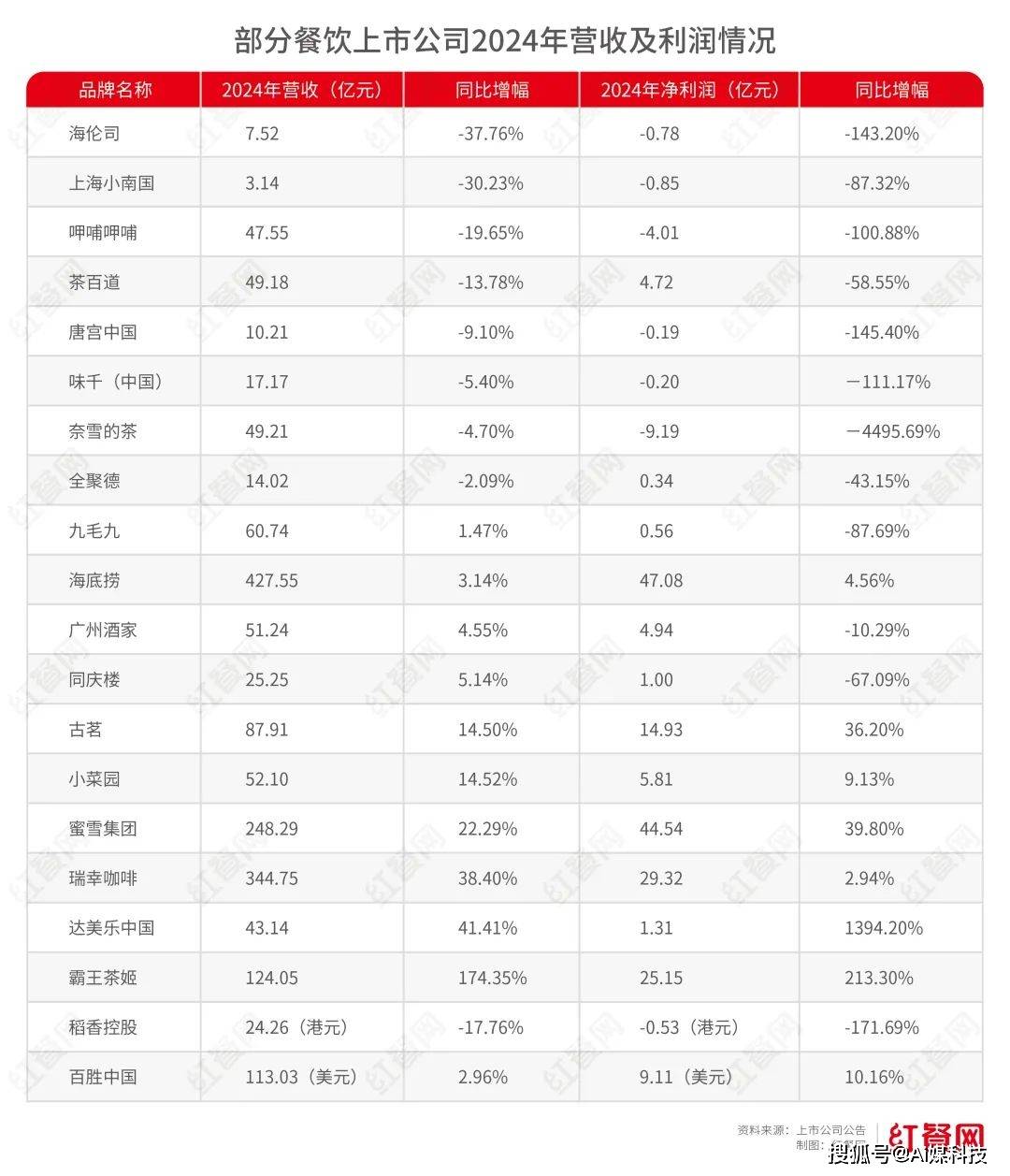
Core Viewpoint - The restaurant industry is facing its most severe challenges in nearly a decade, with over half of the listed companies reporting a decline in net profits for the first half of 2024, leading to significant losses for major brands [1][4]. Financial Performance - More than half of the 20 listed restaurant companies reported a year-on-year decline in net profits, with some major brands like Nayuki and Ajisen turning from profit to loss, with the highest single loss reaching 900 million yuan [1] - Helen's net profit dropped by 143.20% to a loss of 78 million yuan, while Shanghai Xiao Nan Guo's net profit fell by 87.32% to a loss of 85 million yuan [3] - Nayuki's revenue decreased by 4.70% to 4.92 billion yuan, with a staggering net profit decline of 4495.69% to a loss of 919 million yuan [3] - The overall restaurant revenue in first-tier cities like Beijing and Shanghai saw declines of 3.5% and 3.1%, respectively [3]. Market Challenges - The industry attributes profit declines to shrinking consumer demand and intensified price wars, with fixed costs like rent and labor remaining high [4][6] - Price wars have become a necessary strategy for companies to maintain market share, with some brands significantly reducing prices without achieving sustainable growth [6]. Strategic Adjustments - Major restaurant chains are shifting from aggressive expansion to conservative management, focusing on cash flow and profitability [7] - Companies like Haidilao have implemented cost-optimization strategies, resulting in a net profit of 4.5 billion yuan in 2023, making it one of the few companies to grow against the trend [9]. Industry Outlook - The restaurant industry is entering a "micro-profit era," where blind expansion could lead to significant losses [10] - Despite the challenges, some brands are exploring differentiated strategies to find new growth opportunities, indicating a shift from rapid growth to refined operations [11][12].