POP MART(PMRTY)

Search documents
大跌36%后,泡泡玛特仍获华尔街大行力挺:Labubu明年推4.0版,价值尚未完全释放
Hua Er Jie Jian Wen· 2025-11-18 02:36
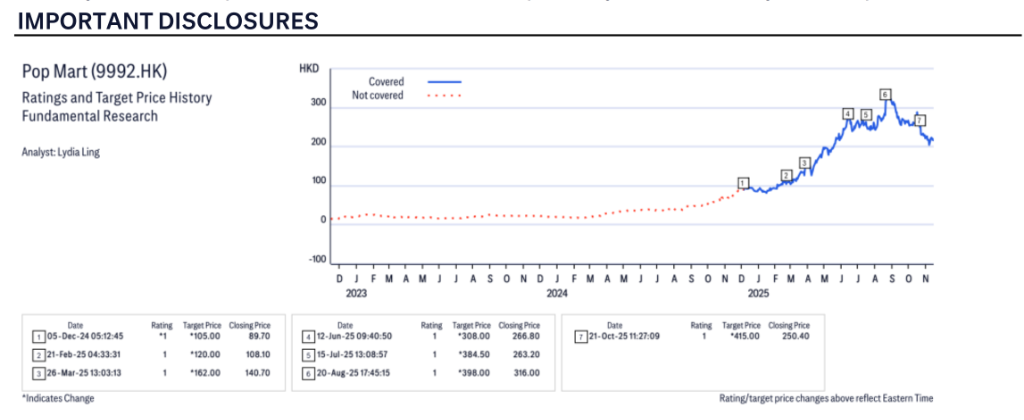
Core Viewpoint - The market's concerns regarding Pop Mart's growth sustainability and single IP risk are considered excessive, with the company's core value lying in its unparalleled IP incubation and operational capabilities [1][4]. Group 1: IP Strength and Growth - The flagship IP Labubu has strong vitality, with its 4.0 version postponed to 2026 due to high demand for Labubu 3.0, and Sony Pictures is reported to have acquired the film adaptation rights, potentially enhancing the IP's global recognition [4][8]. - The company is diversifying its growth engines by actively managing online pre-sale scales to ensure sustainable IP operations, with a successful IP matrix formed around Labubu, SKULLPANDA, and CRYBABY, effectively mitigating risks [4][9]. Group 2: Global Expansion and Market Performance - Pop Mart's global expansion is exceeding expectations, particularly in the U.S. and Japan, with plans to optimize operations and deepen local market channels [6][10]. - The company aims to operate over 60 stores in the U.S. by the end of 2025, with additional plans for Canada, Latin America, and the Middle East, emphasizing localized operations and partnerships [10]. Group 3: Financial Performance and Valuation - Financial projections indicate significant growth, with net profit expected to rise from 1.082 billion RMB in 2023 to 23.169 billion RMB by 2027, and diluted EPS increasing from 0.807 RMB to 17.370 RMB over the same period [7]. - Citi has set a target price of 415.00 HKD for Pop Mart, representing a potential upside of 91.8% from the closing price of 216.40 HKD, based on a 28x P/E ratio for 2026 [1][13].


泡泡玛特努力为IP注入故事与内涵
Zheng Quan Ri Bao· 2025-11-17 16:13
Core Viewpoint - Sony Pictures has reportedly acquired the film adaptation rights for the LABUBU IP owned by Pop Mart, which plans to create a related film series, although details regarding producers and directors remain undecided [2] Group 1: Film Adaptation and IP Development - If the rumors are true, collaborating with a top Hollywood studio could significantly enhance LABUBU's global recognition and IP value, further advancing Pop Mart's globalization efforts [2] - Pop Mart has already taken steps towards IP film adaptation, having established a film studio in January 2025 and registered the script for the animated series "LABUBU and Friends" [2] - The LABUBU family includes other character IPs such as ZIMOMO and MOKOKO, which will appear in the upcoming animated series [2] - The release date for "LABUBU and Friends" is currently uncertain, with projections indicating a premiere year of 2028 on the Douban platform [2] Group 2: Market Expansion and Collaboration - LABUBU has global influence, but if Pop Mart handles the film adaptation, success in overseas markets may be challenging; Sony's involvement could facilitate entry into international film markets [3] - Pop Mart's founder, Wang Ning, has indicated that many Hollywood companies have sought collaboration for a LABUBU film, and the company is considering whether to produce independently or partner with Hollywood [3] - Collaborating with overseas companies or having a major foreign studio lead the project could leverage their distribution networks and resources, which is crucial for Pop Mart's success in the global market [3] Group 3: Financial Performance - In the third quarter of 2025, Pop Mart reported significant revenue growth across regions: 170% to 175% in the Asia-Pacific, 1265% to 1270% in the Americas, and 735% to 740% in Europe and other regions [4] Group 4: Strategic Direction - Pop Mart is shifting from merely exporting products to embedding organizational capabilities in key markets, indicating a commitment to enriching its IP with stories and content [5] - Successful film adaptations could extend the lifecycle of Pop Mart's IPs and create a positive cycle for its ecosystem, including parks and merchandise [5] - The company has numerous exploration avenues ahead, emphasizing the importance of storytelling in sustaining the popularity of its trendy toy IPs [5]
泡泡玛特回应与索尼合作LABUBU大电影称不予置评
Mei Ri Jing Ji Xin Wen· 2025-11-17 02:48
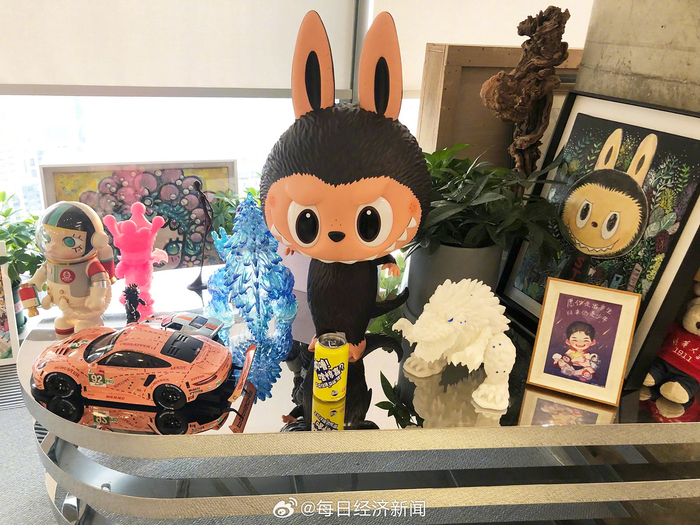
Core Viewpoint - The collaboration between Pop Mart and Sony Pictures for the LABUBU movie is in the early development stage, with no decision made on whether it will be a live-action or animated film. Pop Mart has chosen not to comment further on the matter [1]. Group 1 - Pop Mart has confirmed the news regarding the collaboration with Sony Pictures for the LABUBU movie [1]. - The movie development is still in its early stages, indicating that details are yet to be finalized [1]. - Pop Mart's official response to inquiries was to refrain from providing additional comments [1].

79元挂链贵吗?泡泡玛特的争议还不止是定价
Xin Jing Bao· 2025-11-14 13:48
Core Insights - The recent "Pop Mart live streaming incident" has sparked discussions about the pricing of a 79 yuan blind box, raising questions about its value [1][2] - In the first half of 2025, Pop Mart is projected to generate revenue of 13.88 billion yuan, with a gross margin of 70.3%, significantly higher than Apple's 47% and nearly on par with Hermès [1] Group 1 - The high profitability of Pop Mart is accompanied by controversies regarding product quality control and pricing strategies [2] - The company is currently facing critical issues that need to be addressed, particularly in terms of product quality and pricing [2]
泡泡玛特王宁身家还在涨,但有人恐惧了 || 深度
Sou Hu Cai Jing· 2025-11-14 01:36
Core Viewpoint - The article discusses the recent challenges faced by Pop Mart, including a negative report from Bernstein and internal employee dissatisfaction, while highlighting the continued wealth accumulation of its founder, Wang Ning, amidst these issues [1][2][3]. Group 1: Company Performance and Market Reaction - Bernstein has categorized Pop Mart as a speculative toy company and has issued a "underperform" rating, marking the second time the firm has expressed a bearish outlook on the company [1][2]. - Despite the negative sentiment, Wang Ning's wealth has surged to 182 billion yuan, an increase of nearly 40 billion yuan in five months, making him the top U40 entrepreneur according to the Hurun report [2][8]. - Following a live-stream incident where employees criticized the pricing, Pop Mart's stock initially dipped but later rebounded, with a notable increase of over 8% on November 10 [7][8]. Group 2: Employee and Consumer Sentiment - Employees have expressed skepticism about the brand's value, with one incident during a live stream revealing internal discontent regarding pricing strategies [3][4]. - The company has faced over 26,000 complaints on the Black Cat Complaints platform, primarily concerning product quality and poor after-sales service [6]. Group 3: Product and Market Dynamics - Pop Mart's products, particularly the DIMOO series, continue to sell well, with significant price premiums observed, such as a 7.3 times increase for certain items [7][9]. - The company reported a 245% year-on-year revenue growth in Q3, with a gross margin of 70.3%, surpassing major luxury brands [12]. Group 4: Future Challenges and Market Trends - Bernstein's bearish outlook is partly due to signs of slowing growth, with a notable decline in transaction volumes and market interest for key products like LABUBU [14]. - Competitors such as Miniso's TOPTOY and 52TOYS are emerging, posing threats to Pop Mart's market share by adopting aggressive pricing and targeting different consumer segments [14][15].
国际投行伯恩斯坦报告预测泡泡玛特四季度业绩或不及预期,给出“跑输大市”评级
Sou Hu Cai Jing· 2025-11-13 21:08
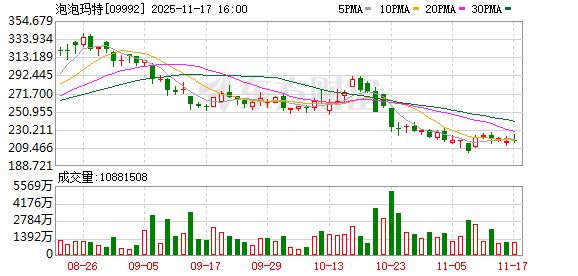
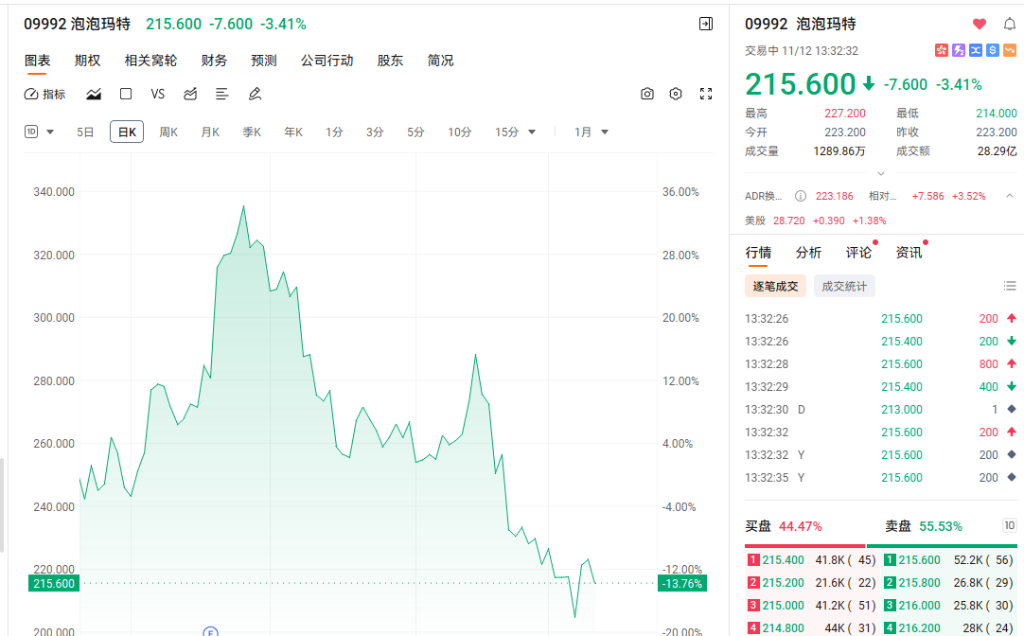
Core Viewpoint - Bernstein's report raises concerns about Pop Mart's fourth-quarter performance, suggesting it may fall short of market expectations, leading to a decline in the company's stock price in the Hong Kong market [3]. Group 1: Market Performance - Bernstein's report indicates a general slowdown in demand for Pop Mart's products in both domestic and overseas markets since June, which analysts believe signals a fundamental demand deceleration rather than temporary market noise [3]. - Following the report, Pop Mart's stock experienced a drop of 3.7% on November 12, becoming one of the biggest losers in the market, with the stock having already declined nearly 40% from its peak in late August [3]. - Despite the recent downturn, Pop Mart's stock has seen a cumulative increase of approximately 140% year-to-date [3]. Group 2: Analyst Ratings - Among over 40 brokerages covering Pop Mart, Bernstein is the only firm to issue an "underperform" rating, while the majority remain optimistic about the company's prospects [4]. - As of November 13, Pop Mart's stock opened down 1.6% but closed slightly up at 220.4 HKD per share, reflecting mixed market sentiment [4]. Group 3: Sales Performance - Pop Mart reported a staggering 250% year-on-year increase in sales for the third quarter, yet there are ongoing concerns regarding the sustainability of demand for its popular products, particularly the Labubu dolls [4].
胖东来与泡泡玛特案例,河南为什么出营销奇才?
Sou Hu Cai Jing· 2025-11-12 18:36
Core Insights - The article discusses the rise of marketing talents from Henan, highlighting how local entrepreneurs have transformed retail and new consumption from regional to national and global levels [1] Group 1: Key Entrepreneurs and Their Achievements - Yu Donglai opened the first store in 1995, achieving sales of 16.964 billion yuan by 2024 with a focus on customer service and return policies [2] - The Zhang brothers of Mixue Ice City rebranded in 1998 and are set to list on the Hong Kong stock exchange in 2025 with a market value exceeding 200 billion HKD, operating nearly 30,000 stores [2] - Wang Ning founded Pop Mart in 2010, reaching revenue of 13.04 billion yuan in 2024, with overseas business growing by 375.2% [2] Group 2: Business Strategies and Market Positioning - Entrepreneurs from Henan leveraged local advantages such as high agricultural output and established supply chains to build their businesses [2] - The common strategy among these entrepreneurs includes a long-term commitment to their business models, often taking 20 years to reach a breakthrough [2][4] - Each entrepreneur faced significant challenges, such as store fires for Yu Donglai and price wars for Mixue Ice City, but they adapted their supply chains and service standards to overcome these obstacles [4][5] Group 3: Capital and Growth Dynamics - Some brands opted for slow growth, while others, like Mixue Ice City, saw their valuations soar post-IPO [5] - Pop Mart has successfully commercialized its IP, creating a comprehensive brand ecosystem that includes blind boxes and international stores [5] - By 2024 and 2025, Henan's enterprises have established a strong presence in the supermarket, new consumption, and trendy toy sectors, forming a notable industry matrix [5]

泡泡玛特股价承压下挫,伯恩斯坦预警Q4业绩恐不及预期
Hua Er Jie Jian Wen· 2025-11-12 06:21
Core Viewpoint - Bubble Mart's stock price is under pressure due to a warning from Bernstein regarding potential underperformance in Q4 earnings, driven by a slowdown in demand observed since June [1][3]. Group 1: Demand and Performance Indicators - Bernstein's report indicates a general slowdown in demand for Bubble Mart's products in both domestic and international markets, with data from October showing a significant decline from peak levels in June [1]. - The report highlights that various independent data sources, including transaction data, social media trends, and search interest, collectively suggest a deceleration in fundamental demand, which cannot be dismissed as mere noise or channel shifts [1]. - The decline in indicators during October is noted to be substantial and consistent, leading to expectations that Q4 performance may disappoint market forecasts [1]. Group 2: Stock Performance and Market Sentiment - Following Bernstein's warning, Bubble Mart's stock experienced a drop of 3.7% on November 12, making it one of the worst performers in the market despite a remarkable 250% year-on-year increase in Q3 sales [1][3]. - The stock has seen a nearly 40% decline from its record high in late August, resulting in a market capitalization loss of approximately $20 billion [3]. - Despite the recent downturn, the stock has still achieved a cumulative increase of about 140% year-to-date, indicating a significant divergence in market sentiment among the 40+ brokerages covering Bubble Mart, with Bernstein being the only one to assign an "underperform" rating [3].
79元的“含金量”:泡泡玛特全球已截获超1000万件假货 拟与国际刑警组织合作打假|进博会
Zhong Guo Jing Ying Bao· 2025-11-11 07:29
Core Insights - The article discusses the challenges faced by Pop Mart regarding brand trust due to a leaked employee conversation questioning the pricing of a product, while the company is actively working on international anti-counterfeiting efforts to maintain its brand value [1] - Pop Mart's Vice President, Chen Xiaoyun, announced plans to collaborate with Interpol and law enforcement agencies from various countries to enhance anti-counterfeiting actions [1][2] Group 1: Anti-Counterfeiting Efforts - Pop Mart has intercepted over 10 million counterfeit items globally since 2025, covering 61 countries and regions, with a focus on the Labubu and cat series products [2] - The company is establishing a comprehensive system that includes customs interception, judicial litigation, and joint law enforcement to combat counterfeiting [2][3] - Pop Mart has registered with customs in over 30 countries and has formed cooperation mechanisms with the UK, the US, and several European and Southeast Asian nations to intercept counterfeit goods at the source [2] Group 2: Collaboration with Authorities - The Chinese Customs has played a significant role in supporting Pop Mart's anti-counterfeiting initiatives and has led efforts to create a global customs cooperation mechanism [2][3] - The Ministry of Public Security and the State Administration for Market Regulation in China are collaborating to reduce consumer exposure to counterfeit products through coordinated enforcement actions [3] - Pop Mart is also working with law enforcement and judicial authorities to handle cases of counterfeiting, which not only protects the company's rights but also contributes to the global intellectual property protection ecosystem [3]
汉堡王中国卖了!买方还投资过蜜雪冰城、老铺黄金、泡泡玛特
Sou Hu Cai Jing· 2025-11-11 02:17
Core Viewpoint - CPE Yuanfeng and Restaurant Brands International (RBI) are forming a strategic partnership to establish a joint venture named "Burger King China," with an initial investment of $350 million to support expansion and operations in the Chinese market [1][2]. Group 1: Investment and Partnership Details - CPE Yuanfeng will inject $350 million into Burger King China for restaurant expansion, marketing, menu innovation, and operational improvements [1]. - The joint venture will be governed by a 20-year master development agreement, granting exclusive rights to develop the Burger King brand in China [1]. - Post-transaction, CPE Yuanfeng will hold approximately 83% of Burger King China, while RBI will retain about 17% [1]. Group 2: Market Expansion Plans - The partnership aims to increase the number of Burger King outlets in China from approximately 1,250 to over 4,000 by 2035, with a focus on sustainable same-store growth [2]. - The transaction is expected to be completed in the first quarter of 2026, subject to regulatory approval [2]. Group 3: Industry Context - The collaboration reflects a growing trend where global brands partner with asset management companies to expand in the Chinese market, as seen with Starbucks' recent joint venture with Boyu Capital [2]. - Starbucks currently operates 8,000 stores in China and aims to reach 20,000 stores through its new joint venture [2].