Tesla(TSLA)

Search documents
Dow Jones Futures: Trump Threatens 100% Canada Tariff; Tesla, Microsoft, Meta, Apple Lead Earnings Wave
Investors· 2026-01-24 16:57
Group 1 - The stock market is experiencing volatility with significant earnings reports from major companies like Tesla, Microsoft, Meta Platforms, and Apple expected this week [5][10] - President Donald Trump has threatened to impose 100% tariffs on Canadian goods if a trade deal with China is reached, which could impact market sentiment [5] - The Dow Jones and small-cap stocks have shown mixed performance, with Nvidia and Amgen nearing buy points, while some long-term underperformers are gaining traction [8][10] Group 2 - The upcoming week includes a Federal Reserve meeting, a federal funding deadline, and a heavy earnings schedule, which may influence market dynamics [6] - Tesla has made changes to its safety monitors in robotaxis, and CEO Elon Musk has issued warnings regarding Full Self-Driving (FSD) technology [10] - Boeing is expected to report its Q4 results soon, and several data storage stocks are also in the earnings spotlight [10]




美股市场速览:整体市场平静,能源变数较大
Guoxin Securities· 2026-01-24 15:19
Market Performance - The S&P 500 decreased by 0.4% this week, while the Nasdaq fell by 0.1%[1] - Small-cap value (Russell 2000 Value) outperformed with a gain of 0.2%, compared to large-cap value (Russell 1000 Value) which declined by 0.2%[1] - The energy sector saw a notable increase of 3.1%, while the banking sector experienced a decline of 2.8%[1] Fund Flows - Estimated fund flow for S&P 500 constituents was +$5.6 billion this week, up from -$1.7 billion last week[2] - Key sectors with inflows included automotive and auto parts (+$9.2 million) and semiconductor products (+$9.2 million)[2] - Significant outflows were observed in the financial sector, particularly in diversified financials (-$13.6 million) and capital goods (-$7.4 million)[2] Earnings Forecast - The forward 12-month EPS expectation for S&P 500 constituents increased by 0.2% this week, slightly down from 0.3% last week[3] - Notable upward revisions were seen in real estate (+2.0%) and semiconductor products (+0.7%), while the energy sector was revised down by 2.0%[3] - Risks include uncertainties in economic fundamentals, international political situations, U.S. fiscal policies, and Federal Reserve monetary policies[3]



人形机器人行业周报:Optimus 量产节奏进一步明确,微软推出首个机器人大模型-20260124
Guohai Securities· 2026-01-24 15:16
Investment Rating - The industry investment rating is "Recommended" (maintained) [1] Core Insights - The humanoid robot industry is expected to experience significant growth, akin to a "Chat GPT moment," driven by advancements in technology and increasing market demand. The report emphasizes the importance of core component manufacturers and companies actively entering the humanoid robot sector [16] - Key developments include Tesla's plan to start selling its humanoid robot, Optimus, by the end of next year, and Microsoft's launch of its first robot model, Rho-alpha, which enhances adaptability and reliability in robotic operations [3][12][16] Summary by Sections Industry Dynamics - Tesla plans to sell its humanoid robot, Optimus, to the public by the end of next year, with current models already performing simple tasks in factories [3] - Juwu Intelligent has submitted its prospectus for an IPO on the Hong Kong Stock Exchange, ranking second in China's intelligent embodied industrial robot solutions market with a 5.9% market share [4] - Yupan Intelligent completed a Pre-IPO+ financing round of 513 million RMB, focusing on core capabilities and overseas market expansion [5] - Being Beyond released the cross-entity VLA model Being-H0.5, which is open-sourced and aims to enhance robotic training and evaluation [6] Market Performance - The humanoid robot industry is witnessing rapid product iterations and business collaborations, with a notable increase in the number of companies and products in the market. By 2025, over 140 companies are expected to produce more than 330 humanoid robot products [11][12] - The report highlights the performance of the power equipment sector, which has shown significant growth over the past year, outperforming the Shanghai and Shenzhen 300 index [7] Investment Strategy - The report suggests focusing on companies with core component expertise and those actively entering the humanoid robot market, including Sanhua Intelligent Control, Top Group, and others involved in actuator and sensor production [16]
BigBite思维随笔分享特斯拉FSD就是一个端到端大模型的视角
理想TOP2· 2026-01-24 15:11
2026年1月24日BigBite思维随笔发文《 为什么说Tesla FSD就是一个端到端大模型 》,主要针对《 刘延说特斯拉FSD是近200个小场景模型的组合 》的回 应 理想自动驾驶负责人郎咸朋在BigBite思维随笔这篇文章评论区评论"赞"。 以下为原内容: green发现的FSD模型参数文件信息 这里可以发现B核神经网络参数远多于A核,同时A,B共用的只有61个参数文件,也就是 说早年Al Day上分享的A,B核互成冗余的设计实际上在Tesla V12端到端化之后神经网络 规模急速膨胀之后已经很难实现完全的A,B核冗余(其实传说中V11阶段就很难实现完全 的冗余备份了)。 "Speaking to the location specific models, we still have a generalized approach, and you can see that from ... the deployment of FSD supervised in China where, with this very minimal data that's China specific, the mod ...


机器人行业周报:Optimus 预计 27 年 toC 销售,宇树 25 年出货 5500 台机器人-20260124
GUOTAI HAITONG SECURITIES· 2026-01-24 15:05
Investment Rating - The report assigns an "Accumulate" rating for the robotics industry [4]. Core Insights - Major overseas players are deepening their strategies, with OpenAI entering the robotics field and embodied intelligence accelerating in Europe. In China, new products and operational scenarios are flourishing, leading to breakthroughs in both production scale and data elements. The investment and financing market is robust, with expansions in the robotics supply chain and production capacity [2]. Summary by Sections Industry News and Company Dynamics - Optimus is already operational in factories and is expected to begin consumer sales by the end of 2027. CEO Elon Musk confirmed this timeline at the World Economic Forum in Davos, stating that several units are currently performing simple tasks and will be ready for more complex operations soon [6]. - UTree Technology announced that it exceeded 5,500 units in actual sales of humanoid robots for 2025, with over 6,500 units produced. The company clarified that this figure refers to actual sales delivered to end customers [7]. Investment Dynamics - The financing demand in the robotics sector is increasing, with Skild AI raising approximately $1.4 billion in funding led by SoftBank and NVIDIA, focusing on developing a general-purpose robotic "brain" [9]. - Zhejiang Human Robot Innovation Center completed a Pre-A round financing of 450 million yuan, with a strong lineup of investors, aimed at advancing core technologies and scaling production [9]. Investment Recommendations - The report suggests focusing on both complete robotics manufacturers and core component suppliers. Recommended companies include: 1. Actuators and Motors: Zhaowei Electromechanical, with related companies Mingzhi Electric and Jiechang Drive. 2. Reducers: Recommended companies include Ruidi Zhichu and Haoneng Co., Ltd. 3. Lead Screws: Recommended company Hengli Hydraulic, with related companies including Zhejiang Rongtai and Best. 4. Equipment for Lead Screws: Recommended company Qin Chuan Machine Tool, with related companies including Rifa Precision and Huachen Equipment. 5. Bearings: Recommended company Longxi Co., Ltd. 6. Sensors: Recommended companies include Donghua Testing and Anpeilong, with related companies like Lingyun Co., Ltd. 7. Complete Machines: Related companies include Ubtech and Yijiahe [10][12].
Elon Musk Says FSD's $99/Month Subscription Fee Will Rise As Tesla Scraps Autopilot In US: 'You Can Be On Your Phone…'
Yahoo Finance· 2026-01-24 14:31
Core Insights - Tesla's Full Self-Driving (FSD) system will see a price increase as its capabilities improve, with the current $99/month for supervised FSD expected to rise once unsupervised FSD is implemented [2][4] - The unsupervised FSD will allow users to engage in other activities, such as being on their phone or sleeping during the ride, marking a significant value enhancement for customers [2][3] FSD Price Hike - Elon Musk announced on social media that the price for supervised FSD will increase as the technology advances [2] - The anticipated "value jump" will occur with the introduction of unsupervised FSD, which allows for complete hands-off driving [2][3] Autopilot Changes - Tesla has discontinued the Autopilot feature in the U.S. and Canada, replacing it with Traffic-Aware Cruise Control for all new car purchases [3] Value Generation - ARK Invest, led by Cathie Wood, estimates that the FSD system could generate eight times more value for customers once unsupervised autonomy is achieved, making the current pricing a great deal [4] Driverless Robotaxis - Tesla has launched driverless Robotaxis in Austin, which operate on unsupervised FSD, with Musk claiming that autonomous vehicles are "essentially" solved by Tesla [5] - Concerns have been raised regarding the safety of these Robotaxis, as human-driven Tesla vehicles were observed following them, suggesting a potential shift in safety protocols [6] Insurance Collaboration - Lemonade Inc. has partnered with Tesla to reduce insurance rates by 50% for FSD-engaged driving, promoting the system as safer than human drivers [7] - This collaboration has faced criticism, with some investors labeling it a marketing gimmick rather than a genuine safety improvement [7]
马斯克在达沃斯上夸了中国
21世纪经济报道· 2026-01-24 13:40
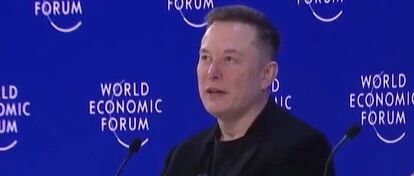
Core Viewpoint - Elon Musk emphasizes the concept of "Abundance" during his discussion at Davos, suggesting that a future with an overflow of goods and services is imminent. He outlines a clear path to achieving this abundance through advancements in robotics and AI [1][2]. Group 1: Robotics and AI Development - Tesla has updated its mission statement to focus on building a "remarkable abundant world," with a clear timeline for its humanoid robot, Optimus, to perform complex tasks by the end of this year and to be available to the public by the end of next year. Musk predicts that within three to five years, the number of robots will surpass the human population [1]. - Musk forecasts that by the end of this year or next, AI will surpass human intelligence, and by 2030, AI will be smarter than all humans combined. He presents a formula for economic output based on the productivity of robots and their quantity, suggesting that AI-driven robots will lead to explosive economic growth [2]. Group 2: Energy Supply Challenges - Musk identifies electricity supply as the primary constraint for AI and future developments, stating that while chip production is rapidly increasing, the energy grid's expansion is lagging significantly. He warns of a potential scenario where there are sufficient chips but insufficient electricity to power them [2]. - He proposes a solution to the energy issue by suggesting that a solar panel installation in Utah or Nevada could meet the entire electricity demand of the United States. Musk praises China's solar energy deployment, which exceeds 1,000 gigawatts annually, as a model for stable power supply [2]. Group 3: Space-Based Solutions - Musk introduces the idea of deploying solar-powered AI data centers in space, where solar energy efficiency is five times greater than on Earth, and operational costs could be significantly reduced with the advent of reusable spacecraft. He anticipates the first solar AI data centers to be launched within two to three years [3][4]. - This approach could bypass terrestrial limitations such as land use, electrical grid constraints, and environmental regulations, allowing for rapid advancements in energy and data processing capabilities [4].
机器人产业跟踪:特斯拉计划27年向公众销售人形机器人,产业速度较快,市场期待提升
Orient Securities· 2026-01-24 13:31
Investment Rating - The report maintains a "Positive" investment rating for the machinery equipment industry [6]. Core Insights - Tesla plans to sell humanoid robots to the public by 2027, with expectations for increased market interest and investment opportunities [3][9]. - The humanoid robot production capacity is set to accelerate, with Tesla aiming to produce 50,000 units in 2026 and ramping up to 1 million units by 2030 [9]. - Companies with strong manufacturing and operational capabilities are expected to gain higher market shares as humanoid robot sales increase and prices decrease [9]. Summary by Sections Industry Overview - The report highlights the rapid development of the humanoid robot industry, with Tesla's announcements indicating a faster-than-expected timeline for public sales [9]. Investment Recommendations - The report suggests several investment opportunities, including Top Group (601689, Buy), Sanhua Intelligent Control (002050, Buy), Wuzhou New Spring (603667, Buy), Hengli Hydraulic (601100, Not Rated), and Zhenyu Technology (300953, Buy) [3]. Market Expectations - The anticipated deployment of Tesla's humanoid robots in industrial settings by late 2026 is expected to enhance market expectations and create investment opportunities [3][9].
下周财经日历(1月26日-2月1日)
Di Yi Cai Jing· 2026-01-24 12:18
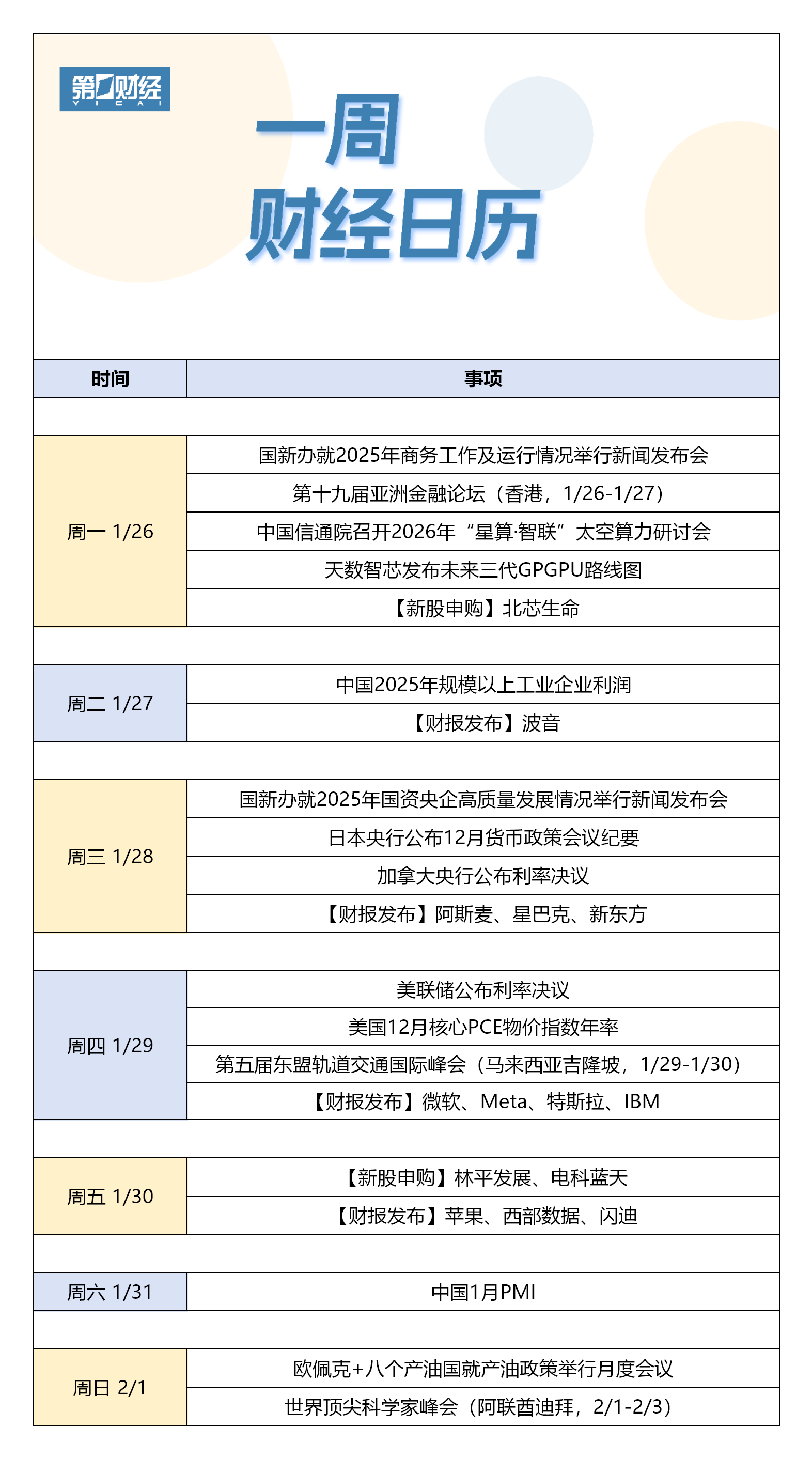
Group 1 - The Bank of Japan announced its monetary policy for December on January 28 [2] - The Bank of Canada announced its interest rate decision on January 28 [2] - Earnings reports were released by ASML and Starbucks on January 28 [2] Group 2 - The Federal Reserve will announce its interest rate decision on January 29 [2] - The U.S. core PCE price index for December will be released on January 29 [2] - Earnings reports will be released by Microsoft, Meta, and others on January 29 [2] Group 3 - New stock subscriptions for Linping Development and others will occur on January 30 [2] - Earnings reports will be released by Apple and Western Digital on January 30 [2] Group 4 - China's January PMI will be released on January 31 [2] - OPEC+ and eight oil-producing countries will discuss oil production policies on February 1 [2] - The World Summit of Top Scientists will take place in Dubai, UAE [2]
Investors came to Davos for AI. They left talking about Greenland
CNBC· 2026-01-24 12:12
Group 1: Optimism in Technology - The mood at Davos was notably optimistic regarding artificial intelligence, with discussions on "world models" and "physical AI" indicating a shift from hype to production, supported by significant capital availability [2][3] - Elon Musk's presentation on Tesla's vision for robotaxis and AI development reset the atmosphere, with predictions of widespread driverless robotaxis in the U.S. by the end of 2026 and AI potentially surpassing human intelligence this year [8][10] Group 2: Geopolitical Concerns - Conversations at Davos frequently shifted from technological advancements to geopolitical issues, including tariffs and the acquisition of Greenland, highlighting a growing sense of uncertainty in global investment rules [6][7][17] - Finance ministers emphasized the need for reassurance amidst geopolitical tensions, with South Africa's finance minister noting that the primary risk to the economy is the geopolitical situation [14][16] Group 3: Diverging Perspectives - The conference showcased two contrasting narratives: one focused on technological innovation and the other on navigating geopolitical uncertainty, often occurring within the same discussions [18] - Industry leaders like Joe Kaeser of Siemens Energy framed AI as an industrial opportunity, emphasizing Europe's potential in data and computing power to drive innovation [11][12]