
耐世特

Search documents
国泰海通晨报-20251223
GUOTAI HAITONG SECURITIES· 2025-12-23 02:54
Group 1: Strategy Research - Global asset performance shows significant divergence, with developed European equities rising while emerging Asian equities decline. COMEX silver saw a weekly increase of 9.4%, with an annual increase exceeding 120%. The Federal Reserve has brought forward its interest rate cut expectations for 2026 [3][4][5] Group 2: Food and Beverage Research - Wuliangye held its 29th conference, emphasizing a pragmatic attitude and commitment to reform. The company aims to anchor its market share goals for 2026, maintaining a balance between volume and price, and focusing on product and channel collaboration to solidify its industry-leading position [3][8][9] Group 3: Oil and Chemical Research - Since Q4 2025, crude oil prices have been on a downward trend, with Brent crude closing at $59.68 per barrel as of December 18, 2025, a decrease of 12.43% since early September. Upstream oil and gas extraction companies are expected to face profit pressure, while refining businesses may see improved profitability due to expanded price differentials [3][11][12][14] Group 4: Automotive Research - The draft "Automotive Industry Price Behavior Compliance Guidelines" is expected to advance the anti-involution process in the automotive sector. This guideline aims to regulate pricing behaviors of automotive manufacturers and dealers, potentially alleviating price wars and improving profit margins for dealers [3][15][16][17]
如何看L3自动驾驶及Robotaxi投资机会?
2025-12-22 15:47
Summary of Key Points from Conference Call Records Industry Overview - The records discuss the advancements in the autonomous driving industry, particularly focusing on Level 3 (L3) autonomous driving and Robotaxi developments in China and Tesla's initiatives abroad [1][2][4]. Core Insights and Arguments - **L3 Autonomous Driving License Issuance**: China has issued L3 autonomous driving licenses for the first time, allowing preliminary commercial testing, indicating strong governmental support for the autonomous driving industry. Previously, only Germany permitted L3 testing under specific conditions [1][2]. - **Tesla's Robotaxi Testing**: Tesla has advanced its Robotaxi testing overseas, demonstrating instances of fully autonomous driving, suggesting that its technology is reaching a mature evaluation stage, which may accelerate the commercialization process of Robotaxi [1][2][6]. - **Human-Machine Collaboration**: L3 represents a critical phase of human-machine collaboration, where vehicles handle issues and alert drivers, who must take over if not done within a specified time (usually 8 seconds). This makes L3 more suitable for consumer users, especially in stable driving conditions [3][4]. - **Market Potential for L3 Development**: The development of L3 will enhance algorithms and computing power. Key systems like steer-by-wire are crucial for freeing up driver time, indicating a broad market potential. Additional redundancy in actuators, such as brake-by-wire, is also necessary [5]. Industry Beneficiaries - **Nexteer Automotive**: As a leading domestic player, Nexteer is expected to benefit from the steer-by-wire trend and has already secured numerous customer orders [5]. - **China Automotive Technology & Research Center (CATARC)**: As a top enterprise, CATARC is poised to gain from the increased testing business volume and value brought by the upgrade in autonomous driving technologies [5]. Additional Important Insights - **CyberCab Hardware**: Tesla's CyberCab, designed specifically for Robotaxi, is a significant development, and related hardware manufacturers are worth monitoring from an investment perspective [6][7]. - **Supply Chain Opportunities**: The supply chain associated with CyberCab and applications in steer-by-wire technology are highlighted as important areas for investment consideration [7]. This summary encapsulates the key developments and insights from the conference call records, focusing on the advancements in L3 autonomous driving and the implications for the industry and potential investment opportunities.

港股概念追踪 L3级自动驾驶获批上路 机构看好智驾行业进入高速发展期(附概念股)
Jin Rong Jie· 2025-12-22 02:20
Group 1: L3 Autonomous Driving Approval - The Ministry of Industry and Information Technology of China officially announced the first batch of L3 conditional autonomous driving vehicle approvals, marking a significant step towards commercial application [1] - Longcheng Securities noted that the approval indicates a shift from testing to commercial application for L3 autonomous driving, with the industry entering a high-growth phase [1] - Changjiang Securities highlighted that China becomes the second country after Germany to approve L3 vehicles, with the potential for large-scale deployment [1] Group 2: Investment Opportunities - Longcheng Securities suggests focusing on intelligent driving algorithm providers, hardware suppliers, and Robotaxi operation platforms as investment opportunities [1] - Huatai Securities emphasized that the approval will accelerate the restructuring of the intelligent driving industry chain, with significant investment opportunities in core areas such as intelligent vehicles, control chassis, domain control chips, and LiDAR [1] - Companies like Junsheng Electronics and CAOCAO are actively engaging in strategic partnerships and launching new autonomous driving platforms, indicating a robust market presence [2][3] Group 3: Technological Developments - Zero Run's Lafa5 has commenced nationwide delivery, featuring dual AI models and a LiDAR perception system [3] - Horizon Robotics and ZF Group announced a collaboration to develop an L3 intelligent driving system, expected to be mass-produced in China by 2026 [3] - Black Sesame Intelligence has introduced high-performance computing chips and is collaborating with major automotive OEMs, enhancing its product offerings in the autonomous driving sector [4] Group 4: Market Position and Performance - TuDatong is recognized as a leading supplier of automotive-grade LiDAR solutions, with a projected delivery of approximately 230,000 units in 2024, ranking fourth globally in market share [5] - Nexperia is investing 1 billion yuan in a new intelligent manufacturing headquarters in Suzhou, focusing on electric power steering and steering-by-wire technologies for various levels of driving assistance [6]
L3商业化临近,智驾全产业链机会梳理?
2025-12-22 01:45
Summary of Key Points from Conference Call Records Industry Overview - The L3 level autonomous driving is approaching commercialization, with significant progress expected by 2026 as more regulations and policies are implemented to drive industry development [1][3] - The autonomous driving industry chain includes vehicle manufacturers (e.g., XPeng, Li Auto, Huawei, Xiaomi), Robotaxi companies (e.g., Pony.ai, WeRide), chip manufacturers (e.g., Horizon Robotics), domain control systems, steer-by-wire and braking systems, LiDAR, and testing segments [1][5] Core Insights and Arguments - The recent surge in the autonomous driving sector was triggered by the Ministry of Industry and Information Technology approving two L3 products from Arcfox and Changan Deep Blue, marking a transition from early testing to formal assessment [2] - More L3 regulations are anticipated to be established in 2026, further propelling industry growth [3] - Tesla's Robotaxi-specific model is set to be delivered in Q2 of next year, alongside advancements in humanoid robots, indicating 2026 will be a pivotal year for Tesla [4][3] Company-Specific Highlights XPeng Motors - XPeng plans to launch six new models in the first half of 2026, including three range-extended models, which are expected to boost sales [1][6] - The company is also making strides in its Model series and flying car initiatives, positioning itself as a benchmark in the smart driving market despite facing recent sales pressures [6] Pony.ai and WeRide - Pony.ai is focusing on the domestic Robotaxi market, planning to deploy 3,000 vehicles by the end of next year, which gives it a competitive edge [1][7] - WeRide is targeting overseas markets and has demonstrated economic benefits in the Middle East [1][7] Horizon Robotics - Horizon Robotics is a leading domestic chip supplier, providing cost-effective products and developing advanced intelligent driving solutions that integrate algorithms with chips, giving it a competitive advantage in the high-end autonomous driving market [1][8][9] Continental AG - Continental AG is a key player in steer-by-wire technology, which is increasingly being applied in Robotaxi vehicles, benefiting from the growth of L3 autonomous driving and the Robotaxi industry [11] Kaizhong Co., Ltd. - Kaizhong has invested in Suzhou Jiuli, focusing on electronic mechanical brake (EMB) products, and has secured orders from leading new car manufacturers for 2026 [12] - The recent acquisition of Anhui Tuosheng is expected to enhance net profit and strengthen the company's safety margin, with a strong market presence in high-performance polyurethane materials [13][14] Additional Important Insights - The integration of high-performance chips in robots is crucial for achieving large-scale commercialization, with Horizon Robotics positioned to play a significant role in this evolution [9][10] - The steer-by-wire technology is essential for the future of autonomous vehicles, with companies like Continental AG leading the way [11] - The competitive landscape in the autonomous driving sector is evolving, with various companies focusing on different aspects of the technology and market opportunities [5][7]

L3级自动驾驶获批上路 机构看好智驾行业进入高速发展期(附概念股)
Zhi Tong Cai Jing· 2025-12-22 00:55
Group 1 - The Ministry of Industry and Information Technology officially announced the first batch of L3 conditional autonomous driving vehicle permits in China, marking a significant step towards commercial application of L3 autonomous driving [1][2] - Longhua Securities noted that the approval of L3 autonomous driving vehicles indicates that China is the second country after Germany to allow L3 vehicles on the road, with the potential for large-scale deployment [1][2] - The approval is expected to accelerate the commercialization of autonomous driving technology, benefiting the entire industry chain [1][2] Group 2 - Investment opportunities are suggested in sectors such as intelligent driving algorithms, related hardware providers, and Robotaxi operation platforms, as the approval of L3 vehicles transitions the industry from testing to product entry and road trials [2] - Companies like Junsen Electronics and Sailyus are actively engaging in strategic partnerships and product launches to enhance their positions in the autonomous driving market [3][4] - The development of L3 intelligent driving systems is being pursued by companies like ZF and Horizon Robotics, with expectations for mass production in 2026 [4][5] Group 3 - TuDatong is recognized as the first global supplier to achieve mass production of automotive-grade high-performance LiDAR solutions, with a projected delivery of approximately 230,000 units in 2024 [5][6] - The establishment of a new manufacturing headquarters by Nexperia in Suzhou, with an investment of 1 billion yuan, aims to focus on electric power steering and steering-by-wire technologies to meet various levels of assisted and autonomous driving needs [7]
港股概念追踪|L3级自动驾驶获批上路 机构看好智驾行业进入高速发展期(附概念股)
智通财经网· 2025-12-22 00:50
Group 1 - The Ministry of Industry and Information Technology of China has officially announced the first batch of L3 conditional autonomous driving vehicle permits, marking a significant step towards commercial application of L3 autonomous driving in China [1] - Longyuan Securities reports that the approval of L3 autonomous driving vehicles indicates a transition from testing to commercial application, with the industry moving towards higher levels of intelligent driving [1] - Changjiang Securities states that China becomes the second country after Germany to officially permit L3 vehicles, with the approval of two models indicating a new phase for intelligent connected vehicles in mass production [1] Group 2 - The approval of L3 vehicles is expected to accelerate the development of the intelligent driving industry chain, with recommendations to focus on intelligent driving algorithm providers, hardware suppliers, and Robotaxi operation platforms [1] - Huatai Securities emphasizes that the approval will lead to a restructuring of the value chain in the intelligent driving industry, with significant investment opportunities in core areas such as intelligent vehicles, control chassis, domain control chips, and lidar [1] - Companies like Junsheng Electronics and CAOCAO Mobility are actively engaging in strategic partnerships and launching new autonomous driving platforms, indicating a competitive landscape in the autonomous driving sector [2][3] Group 3 - Leap Motor has officially started nationwide deliveries of its Lafa5 model, which supports dual AI models and a lidar perception system [3] - Horizon Robotics and ZF have announced a joint development of an L3 intelligent driving system, expected to be mass-produced in China by 2026 [3] - Companies like Black Sesame Intelligence and TuDatong are advancing in the autonomous driving field with innovative products and significant market presence, including high-performance lidar solutions [4][5]
成交放量!资金再度加仓
Zhong Guo Zheng Quan Bao· 2025-12-19 12:48
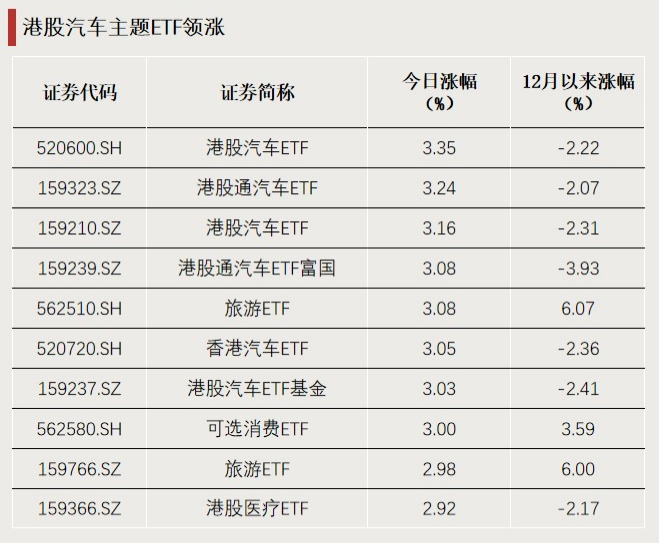
Market Performance - On December 19, all three major A-share indices closed higher, with over 80% of more than 1,300 ETFs in the market also rising [1] - The Hong Kong automotive-themed ETFs led the market, with six products ranking among the top ten in daily gains, each rising over 3% [1] Trading Activity - ETF trading was active, with total trading volume exceeding 450 billion yuan, an increase of nearly 25 billion yuan from the previous day [2] - Twelve ETFs had trading volumes exceeding 10 billion yuan, with several bond ETFs seeing significant increases in trading volume [2][6] Net Inflows - On December 18, the ETF market saw a net inflow of over 17 billion yuan, marking the third consecutive day of net inflows exceeding 10 billion yuan [3][8] - Over the past five trading days, the total net inflow into ETFs has surpassed 87 billion yuan [3] Sector Performance - The Hong Kong automotive ETFs performed exceptionally well, with six out of seven ETFs in this category seeing gains, and 38 out of 46 component stocks closing higher [4] - The total scale of the seven Hong Kong automotive ETFs is approximately 1.168 billion yuan, with the largest ETF having a scale of about 528 million yuan [4] Specific ETF Performance - The top-performing ETFs on December 19 included several automotive and tourism ETFs, with notable gains ranging from 2.92% to 3.35% [5] - Bond ETFs were particularly active, with the Shanghai Company Bond ETF's trading volume increasing to over 10 billion yuan, a 4.2-fold increase from the previous day [6][7] Investment Trends - The A500 ETF and the Sci-Tech Bond ETF attracted significant net inflows, with the A500 ETF seeing over 4 billion yuan in net inflows on December 18 [8][9] - Conversely, several military-themed ETFs experienced substantial net outflows, totaling over 2.9 billion yuan in the past five trading days [10] Fund Management Changes - Multiple ETFs announced changes to their fund names, aligning with new regulations from the Shanghai and Shenzhen stock exchanges [11] Sector Insights - Investment opportunities in the innovative pharmaceutical sector are gaining attention, with expectations for a stable upward trend in 2026 [12] - Analysts suggest focusing on companies with global intellectual property and strong cash flow in the pharmaceutical sector [12]

L3级自动驾驶商业化进程加速 小米汽车获路测牌照
Xin Lang Cai Jing· 2025-12-19 12:48
Core Insights - The Ministry of Industry and Information Technology has issued the first batch of L3 conditional autonomous driving vehicle permits, with Xiaomi Auto being the latest company to obtain an L3 road testing license in Beijing [1][14] - The report indicates that by September 2025, 23 companies, including Xiaomi, have accumulated over 60.27 million kilometers of operation with 750 autonomous passenger vehicles [1][14] - The L3 autonomous driving permit process follows a structured pathway, and companies are categorized into those with official "entry permits" and those with "road licenses" for internal testing [1][14] Company Developments - Changan Automobile's "Deep Blue SL03" has received L3 permit for operation in specific congested areas in Chongqing [2][15] - BAIC Blue Valley's "ARCFOX Alpha S" has been granted L3 permit for operation on specific highways in Beijing [2][15] - BYD was the first to obtain an L3 road testing license in July 2023 and has begun large-scale road validation [3][16] - Seres (Wenjie) has obtained L3 testing permits primarily in Chongqing and Shenzhen for its Wenjie M9 model [4][17] - SAIC Group has received two L3 road permits, making it one of the companies with the most licenses [4][17] - NIO has been selected for the first batch of L3/L4 autonomous driving permits and road testing trials [5][17] - GAC Group has made progress in L3 autonomous driving technology [6][18] - JAC Motors has obtained L3 road testing permits [7][19] - Foton Motor has completed the development and acceptance of L3 autonomous driving prototypes [8][20] - Yutong Bus is the first in the bus industry to enter the L3 autonomous driving pilot program [9][21] - FAW Jiefang's high-level autonomous driving truck J7 L3 has completed road testing [10][22] Industry Trends - The transition to L3 autonomous driving represents a significant technological milestone, shifting driving control and accident liability from the driver to the system itself [10][22] - Multiple institutions emphasize the hardware upgrade logic due to the increased safety and reliability requirements associated with L3 [11][23] - The regulatory framework for L3 permits indicates a closed loop in product safety, network security, and accident liability, alleviating long-standing compliance concerns for automakers [12][23] - The commercialization of L3 is expected to drive the mass application of intelligent chassis technologies, including active suspension, electronic brake-by-wire (EMB), and steer-by-wire (SBW) systems [12][23][24] - Specific components benefiting from this trend include active suspension systems from companies like Baolong Technology and Top Group, EMB systems from Bertel and Asia Pacific Holdings, and SBW systems from companies like Nexperia [12][24]





L3自动驾驶产业化启动,带来哪些投资机会?
2025-12-17 02:27
Summary of L3 Autonomous Driving Industry Conference Call Industry Overview - The approval of L3 autonomous driving trial runs marks readiness in regulations and the industry chain for large-scale commercialization, indicating that regulatory bodies are preparing for further promotion of autonomous driving [1][2] Core Insights and Arguments - L3 technology is initially launched in a B2B model, focusing on professional controlled testing on designated roads, which is more advantageous than directly targeting consumers due to lower education costs [1][3] - The L3 technology is expected to drive upgrades in the automotive supply chain, particularly in sensors (especially LiDAR), controllers (chip computing power), algorithms (full-stack self-research), and testing phases [1][4] - Steer-by-wire technology, as a key enabler for L3, is anticipated to improve driving experiences significantly, leading to an increase in its application ratio, benefiting related companies [1][5] - The increase in testing task requirements for L3 will provide more development opportunities for testing companies, potentially enhancing their business volume and profitability [1][5] Companies Mentioned - Changan Automobile, as one of the first approved manufacturers, is expected to benefit significantly in vehicle manufacturing [1][6] - Aptiv, a leader in steer-by-wire technology, is also viewed positively due to a high increase in Average Selling Price (ASP) [1][6] - China Automotive Research, as a key provider in the testing phase, is projected to benefit from increased task volume, leading to performance growth [1][6] Additional Important Points - The approval of L3 commercial trial runs includes two models: Changan Deep Blue S203 and BAIC Jihoo, which will be tested in Chongqing and Beijing, covering over 200 kilometers of roads, including complex urban elevated roads [2][3] - The regulatory approval signifies that the necessary preparations in regulations and the industry chain are in place for the commercial promotion of L3 autonomous driving technology [2]

L3商用加速落地,有望推动智能底盘批量应用 | 投研报告
Zhong Guo Neng Yuan Wang· 2025-12-17 02:04
Core Viewpoint - The recent approval of L3-level conditional autonomous driving vehicles by the Ministry of Industry and Information Technology (MIIT) marks a significant step towards the commercialization of advanced autonomous driving technology in China [2][5]. Group 1: L3 Autonomous Driving Approval - Changan Automobile and BAIC BluePark Magna Automotive have submitted applications for L3-level conditional autonomous driving vehicles, which have been approved by MIIT in the 401st batch of announcements [2][3]. - L3 autonomous driving allows for conditional self-driving within a limited operational range, differing fundamentally from L2 assistance systems [2][3]. Group 2: Impact on Intelligent Chassis - The approved vehicles include Changan's Deep Blue product and BAIC's Arcfox Alpha S (L3 version), which features a high-performance redundant sensor system with 34 sensors, including three LiDARs [3][4]. - The commercialization of L3 is expected to accelerate the application of intelligent chassis technologies, such as active suspension, electronic brake-by-wire (EMB), and steer-by-wire (SBW) systems [3][4]. Group 3: Investment Strategy - The approval of L3 vehicles provides policy support for the popularization of high-level autonomous driving, benefiting companies actively engaged in this sector [5]. - Key investment areas include vehicle application, where leading companies are establishing advantages in training data and smart driving ecosystems, and the intelligent chassis sector, which is expected to see rapid mass application by 2026 [5].




