华润啤酒

Search documents
食品展健康升级,SIAL西雅展9月深圳响应健康中国2030,健康化创新成主流
Zhong Guo Shi Pin Wang· 2025-07-23 06:06
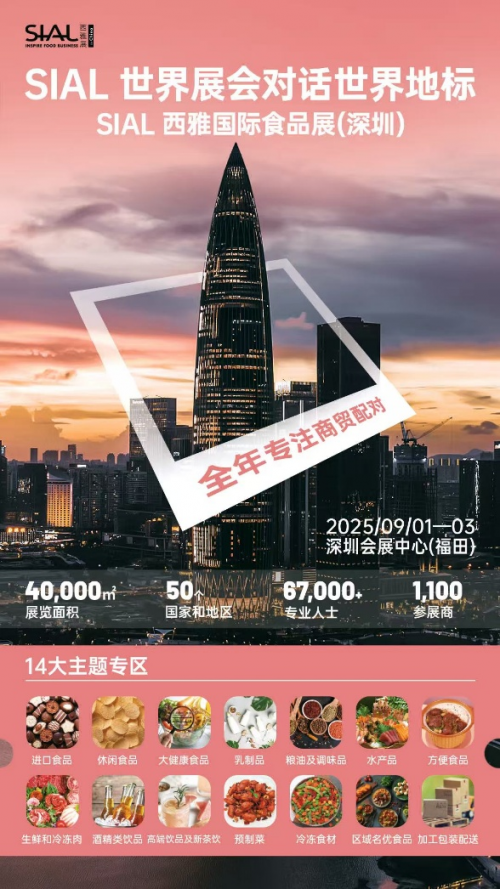
Core Insights - The transformation of the snack food industry is shifting from "pursuing tasty" to "pursuing quality," encompassing health, fun, and culture [1] - The SIAL International Food Exhibition in Shenzhen serves as a vital platform for the industry, injecting new vitality into the sector [1] Policy-Driven Health Innovation - National strategies are guiding the health-focused innovation in the snack food industry, with policies aimed at reducing sugar, salt, and oil, as well as promoting clean labels and nutrition [4][5] - The SIAL exhibition will gather over 1,100 exhibitors from 50 countries and regions, discussing pathways and opportunities for health innovation [5] Fun Integration and Young Market - Snack food companies are incorporating fun elements and cultural connotations to attract younger consumers [7] - Companies like Guangdong Jintian Animation Co., Ltd. and Dongguan Jinwang Food Co., Ltd. are leveraging popular IP collaborations to create products appealing to young consumers [7] Channel Innovation - The SIAL exhibition highlights channel innovations, such as Sam's Club's localization strategy, which accelerates the rise of Chinese snacks [9] - The introduction of WeChat's "gift" feature expands new consumption scenarios for snacks, presenting new growth points for the e-commerce sector [9] Supply and Demand Matching - The SIAL exhibition facilitates efficient cooperation and win-win scenarios through its supply-demand matching services, optimizing resource allocation [10] - A significant number of buyers from various channels, including retail, trade, and e-commerce, have pre-registered for the event, enhancing its international appeal [10] Industry Development - The SIAL International Food Exhibition is a key driver for the upgrade and development of the snack food industry, providing a platform for showcasing and exchanging ideas [11] - The exhibition supports companies with comprehensive solutions from product development to scene implementation, underpinned by policy and consumer upgrade dynamics [11]

全球第四!汾酒品牌价值达58.73亿美元!
Sou Hu Cai Jing· 2025-07-22 23:22
Core Insights - Fenjiu has been ranked fourth in the "2025 Global Spirits Brand Value Top 50" list, showcasing its strong market position [1][5] - The Chinese liquor industry continues to dominate globally, with a total market value of $123.38 billion, reflecting a year-on-year growth of 5.2% [1] Group 1: Spirits Brand Rankings - Moutai leads the global spirits market with a brand value of $58.38 billion, marking a 16.5% increase [5][6] - Wuliangye follows in second place with a brand value of $27.78 billion [6] - Fenjiu's brand value is reported at $5.873 billion, despite a decline of 18.9% from the previous year [6][7] Group 2: Beer Brand Rankings - Snow Beer is recognized as the most valuable beer brand in China, with a brand value of $4.66 billion, up 8.6% year-on-year [3] - Yanjing Beer saw a significant increase of 21.5% in brand value, reaching $640 million [3] Group 3: Wine Brand Rankings - Zhangyu is the only Chinese wine brand listed in the "Top 10 Global Champagne and Wine Brands," with a brand value of $820 million, reflecting a growth of 16.1% [9] Group 4: Industry Trends - The Chinese liquor market is characterized by a commitment to quality and cultural depth, which has helped brands like Fenjiu gain international recognition [7] - Fenjiu has actively expanded its international presence through participation in global wine exhibitions and cultural events [7]

食品饮料行业 2025 年中报前瞻:白酒出清探底,食品亮点频现
Huachuang Securities· 2025-07-22 09:25
Investment Rating - The report maintains a "Recommended" rating for the food and beverage industry, particularly highlighting opportunities in the liquor sector and food products [1] Core Insights - The liquor industry is undergoing extreme pressure testing, with a significant focus on inventory clearance and bottoming out of financial reports. The second quarter has shown weak demand due to seasonal factors and regulatory impacts, leading to a notable decline in sales and pricing pressures [5][10] - High-end liquor brands like Moutai are expected to maintain growth, while mid-tier brands face challenges with declining revenues and profits. The overall industry is in a deep clearance phase, with potential for recovery as regulations stabilize [5][12] - The consumer goods sector shows mixed performance, with snacks and beverages remaining strong, while other segments like frozen foods and chain restaurants face ongoing demand pressures [20][25] Summary by Sections 1. Liquor Sector - The liquor industry is experiencing extreme pressure, with weak demand in the second quarter and significant inventory levels. Major brands like Moutai and Wuliangye are expected to show modest growth, while others like Yanghe and Luzhou Laojiao are facing declines [5][11][12] - Moutai's revenue is projected to grow by 7% in Q2, while Wuliangye is expected to see a 1% increase. In contrast, brands like Yanghe and Luzhou Laojiao are forecasted to decline by 35% and 8% respectively [11][12] 2. Consumer Goods - The overall demand for consumer goods remains weak, but segments like snacks and beverages are performing well. For instance, East Peak is expected to see a 33% increase in revenue, while other snack brands are also showing positive trends [20][25] - The beverage sector is projected to see positive growth, with major brands like Qingdao Beer and Yanjing expected to report increases in revenue and profit [25][26] 3. Investment Recommendations - The report suggests focusing on high-performing stocks in the short term while considering long-term investments in liquor brands that are currently at their bottom. Brands like Moutai and Gujing are recommended for their lower risk profiles [7][8] - For consumer goods, companies like Anqi and East Peak are highlighted for their growth potential, while traditional dairy brands like Yili and Mengniu are suggested for a bundled investment approach [7][8]





平安证券(香港)港股晨报-20250722
Ping An Securities Hongkong· 2025-07-22 05:05
Market Overview - The Hong Kong stock market showed volatility, with the Hang Seng Index closing at 23,831 points, down 145 points or 0.61% [1] - The market turnover decreased to 82.799 billion HKD, with net inflows of 484 million HKD recorded in the Hong Kong Stock Connect [1] - The Hang Seng Index reached a high of 24,994.14 points, marking a 0.68% increase, with significant contributions from the technology sector [1][3] U.S. Market Performance - Investor optimism regarding corporate earnings outweighed concerns about trade developments, leading to gains in the U.S. stock market [2] - The S&P 500 Index closed at 6,305 points, up 0.1%, while the Nasdaq rose by 78 points or 0.4% to 20,974 points [2] - Notable stock movements included Alphabet rising by 2.8% ahead of its earnings report, while Tesla fell by 0.4% [2] Investment Opportunities - The report emphasizes the low valuation of Hong Kong stocks, inflows from mainland investors, and increased trading activity as positive indicators for the market's medium to long-term outlook [3] - Suggested sectors for investment include: 1. Technology sectors such as artificial intelligence, robotics, semiconductors, and industrial software [3] 2. Innovative pharmaceutical sectors supported by policy initiatives, along with traditional Chinese medicine and healthcare [3] 3. Coal, oil, gas, and telecommunications sectors benefiting from low-risk interest rates in mainland China [3] 4. Consumer sectors like clothing, footwear, and dining that are currently undervalued [3] Key Company Insights - The report highlights the performance of major companies, including: - China Railway Group, which is expected to see a decline in revenue and net profit for 2024, but has a strong order backlog providing future earnings support [10] - Alibaba's stock buyback and BYD's production milestone of 13 million electric vehicles are noted as significant developments [11] - The report suggests monitoring companies like China CRRC and Times Electric for their roles in the railway equipment manufacturing sector, which is poised for growth due to substantial infrastructure investments [9]
《Brand Finance 2025年全球酒精饮料品牌价值榜》发布
Jing Ji Guan Cha Wang· 2025-07-21 13:29
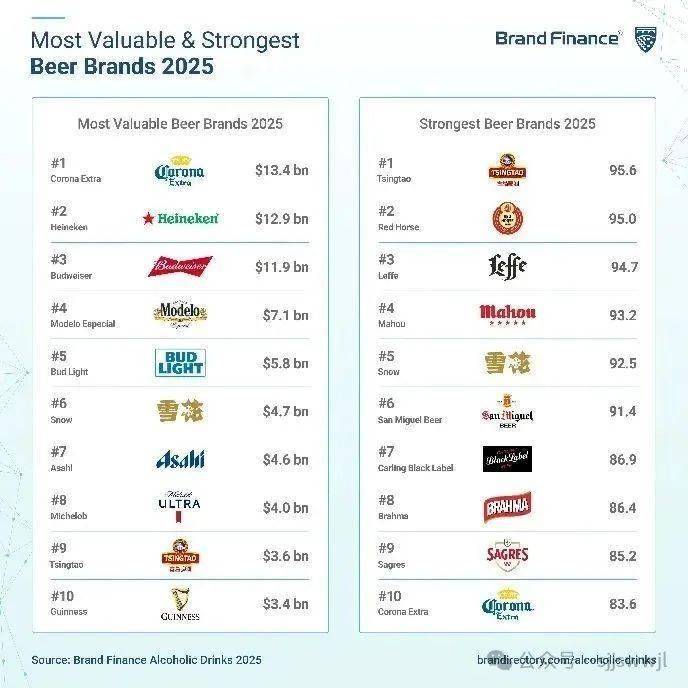
Core Insights - The report from Brand Finance reveals that Chinese alcoholic beverage brands continue to dominate the global market, with the industry valued at $123.38 billion, reflecting a 5.2% increase from 2024 [1] Beer Segment - Snow Beer is recognized as the most valuable beer brand in China, with a brand value of $4.66 billion, marking an 8.6% year-on-year growth and ranking sixth globally [1] - Tsingtao Beer saw a significant brand value increase of 42.3%, reaching $3.63 billion, and rose three positions to ninth in the global beer brand ranking [2] - Yanjing Beer experienced a 21.5% growth in brand value, reaching $640 million, and improved its ranking by seven places to 38th [2] Spirits Segment - Six Chinese liquor brands made it to the top ten in the global spirits brand value ranking, with Moutai, Wuliangye, Luzhou Laojiao, and Fenjiu maintaining the top four positions [3] Wine Segment - Zhangyu is the only Chinese wine brand listed, with a brand value increase of 16.1% to $820 million, solidifying its position among the top five global wine brands [4] Global Brand Leaders - Corona Extra retained its title as the most valuable beer brand globally, valued at $13.36 billion [5] - Jack Daniel's remains the most valuable whiskey brand with a value of $4.44 billion [5] - Crown Vodka's brand value grew by 33.3% to $2.93 billion, maintaining its leading position in the vodka category [5] Industry Trends - The Chinese alcoholic beverage industry is experiencing four key development trends: accelerated premiumization, deepened internationalization, innovation-driven competition, and cultural empowerment reshaping brand value [5]


21现场|地沟油变航空燃料!霍尼韦尔余锋:这是一个万亿产业
2 1 Shi Ji Jing Ji Bao Dao· 2025-07-21 10:52
Core Insights - The third China International Supply Chain Promotion Expo concluded with 102 companies signing intentions for the next expo, indicating strong interest in China's market and supply chain collaboration [2] - Honeywell emphasizes its commitment to China as a core engine for innovation and development, showcasing its local R&D efforts at the expo [2][3] Company Highlights - Honeywell's sustainable aviation fuel (SAF) solution is crucial for the sustainable development of the aviation industry, which is a significant part of the modern supply chain [3] - The SAF can reduce greenhouse gas (GHG) emissions by up to 80% compared to fossil fuels, and Honeywell has been a pioneer in commercializing SAF since 2016 [3][4] - The current market demand for aviation fuel is approximately 400 million tons per day, and if 25% is replaced with SAF, it could represent a trillion-dollar industry [4]

影响市场重大事件:中国雅江集团有限公司成立;工信部推动人形机器人、脑机接口等未来产业创新发展
Mei Ri Jing Ji Xin Wen· 2025-07-21 00:32
Group 1 - The Ministry of Industry and Information Technology emphasizes the promotion of humanoid robots, brain-computer interfaces, and other future industries for innovation and development [1] - The establishment of China Yajiang Group is a significant step to ensure the smooth construction and operation of the Yajiang Hydropower Project, aligning with national security and energy strategies [2] - UBTECH Robotics has secured the largest procurement order in the humanoid robot sector, amounting to approximately 90.51 million yuan, and plans to deliver 500 industrial humanoid robots this year [3] Group 2 - Central state-owned enterprises have signed 75 investment agreements in Tibet, totaling 317.54 billion yuan, focusing on clean energy, green minerals, and infrastructure, which is expected to create over 11,400 jobs [4] - Over 43% of A-share companies have reported positive half-year performance forecasts, with 193 companies expected to turn losses into profits, indicating a favorable trend in the market [8] - The merger and acquisition market has seen a surge with 200 new major asset restructuring projects reported since the introduction of the "Merger Six Guidelines" [10]

2025年中国保健品行业全景洞察报告:市场需求、竞争格局与消费行为
Sou Hu Cai Jing· 2025-07-20 12:02
Core Insights - The Chinese health supplement industry is experiencing robust growth driven by economic improvement, increased health awareness, and an aging population, with the market expected to reach 260.2 billion yuan by 2024, ranking second globally and growing at a rate of 6% thereafter [1][5][21]. Market Demand - The primary consumer groups for health supplements are the elderly and those in sub-health conditions, with over 230 million elderly individuals and more than 568 million sub-healthy individuals in China [1][22]. - The domestic health supplement industry has a gross profit margin of approximately 30-40%, with leading brands like Tongrentang achieving margins of 60-70% [1][5]. Competitive Landscape - There are over 8.2 million companies in the health supplement sector, with 1.837 million new companies registered in 2024, and over 32,882 products registered or filed, of which 99.05% are domestic [1][10]. - The market is characterized by low concentration, with leading brands such as Tongrentang, Amway, and others dominating the top positions, while e-commerce has become the primary sales channel, accounting for 42% market share on platforms like Taobao/Tmall [1][10][11]. Consumer Behavior - Middle-aged individuals are the main consumers, with a noticeable trend of younger and more diverse online users. Consumers are becoming more rational, focusing on product functions and ingredients, with a preference for innovative forms and mid-to-high-end products priced between 500-1000 yuan [2][5][10]. - The purchasing motivation is often driven by recommendations from others, and there is a growing preference for products that taste good [2][5]. Policy Environment - The government is continuously regulating the market, with multiple policies expected to be introduced by 2025 to optimize approvals and standardize labeling, providing guidance for industry development [2][5][18].


举杯时代 勇闯天涯
Sou Hu Cai Jing· 2025-07-20 11:56
Core Insights - The forum "New Consumption Era: Strategic Transformation and Brand Reshaping" highlights the challenges and opportunities faced by the liquor industry amid global economic changes and the uncertainties of the new consumption era [2][21] - The concept of "Brave New World" emphasizes the need for brands to evolve beyond mere symbols to become representations of comprehensive strength and emotional connection with consumers [2][3] Group 1: Brand Value Reconstruction - "Brave New World" signifies a reconstruction of value, where consumption transcends basic needs, turning liquor into a cultural and emotional experience [2] - The brand's value must resonate with consumers' emotional needs, transforming from functional attributes to a spiritual haven and cultural totem [3] Group 2: Paradigm Revolution - The old era of one-way brand communication is ending, giving way to genuine dialogue and deep resonance with consumers [4] - Trust has become a critical factor in consumer choice, shifting from brand worship to value equality, where consumers demand transparency in value [4] Group 3: Integration of Virtual and Reality - The key to success in the liquor industry lies in creating seamless experiences that connect online and offline channels, enhancing consumer satisfaction [5][6] - New consumption scenarios are emerging, reflecting a shift from uniformity to personalization in consumer experiences [6] Group 4: Consumer Leadership - Consumers are becoming creators in the liquor market, driving trends towards personalized expression and diverse needs [7] - The liquor industry is transitioning from scale-driven competition to value-driven competition, emphasizing the importance of understanding consumer demands [7][8] Group 5: Brand Value Dimensions - Brands must anchor their value in the changing landscape by understanding new consumer demographics and their evolving values [10] - The essence of brand value lies in its ability to resonate with consumers' emotional and cultural needs while maintaining resilience through market fluctuations [10][11] Group 6: Cultural Nurturing - Culture is identified as the soul of the brand, essential for value realization and innovation [13][14] - The liquor industry is moving towards a creative era, where cultural narratives and consumer engagement are pivotal for brand differentiation [13][14] Group 7: Quality Beyond Measure - Quality remains the lifeline of liquor brands, essential for building consumer trust and ensuring brand value realization [15] - Both hard quality (material standards) and soft quality (cultural experience) are crucial for enhancing consumer satisfaction and loyalty [15][16] Group 8: Emotional Resonance - The fragmented and experiential nature of modern consumption necessitates deep consumer insights for effective brand communication [17] - The liquor industry must leverage unique cultural narratives and immersive experiences to create lasting emotional connections with consumers [18][19]

食饮行业周报(2025年7月第3期):龙头白马持续反弹,大众品Q2业绩表现分化-20250720
ZHESHANG SECURITIES· 2025-07-20 11:52
Investment Rating - The industry rating is maintained as "Positive" [4] Core Views - The rotation between old and new consumption sectors continues, with leading brands in liquor and dairy products rebounding. The performance of mass-market products in Q2 shows divergence, with new consumption-related stocks experiencing rapid growth despite previous adjustments in performance expectations. Traditional channel reforms have impacted some stocks, leading to ongoing adjustments in performance [1][3][33] - The liquor sector is expected to have limited downside potential for leading companies, with high ROE, dividends, and cautious profit assumptions indicating a valuation floor. Recommended stocks include Guizhou Moutai, Shanxi Fenjiu, and Luzhou Laojiao [2][12] - New consumption trends are anticipated to continue, with potential for recovery in the second half of the year. Focus on low-priced or undervalued stocks with future catalysts, including Wei Long, Yili, and Wancheng Group [1][3][33] Summary by Sections Liquor Sector - The liquor sector remains at a low point, with a focus on potential policy catalysts and rebound opportunities. Leading brands with strong market positions are prioritized for investment. Recommended stocks include Guizhou Moutai, Wuliangye, and Shanxi Fenjiu [2][12] - Recent performance shows a positive trend, with Luzhou Laojiao, Yanghe, and Jiu Gui Jiu leading in gains, while Jinzhidao and Huangtai Jiuye faced declines [5][39] Mass-Market Products - The new consumption paradigm is reshaping the food and beverage investment landscape. Despite a recent pullback, the long-term trend remains positive, with clear opportunities for continued investment. Focus on stocks that align with new consumption trends, such as Wei Long, Yili, and Wancheng Group [3][33] - The mass-market sector has seen significant fluctuations, with stocks like Huangshi Group and Guoquan showing strong gains, while stocks like Ganyuan and Gu Ming faced notable declines [39][42] Performance Metrics - From July 14 to July 18, the Shanghai Composite Index rose by 1.09%, with non-dairy beverages and liquor sectors showing gains of 2.16% and 1.30%, respectively. Conversely, frozen foods and snacks experienced declines of 2.26% and 1.10% [39][40] - The valuation levels for the food and beverage industry have adjusted, with the liquor sector showing the highest valuation increase this week [43]