
赛力斯

Search documents
张兴海:问界用“五高”标准打造高端汽车
Zhong Guo Zheng Quan Bao· 2025-12-18 08:41
Core Viewpoint - The discussion highlights the growth journey of the AITO brand, emphasizing high standards in safety, reliability, performance, quality, and value as key pillars of the brand's philosophy [1] Group 1: Company Achievements - AITO has achieved cumulative deliveries exceeding 900,000 units, with over 50,000 units delivered in November alone, setting a new monthly delivery record [2] - The average transaction price for the entire AITO lineup is 400,000 yuan, with the AITO M9 model alone surpassing 260,000 cumulative deliveries and being recognized as the sales champion in the 500,000-unit category for 20 consecutive months [2] - AITO is the first and only domestic brand to exceed traditional luxury brands in both monthly sales and average transaction price [2] Group 2: Customer Engagement and Innovation - AITO has introduced a unique delivery model called "user approval before vehicle delivery," allowing customers to participate in the testing and acceptance of new vehicles [2] - The company emphasizes a customer-centric approach, gathering user feedback to enhance research and development, ensuring that vehicles meet customer expectations [2] - The founder has actively engaged with users across multiple cities to listen to their suggestions, reinforcing the brand's commitment to customer satisfaction and trust [2] Group 3: Industry Context - By 2025, it is projected that the sales share of new energy vehicles in China will exceed 50%, marking a significant turning point in the automotive industry [1] - The transformation towards digitalization, electrification, and green initiatives is reshaping the automotive landscape, with AITO positioning itself as a leader in this evolution [1] - The company aims to build a globally influential high-end brand, contributing to China's goal of becoming a strong automotive nation [1]

港股IPO“堵了”?
3 6 Ke· 2025-12-18 08:39
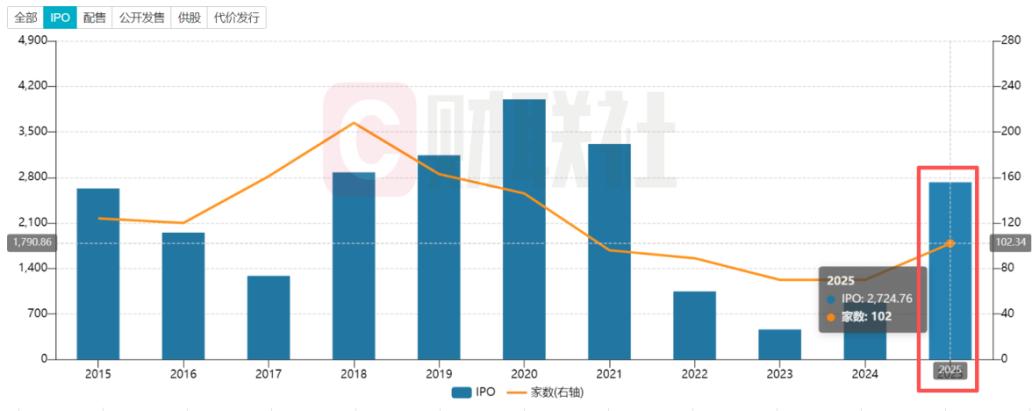
2025年港股IPO市场迎来爆发式增长,募资规模登顶全球主要交易所的同时,上市排队企业数量也持续攀升,形成一定程度的"堰塞湖"现象。 最新数据统计显示,截至12月17日,处于港股IPO聆讯处理中阶段的企业多达298家,其中12月半个多月内新增28家,远超11月同期的 18家,排队企业增速明显,后续节奏变化备受市场关注。此外,从市场格局来看,年内港股IPO已完成102家上市,募资额达2724.76亿 港元,同比激增226.62%,创下四年以来新高。 港股IPO"堰塞湖"现象背后,是市场对热度与潜在风险的担忧,港股监管层已针对申报质量下滑发出联合关切,投行人手短缺、文件粗糙等问题引 发关注;而二级市场"抽血"担忧虽持续发酵,但卖方研究显示一二级市场弱正相关,短期压力难改长期产业赋能逻辑,港股在规模扩张与风险防控 的平衡中持续前行。 近300家企业排队港股IPO Wind数据统计显示,科技与创新驱动的行业主导上述拟上市项目中,软件服务与硬件设备占比最高,合计约35%;医药生物行业多达6 家企业,聚焦创新药、肿瘤治疗、自身免疫疾病等高壁垒赛道,政策支持与市场需求双重驱动。 消费者服务与日常消费零售占比约25%,传统消 ...

“鸿蒙智行大饭店”被停止宣传?回应来了
Xin Lang Cai Jing· 2025-12-18 05:54
Core Viewpoint - Hongmeng Zhixing has announced a policy adjustment to stop the promotion of "Hongmeng Zhixing Grand Hotel" and remove historical promotional materials across platforms, aiming to optimize the market environment and reduce operating costs for dealers [2][11]. Summary by Relevant Sections Policy Adjustments - The adjustments include prohibiting free charging, with fast and super charging stations now requiring payment or points through the Hongmeng Zhixing app, while slow charging stations will not be available for public use [2][11]. - Free car washes and dining services are also prohibited, with such services only available during specific customer interactions like vehicle viewing, delivery, maintenance, and repairs, and must be properly documented [2][11]. Customer Service Changes - Despite the policy changes, free car washes and dining services are still available but require prior appointment, with a QR code for reservations being developed [12]. - The user center staff indicated that the changes were necessary due to excessive customer traffic causing congestion, impacting the experience for customers coming for vehicle delivery and maintenance [12]. Background Information - Hongmeng Zhixing is a smart automotive technology ecosystem alliance formed by Huawei in collaboration with several car manufacturers, including Seres, Chery, BAIC, JAC, and SAIC, and operates five major brands [3][12]. - The term "Hongmeng Zhixing Grand Hotel" is a humorous nickname for the user service centers, which previously offered high-quality complimentary services like dining and car washes [3][12]. Industry Context - In July, Huawei's executive highlighted the launch of free summer vehicle inspections at over 600 user centers, with more than 200 centers offering night services for customer convenience [6][15]. - The recent adjustments align with broader regulatory efforts by the National Market Supervision Administration to standardize pricing behaviors in the automotive industry, including the regulation of non-monetary incentives [18].



价值百强撑起万亿市值 综合实力持续提升
Zheng Quan Shi Bao· 2025-12-17 19:26
证券时报记者 杨霞 近日,"第十九届上市公司价值论坛暨2025新质生产力巡礼宜宾行"在四川宜宾举行,"第十九届上市公司价值评 选"获奖公司也同步揭晓。 由证券时报主办的上市公司价值评选活动是资本市场一年一度的盛事,迄今已成功举办至第十九届。在资本市场 深化改革与高质量发展的时代浪潮中,上市公司作为经济"基本盘"的价值愈发凸显。本文以主板百强公司为样 本,分析这些公司的行业特征和基本面质量,挖掘19年来A股价值龙头的变动趋势和个股穿越牛熊的核心逻辑。 百强企业构筑价值高地 本次入选主板百强的企业堪称中国资本市场的中流砥柱,这些行业领军者以卓越的综合实力构筑起A股市场的价值 高地。 数据显示,百强企业总市值达19.13万亿元,占全部A股总市值的18.15%,聚集了各个行业的龙头企业。其中,石 化行业的中国石油、保险业的中国平安、通信领域的中国移动与中国电信,以及新能源汽车领军者比亚迪等企业 市值排名居前。 从市值结构看,百强企业呈现显著的头部聚集效应:超半数企业市值超千亿元,贵州茅台与中国石油以万亿市值 稳居市场前列,中国人寿、比亚迪、长江电力等9家企业市值逾5000亿元,构成稳定的中坚力量。 投资者回报是检验上 ...

工商变更!余承东出任华为终端公司董事长
Sou Hu Cai Jing· 2025-12-17 14:28
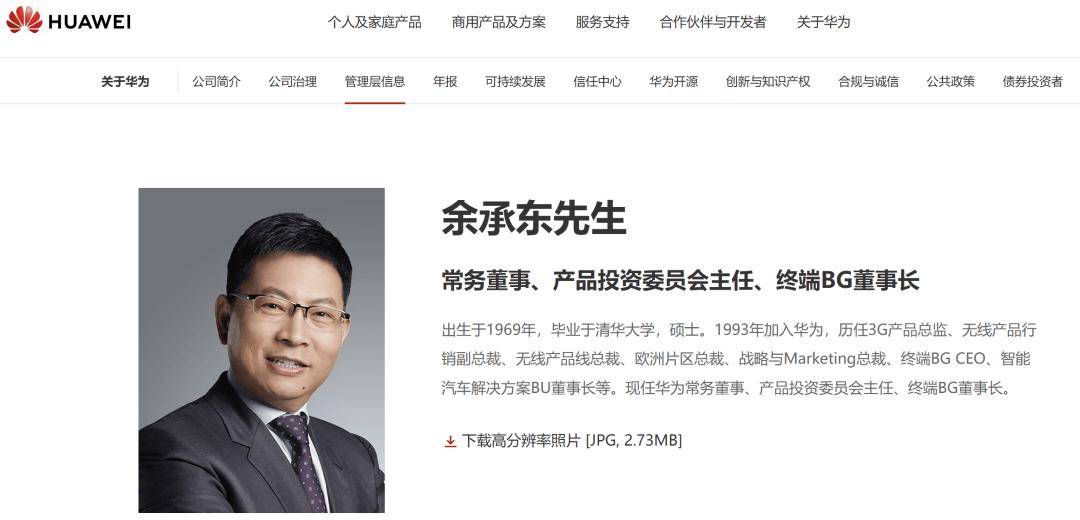
Core Viewpoint - Huawei Terminal Co., Ltd. has undergone significant management changes, with Yu Chengdong appointed as the new chairman, succeeding Guo Ping, alongside other executive changes [1]. Group 1: Management Changes - On December 12, Huawei Terminal Co., Ltd. experienced a corporate change where Guo Ping stepped down as chairman, and Yu Chengdong took over the role [1]. - Other executives, including Meng Wanzhou and Xu Zhijun, also resigned from their positions [1]. Group 2: Company Background - Huawei Terminal Co., Ltd. was established in November 2012, with a registered and paid-in capital of 606 million RMB, primarily engaged in the manufacturing of computers, communications, and other electronic devices [1]. - The company is wholly owned by Huawei Terminal (Shenzhen) Co., Ltd. [1]. Group 3: Yu Chengdong's Career - Yu Chengdong, born in 1969, has a long history with Huawei, joining in 1993 as a technician and progressing through various roles, including 3G product director and CEO of the consumer business group [5]. - He has been instrumental in Huawei's smartphone business growth since taking over the terminal business in 2012, focusing on Huawei's own brand rather than OEM products [5]. Group 4: Automotive Market Entry - Since 2019, Yu Chengdong has led Huawei's entry into the automotive market, establishing the Intelligent Automotive Solutions Business Unit (BU) [7]. - Huawei has adopted various collaboration models with car manufacturers, including traditional parts supplier, HI model, and the "Smart Selection" model, resulting in partnerships with several automotive companies [8]. Group 5: Sales Performance - Under Yu Chengdong's leadership, the sales of Huawei's automotive products have been notable, with the "Hongmeng Smart Travel" series achieving over 1 million deliveries in just 43 months [8]. - The top three models in sales for the first eleven months of this year were the AITO M8, AITO M9, and AITO M7, with cumulative sales of 133,300, 108,900, and 89,100 units, respectively [9].
【重磅深度】2025年主流车企城市NOA试驾报告—11月深圳篇
东吴汽车黄细里团队· 2025-12-17 14:11
Core Insights - 2025 is identified as a pivotal year for automotive intelligence, initiating a three-year cycle that will elevate domestic electrification penetration rates to over 50%-80%, leading to a restructuring of the automotive landscape [4][11] - Leading intelligent driving manufacturers have successfully implemented complex urban scenarios such as roundabouts and U-turns, enhancing high-level functionalities like parking from space to space and scene understanding, thereby improving the driving experience for passengers and safety personnel [4][11] Group 1: Intelligent Driving Experience Evaluation - A comprehensive evaluation was conducted on seven intelligent driving manufacturers, including AITO, Blue Mountain, Xiaopeng, Ideal, Tengshi, Xiaomi, and NIO, using both large sample concentrated road tests and small sample in-depth road tests, focusing on scene realization, takeover frequency, and comfort [5][11] - The report does not rank the intelligent capabilities of specific manufacturers due to subjective factors and real-world conditions affecting the evaluation [5][11] Group 2: Performance Trends - Compared to Q1, the performance gap among manufacturers in Q4 is narrowing, with the second-tier manufacturers improving their capabilities in urban scenarios like roundabouts and U-turns, and showing a significant reduction in takeover frequency [7][11] - The first-tier manufacturers are currently undergoing a foundational architecture transition, with tangible results expected to be validated through iterative improvements [7][11] Group 3: Specific Manufacturer Insights - In Shenzhen, the intelligent driving systems must handle complex scenarios such as roadside parking and narrow road navigation, with proactive understanding being more suitable [6][11] - Huawei and Xiaopeng lead in overall takeover frequency and performance across various scenarios, particularly excelling in challenging situations [6][11] - Wei brand Blue Mountain demonstrated strong capabilities in handling complex scenarios during large sample concentrated road tests [6][11] Group 4: Road Test Methodology - The concentrated road test involved nearly 50 participants testing various models along a standardized route, while the small sample in-depth tests were conducted by the same evaluators under similar conditions to ensure consistency [12][15] - The concentrated road test aimed to assess the overall performance, reliability, and efficiency of the intelligent driving systems under real-world conditions [41][12] Group 5: Technical Developments - The report highlights advancements in intelligent driving technologies, including the latest iterations of systems from manufacturers like Huawei, Xiaopeng, and NIO, showcasing improvements in perception and decision-making capabilities [19][20][27] - Each manufacturer has adopted different hardware and software solutions, with most having developed their own intelligent driving chips [36][36]
11月新能源销量放榜,奇瑞首次进入前三,跨界具身智能寻求新增长极
Jin Rong Jie· 2025-12-17 10:11
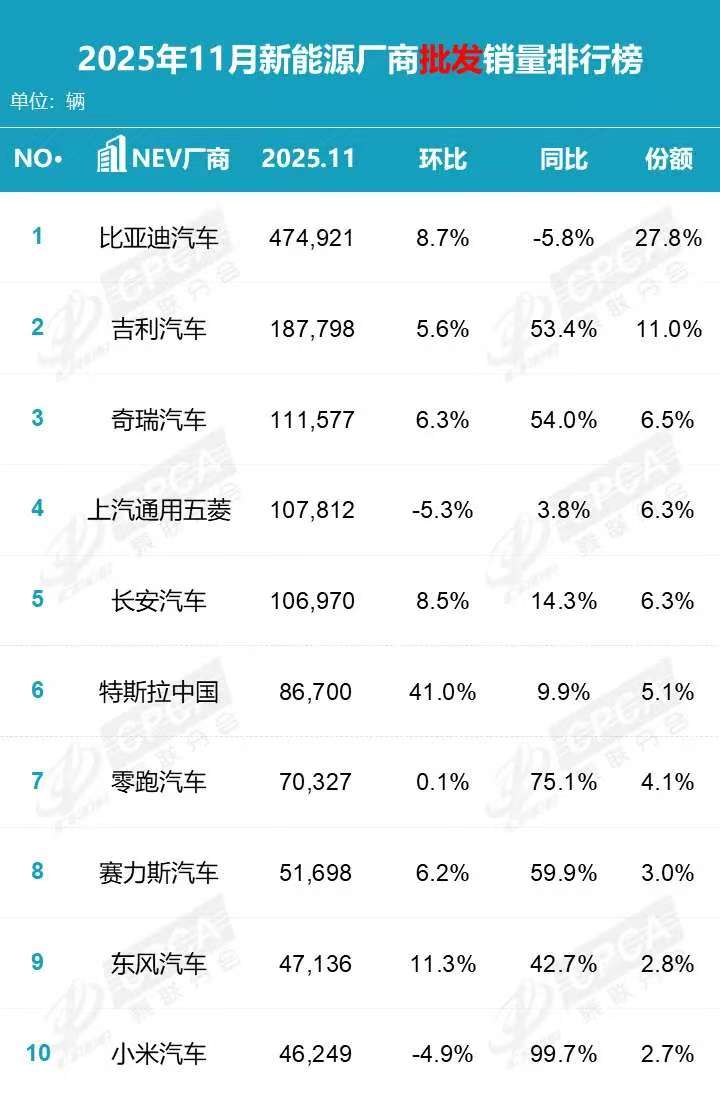
Core Viewpoint - Chery's new energy vehicle (NEV) sales reached a record high in November, marking significant growth and positioning the company among the top three in the industry for the first time [1][3]. Group 1: Sales Performance - In November, Chery's NEV wholesale sales reached 111,577 units, a year-on-year increase of 54% and a month-on-month increase of 6.3% [1][2]. - Chery Group's total NEV sales for November were 116,794 units, reflecting a 50.1% year-on-year growth, contributing to a cumulative total of 814,685 units sold from January to November, which is a 69.4% increase year-on-year [3][6]. Group 2: Market Position - Chery's market share in the NEV sector reached 6.5% in November, placing it third behind BYD and Geely, which had shares of 27.8% and 11.0% respectively [2]. - The company has achieved four consecutive months of sales growth in the NEV segment, indicating a strong upward trend [5]. Group 3: Technological Advancements - Chery's growth in the NEV market is supported by its robust R&D capabilities, including the development of the Kunpeng Tianqing hybrid engine with a thermal efficiency of over 48% and the Rhino solid-state battery with an energy density of 600 Wh/kg [7][10]. - The company has introduced several successful models, such as the A9L and T11, which have significantly contributed to its market presence [8]. Group 4: International Expansion - Chery's NEV products have gained recognition in international markets, with accolades such as the "Car of the Year" in the UK for the Tiggo 8 and multiple five-star safety ratings from European NCAP [11][19]. - The company is actively expanding its global footprint, with plans to establish 26 new overseas R&D centers to enhance local development capabilities [19]. Group 5: Financial Performance - Chery reported a revenue of 214.83 billion yuan for the first three quarters of 2025, a 17.9% increase from the previous year, with a net profit of 14.37 billion yuan, up 28% year-on-year [22].
抱紧检测金饭碗,中国汽研的生意经
市值风云· 2025-12-17 10:07
既有保底的饭碗,也有成长的空间。 | 作者 | | 白猫 | | --- | --- | --- | | 编辑 | | 小白 | 买车对许多家庭来说是件大事。消费者在挑选新车时,往往关注品牌、外观和动力。 但很少有人知道,在一辆新车上市前,必须经过一系列严苛的"体检"。从风阻系数的测定到碰撞安全 测试,这些看不见的环节决定了一辆车能否合法上路。 在这个隐秘而关键的环节中,有一家企业扮演着"考官"的角色。 它就是中国汽研(601965.SH)。 手握"通行证"的行业考官 在中国,并不是谁都有资格给新车做"体检"。 新车上市强制性检测是一个有着高准入门槛的行业。 据东吴证券,目前国内仅有六家机构具备政府主管部门全面授权检测资质,检测范围涵盖各类车型, 具备工信部公告体系要求的全部检验检测能力。 中国汽研便是当中之一。 从历史数据看,技术服务业务一直是公司的利润核心。这项业务不仅收入占比高,毛利率更是长期维 持在高位。即便在行业竞争加剧的背景下,凭借资质壁垒,这部分业务依然是公司最稳定的现金奶 牛。 2025年1-9月,公司实现营收30.2亿元,其中汽车技术服务业务营收为27.5亿元,营收占比91%。2024 年, ...

汽车行业12月17日资金流向日报
Zheng Quan Shi Bao Wang· 2025-12-17 09:44
Market Overview - The Shanghai Composite Index rose by 1.19% on December 17, with 28 out of 33 sectors experiencing gains, led by the communication and non-ferrous metals sectors, which increased by 5.07% and 3.03% respectively [1] - The automotive sector saw a modest increase of 0.77% [1] - The sectors that declined included agriculture, forestry, animal husbandry, and fishery, defense and military industry, and coal, with declines of 0.54%, 0.20%, and 0.11% respectively [1] Capital Flow Analysis - The net inflow of capital in the two markets was 9.51 billion yuan, with 16 sectors experiencing net inflows [1] - The communication sector had the highest net inflow of 6.45 billion yuan, coinciding with its 5.07% increase [1] - The electronics sector followed with a net inflow of 6.34 billion yuan and a daily increase of 2.48% [1] - Conversely, 15 sectors experienced net outflows, with the defense and military industry leading with a net outflow of 4.87 billion yuan [1] - The retail sector also saw significant outflows, totaling 2.31 billion yuan, along with notable outflows in the automotive, agriculture, forestry, animal husbandry, and fishery, and computer sectors [1] Automotive Sector Performance - The automotive sector had a net outflow of 2.24 billion yuan, with 282 stocks in the sector, of which 178 rose and 97 fell [2] - Notably, 5 stocks had net inflows exceeding 50 million yuan, with Feilong Co. leading at 348 million yuan, followed by Junsheng Electronics and Zhejiang Shibao with inflows of 140 million yuan and 76 million yuan respectively [2] - The stocks with the highest net outflows included Beiqi Blue Valley, with an outflow of 619 million yuan, followed by Sailis and Haima Automobile with outflows of 256 million yuan and 228 million yuan respectively [3] Automotive Sector Inflow and Outflow Rankings - **Inflow Rankings**: - Feilong Co. (10.01% increase, 348 million yuan inflow) [2] - Junsheng Electronics (5.01% increase, 140 million yuan inflow) [2] - Zhejiang Shibao (10.04% increase, 76 million yuan inflow) [2] - **Outflow Rankings**: - Beiqi Blue Valley (-0.85% decrease, 619 million yuan outflow) [3] - Sailis (-1.43% decrease, 256 million yuan outflow) [3] - Haima Automobile (-6.76% decrease, 228 million yuan outflow) [3]




港股破发股赛力斯上市累跌17.79% 林园广发携手浮亏
Zhong Guo Jing Ji Wang· 2025-12-17 09:11
Core Points - The stock price of Sais (601127) closed at HKD 108.10, with a decline of 0.64%, marking a cumulative drop of 17.79% since its listing on the Hong Kong Stock Exchange [1] - Sais reached an all-time low of HKD 107.40 during intraday trading, the lowest since its IPO on November 5, 2025, when it opened at HKD 128.9 [1] - The total number of shares offered globally was 108,619,000 H-shares, with 10,861,900 H-shares allocated for the Hong Kong offering and 97,757,100 H-shares for international offering [1] Financial Summary - The final offer price for Sais was HKD 131.50, raising a total of HKD 14,283.40 million, with net proceeds amounting to HKD 14,016.41 million after deducting estimated listing expenses of HKD 266.99 million [2] - Key cornerstone investors included Chongqing Industry Mother Fund, Linyuan Fund, Huatai Capital, and several asset management firms [2] Investor Details - New China Asset Management is 99.6% directly and indirectly owned by New China Life Insurance [3] - Sanhua (Hong Kong) is wholly owned by Zhejiang Sanhua Intelligent Control [3] - Other notable investors include Hichain Logistics HK, which is ultimately controlled by Jiangsu Haichen Logistics, and Zhongsheng, which is indirectly wholly owned by Zhongsheng Holdings [3]